By Ramachandran Rajeev Kumar — 2026-01-13
By Ramachandran Rajeev Kumar
On January 12, 2026, China's Foreign Ministry rejected India's claim to the Shaksgam Valley in Jammu and Kashmir.
Most Indians reading that headline probably wondered: What's Shaksgam Valley?
And that's exactly the problem.
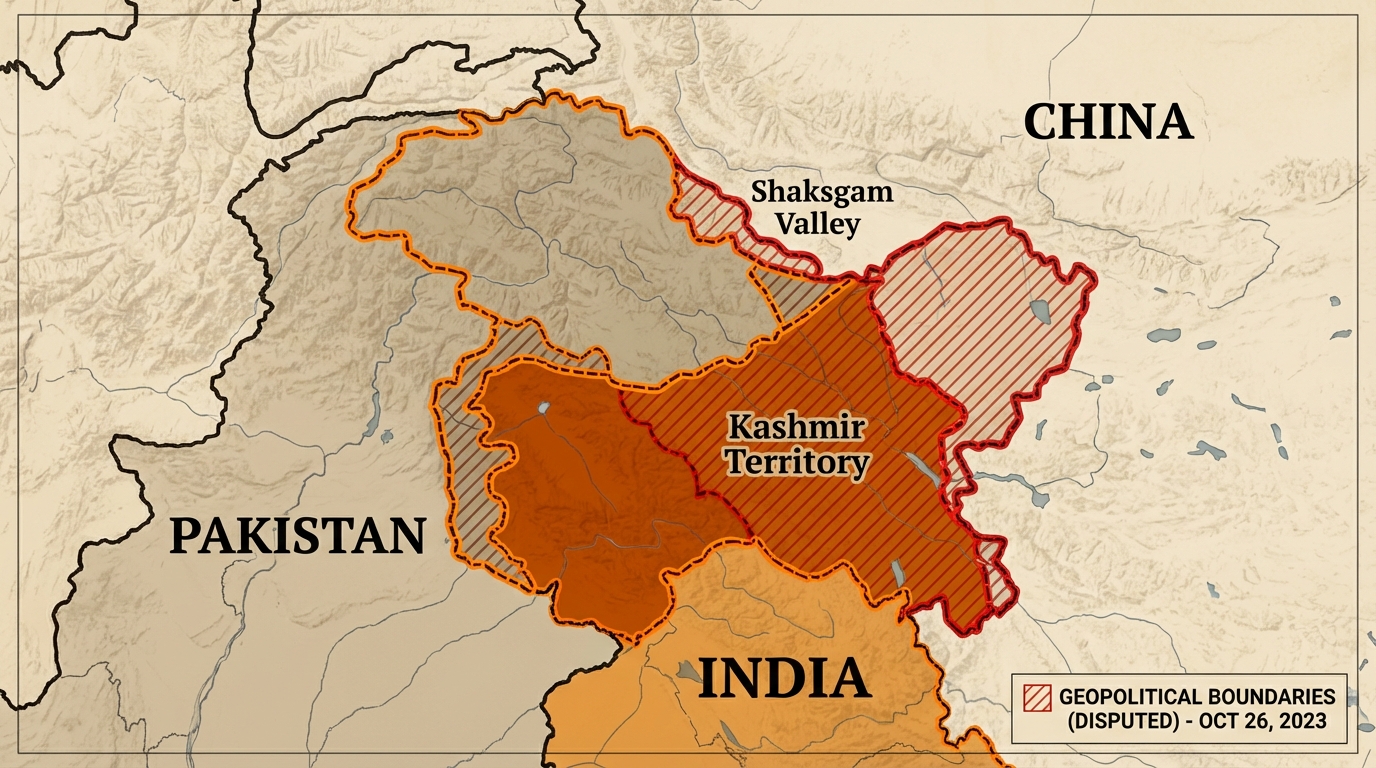
Shaksgam is approximately 5,180 square kilometers of Indian territory that China occupied in the 1950s, then received formal recognition for from Pakistan in 1963 through a boundary agreement that India has never accepted.
Think about that for a moment. Pakistan—illegally occupying parts of Kashmir—signed away Indian territory to China, legitimizing Chinese occupation and cementing a strategic alliance against New Delhi.
This is not ancient history. The 1963 Sino-Pakistan boundary agreement is still in force. The territory China now controls hosts critical infrastructure for the China-Pakistan Economic Corridor (CPEC), Beijing's flagship Belt and Road project.
And when India recently reasserted its claim to Shaksgam, China's response was dismissive: We don't recognize your claim. Move on.
Shaksgam Valley is India's forgotten territorial loss—erased from public memory, ignored in textbooks, absent from popular discourse. But it is the single clearest proof of why trust between India and China is impossible.
Not difficult. Not complicated. Impossible.
The Geography: What Is Shaksgam Valley?
Shaksgam Valley lies in the Trans-Karakoram Tract, north of the Siachen Glacier and east of the Shaksgam River, in what was historically part of the princely state of Jammu and Kashmir.
When Maharaja Hari Singh signed the Instrument of Accession in 1947, Shaksgam became legally Indian territory. It was remote, sparsely populated, and strategically located—bordering both China (Xinjiang) and Pakistan (Gilgit-Baltistan).
In the 1950s, China began occupying the region as part of its broader encroachments into Aksai Chin and other areas of Ladakh. India protested but lacked the military capacity to evict Chinese forces from such remote, high-altitude terrain.
Then came 1963.
The Betrayal: Pakistan Legitimizes China's Theft
On March 2, 1963, Pakistan and China signed the Sino-Pakistan Boundary Agreement.
Under this agreement, Pakistan relinquished its claim to the Shaksgam Valley (Trans-Karakoram Tract)—approximately 5,180 to 5,300 square kilometers—recognizing Chinese sovereignty over this territory north of the Karakoram watershed. In return, China agreed to recognize Pakistan's control over approximately 750 square miles (about 1,942 km²) of grazing land south of the watershed, historically used by the people of Hunza.
But here's the thing: The Shaksgam Valley that Pakistan ceded was not Pakistan's to give away.
Shaksgam was part of Jammu and Kashmir, which India claims in its entirety under the legal framework of the 1947 Instrument of Accession. Pakistan, as an illegal occupier of parts of Kashmir, had no legal authority to sign away Indian territory.
So when Pakistan "ceded" Shaksgam to China, it was legitimizing the theft of Indian land. Pakistan gave up claims to Indian territory to cement an alliance with China against India.
Why Did China Do This?
The answer is simple: to encircle India.
In the early 1960s, China and Pakistan were both hostile to India but not yet formal allies. The 1962 Sino-Indian War had shattered any illusions of "Hindi-Chini bhai-bhai." China wanted a reliable partner on India's western flank—and Pakistan wanted Chinese backing against India.
The Shaksgam transfer cemented the China-Pakistan strategic alliance. It was a message to India: We are coordinating against you. You are surrounded.
And it worked. For six decades, China and Pakistan have maintained what they call an "all-weather friendship" built on shared animosity toward India.
The Legal Status: India Never Accepted It
India's response in 1963 was immediate and unequivocal: the agreement is illegal and void.
From India's perspective:
- Shaksgam is part of Jammu and Kashmir, which is Indian territory.
- Pakistan has no legal claim to Gilgit-Baltistan (which it occupies illegally).
- Therefore, Pakistan had no authority to sign away any part of Kashmir to China.
- China's transfer of Shaksgam was an illegal transaction between two parties that had no legitimate claim to the territory.
India has never recognized the 1963 Sino-Pakistan boundary agreement. Indian maps still show Shaksgam as part of India (though most maps don't clearly delineate it, contributing to public ignorance).
But legal positions are one thing. Geopolitical reality is another.
The reality is: China controls and administers Shaksgam as part of Xinjiang, and India can't do anything about it.
The CPEC Connection: Why Shaksgam Matters Today
For decades, Shaksgam was a forgotten corner of the border dispute—too remote to matter, too small to fight over, too complex to explain to the public.
Then came the China-Pakistan Economic Corridor (CPEC).
CPEC is the $60 billion flagship project of China's Belt and Road Initiative. It connects Xinjiang (China) to Gwadar port (Pakistan) via a network of roads, railways, pipelines, and energy projects.
And a portion of CPEC runs through Gilgit-Baltistan—the region Pakistan administers illegally and where Shaksgam is located.
This changes everything.
India's objection to Shaksgam is no longer just about 5,180 km² of remote mountain terrain. It's about the legal legitimacy of CPEC itself.
If Shaksgam (and by extension Gilgit-Baltistan) is illegally occupied Indian territory, then CPEC is running through disputed land. That makes every CPEC project in the region legally questionable and every Chinese investment potentially illegitimate.
India has repeatedly stated: "CPEC runs through Indian territory. We do not recognize any such corridor."
China's response? "Shaksgam is ours. CPEC is legitimate. India has no claim."
This is not a historical footnote. This is a live geopolitical dispute with billions of dollars and strategic infrastructure at stake.
China's January 2026 Rejection: Why Now?
So why is China rejecting India's Shaksgam claim now, in January 2026?
Because India is asserting itself.
Over the past decade, India has:
- Built extensive infrastructure along the LAC (roads, tunnels, airstrips, troop deployments)
- Stood firm after the 2020 Galwan clash (refused to back down despite casualties)
- Integrated Ladakh as a Union Territory (strengthening administrative control)
- Publicly challenged China's territorial claims (including Aksai Chin and Shaksgam)
China's rejection is a warning shot: Don't push too hard. Remember Shaksgam—you already lost territory to us once. We can make you lose more.
It's also about domestic signaling. Xi Jinping wants to remind the Chinese public that China "won" territory from India in the past—and will defend it in the future.
But for India, China's rejection is a reminder of betrayal.
Why Trust Is Impossible: The Shaksgam Lesson
Every time Indian and Chinese diplomats meet for border talks, the word "trust" comes up. "We need to build trust." "Both sides must show goodwill." "Trust-building measures are essential."
But trust requires honesty about the past. And China has never been honest about Shaksgam.
China occupied Indian territory. China received legitimacy for that occupation from Pakistan through a bilateral deal that excluded India. China refuses to acknowledge India's legal claim. And China now uses that territory to build strategic infrastructure aimed at encircling India.
This is not the behavior of a partner. This is the behavior of an adversary.
Trust is built through transparency, respect for sovereignty, and good-faith negotiation. Shaksgam represents the opposite: opacity, violation of sovereignty, and bad-faith territorial transfers.
Some will argue: "That was 1963. It's been 63 years. Both countries should move on."
But here's the problem: China hasn't moved on from its territorial ambitions.
- Galwan Valley (2020): China attempted to change the LAC status quo by force.
- Doklam (2017): China tried to build a road in disputed Bhutanese territory (which India defends).
- South China Sea: China has claimed and militarized islands despite international law ruling against it.
- Taiwan: China threatens military invasion of a de facto independent state.
China's behavior in Shaksgam is not an isolated incident. It's a pattern.
China believes in territorial expansion through fait accompli. Occupy the land. Deny the other side's claim. Wait until memories fade. Then declare it's yours forever.
This is why trust with China is impossible. Not because Indians are holding grudges, but because China's actions prove it cannot be trusted.
The Collusion: China-Pakistan Against India
Shaksgam also reveals the depth of China-Pakistan strategic coordination against India.
Pakistan has fought four wars with India (1947, 1965, 1971, 1999). It sponsors cross-border terrorism in Kashmir. It provides safe haven to anti-India militant groups. It blocks India at international forums.
China has clashed with India militarily (1962, 2020). It encroaches on Indian territory. It blocks India's entry to the Nuclear Suppliers Group. It shields Pakistan's terrorism at the UN Security Council.
Separately, China and Pakistan are formidable challenges for India. Together, they are a coordinated threat.
And Shaksgam is where that coordination was formalized. The 1963 agreement wasn't just about land—it was about alliance against India.
Every time India negotiates with China, it must remember: Pakistan legitimized China's occupation of Indian territory to cement their anti-India alliance. That's not ancient history. That's strategic intent.
What India Must Do: Memory and Strength
So what should India do about Shaksgam?
1. Keep the Claim Alive
India must continue to assert its legal claim to Shaksgam in every international forum, every border negotiation, every diplomatic engagement.
The moment India stops claiming Shaksgam is the moment China wins by default. Legal claims don't expire—but they do weaken if abandoned.
2. Challenge CPEC's Legitimacy
Every time China touts CPEC, India should remind the world: "CPEC runs through disputed Indian territory. Every project in Gilgit-Baltistan is built on land illegally occupied by Pakistan and transferred by China."
This won't stop CPEC, but it delegitimizes it—and makes third countries think twice before participating.
3. Build Strength, Not Trust
India should engage China diplomatically—manage the LAC, avoid escalation, keep channels open. But India should never base its strategy on trusting China.
Trust requires a shared understanding of rules and mutual respect for sovereignty. China has demonstrated it respects neither.
India's China policy must be based on strength: military, economic, diplomatic. Build infrastructure on the LAC. Forge alliances (Quad, Pax Silica, Indo-Pacific partnerships). Grow the economy. Increase defense spending.
Strong countries can manage adversaries. Weak countries get swallowed by them.
4. Educate the Public
Most Indians don't know about Shaksgam. That's a problem.
If Indians don't know their own country lost 5,180 km² to Chinese occupation—legitimized through a Pakistan-China deal that excluded India—they can't understand why India-China relations are so difficult.
Textbooks should teach Shaksgam. Media should cover it. Politicians should reference it. Public memory is strategic memory.
Amnesia is China's greatest ally.
Conclusion: The Valley That Proves the Point
Shaksgam Valley is approximately 5,180 square kilometers of cold, remote, mountainous terrain. Most people will never visit it. Most maps barely show it. Most Indians don't know it exists.
But Shaksgam is the clearest proof of China's intentions toward India.
China occupied Indian land. Pakistan legitimized that occupation through a boundary deal. China denies India's claim. And China now uses that land to build infrastructure aimed at containing India.
This is not the behavior of a country India can trust. This is the behavior of a country India must manage, counter, and outmaneuver.
Every time Indian diplomats sit down with Chinese counterparts for "trust-building talks," they should carry a map of Shaksgam.
Every time Indian strategists debate whether to engage or confront China, they should remember Shaksgam.
Every time India is asked to choose between strategic autonomy and appeasing great powers, Shaksgam is the answer.
Pakistan legitimized China's occupation of Indian territory to cement their anti-India alliance. Trust after that betrayal isn't just difficult.
It's impossible.
Ramachandran Rajeev Kumar is the founder and editor-in-chief of BarathVector. He writes on history, geopolitics, and the hard lessons India must learn from its past.