By BarathVector Editorial — 2026-02-24
The Exit Ramp No One Took
On February 20, 2026, the United States Supreme Court handed Donald Trump something rare in politics: a clean exit. In Learning Resources, Inc. v. Trump, a 6-3 majority led by Chief Justice John Roberts ruled that the International Emergency Economic Powers Act does not authorise the president to impose tariffs. The decision was unambiguous. IEEPA contains no reference to tariffs or duties. No president in the law's half-century history had ever read it to confer such power. The constitutional guardrail held.
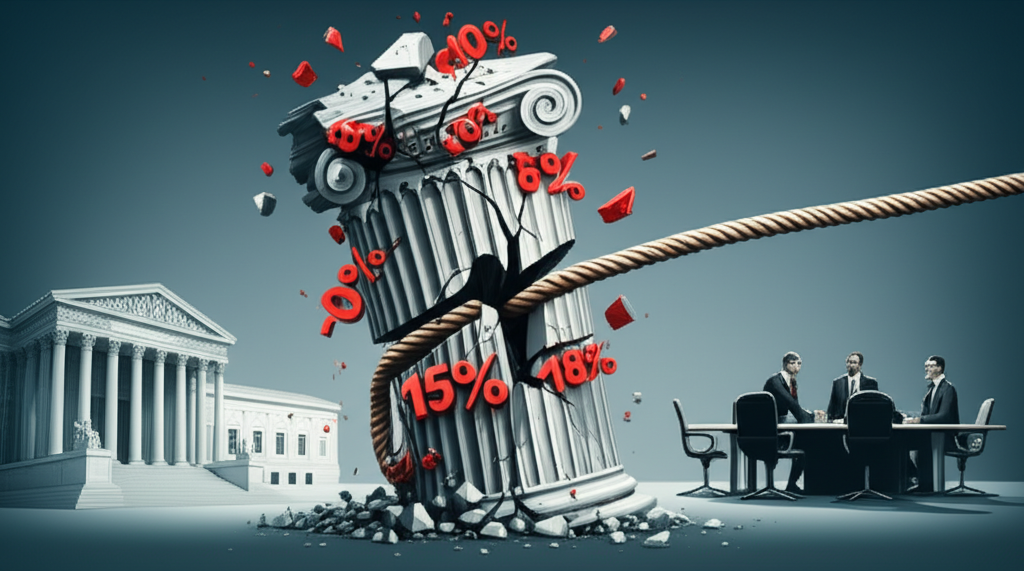
For any rational actor, this would have been the off-ramp -- a chance to blame the judiciary, pivot to Congress, and build a tariff regime on legally durable ground. Instead, within hours of the ruling, Trump signed a proclamation imposing a new 10 per cent global tariff under Section 122 of the Trade Act of 1974. By Saturday, he had raised it to 15 per cent. The Supreme Court said "you cannot do this." Trump's answer was to do it again, under a different letterhead.
This is not dealmaking. This is economic vandalism dressed up as negotiation.
The Dance of the Tariffs
Consider the trajectory. In April 2025, Trump imposed sweeping reciprocal tariffs under IEEPA, targeting nearly every trading partner on the planet. India faced a punishing 50 per cent rate. Then came the bilateral negotiations. On February 2, 2026, Trump and Prime Minister Modi announced a framework deal: India would cut tariffs on US industrial and agricultural goods, pledge to purchase $500 billion in American products over five years, and stop purchasing Russian oil. In return, the US tariff on Indian goods would drop from 50 per cent to 18 per cent.
It was, by the standards of Trump-era trade diplomacy, a genuine achievement. India made real concessions -- on agricultural tariffs that are politically radioactive in New Delhi, on energy purchases that reshape geopolitical alignments, and on Russian oil that touches the nerve of sovereign foreign policy. The deal was not cheap.
Eighteen days later, the Supreme Court rendered the entire IEEPA tariff architecture illegal. The 50 per cent rate that India had negotiated down from? Never lawfully imposed in the first place. The $130 billion in IEEPA tariff revenue collected since 2025? Potentially subject to refunds. And the legal basis of India's hard-negotiated 18 per cent rate? Evaporated.
India's Impossible Calculation
New Delhi now faces a strategic puzzle with no clean answer. Before the SCOTUS ruling, India's calculus was straightforward: absorb politically painful concessions in exchange for tariff relief from 50 to 18 per cent. After the ruling, the central incentive has shifted. If US tariffs are falling back toward zero because of a court decision, why should India maintain large binding concessions in exchange for a benefit that may no longer depend on executive action?
Reports indicate India has put a planned trade delegation to Washington on hold. The ambiguity is maddening: will India face the 18 per cent negotiated rate, or the new 15 per cent Section 122 rate, or something else entirely by the time the delegation arrives? No one -- possibly including the US Trade Representative -- can answer this with certainty.
This is the damage that mood-driven trade policy inflicts. India cannot plan industrial investment around a tariff rate that changes between breakfast and dinner. Exporters in Surat and Tirupur cannot price their goods when the duty structure depends on whether the American president had a productive morning. The uncertainty is not a side effect of Trump's approach -- it is the approach. Maximum unpredictability as a negotiating tool. The problem is that unpredictability is the opposite of what trade requires.
Section 122: A Legal House of Cards
Trump's pivot to Section 122 of the Trade Act of 1974 deserves scrutiny. The statute permits the president to impose temporary import surcharges to address "large and serious" balance-of-payments deficits. It has never been invoked by any president in its fifty-year existence. It has a built-in expiry: tariffs imposed under Section 122 require affirmative congressional approval to continue beyond 150 days.
Legal scholars are already questioning whether Section 122 can support what Trump is attempting. The provision was designed for balance-of-payments emergencies, not as a permanent alternative tariff regime. The same constitutional logic that undid IEEPA tariffs -- that Congress, not the president, holds the power to tax -- applies with equal force. Another legal challenge is virtually certain.
So the cycle continues. Tariffs imposed. Tariffs challenged. Tariffs struck down. New tariffs imposed under new authority. New challenges filed. And through every iteration, businesses, governments, and workers on both sides of every ocean are left guessing.
The Wreckage of Predictability
The damage extends far beyond India. The European Union has warned that Trump's shifting tariff priorities likely violate its own trade agreement with the US. China -- which faces its own renegotiation with Trump at an April summit -- now has increased leverage, knowing that the president's tariff authority is constitutionally constrained. Every bilateral deal signed under IEEPA authority is now legally questionable.
For India specifically, the strategic implications are profound. The Modi government staked significant political capital on the February 2 deal -- conceding on Russian oil purchases, agricultural tariffs, and a massive procurement commitment. These concessions were calibrated against a specific tariff number that no longer has legal standing. India's negotiators now find themselves in the bizarre position of having paid for something that may have been free.
The silver lining, such as it is, lies in leverage. If the legal basis of US tariffs is crumbling, India can renegotiate from strength -- demanding better terms on services mobility, technology access, and H-1B visa allocations. But leverage is cold comfort when the fundamental problem persists: no one knows what US trade policy actually is.
Governing by Chaos
There is a word for what is happening, and it is not "strategy." When a government imposes tariffs, withdraws them, reimposes them under different statutory authority, raises them overnight by 50 per cent, and then claims to be the world's most reliable trading partner -- that is not the art of the deal. It is governance by tantrum.
The Supreme Court offered Trump a constitutional exit ramp. He could have accepted the ruling, worked with Congress to pass tariff legislation on durable legal ground, and presented the world with a trade policy that might survive past the next court filing. Instead, he attacked the Court, invoked an untested statute, and created a new layer of legal uncertainty on top of the old one.
For India and every other nation trying to navigate American trade policy, the message is grim: do not plan. Do not invest based on what Washington says today, because tomorrow it will say something different. Do not negotiate in good faith, because the terms will change before the ink dries. The only constant in Trump-era trade is inconstancy.
This is the real cost of tariff chaos -- not measured in percentages or billions, but in the slow erosion of the idea that the United States is a country you can do business with. That erosion, once complete, will take far longer to repair than any tariff takes to impose.