By Ramachandran Rajeev Kumar — 2026-06-08
India Is Adding Solar and Burning More Coal. That Is Not a Contradiction.
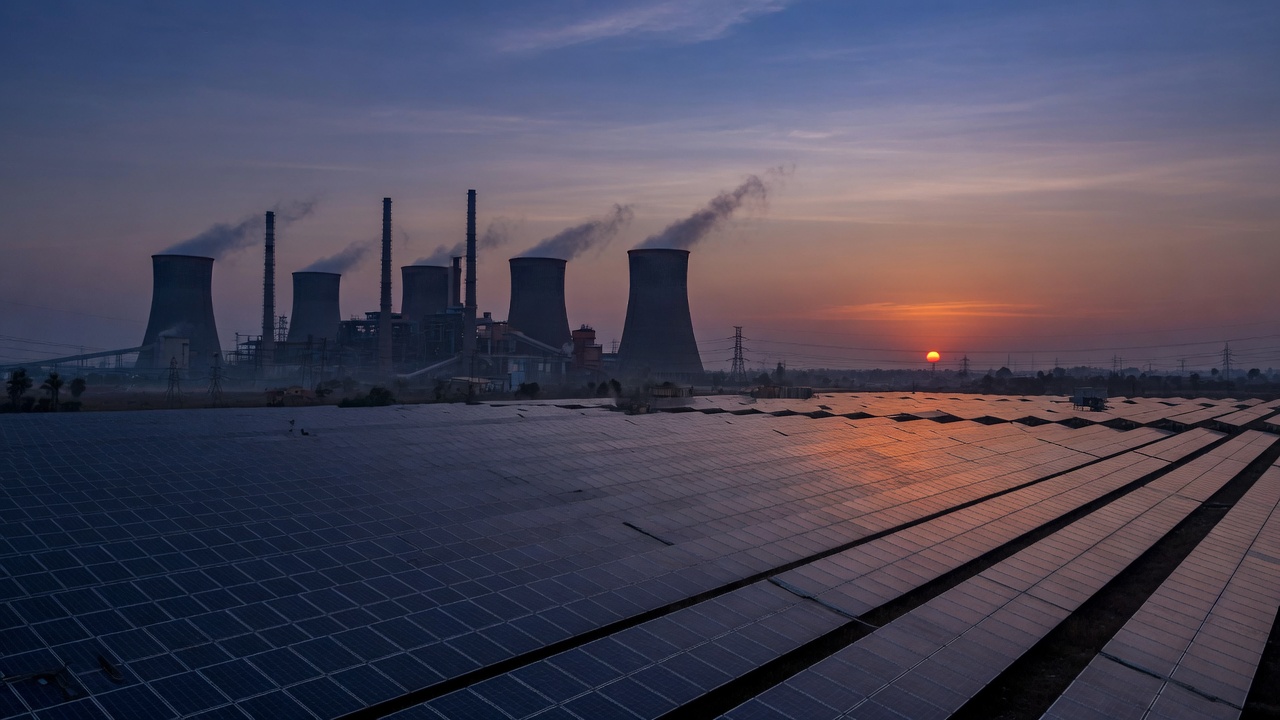
India crossed a milestone this year: more than half its installed power capacity is now non-fossil. It also burned coal for over three-quarters of its electricity during the hottest hours of a record summer. Both facts are true, and the gap between them is where the country's real energy fight now lives.
By Ramachandran Rajeev Kumar
There is a headline number India likes to repeat, and it is a good one. The country now has more non-fossil generating capacity installed than fossil capacity. Solar farms, wind turbines, hydro and nuclear together make up more than half the nameplate total. It is the kind of figure that closes a speech, and it deserves to.
Then there is the other number, the one that does not make it into the speech. On the afternoon and evening of the hottest days this summer, coal was still doing more than three-quarters of the actual work. India's peak electricity demand touched 270.82 gigawatts on May 21, 2026, an all-time record, and the fuel that met the crest of that demand was, overwhelmingly, coal. In late April, by one accounting, every one of the fifty hottest cities on the planet was inside India's borders.
Both of these things are true at the same time. The instinct is to treat the second number as an embarrassment that cancels the first. It is not. The two numbers describe two different things, and the distance between them is the most important fact in Indian energy policy right now. Capacity is what you have built. Generation is what you are actually running at the moment the country needs power most. India is winning the first contest and, at the worst hours, losing the second.
The problem is the time of day
The reason is almost banal once you say it plainly. Solar power is generated when the sun is up. India's electricity demand, in a heatwave, peaks twice: once in the working afternoon, and again, harder, in the evening, when people come home, the day's accumulated heat is still trapped in concrete and brick, and air conditioners and fans run into the night.
The second peak is the problem. By the time it arrives, the sun is going down and the solar fleet is fading toward zero. The grid has to find that power somewhere else, immediately, and the somewhere else is a thermal plant that can be told to ramp up on command. That is coal. A solar panel cannot be instructed to produce electricity at nine in the evening. A coal unit can.
This is why India can keep adding solar capacity, genuinely and at impressive speed, while coal generation at peak stays stubbornly high or even rises. Every gigawatt of solar added during the day does real work, displaces real emissions, and is worth building. But none of it addresses the evening crest, and the evening crest is what sets how much firm, dispatchable coal capacity the country believes it must keep on hand. A Carnegie Endowment analysis published on June 2, 2026, laid out this dynamic in detail: the summer is not testing India's generation capacity, where the country is doing well. It is testing the grid's ability to deliver power at the exact hour solar cannot.
The uncomfortable implication is that, absent something in between, solar and coal are not really competing. They are dividing the day between them. Solar takes the afternoon. Coal keeps the evening. And the more demand grows at the evening peak, the more the system leans on the thing it says it wants to retire.
The missing piece has a name
The piece that breaks this arrangement is storage. A battery, or a pumped-hydro reservoir, charged by cheap solar at midday and discharged into the evening peak, is the only thing that lets daytime sunshine do nighttime work. It is the bridge between the capacity number India celebrates and the generation number it would rather not discuss.
This is the real frontier, and it is far less flattering than the generation story. Building solar has become something India does well and cheaply; the auctions are competitive, the tariffs are low, the panels go up fast. Storage is harder. It is more expensive per unit of useful energy delivered, it depends on supply chains and critical minerals India does not fully control, and it does not produce a satisfying ribbon-cutting photograph of a field full of panels. So the country has poured itself into the part of the transition that is easy to win and visible, and moved more slowly on the part that is hard and invisible.
The result is a grid being built on a renewable face and a fossil spine. The face is what the world sees. The spine is what carries the load at 9 p.m. on the hottest night of the year. Until storage scales to the size of the evening peak, adding solar will keep improving the daytime picture while leaving the moment of maximum stress to coal.
The war made it worse
None of this happened in a vacuum this year. The 2026 Iran war and the disruption of traffic through the Strait of Hormuz squeezed the global market for liquefied natural gas precisely when India might have leaned on gas as a cleaner firming fuel for the evening. Reporting from CNBC on May 4, 2026, described India burning more coal as the heat and the war combined to tighten its energy supply at the same moment.
The logic is bleak but straightforward. Gas-fired plants are the conventional cleaner-than-coal option for meeting a sharp evening peak. When the war pushed gas prices up and made supply uncertain, the cheapest reliable way to keep the lights and the air conditioners on was to run more coal. So a geopolitical shock thousands of kilometres away ended up adding tonnes of coal to Indian furnaces. It is a reminder that the storage gap is not only an emissions problem. It is an energy-security problem. A country that cannot store its own sunshine stays exposed to every tremor in the global fossil market.
Who actually feels the heat
There is a temptation to keep this argument in the language of gigawatts and tariffs, where it is comfortable and abstract. The summer does not allow that.
Consider two figures that belong side by side. Only about eight per cent of Indian households own an air conditioner. And roughly three-quarters of the country's workforce is exposed to heat as a condition of the job: the people on construction sites, in fields, behind delivery handlebars, in workshops without cooling. India's heat-related economic losses in 2024 were estimated to run past 194 billion dollars.
Put those together and the politics of the evening peak become clear. The demand that coal is being burned to meet is, disproportionately, the comfort of the minority who can afford a machine to cool one room. The cost of the heat itself falls hardest on the majority who cannot, and who keep working through it. An energy transition that solves the daytime generation story while leaving the evening to coal is, quietly, optimising for the air-conditioned and leaving the heat-exposed to absorb both the warming and the price of the fuel burned to escape it.
This is not an argument against air conditioning, which is fast becoming a survival tool rather than a luxury as wet-bulb temperatures climb. It is an argument that the storage gap is also an equity gap, and that closing it is how the transition starts serving the seventy-five per cent rather than the eight.
What winning would actually look like
The honest distinction is this. India has already proven it can build clean capacity. That contest is being won, and the people who drove the solar build-out should take the credit. What has not been proven is that India can deliver clean power at the precise hour the country needs it most. That is a different claim, and it will be settled not by more panels but by storage, by a grid flexible enough to move midday sun into the evening, and by a willingness to treat the unglamorous part of the transition as the main event rather than the afterthought.
The feedback loop is the thing to fear. Heat drives cooling demand. Cooling demand at the evening peak drives coal. Coal drives warming. Warming drives more heat. Left alone, that loop tightens every summer, and each record peak becomes the floor for the next one. It is no longer an episodic crisis that arrives with a bad May and leaves with the monsoon. It is becoming structural.
The good news buried in all of this is that the solution is known, available, and falling in price. The country does not need a scientific breakthrough. It needs to decide that the storage gap, not the capacity headline, is the number that matters, and to chase it with the same single-mindedness it brought to building solar in the first place. The sun sets every evening. The question India has to answer this decade is whether, by then, it has somewhere to keep the day's light.