By Ramachandran Rajeev Kumar — 2026-05-13
India Stops Signing, Starts Executing: The Quiet Implementation Phase
On 12 May, on the sidelines of the Confederation of Indian Industry Annual Business Summit in New Delhi, Commerce Minister Piyush Goyal told reporters that the Comprehensive Economic Partnership Agreement between India and Oman is expected to take effect on 1 June 2026. The announcement was matter-of-fact. It did not lead the news cycle. It will not run on television panels.
It is one of the more important pieces of trade news India will get this year.
The reason it matters has nothing to do with Oman, which accounts for a useful but modest share of Indian trade. It has to do with the phase shift it confirms. After more than a decade of Indian trade diplomacy that was dominated by negotiation theatre -- summit photographs, joint statements, signed-but-not-operational agreements, repeated extensions of "framework" deals that never produced ratified text -- the country is now entering the phase where the agreements actually start working. Implementation is the boring word. It is also the word that determines whether any of it counts.
The active list
As of mid-May 2026, India has three new-generation trade agreements operational or imminently operational.
The Comprehensive Economic and Trade Agreement with the United Kingdom, signed in February, has been in operation through the spring. Tariff reductions on whisky, automobiles and select textiles are flowing in both directions. Services-mobility provisions for Indian professionals in finance, technology and architecture are active. The agreement is producing measurable trade-volume movement on the bilateral pair.
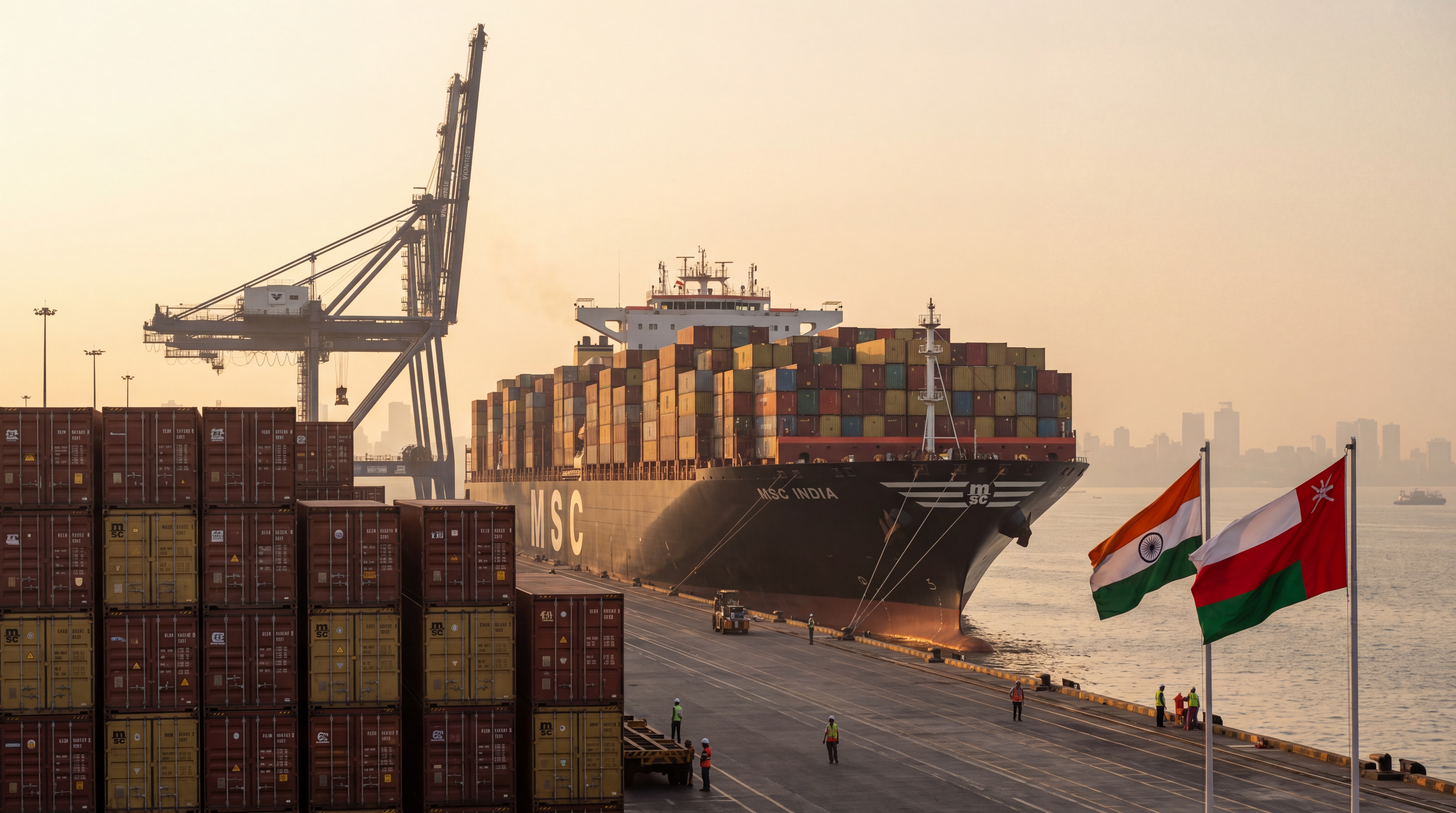
The CEPA with Oman, announced on 12 May for a 1 June effective date, is the second. It opens new tariff terms on a broad basket including food security inputs, renewable-energy equipment, advanced-technology goods, logistics services, fisheries products and agricultural goods. Oman is also a useful entry point into the broader Gulf Cooperation Council market, and the agreement sets a template for the eventual GCC-wide agreement that has been in slow negotiation for two decades.
The third agreement, less remarked on but consequential, is the framework deal with the United States announced in February of this year. The deal is partial and contested in places, but the operational pieces -- particularly on technology export controls, defence procurement, and select agricultural lines -- are running. The full ratified text is still in negotiation. The operational pieces are not waiting for it.
Behind these three, the negotiation track remains active. The CEPA upgrade discussion with South Korea is in renewed motion after India and Korea jointly committed in March to accelerate. The ASEAN review is in its substantive phase. The European Union talks have not concluded but are still alive. The Australia agreement, signed earlier, continues to deepen.
This is not, as some critics of Indian trade policy have suggested, a country drifting away from trade integration. It is a country that has, for the first time in this generation of policymakers, accumulated a credible operational stack of trade agreements with real implementation cycles attached.
Why implementation is the harder phase
Negotiating an agreement is, despite the press coverage, the easier part of trade policy. The harder part is what happens after the signature.
Implementation requires that customs officials at every Indian port know the new tariff schedules and apply them without rent-seeking. It requires that rules-of-origin certificates be issued at speed by industry chambers that have never been pressured for turnaround time. It requires that quality and standards verification, particularly on agricultural and food-security imports, function within the timeframes the agreements assume. It requires that services-mobility provisions translate into actual visa processing at consulates that have, historically, been opaque and slow.
The Indian system has not historically excelled at this layer. The post-signing track record of earlier agreements -- the ASEAN deal, the Japan CEPA, the Korea CEPA -- shows years of slow utilisation, with the actual trade flows arriving well below the projected potential. Indian exporters, in survey after survey, have reported difficulty in actually using the tariff preferences they were promised. Indian importers have reported customs frictions that erode the value of the negotiated terms.
This time, by the available signals, is different. The Commerce Ministry has, since 2024, run an explicit implementation cell that tracks utilisation by tariff line and chamber. The Directorate General of Foreign Trade has compressed turnaround for rules-of-origin certification. Customs, under prodding, has issued more granular pre-implementation circulars than in any prior agreement. The data on UK CETA utilisation in its first quarter of operation suggests the new system is producing measurably higher uptake than the legacy agreements achieved in their equivalent windows.
This may or may not hold at scale. The early signs are positive.
What changes for the Indian exporter
The on-the-ground effect of three operational agreements simultaneously, with a fourth and fifth in advanced negotiation, is that the medium-sized Indian exporter -- the engineering-goods firm in Coimbatore, the chemicals producer in Vapi, the textile manufacturer in Tiruppur, the pharma exporter in Hyderabad -- now has access to multiple preferential markets at the same time. The trade strategy at the firm level can finally be diversification rather than concentration.
The diversification matters because Indian export concentration has been a persistent vulnerability. Roughly one-fifth of Indian merchandise exports go to the United States. Close to one-sixth go to the European Union taken as a block. A further tenth flow into the United Arab Emirates and other Gulf destinations. Any single one of these markets going into political headwinds -- and several have, in this cycle -- produces immediate revenue stress for thousands of Indian firms.
The UK, Oman, and broader GCC routes do not solve concentration risk. They reduce it at the margin. They give firms options for where to grow when one major destination is becoming difficult. The combined operational stack is the closest thing India has had, in this generation, to a genuine export diversification toolkit.
What it does not change
The implementation phase will not solve the structural weaknesses of Indian exports. The logistics gap remains. The container-handling capacity at Indian ports is still a fraction of what comparable economies offer. The trucking and rail freight system is still expensive and slow. The export financing layer, where Indian firms borrow against shipments, is still under-developed compared with Asian peers.
Trade agreements, in other words, are necessary and not sufficient. They are the demand-side handshake. The supply-side build is a separate and longer project. The honest assessment is that the agreements are now running ahead of the domestic infrastructure that needs to feed them. That is a better problem to have than the opposite, but it is still a problem.
The political economy of the shift
The shift from negotiation theatre to implementation has a quiet political-economy underpinning that deserves naming. Negotiations are owned by the foreign-service establishment and the central political leadership. Implementation is owned, in practice, by the customs service, the DGFT, the state-level industries departments, and the industry chambers. These are not the constituencies that get summit photographs. They are the constituencies that get audit notices.
For the implementation phase to actually deliver, the political leadership has to be willing to defend the boring middle-tier officials when they make calls that displease specific interest groups. The first eighteen months of UK CETA utilisation have produced exactly such moments -- specific industry segments arguing that the new tariff preferences are being applied too liberally, others arguing too narrowly. The system has, in most cases, held its line. Whether it continues to is the test.
The shorter version
India has, for the first time in a generation, a stack of operational trade agreements that genuinely affect what Indian exporters can do. The Oman CEPA going live on 1 June joins the UK CETA already in operation and the partial US framework that has been running since February. The negotiation cycle is not over -- Korea, ASEAN and the EU remain in motion -- but the centre of gravity in Indian trade diplomacy has shifted from signing to executing.
This is exactly the quieter and more important phase. The trade press is not going to give it the column inches the signing ceremonies received. The Indian exporter will give it the consideration that matters.
The author is the founder of nBookMedia and writes on national strategy, economic policy and the Indian growth story.