By Ramachandran Rajeev Kumar — 2026-01-15
In February 2026, India will host the AI Impact Summit in New Delhi, bringing together global leaders to discuss artificial intelligence's role in shaping humanity's future. The summit rests on three pillars—"Sutras" in Sanskrit, meaning guiding principles—called People, Planet, and Progress.
The Planet Sutra is the most ambitious: AI that advances innovation responsibly, reducing its resource footprint while accelerating climate resilience, ensuring AI strengthens rather than undermines global sustainability.
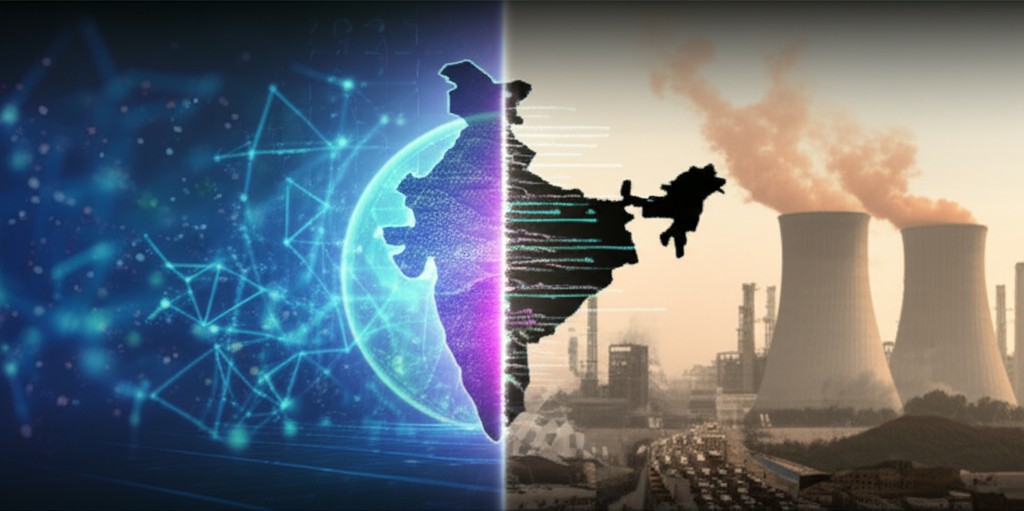
It sounds like enlightenment meets engineering. But scratch beneath the surface, and the Planet Sutra reveals a more uncomfortable question: Is India using AI to solve its climate problem, or to avoid admitting it has one?
The ₹10,300 Crore Bet on Optimization
India's commitment to AI climate solutions isn't rhetorical. The government has launched the IndiaAI Mission with an investment of ₹10,300 crore and deployment of 38,000 GPUs, building one of the largest AI ecosystems globally. AI is being woven into climate forecasting, renewable energy optimization, sustainable agriculture, and disaster resilience.
In summer 2025, the Ministry of Agriculture used AI weather models to predict the monsoon's arrival 30 days in advance for 38 million farmers. The AI model accurately predicted a three-week stall in monsoon rains that traditional forecasts missed—a breakthrough for a country where 60% of agriculture depends on rainfall.
AI-powered systems now optimize energy production by forecasting solar and wind output, ensuring grid stability. Google DeepMind's hybrid AI-physics model improved wind energy forecasting by 20%, demonstrating tangible gains.
On paper, AI is delivering results. But here's the problem: optimization isn't transformation. AI can help India squeeze more efficiency out of existing systems—better solar forecasts, smarter grids, precision agriculture. But can it help India fundamentally change those systems? Or is it just making carbon-intensive growth slightly less wasteful?
The Uncomfortable Record: Coal Keeps Rising
India has legitimate climate achievements. It surpassed 50% non-fossil installed capacity—a target set for 2030—well ahead of schedule. Emissions intensity has already fallen 34% below 2005 levels, and India is on track to hit the 45% reduction target before 2025.
But here's what the Planet Sutra conveniently sidesteps: India continues record-high coal production and is building new coal plants. The Climate Action Tracker rates India's climate policies as "Highly Insufficient", noting that the lack of a coal phase-out plan locks India into a carbon-intensive future.
This is where AI becomes politically convenient. If you can claim that AI-optimized coal plants emit 15% less CO₂, you don't have to shut them down. If AI forecasting lets you integrate more renewables alongside coal, you can call it progress without phasing out fossil fuels. AI becomes the justification for incremental improvement instead of structural change.
And that's precisely what the Planet Sutra enables: the appearance of climate leadership without the pain of climate sacrifice.
The AI Paradox: Can the Solution Be Part of the Problem?
Here's the deeper irony: Training large-scale AI models requires significant energy, contributing to carbon emissions—ironically counteracting AI's role in climate mitigation.
India's 38,000 GPUs, running 24/7 to model climate scenarios, don't run on wishful thinking. They run on electricity. If that electricity comes from coal—which, in India, much of it still does—then India is burning fossil fuels to simulate how to stop burning fossil fuels. The absurdity is hard to miss.
NVIDIA's Earth-2 platform, which provides AI-accelerated climate modeling at global scale, is a technological marvel. But it's also computationally expensive. The question isn't whether AI can model climate futures accurately—it can. The question is whether India will use those models to make hard policy choices, or to justify avoiding them.
The Black Box Problem: When Models Replace Accountability
AI climate models operate as "black boxes", making it difficult for scientists and policymakers to interpret their decision-making processes. This creates a trust gap: If an AI model says India can meet its 2070 net-zero target while continuing coal expansion until 2040, how do you verify that claim?
Worse, recent research shows that simpler models can outperform deep learning at climate prediction. MIT found that linear pattern scaling (LPS) outperformed deep-learning models on nearly all parameters tested, including temperature and precipitation. The study serves as a "cautionary tale" about deploying large AI models for climate science when simpler, more interpretable methods work better.
If simpler models work, why is India investing ₹10,300 crore in complex AI infrastructure? Because complex AI has political cover. If your climate plan relies on a sophisticated AI model that only a handful of researchers understand, criticism becomes harder. "Trust the algorithm" is the 21st-century version of "trust the experts"—except algorithms don't face elections, and they don't get blamed when projections fail.
The Real Test: Will India Use AI to Act, or to Stall?
The Planet Sutra framework calls for AI that "reduces its resource footprint while accelerating climate resilience." That's the right ambition. But the devil is in implementation.
If India uses AI to:
- Optimize renewable energy deployment at scale
- Accelerate coal phase-out by proving grid stability with renewables
- Model the economic transition to green industries and retrain displaced workers
- Predict climate impacts with enough granularity to drive adaptation investments
...then the Planet Sutra becomes transformative.
But if India uses AI to:
- Justify continued coal expansion with efficiency gains
- Greenwash carbon-intensive growth with optimized emissions accounting
- Delay hard decisions by claiming "the AI model says we can wait"
- Replace policy action with technological optimism
...then the Planet Sutra becomes sophisticated procrastination.
The Summit as a Mirror
The AI Impact Summit 2026 will be a moment of global attention. India has positioned itself as a leader in AI governance, publishing AI Governance Guidelines widely viewed as the country's blueprint for emerging technology. But those guidelines do not adequately focus on environmental and energy impacts of AI beyond indirect references to "green AI."
If India truly wants the Planet Sutra to be a model for the Global South—countries facing the same growth-vs-climate tension—it needs to demonstrate that AI isn't an excuse, but an accelerator. That means:
- Publishing transparent AI model assumptions: What are the models predicting, and what policy assumptions are baked in?
- Setting AI energy transparency standards: How much energy do these models consume, and what's the source?
- Tying AI recommendations to policy action: If the model says "phase out coal by 2035," will India commit to it?
- Requiring third-party validation: AI climate models should face peer review, not just industry validation.
Without these safeguards, the Planet Sutra risks becoming another COP pledge—inspiring in principle, hollow in practice.
The Choice India Faces
AI can help India navigate the climate-growth dilemma. It can forecast droughts for farmers, optimize renewable integration, model economic transitions, and predict disaster impacts. These are genuine contributions.
But AI cannot replace political will. It cannot force India to phase out coal. It cannot compel investments in public transport over highways. It cannot redistribute the costs of climate transition fairly across society.
The Planet Sutra's success won't be measured by the sophistication of its algorithms, but by the courage of the policies it enables. If India emerges from the AI Impact Summit 2026 with a roadmap that uses AI to justify ambition rather than excuse inaction, then the Sutra will have succeeded.
If not, India will have built the world's most advanced system for modeling a future it has no intention of creating.
The choice is India's. The algorithms are ready. The question is: Are we?
Sources:
- India AI Impact Summit 2026 Overview
- Planet Sutra Framework (OECD.AI)
- IndiaAI Mission: ₹10,300 Crore Investment
- AI and Climate Action in India 2025
- India's Climate Commitments (Climate Action Tracker)
- AI Climate Modeling Capabilities and Limitations
- Simpler Models Outperform Deep Learning (MIT)
- NVIDIA Earth-2 Platform