By Ramachandran Rajeev Kumar — 2026-07-05
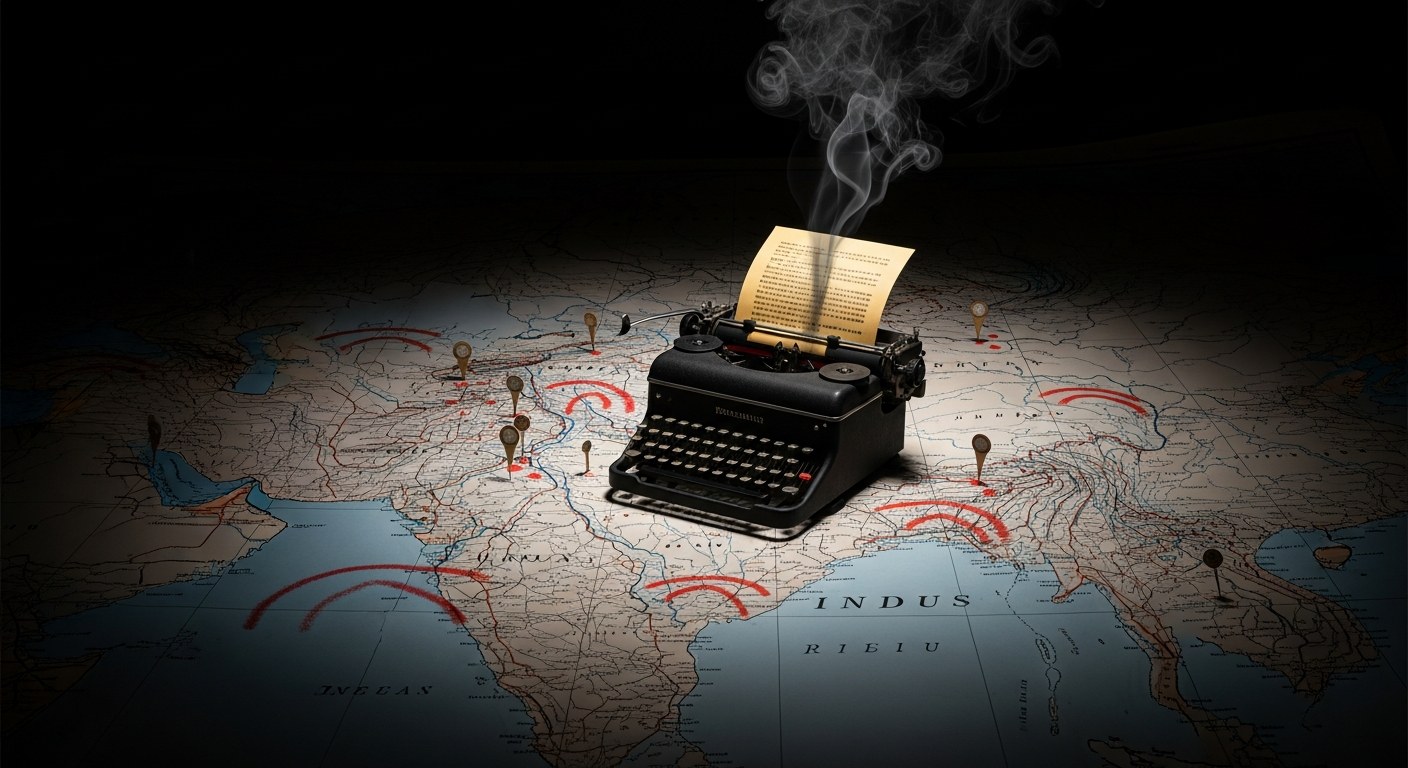
The Next War Is Already Written
The grievance has been drafted, the coalition auditioned, the enemy named. Only the date is blank.
This series ended, or meant to. Part IV called itself the conclusion, and by the logic of the argument it was: an army that sells fear cannot buy peace, and there the matter should have rested. But in the first week of July 2026, three scenes played out in three capitals — a seminar in Islamabad draping the dead over a treaty, a funeral in Tehran turned into an audition, a summit in New Delhi where two wary giants finally signed their names to the same sheet of steel — and together they read like chapters of a book being written in advance. The book is Pakistan's next war. This is the postscript the series did not want to need.
The house on fire
Start where the generals must start each morning: at home, where the state's writ is burning at three corners at once.
In Pakistan-occupied Kashmir — the territory Islamabad's anthems call azad, free — the freedom on offer was measured in early June, when police and protesters clashed in Rawalakot and at least eleven people were killed and more than seventy injured. The protests were not India's doing, whatever the press wing says; they were led by the Jammu Kashmir Joint Awami Action Committee, a grassroots umbrella of traders and civil-society groups that has spent three years asking for bread-and-butter dignity. The government's answer was to ban the JAAC as a terrorist organisation, pour in federal paramilitaries, and arrest its leader, Shaukat Nawaz Mir, at the end of June. A state that must ban its own "free" Kashmiris from assembling has conceded the argument it wages against India at every forum on earth.
In Balochistan, the insurgency announced its year in January with coordinated BLA attacks across nine towns in a single day, and punctuated it in May with a suicide bomb on a train carrying soldiers out of Quetta — at least 24 dead. On the western marches, meanwhile, the fiction of "strategic depth" has completed its inversion: Pakistan and the Taliban government it midwifed have been trading airstrikes and artillery since February, when Islamabad's defence minister spoke of "open war." In the last days of June, Pakistani jets struck Paktia, Paktika and Kunar; Islamabad said it killed 29 fighters, Kabul said the dead included at least 36 civilians and summoned Pakistan's envoy. The United Nations counted 372 Afghan civilians killed in the first quarter of the year. The war Pakistan exported for forty years is being re-imported with interest — a blowback this series traced in Part III, now matured into a standing front.
Honesty compels a caveat the war party in Rawalpindi will not offer: Pakistan's aggregate violence numbers actually declined month-on-month in June and quarter-on-quarter through Q2, even as Khyber Pakhtunkhwa's toll surged by half. The fires are concentrated, not general. But that is precisely the point. An institution whose licence is the Indian threat does not need the whole house burning; it needs enough smoke to justify the fire brigade forever, and enough disillusionment — in Rawalakot, in Gwadar, in the tribal districts — to require a unifying enemy. When the neighbours are this angry, the army reaches for the one story that has always changed the subject.
The grievance factory
The subject-changer is being manufactured in plain sight, and its raw material is water.
India placed the Indus Waters Treaty in abeyance in April 2025, after Pahalgam — the position from which this series began. Fourteen months later, on June 30, Islamabad convened an international seminar on the treaty and rolled out its full front bench. Deputy Prime Minister Ishaq Dar called India's move illegal and warned that depriving Pakistan of water would be "weaponization" with consequences for regional peace. Bilawal Bhutto Zardari supplied the poetry: "Water is not a weapon. Thirst is not diplomacy. Famine is not statecraft." The climate minister, Musadik Malik, has toured UN platforms with the imagery of catastrophe — nearly 6,000 dead, tens of thousands injured, forty million displaced.
Note the sleight of hand, because it is the tell. Those 6,000 dead are Pakistan's flood victims — a fifteen-year climate-disaster toll, killed by cloudbursts, by unmaintained embankments, by a state that builds garrisons instead of drainage. No Pakistani official has produced a single death caused by India's abeyance of the treaty, because India has not stopped the rivers; the abeyance is legal posture, not a closed sluice. But lay the flood dead beside the treaty grievance often enough, in the same speeches, on the same stages, and the two fuse in the listening ear — and sometimes the mask slips entirely: a Pakistani news channel captioned the minister's flood figures with the headline "India's water aggression has claimed 6,000 Pakistani lives." The body of the report says floods. The headline says India. That gap is the whole operation: India is killing us with water. That is not diplomacy. That is the drafting of a casus belli — an atrocity story stockpiled in advance, the way the army stockpiles anything else it plans to use. Part II showed how Pakistan edits its past. The water campaign is something new: the editing of a war's future history before the war has begun.
The funeral as audition
A war needs more than a grievance; it needs a congregation. And in the first week of July, Pakistan went looking for one at a funeral.
The circumstances deserve a paragraph of their own, because history has moved fast. In February, a US-Israeli strike killed Iran's Supreme Leader, Ali Khamenei, along with members of his family and his senior commanders — and set the region alight. By April a ceasefire had been brokered, and it was Pakistan, of all states, that hosted the highest-level direct talks between Washington and Tehran in decades: the army of rentable services, described in Part IV, finding its newest tenancy as broker to both sides. When Khamenei's delayed funeral finally began in Tehran on July 3, most of the world sent measured regrets. Turkey sent its vice-president. Saudi Arabia sent a deputy foreign minister. China sent a parliamentary functionary. Russia sent Medvedev.
Pakistan sent everyone. The prime minister. The field marshal who runs the country. The deputy prime minister. The Bhutto scion. The speaker, the information minister, chief ministers — the entire civil-military establishment, airborne for a one-day pilgrimage of grief for a Shia cleric, from a state whose own Shia citizens are gunned down in processions and whose laws make worship a crime for millions. Asim Munir found time for a sideline meeting with Iran's foreign minister; the prime minister flew onward from Tehran to Ankara for talks on "regional security." Grief was the occasion. The itinerary was the message: Islamabad is assembling a pan-Islamic gallery for the next confrontation with India — Tehran courted, Ankara embraced, the OIC pulpit permanently booked. And the contrast was allowed to speak: India sent a minister of state and a governor.
Will the gallery turn up when the shooting starts? The record suggests not. Iran buried a leader killed by the very wars of others it was dragged into; a state that has just crawled out of one fire does not leap into its neighbour's, and Tehran's long commercial and civilisational ties with Delhi did not burn in February. The Gulf monarchies bankroll Pakistan's bailouts precisely so that it stays quiet, not so that it starts wars that close Hormuz and vaporise their diversification plans. What the funeral diplomacy will reliably produce is narrower and darker: the appearance of ummah cover, a few radical volunteers, Turkish drones — Ankara supplied hundreds in May 2025, with operatives reportedly alongside, and will supply more — and Chinese satellites overhead. That was the actual coalition last time. It will be the coalition next time.
The butcher's claim to the pulpit
There is a deeper fraud in the pan-Islamic audition, and this series would be incomplete without naming it: no state in modern history has killed more Muslims, more systematically, than the one now auditioning to lead them.
The résumé is documented, much of it by Pakistanis. In 1970-71, a Pakistani brigadier named Zia-ul-Haq was in Amman retraining the Jordanian army; by the accounts preserved in the CIA's own retrospective, when Syrian armour crossed the border he was sent forward and effectively took charge of part of the counterattack in a war that killed thousands of Palestinian fedayeen. In 1971 the same army turned east and conducted, against its own Bengali Muslim citizens, one of the great slaughters of the century — hundreds of thousands killed by independent counts, up to three million by Bangladesh's, with mass rape on a scale that made the word systematic unavoidable, while ten million refugees fled to India and Pakistan's own commission of inquiry conceded a fraction of the toll. At home the machinery was then turned inward and made constitutional: the Second Amendment of 1974 declaring Ahmadis non-Muslim by law; Ordinance XX of 1984 criminalising their worship; a blasphemy statute that makes their creed a capital offence; a passport form that requires any Muslim citizen to sign a declaration calling the Ahmadi founder an imposter; an electoral roll that forced half a million Ahmadis to sit out the 2024 election rather than renounce their faith. In 2010, gunmen walked into two Ahmadi mosques in Lahore and killed 94 worshippers at prayer. The persecution of Shias, Hazaras and anyone else on the wrong side of the state's theology is a settled fact of Pakistani life.
Across the border sits the standing refutation, as it has since 1947: an India whose two hundred million Muslim citizens are the second-largest Muslim population on earth, which absorbed ten million refugees in 1971 without turning a war of rescue into a war of religion, and which has never — under any government — made the killing of a sect a matter of state doctrine. When the call to jihad against India comes, as it will, wrapped in the flag of a wounded ummah, the ummah might remember who actually wounded it. The devout butchers of Rawalpindi are not the guardians of Islam. They are its most prolific undertakers, seeking one more congregation to lead to the graveside.
The patron, and the answering steel
Behind the audition stands the patron. China spent January upgrading the franchise: a commitment to "CPEC 2.0" from the foreign ministers on January 5; a standing quarterly security working group and a special protection unit for Chinese nationals agreed on January 7. Analysts now write plainly of China's hold on the country. Beijing does not want a subcontinental war it cannot control — but it funds, arms and shields the institution whose survival logic points to one, because Pakistan is the cheapest instrument ever invented for keeping India looking west. The proxy cannot be allowed to fail, and cannot be allowed to reform, which is the same thing.
India has stopped pretending otherwise, and the first week of July supplied the proof that its answer is no longer rhetorical. At the sixteenth annual summit in New Delhi — Prime Minister Sanae Takaichi's first visit to India in office — India and Japan, the two great status-quo powers of Asia, both patient to a fault for decades, agreed their first-ever defence co-development project: UNICORN, a next-generation naval communications mast for the fleets that watch the Indian Ocean, with a 2+2 ministerial to follow in Tokyo. It arrives atop a lattice already forming: Japan's resupply pact with the Philippines in January, the Quad's Malabar exercises, and a widening circle of states — Manila, Seoul, Hanoi, Canberra, Wellington — each of which has felt the edge of Beijing's territorial appetite. Two sleeping giants are waking together, and the steel being forged between them is not for conquest; it is the fence around the free will of Asia. Pakistan's generals should study what it means that India now plans beyond them: the strategy is to deter the patron, and let the proxy price itself out.
New Delhi's own doctrine has hardened into three words that need no translation in Rawalpindi — strength, strategy, self-sufficiency — the operational grammar of a state whose prime minister now boasts that Made-in-India weapons finished their work in twenty-two minutes in May 2025, and that has spent every month since building so that the next demonstration is unnecessary. Preparation is not warmongering. Against an adversary whose institution requires war, preparation is the only peace policy with a track record.
The bill
Every part of this series has ended at the same counter, and the postscript pays there too. The war being written will be billed, as always, to people who never commissioned it: the Rawalakot trader shot protesting for electricity, the Bengali grandmother of 1971 whose state still denies her dead, the Ahmadi child whose passport calls her faith a lie, the Baloch mother at a train platform in Quetta, the Pakistani soldier buried by the same establishment that armed the men who killed him. And to Indians — who are asked, one more time, to treat as a negotiating partner an institution that is at this moment drafting the grievance, auditioning the congregation and renting the patron for the next round.
India's answer is the right one: prepare fully, ally deeply, deter visibly — and keep the quarrel where it belongs, with the general staff in Rawalpindi, never with the Pakistani people, who are the first victims of every war their army writes and the only audience that can one day refuse the script. The next war is already written. Whether it is ever performed depends on how unmistakably India makes plain that the price of staging it would be the institution itself. Strength, strategy, self-sufficiency — and no more pretending. Jai Hind.