By Ramachandran Rajeev Kumar — 2026-07-02
The Enemy the Army Needs
Pakistan's generals cannot make peace with India, because peace is the one thing their institution cannot survive.
There is an old line about Pakistan: most countries have an army, but the Pakistani army has a country. It is quoted so often that it has stopped sounding like an argument and started sounding like a joke. It is not a joke. It is the single fact that explains why every peace overture across the last three decades has died, why the terror keeps coming, and why India's patience is finally running out. The generals in Rawalpindi are not failing to make peace with India. They are declining to, because peace would cost them everything they own.
This is the last part of a series on a state's relationship with the truth. The first three traced what Pakistan edits — a war, an origin, a present. This one is about who does the editing, and why he cannot stop.
The firm
Start with the money, because the money is the tell. The Pakistani scholar Ayesha Siddiqa spent years documenting what she named "Milbus" — military capital run for the private benefit of the officer class, off the books and outside the defence budget — and put its scale past twenty billion dollars. The army does not merely defend Pakistan; it owns large parts of it. Through the Fauji Foundation, the Army Welfare Trust and the Defence Housing Authorities, the officer corps runs banks, insurers, cement and fertiliser plants, farms, hotels, malls, an airline, and, as Siddiqa noted, even a breakfast-cereal line. Her conclusion was blunt: the arrangement funnels the nation's money into the military's enterprises and leaves everyone else poorer.
The public budget tells the same story louder. After the four-day clash with India in May 2025, Pakistan raised defence spending by twenty per cent, to more than 2.5 trillion rupees — while surviving on an IMF programme that polices its every account. Across the previous decade Islamabad spent, on average, seventeen per cent of all government expenditure on its military, against India's 8.6 per cent — the second-highest ratio in the Indo-Pacific. A country that cannot keep its schools open or its currency stable can always find money for the army. That is not a paradox. It is the design.
Why peace is bad for business
Now ask what an institution this size needs in order to justify itself. It needs a threat large enough to explain why it consumes the state — its budget, its foreign policy, its politics, and periodically its government. India is that threat. Not because India plans to march on Lahore, but because the idea of India-as-existential-danger is the licence under which the army writes its own cheques and overrules its own civilians. Remove the threat and you remove the licence. Peace with India would not be a diplomatic achievement for the Pakistani general staff. It would be a redundancy notice.
This is why the same institution that periodically pantomimes peace can never deliver it. And it is why the army has always been available for hire. It rented itself to Washington in the Cold War and again in the War on Terror; it has now signed a mutual-defence pact with Riyadh and cast itself as Washington's broker to Tehran. The strategic rent changes hands; the business model does not. An army that sells fear to its own people and services to foreign patrons has every incentive to keep the region tense and no incentive at all to let it calm. Enmity is not the army's problem. Enmity is the army's product.
The assets it cannot disown
A product needs suppliers, and here the mask slips entirely. After India's strikes under Operation Sindoor in May 2025, the funerals of the men killed were not conducted in the shadows. A Lashkar-e-Taiba operative, Mudassar Khadian Khas, received a guard of honour from the Pakistan Army; wreaths were laid on behalf of the Army Chief and the Chief Minister of Punjab; the prayers were led by a United States-designated figure, Hafiz Abdul Rauf, and attended by a serving lieutenant-general and the provincial police chief. A Pakistani politician stated openly that Hafiz Saeed and Masood Azhar — men with United Nations designations and Indian blood on their hands — had been given military honours. This is not a state fighting terrorism. It is a state burying its employees.
Nor is the mainstreaming confined to the army's own parades. In June 2026, when the cricketer Shoaib Akhtar — a man with as large a following in India as at home — buried his elder brother in Islamabad, the mourners caught on camera included Saifullah Kasuri, the Lashkar deputy chief whom Indian agencies name as the alleged mastermind of the Pahalgam attack that began this very story, alongside Hafiz Saeed's son and other proxies of the banned Jamaat-ud-Dawa. There is no evidence the cricketer invited them or endorses them, and that is precisely the point. It is that Pakistan's most wanted can walk into a celebrity's family funeral and film themselves doing it — because they move through Pakistani society without fear. When the man accused of planning Pahalgam pays public respects at the funeral of a figure millions of Indians grew up admiring, and then posts the video, the disease has left the barracks. It is in the bloodstream.
Treating internationally designated terrorists as pillars of the social order is not merely an affront to the neighbour they were built to bleed. It is a slow suicide. The doctrine of nurturing jihadist "assets" for use against India and Afghanistan produced the Pakistani Taliban that now kills Pakistani soldiers by the hundred, the insurgency the state cannot end, the blowback traced through Part III of this series. A country that mainstreams the men it should be hunting is not planning for the long term. It is mortgaging it.
The lie that needs refreshing
All of this rests on a founding claim that history has already falsified: the two-nation theory, the idea that Hindus and Muslims were separate nations who could never share a country. It died its first death in 1971, when Bengali Muslims chose language and nation over religion and tore Pakistan in half. It had, in truth, been rejected at birth — by Indian Muslims themselves. Maulana Abul Kalam Azad argued that Muslims were native to India and belonged in it; the Deobandi scholars of the Jamiat Ulema-e-Hind opposed partition; the All India Azad Muslim Conference gathered 1,400 nationalist Muslim delegates in 1940 to reject Jinnah's premise outright. The roughly two hundred million Muslims who are citizens of India today are the standing, living refutation of the theory Pakistan was founded on.
Which is what makes the crocodile tears so cynical. Whenever it is convenient, the Pakistani establishment appoints itself the guardian of India's Muslims — invoking them at the OIC, weaponising every Indian controversy as a grievance to be inflamed. But it is claiming a constituency that told Jinnah "no" in 1940 and India "yes" in 1947, and that has spent seventy-eight years declining the offer. The performance is not solidarity. It is instrumentalisation, and its real victims are the very Indian Muslims it pretends to speak for, on whom it casts a shadow of suspicion they never earned and do not want. India should see the tactic clearly, and so should India's Muslims: the state weeping for them is the one that has done them the most harm, by making their loyalty a subject of debate it manufactured.
The Dhaka tell, and the end of soft-pedalling
If proof were needed that ideology, for this establishment, outranks even memory, look east. Bangladesh was carved out of Pakistan in 1971 through one of the era's great atrocities, in which the Jamaat-e-Islami collaborated. Yet since the fall of Sheikh Hasina in 2024, the interim government in Dhaka has unbanned the Jamaat, resumed direct trade with Pakistan for the first time since 1971, and received an ISI delegation that toured sensitive zones near the Indian border — with Lashkar, Jaish and HuJI moving to revive old networks. A nation born from Pakistani cruelty is being courted by its former tormentor, and the courtship is working, because the shared currency is not history but Islamism. For India, the reopening of an eastern front through Dhaka is not a hypothetical. It is the alarm.
And it marks a line. For decades India answered Pakistani provocation with strategic patience — dialogue offered, buses run, summits attempted, the benefit of the doubt extended past the point of dignity. That era is ending, and this series is, in part, an account of why it deserves to. You do not soft-pedal a structural adversary. There is no reasonable partner waiting across the table for the right gesture; there is an institution whose survival requires that the table stay overturned. Recognising that is not warmongering. It is the end of a category error. The hardening in India is a posture toward Rawalpindi's general staff — not toward Pakistan's people, and emphatically not toward India's own citizens, whom Pakistan's tears are designed to divide.
The bill, again
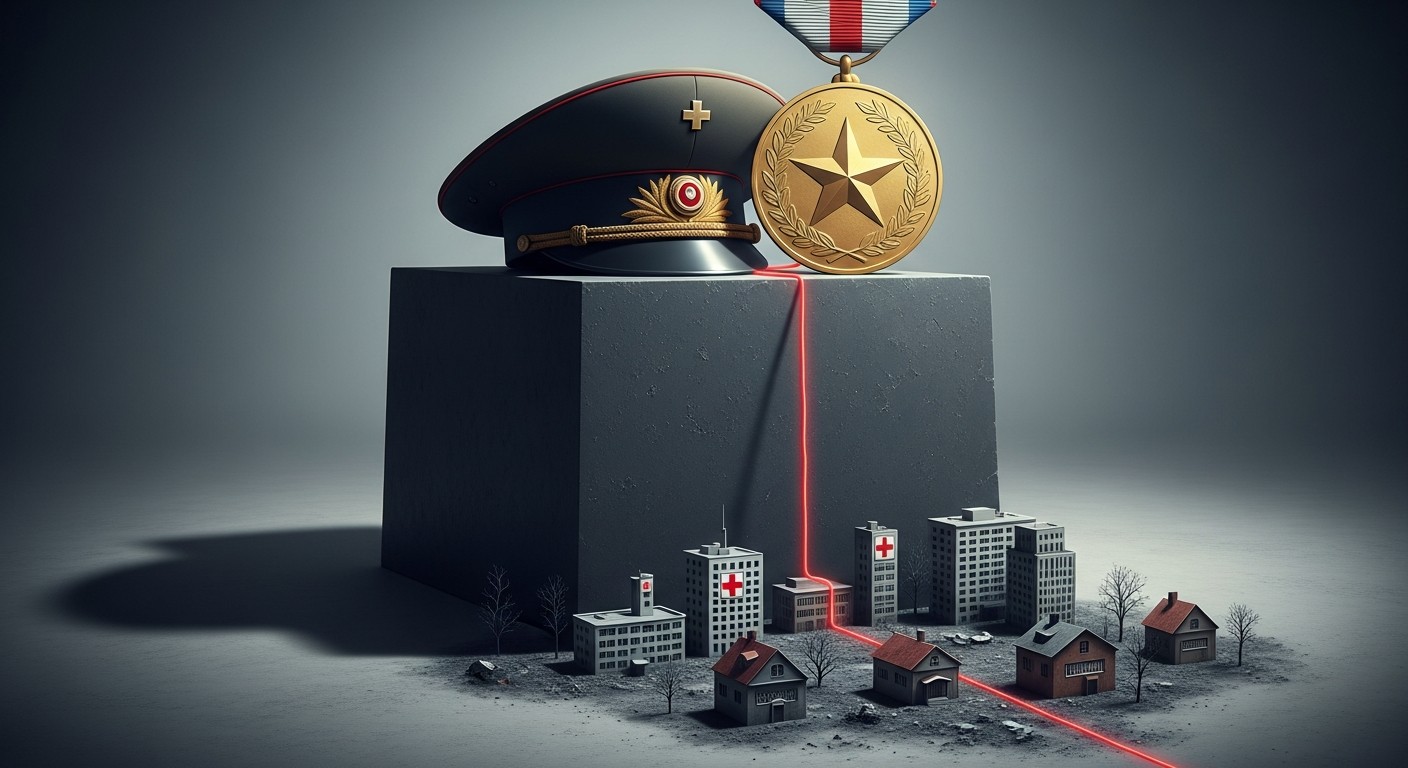
Every part of this series has ended at the same counter, and this one is no exception. The enemy the army needs is not, in the end, India. It is the Pakistani who will never see the hospital that the tank replaced, the child taught to hate before she is taught to read, the soldier sent to bury a terrorist one year and to fight that terrorist's successors the next. They are the institution's first victims; Indians are only its intended ones.
A nuclear-armed state that has organised its entire existence around the permanent necessity of an enemy will not be reasoned out of that necessity, because the necessity is what feeds it. India cannot make peace with such a state by wanting peace more. It can only stop pretending that the wanting was ever the problem. The generals will keep the enmity going for as long as it pays. The task for everyone else — Indian and Pakistani alike — is to stop paying.