By Ramachandran Rajeev Kumar — 2026-07-02
The Country That Edits Its Own Past
How Pakistan teaches a nation to mistake invaders for founders — in the words of its own historians.
A Pakistani child opens a history book and learns that her country began in the year 712, when an Arab general named Muhammad bin Qasim landed in Sindh. Everything before that — the cities of the Indus, five thousand years of the soil under her feet — is prologue at best, a darkness waiting for the light to arrive by ship. She is taught, in the national curriculum to this day, that bin Qasim was the first Pakistani. A man who died more than twelve centuries before Pakistan existed is presented to her as its founder.
This is not an Indian accusation. It is the finding of Pakistan's own historians, and they have been saying it, into official silence, for forty years.
The textbook that starts a nation in 712
In 1985, the historian K.K. Aziz published The Murder of History, a line-by-line autopsy of the textbooks Pakistani children were made to read. His conclusions were not subtle. The national story, he found, is taught as beginning with bin Qasim's invasion — except the word "invasion" is scrupulously avoided. Every Muslim conqueror from bin Qasim to Ahmad Shah Abdali does not invade; he "comes," he "arrives," as a guest might. The Hindu and Buddhist civilisations that built the subcontinent are written out. And the founding claim, repeated page after page, is that Pakistan was created to propagate a religion.
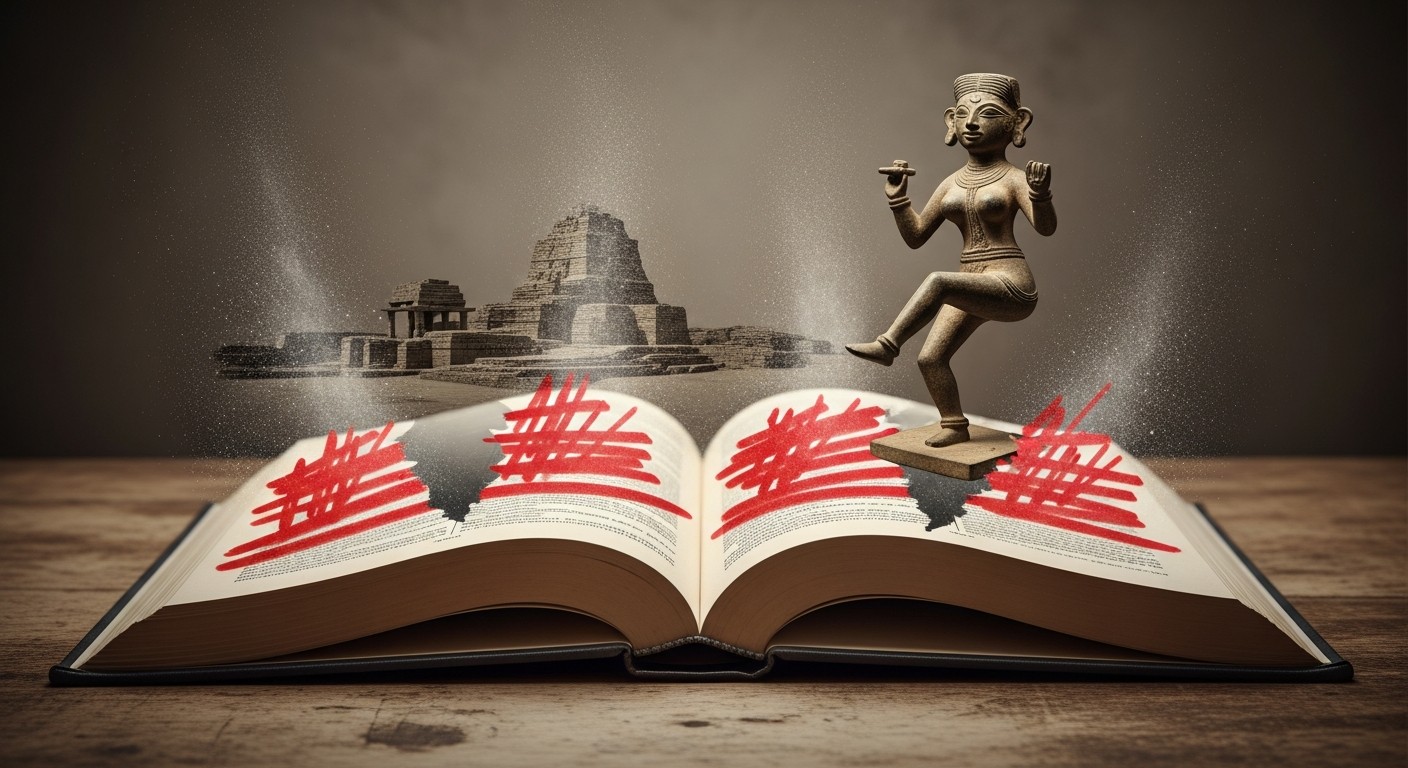
The textbooks are quotable, and they indict themselves. A Text Book of Pakistan Studies informs students that the country "came to be established for the first time" when the Arabs occupied Sindh and Multan, and that by the thirteenth century "Pakistan" had spread across northern India and Bengal — a nation retroactively backdated by twelve hundred years, annexing the past like territory. To teach this, a real inheritance had to be discarded: the Indus Valley is flagged as a tourist site while its Hindu, Buddhist and Vedic continuity is quietly amputated from the story.
Who built the machine
None of this was an accident of bad scholarship. It was policy.
The Pakistani physicist Pervez Hoodbhoy traces the turn to 1976, when an act of parliament required every school, public and private, to teach toward fixed outcomes — among them that pupils should learn to identify "forces working against Pakistan," deliver speeches on jihad, and internalise India's "evil designs." Under General Zia-ul-Haq, this hardened into doctrine. Zia held that the army's duty was to guard the country's "ideological frontiers" — a phrase that tells you everything, because a frontier that lives in the mind must be defended by controlling what enters the mind.
Hoodbhoy and his colleague A.H. Nayyar documented the result in The Subtle Subversion (2003) and Rewriting the History of Pakistan: a curriculum engineering militarism, martyrdom and a manufactured hatred of Hindus into children too young to check the claims. These are not marginal dissidents. They are among Pakistan's most respected scholars, published by Pakistani institutions, debated for two decades in Dawn and Herald — Pakistan's own newspapers of record. The critique is domestic. Only the silence is official.
The ancestry a nation was taught to disown
If the state edits where the story begins, the society edits where it comes from.
There is a long-running status game in South Asian Muslim life around the label ashraf — the claim to descend not from local converts but from Arab, Turkic or Persian conquerors. In its Pakistani form this becomes a quiet shame about subcontinental roots: Hindu surnames dropped, names Arabised, lineages reimagined to point west and north, anywhere but home. Dawn has satirised the reflex in its own pages, under headlines as blunt as "My name is Pakistan and I'm not an Arab."
A caution is owed here, because this is where Indian commentary usually overreaches. This is an elite and curricular project, not the character of a people. Sindhis take fierce pride in Mohenjo-daro; Punjabis in their land; Pashtuns and Baloch in lineages entirely their own. And the genetic footnote — studies putting Arab and Afghan ancestry in the low single digits — matters only as a measure of the distance between the claim and the fact, not as a theory of blood. The point is not what Pakistanis are. It is what they have been trained to wish they were.
That training is visible in real time. When the Turkish historical drama Ertuğrul swept Pakistan, Prime Minister Imran Khan personally instructed state television to air it, as a lesson in Islamic civilisation. The activist Jibran Nasir warned it was feeding an "identity crisis." A writer in Pakistan's own Friday Times named the disease precisely: seven decades on, the country has not recovered from the "Mohammad-bin-Qasim-isation" of its history, and so it keeps "looking elsewhere for cultural validation — to the Arabs, the Persians, the Turks." A nation taught that it began with a foreign general grows up to seek its reflection in foreign heroes.
The cost, and the connection
It is easy to read all this as a country's eccentricity. It is not. It is the foundation stone of everything else.
A state that will forge its own birth certificate at the age of seven will, at seventy, forge a war. The reflex that turns an eighth-century invader into the first Pakistani is the same reflex that turned a ceasefire Pakistan requested into a famous victory, and a favour from a foreign president into a national triumph. The habit is continuous. Only the subject changes.
And there is a victim in it who deserves more sympathy than contempt: the schoolchild, handed a past that was cut to fit a policy, asked to be proud of conquerors who would have regarded her ancestors as plunder. The tragedy of a manufactured history is not primarily that it insults the neighbour it is built against. It is that it robs its own children of the one thing a history is for — an honest account of where they actually come from.
Pakistan's finest minds have been saying this, at cost to themselves, for two generations. The measure of a country is not whether it produces such critics. It is whether it listens to them.