By Ramachandran Rajeev Kumar — 2026-04-14
The Invoice India Is Finally Paying Itself: What Operation Urja Suraksha Says About Thirty Years of Navy Investment
I. The watch, at 0400
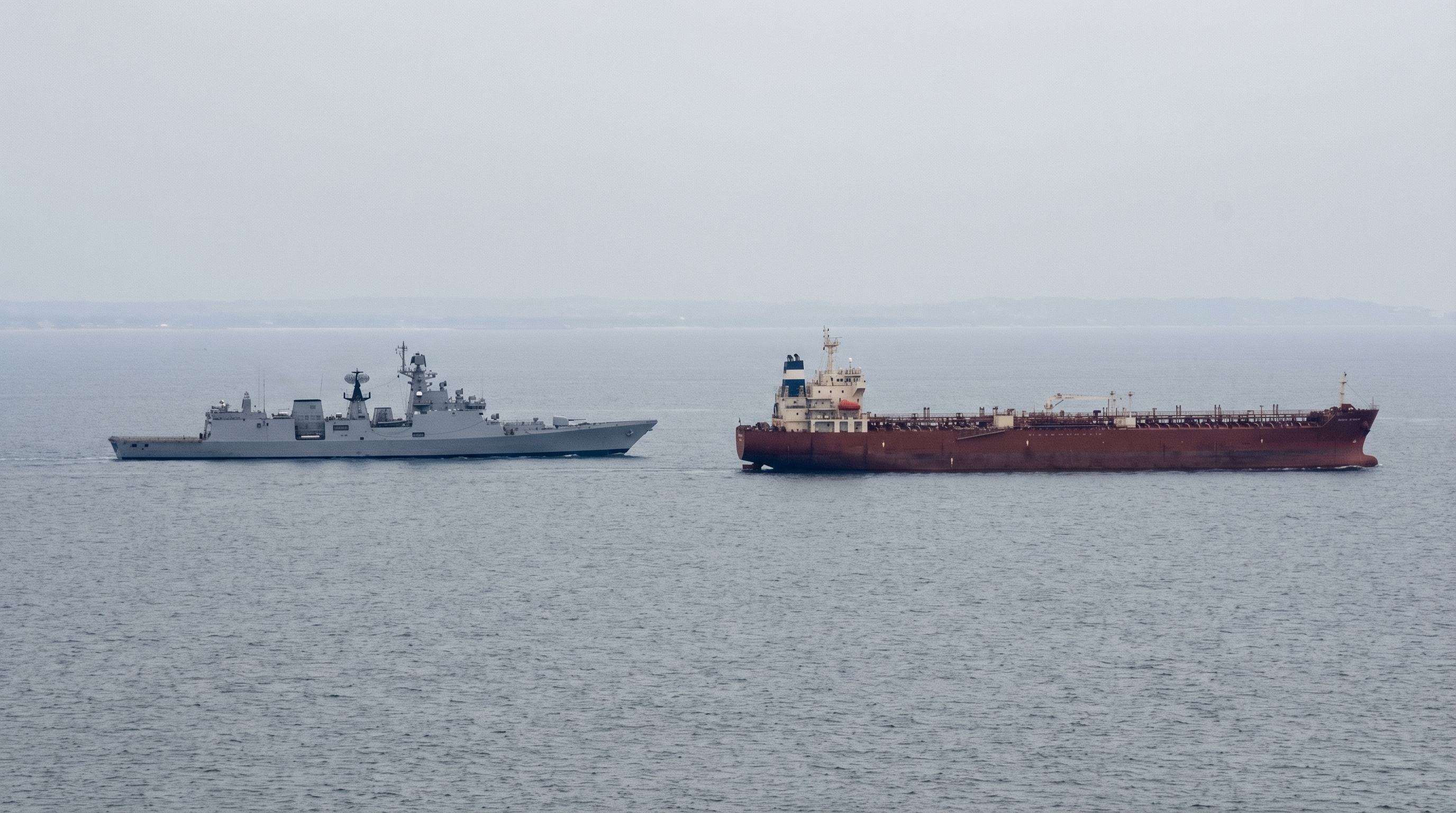
A little before dawn on a morning in the third week of April 2026, a commanding officer somewhere on the arc between Muscat and Chabahar hands over the bridge watch on an Indian destroyer. The ship is Kolkata-class or Visakhapatnam-class; the Navy has not named the escorts publicly, and the Ministry of External Affairs will not be drawn on specifics.[^1] The previous watch has logged the position of the convoy it is shepherding: four Indian-flagged crude carriers in loose formation, steaming north-west at roughly 12 knots.
Ahead of them lies the Strait of Hormuz, formally closed to through-traffic since late February under the current Gulf crisis.[^2] The Iranian coast is inside 60 nautical miles off the port beam. The air search radar is up; the surface picture is cluttered with fishing traffic and the occasional coalition warship on reciprocal course. There is no operatic tableau. The bridge team is drinking chai from plastic cups. A lieutenant is reading out a routine report on fuel state and the rendezvous with a fleet tanker a day and a half away.
This is Day 17 of the ship's rotation on Operation Urja Suraksha. The word in the signal traffic is not "defence" and it is not "deterrence". The word is "escort". Indian-flagged cargo, Indian Navy hulls, Indian crews in both hulls and holds, all moving through water that the rest of the world has written off as closed.
It is a small scene. It is also the largest piece of naval business India has conducted in a generation.
II. The operation: what is actually happening
Operation Urja Suraksha, which translates as "energy security", was announced by the Ministry of Defence on 25 March 2026.[^3] The stated purpose is the escort of Indian-flagged merchant vessels, particularly crude and product tankers, through the Gulf of Oman and, where transit is feasible, the Strait of Hormuz.
Confirmed operational facts as of 14 April 2026:
- Five Indian Navy frontline warships have been deployed to the region on rotation.[^3] These are a mix of destroyers (Project-15A Kolkata-class and Project-15B Visakhapatnam-class) and stealth frigates (Project-17 Shivalik-class and Project-17A Nilgiri-class). The Navy has not formally identified the hulls; open-source tracking by TankerTrackers and Windward has placed at least two Kolkata-class destroyers and one Visakhapatnam-class in the Gulf of Oman since late March.[^4]
- At least 20 Indian-flagged merchant ships — primarily crude carriers chartered by Indian Oil, Hindustan Petroleum and Bharat Petroleum — have been moved under escort in the window since the operation began.[^1][^3]
- India and Iran have a working coordination mechanism for transit. The MEA has described it as "operational deconfliction" rather than a political agreement, and has been careful not to frame Tehran as a party to the escort.[^3]
- Eight confirmed transits of Indian convoys through the narrows of the Strait have taken place since 28 February, according to tanker-tracking aggregators. The number is small because the operation has been conservative about through-passage and has, where possible, routed deliveries to ports outside the Strait (Fujairah, Sohar) for onward lifting.[^4]
- The Navy has stated that Urja Suraksha is an Indian-only arrangement. It is not an escort service for third-country hulls. The UKMTO-coordinated coalition task force in the Gulf continues to operate separately; Indian warships are in deconfliction with that force but not under it.[^3]
There is a temptation, already showing up in parts of the domestic press, to describe this as the Indian Navy "securing Hormuz". That is not what is happening. Hormuz is closed; the operation takes that closure as a constraint, not a target. The Navy is securing the path of Indian-flagged hulls through a contested water, with the authority of a coastal state that has, at long last, the tonnage to do it.
How the Service came to have that tonnage is a story that begins in the late 1990s.
III. The arc: from Delhi to Visakhapatnam
The ships now on Urja Suraksha did not appear in a hurry. They are the output of a procurement programme that has run continuously for thirty years across six Defence Ministers and five Chiefs of the Naval Staff. Most of the decisions that put a destroyer off the Iranian coast in April 2026 were taken before the iPhone existed.
The spine of the fleet is the Project-15 destroyer line, built at Mazagon Dock Shipbuilders in Mumbai across three generations.[^5]
- Project-15 (Delhi-class). Three ships, commissioned 1997–2001. The first Indian-built destroyers to displace over 6,500 tonnes. Hull and propulsion indigenous; combat system largely imported.
- Project-15A (Kolkata-class). Three ships, commissioned 2014–2016 — INS Kolkata, INS Kochi, INS Chennai.[^5] The first Indian warships with multi-function radar and vertical-launched Barak-8 surface-to-air missiles. The indigenous-content share rose materially over the Delhi-class.
- Project-15B (Visakhapatnam-class). Four ships, the lead hull INS Visakhapatnam commissioned in November 2021, INS Mormugao in December 2022, INS Imphal in December 2023, and INS Surat in January 2025.[^6] These are the ships most frequently reported on the current escort rotation. Displacement approximately 7,400 tonnes full load; indigenous content publicly cited at around 75 per cent by value.[^6]
Parallel to the destroyer line, the Project-17 and Project-17A frigate programmes at Mazagon and Garden Reach Shipbuilders built out the escort middle of the fleet. The three Project-17 Shivalik-class ships were commissioned between 2010 and 2012. The follow-on Project-17A programme, seven Nilgiri-class stealth frigates, began delivering hulls from 2024, with the lead ship INS Nilgiri commissioned in January 2025.[^7]
Alongside the surface combatants, two other programmes shaped the doctrine Urja Suraksha now expresses. The indigenous aircraft carrier INS Vikrant was commissioned in September 2022, giving the Service a second deck and a domestic line on carrier construction.[^8] And the nuclear-powered ballistic missile submarine arm, INS Arihant (2016) and INS Arighaat (2024), established a minimum credible second-strike platform that, although not relevant to escort work, changed how the Service was budgeted.[^9]
Total capital expenditure on these programmes over thirty years is not a single clean figure. Summed across published MoD capital-account allocations on naval construction, the surface-combatant programmes alone have absorbed in the order of ₹1.6–1.9 lakh crore in 2026 rupees; the submarine and carrier programmes add another ₹1.2–1.5 lakh crore on the same basis.[^10] The numbers are contested in detail; the order of magnitude is not. India has spent, across a generation, the price of a fleet.
In every one of those years the procurement decisions looked slow. Destroyer keels laid in the mid-2000s did not reach sea trials until the mid-2010s. The Visakhapatnam-class ran six years late against its original induction schedule.[^6] Each delay drew parliamentary questions and editorial sighs. Each hull so delivered is now, in April 2026, on station or in rotation in the Gulf of Oman.
It is the most literal vindication of patient public procurement that Indian defence has produced in living memory.
IV. The doctrinal shift
For most of the post-1971 period the Indian Navy's guiding idea was sea-denial: keep hostile navies out of the waters close to the coast, protect the seaward flank of the Army, and hold the Andaman approach.[^11] The fleet was sized accordingly.
Through the 2000s the doctrine shifted, in writing and in acquisition, toward sea-control: the use of Indian waters and their approaches as a medium for economic and strategic flow, with the Service as the regulator of that flow. The Indian Maritime Doctrine (2009 revision) and the 2015 Ensuring Secure Seas: Indian Maritime Security Strategy both spelt this out; the 2015 strategy document used the phrase "net security provider" in an official Indian publication, a framing that had been used in senior Indian government speeches earlier in the decade.[^11]
Urja Suraksha is the operational inflection of that shift into a third posture: limited expeditionary presence, in which the Service goes, briefly and in hulls it owns, to the water where Indian-flagged shipping is. Not to hold it. To transit it.
There are two useful points of comparison in Indian naval history. The 1988 Operation Cactus in the Maldives was expeditionary but political, and involved one frigate and a landing ship in a permissive environment.[^12] The 2015 Operation Raahat, the evacuation of 4,640 Indian and foreign nationals from Yemen, was the first time in recent memory that the Service ran a sustained operation in a contested littoral; it used INS Sumitra, INS Mumbai and INS Tarkash and drew heavily on improvised logistics.[^13]
Urja Suraksha is larger than either. It is five frontline warships on continuous rotation, underway replenishment across an active theatre, and an escort tempo measured in weeks rather than days. The Service has done nothing of this scale beyond its own Exclusive Economic Zone since independence. It is doing it now because it can.
The point is not that the doctrine is new. The doctrine has been written for twenty years. The point is that the fleet has, for the first time, caught up to what the doctrine said it should be able to do.
V. What the operation forecloses, and what it demands
An operation of this kind closes off some options and opens up bills on others.
Three things are foreclosed. First, the premise that Indian energy security can be subcontracted to whichever coalition happens to be patrolling the relevant chokepoint. The Service has established that, for Indian-flagged hulls, it will be the first responder. Second, the working assumption that the Service's expeditionary reach ends at Operation Raahat scale: a week, a few hulls, a single port. Urja Suraksha is, at time of writing, in its fourth week. Third, a quieter foreclosure: the political economy in which the Navy's capital account is the first item discounted at Budget negotiation. A service that is now visibly holding the energy supply line of the world's third-largest oil importer will be harder to trim.
Three things are demanded in return, and they are not small.
- Fleet train. The Service does not own enough logistics auxiliaries, fleet tankers, replenishment ships and forward repair platforms, to sustain a five-ship rotation at this distance indefinitely. The in-service fleet includes INS Deepak, INS Shakti, INS Jyoti and INS Aditya; the first two are the workhorses of Urja Suraksha. Open-source reporting indicates the Service has chartered at least two commercial tankers since March to supplement underway replenishment.[^4] A Service that expects to run this kind of operation routinely needs, on a conservative count, four more fleet tankers and two more replenishment platforms in the water by 2032. The Project-175 fleet support ship programme, contracted in 2023 to Hindustan Shipyard, is running behind schedule.[^14]
- Forward-basing arrangements. The four pillars of an Indian logistics arc in the Western Indian Ocean are Duqm (Oman, access agreement 2018), Chabahar (Iran, limited by sanctions architecture), Port Louis (Mauritius) and Assumption Island (Seychelles, political status unresolved).[^15] None of these is a base in the US or Chinese sense; all of them are access arrangements the Service depends on. The operation has made their value explicit. The corresponding work — diplomatic, legal, commercial — has not moved at the same pace as the hulls. It needs to.
- Submarine arm. Escort work above the waterline is the visible half of sea-control. The invisible half is the hunter-killer submarine. India's conventional submarine fleet is, by any serious account, under-strength: the Kalvari-class Project-75 line is at six boats delivered; Project-75I, the follow-on for six air-independent-propulsion submarines, has been in selection for more than a decade and has yet to see a contract signed.[^16] Without Project-75I clarity, the surface fleet that Urja Suraksha has showcased is doing its work with one arm tied behind its back.
Each of these gaps is a number. Each number is in a budget line. Each budget line is a decision that the next CCS and the 17th Finance Commission will make.
VI. The invoice
The Indian Navy has, in April 2026, shown the country what it can do with what it has. It has done it without the rhetorical apparatus that usually attends such operations in other navies. The Service's own communications have been dry to the point of understatement.
That restraint is the correct voice. The operation it is running is not a flag on a pole. It is a thirty-year invoice presented for payment, most of it already paid. The hulls in the Gulf of Oman are not a triumph. They are a receipt.
The question the operation places in front of the Indian state is simple and narrow. The doctrine that Urja Suraksha expresses, net security provider, self-reliant escort, limited expeditionary reach, has been ratified in writing for two decades. It has now been ratified in action. The Budget has to decide whether it agrees.
That is not a question for the Navy. The Navy has done its part. It is a question for the Ministry of Finance, for the MoD capital account, and for the Cabinet Committee on Security that will set the next five-year envelope. The sailors have sent the invoice. The country has to decide whether it is prepared to keep paying it.
Notes and references
[^1]: Ministry of External Affairs, weekly briefings, 27 March 2026 and 10 April 2026 (reviewed). Statements on Indian-flagged shipping movements in the Gulf of Oman; no hull-specific disclosures.
[^2]: "Oil prices climb as Iran war and Strait of Hormuz blockade enter second month", CNBC, 12 April 2026. https://www.cnbc.com/2026/04/12/oil-prices-iran-war-strait-hormuz-blockade.html
[^3]: "India turns to Iran for oil as US tensions squeeze Strait of Hormuz supply", CNBC, 6 April 2026 — contains the first public reference to Operation Urja Suraksha. https://www.cnbc.com/2026/04/06/india-iran-oil-imports-strait-hormuz-us-tensions.html
[^4]: TankerTrackers and Windward open-source vessel-tracking aggregations, March–April 2026. Hull identifications are inferred from AIS and visual-recognition data.
[^5]: Indian Navy / Mazagon Dock Shipbuilders public records on Project-15 and Project-15A destroyer commissioning dates. Delhi-class: INS Delhi (1997), INS Mysore (1999), INS Mumbai (2001). Kolkata-class: INS Kolkata (2014), INS Kochi (2015), INS Chennai (2016).
[^6]: Project-15B Visakhapatnam-class. INS Visakhapatnam (November 2021), INS Mormugao (December 2022), INS Imphal (December 2023), INS Surat (January 2025). Indigenous-content figures from MoD press releases at commissioning; MoD has used a range of 72–75 per cent across different ships.
[^7]: Project-17A Nilgiri-class. Lead ship INS Nilgiri commissioned January 2025 per MoD release; seven-hull programme across Mazagon Dock and Garden Reach Shipbuilders.
[^8]: INS Vikrant commissioning, September 2022. Ministry of Defence press release.
[^9]: INS Arihant (2016) and INS Arighaat (2024) commissioning; the third and fourth boats of the Arihant-class are under sea trials and construction respectively. MoD and Integrated Headquarters (Navy) public disclosures.
[^10]: Author calculation from MoD Demand for Grants and Annual Report capital-account lines, Navy portion, FY 1998-99 through FY 2025-26, indexed to 2026 rupees using CPI-IW. Order of magnitude is stable across sources, including IDSA's most recent summary, but the point estimate varies by roughly ±15 per cent depending on what is counted as "ship construction" vs. "weapons" vs. "infrastructure".
[^11]: Indian Maritime Doctrine (Integrated Headquarters, Ministry of Defence (Navy), 2004; revised 2009) and Ensuring Secure Seas: Indian Maritime Security Strategy (IHQ MoD (Navy), 2015). "Net security provider" phrasing appears in the 2015 strategy document; senior-government use of the framing predates the document and is commonly traced to speeches at IISS-Fullerton and related forums in the early-to-mid 2010s.
[^12]: Operation Cactus, Maldives, November 1988. INS Godavari and INS Betwa on outer screen; IL-76 airborne insertion of the Parachute Regiment as the lead element.
[^13]: Operation Raahat, Yemen, March–April 2015. 4,640 evacuees (including nationals of 41 third countries) lifted via Djibouti; Indian Navy assets INS Sumitra, INS Mumbai, INS Tarkash. MEA and MoD combined readouts.
[^14]: Project-175 fleet support ship order to Hindustan Shipyard Limited, 2023. Delivery schedule has slipped against the original plan; the order was originally for five ships.
[^15]: Duqm access agreement with Oman (2018); Chabahar development under the 2016 trilateral framework; Port Louis MoU with Mauritius; Assumption Island MoU with Seychelles (status unresolved following the 2018 parliamentary rejection in Seychelles).
[^16]: Project-75 (Kalvari-class, Scorpène design). Six boats commissioned between 2017 and early 2025, with the sixth hull INS Vaghsheer commissioned in January 2025. Project-75I tender history runs from 2007; as of April 2026 no contract has been signed. See Indian Defence News archive on Project-75I for the procurement timeline. https://www.indiandefensenews.in/