By Ramachandran Rajeev Kumar — 2026-05-17
Off the Bench: India's Doctrine for Forcing Beijing Into Its Own War
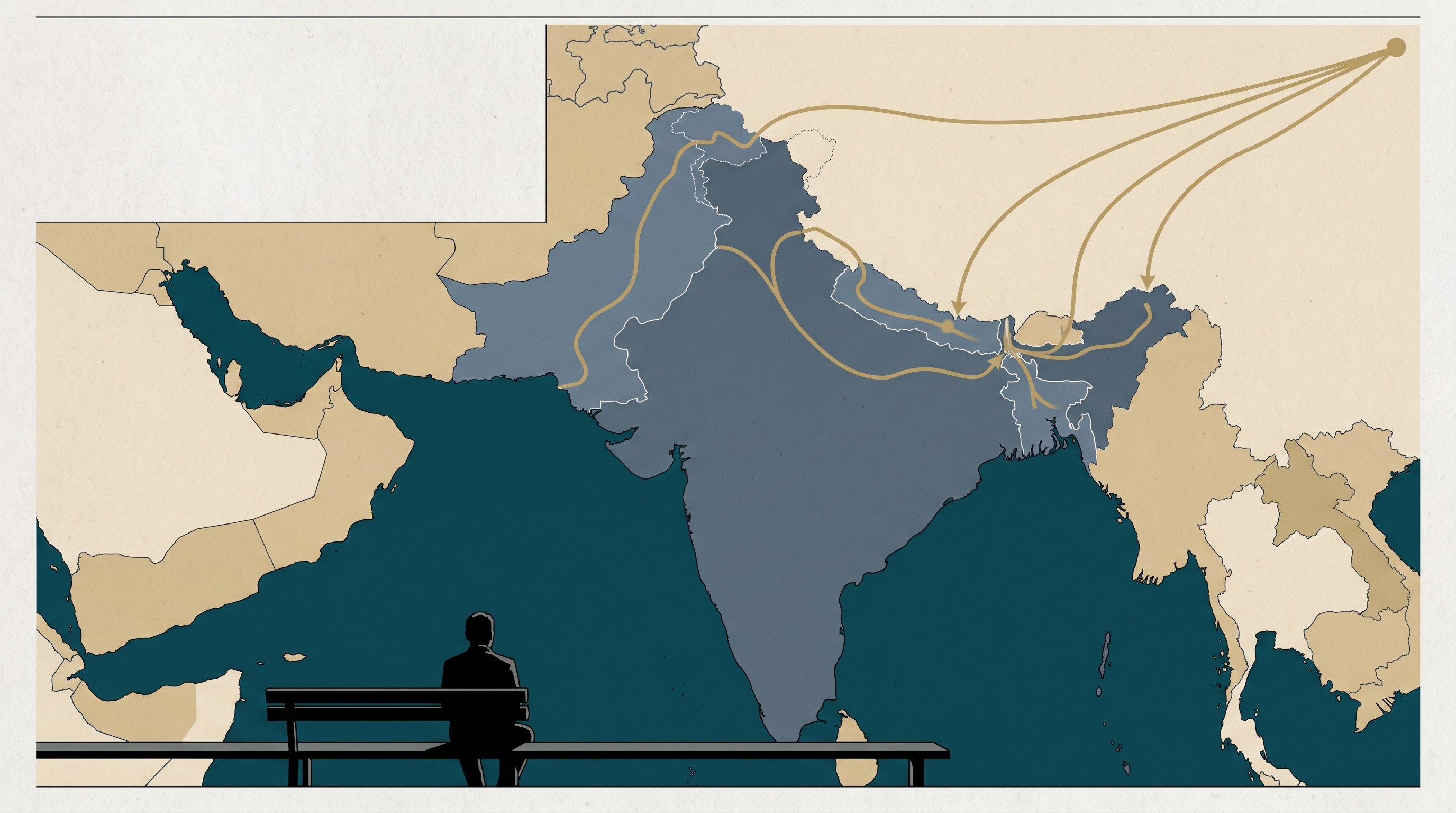
China fights its India war from the sidelines through proxies designed to keep us capped. We are playing by their rules. The doctrine that follows changes the rules -- and the price.
By R. Rajeev Kumar
On Wednesday 6 May, Bangladesh's foreign minister Khalilur Rahman sat across from his Chinese counterpart Wang Yi in Beijing and invited Chinese capital into the Teesta River Comprehensive Management and Restoration Project. The Teesta rises in the eastern Himalayas, passes through Sikkim and West Bengal, and enters Bangladesh kilometres from the Siliguri Corridor -- the narrow ribbon of Indian territory that connects the mainland to eight north-eastern states. The same week, the Bangladeshi side confirmed that Prime Minister Tarique Rahman's first foreign trip would be to Beijing in June, with Teesta and the Bangladesh-China-Myanmar road connectivity extending overland to Kunming on his agenda.
This is not a diplomatic accident. It is the visible face of a doctrine India has not yet named, and therefore has not yet defeated. Beijing is fighting its India war from the sidelines, through proxies whose function is to keep India capped below the Himalayas while contesting our maritime approaches. We are paying for the privilege of fighting back at every cap-point and never at the patron's bench. We are fighting their war by their rules. The doctrine that follows changes the rules. It also changes the price.
The hostile neighbourhood is no accident
Look at the file as it actually sits in May 2026.
Bangladesh is the world's second-largest purchaser of Chinese weapons. Two-thirds of its defence inventory comes from Beijing. In February this year, the Bangladesh Air Force and China Electronics Technology Group Corporation announced a joint-venture drone manufacturing and assembly facility at Bogra. Through 2024 and 2025 the Chinese embassy in Dhaka ran a deliberate political programme with Jamaat-e-Islami -- the first Chinese ambassador visit to the Jamaat's Dhaka office in fourteen years in September 2024, a Jamaat delegation to Beijing in November 2024, a Chinese embassy reception for Jamaat leaders in July 2025, a high-level meeting with the Chinese People's Institute of Foreign Affairs in September 2025. Jamaat, barred from electoral participation under the Awami League, re-entered Bangladeshi politics this February as the principal opposition. The Bangladesh Nationalist Party, whose Tarique Rahman is now Prime Minister, has its own deepening file with Beijing. The foreign minister chose, on 6 May, to invite Chinese capital into the Teesta on the doorstep of India's most strategically vulnerable geography.
Nepal signed a Belt and Road implementation framework during Prime Minister K. P. Sharma Oli's December 2024 visit to Beijing. Ten projects, including the Kerung-Kathmandu cross-border railway -- detailed feasibility now underway -- and the China-Nepal Friendship Industrial Park in Jhapa, the district that touches the Indian border. Nine years after the original Nepal-China BRI memorandum, the framework has been signed and feasibility work has begun on the railway and the industrial park.
Pakistan we already know. AVIC engineers were on operational bases during Sindoor, confirmed by CCTV on 8 May 2026. Over 80% of Pakistan's defence procurement is Chinese -- SIPRI's 2020-2024 fact sheet puts the share at 81%. CPEC routes through Pakistan-administered Kashmir. The China-Pakistan nuclear and missile cooperation file has been open and active for thirty years.
None of this is incidental. None of this is the product of independent Bangladeshi or Nepali or Pakistani agency operating in some sovereign vacuum. It is the visible architecture of a Chinese policy that has spent thirty years building a regional envelope around India -- three neighbours converted, by patient capital and patient politics, into instruments tuned to cap us. The instruments are not interchangeable in detail. They are interchangeable in function. They exist to cost India something every time India tries to grow into its weight.
What India has done in response, for thirty years, is pay each instrument separately to behave. Subsidised power. Discounted fuel. Absorbed migration. Loan write-offs. Diplomatic patience. Every rupee of that goodwill spend buys exactly one election cycle of quiet from the recipient capital. The next government in the same capital re-runs the same shakedown. The return on appeasement spend in the neighbourhood is, in honest economic terms, close to zero.
Wasting good money is not a policy. It is a confession.
The shut-out
The first half of the answer is purely subtractive.
Stop courting the regimes. Treat them as the Chinese instruments they have become. SAARC is a corpse -- stop reviving it. BBIN -- the Bangladesh-Bhutan-India-Nepal initiative -- has been dormant for a decade; let it stay dormant. Subsidised power and discounted fuel get re-priced to market. Loan write-offs end. Visa regimes tighten on official and elite categories. Diplomatic representation is recalibrated downward on the bilateral track and upward on the multilateral one, so the next government in Dhaka or Kathmandu or Islamabad finds it harder to extract rent without burning capital to do it.
The constructive half matters as much.
In Bangladesh there are communities that are not interested in the China file -- the Hindu minority that has been the target of post-Hasina violence, the Awami League diaspora, the secular professional class, the parts of the bureaucracy that remember why Indian goodwill once mattered. Nepal carries its own India-leaning weight: the Madhesi communities of the southern plains, the Pahadi communities economically integrated with India, the parts of the army and bureaucracy historically India-aligned. All have been steadily passed over by the BRI-courted Communist coalition. These constituencies carry political weight inside the country. They get the support that has been wasted on the regimes that target them. The doctrine treats them as partners, not as subjects of polite Indian concern.
The shut-out frees the budget. The support to pro-India constituencies redirects it. The net effect is that the patron's instruments find their domestic political base eroding while their patron-funded faction loses Indian rent and faces strengthened domestic opposition. The proxy is squeezed at both ends. That is the operational definition of changing the rules at the proxy level.
Change the rules -- cost-imposition reciprocity
The half of the doctrine that matters most operates at the moment of contact.
When the next major terror incident traces back through Rawalpindi -- and it will, because the instrument has not been retired -- the response is not the calibrated diplomatic-and-tactical pairing of every previous cycle. The response is structural cost.
The minimum cost of a Pakistan-traced major terror incident is India taking Pakistan-administered Kashmir. Not as theatre. As a permanent reincorporation. The map changes. Concrete moves. India's posture is to adjust the geography.
Simultaneously -- and this is the part the existing Indian doctrine refuses to articulate -- China loses CPEC. The mechanism is accelerated exposure of every CPEC node, every Chinese capital flow into Pakistani infrastructure, every Chinese contractor on Pakistani soil. India makes Beijing's instrument cost Beijing more, in the same window, than the instrument's deployment costs India. The economics of the instrument flip. The patron pays for the proxy's behaviour.
That is the rule change. China has been free to fight from the bench because the bench has been a safe place. The doctrine makes the bench unsafe.
The escalation logic continues from there. If Beijing responds directly -- capital flight, trade weaponisation, an LAC test, a hydrological provocation on the Brahmaputra -- the response abandons the Pangong Tso disengagement template. The response is full-scale conflict prepared for, not avoided. Off-ramps require verified Chinese withdrawals against the six tests this publication has documented in its prior doctrine work. No communiqué language. No summit theatre. The price of a Beijing escalation is paid on the field where Beijing has refused, for thirty years, to play.
No negotiations on Pakistan after the next major incident. No negotiations with Beijing after a direct provocation. The doctrine extracts the negotiating step from the cycle, because the negotiating step has been the trapdoor through which every prior escalation has been allowed to dissipate without cost. The instrument and the patron have both used the negotiating step to reset to baseline and resume. The doctrine closes the step.
This will be read as escalation advocacy. It is not. It is the only deterrence ladder that has not yet been tried. Every other ladder has been tried and discounted. A ladder that promises structural cost, articulated in advance and demonstrated as credible by the posture below, is the only deterrence configuration that prevents the use of the instrument.
The choice is between deterring the use of the proxies or repeatedly absorbing it. India has absorbed it for thirty years. The next thirty years should be different.
Arm to the teeth -- credibility is the doctrine
A doctrine that promises structural cost without the means to impose it is bluff. The bluff has its own cost; it teaches the patron that the threat is empty. The doctrine has to be backed by an arsenal calibrated to make the threat unambiguous.
Start with nuclear. The No First Use posture has served India through a particular cycle of strategic stability. That cycle is closing. The doctrine India needs from 2026 onward is ambiguous use with a low trigger threshold -- the position that India will use nuclear weapons on the first hint of credible threat against the homeland, the deployed force, or the country's leadership. The technical literature calls this posture instability-prone. The empirical record of Pakistani sub-conventional probing and Chinese forward-deployment provocations under cover of NFU shows that the alternative posture has its own instability, paid in Indian lives at the LAC, the LoC, and inside Indian cities. The choice is between Indian instability and the patron's instability. The doctrine moves the instability to the patron.
The arsenal triples. Roughly five hundred warheads is the target -- the threshold beyond which any first-strike calculation by any adversary in any condition becomes mathematically unworkable. Geographic spread is non-negotiable. Every position from which a second strike could be launched is built out. More Arihant-class strategic submarines, with the next two boats of the class compressed forward in their timeline. More canisterised mobile Agni-V Mark Two with deeper roadbed and rail deployment. Air-leg expansion with nuclear-certified Rafale variants and the indigenised follow-on. The spread eliminates the first-strike calculation in the patron's planning.
Then the conventional layer. The doctrine learns from the Chinese Rocket Force model but with Indian industrial discipline applied. India mass-produces ballistic and cruise missiles -- cheap, fast, in quantities measured in thousands rather than hundreds. BrahMos at production scale, Pralay deployments across the western and northern theatres, sub-strategic cruise variants for every layer of the kill chain. Quantity has its own quality. A patron that calculates the cost of conflict in terms of its proxy's missile inventory finds the calculation has changed.
Air defence is the absorptive layer. Mission Sudarshan Chakra is the visible commitment; the Israeli integrated air and missile defence architecture is the technological partner. Iron Dome and Iron Beam co-development, the David's Sling and Arrow conversations now open following the Prime Minister's Israel visit on 25-26 February 2026 -- these are the layers that absorb the proxy's first strikes long enough to apply the response at the patron's level. The Defence Acquisition Council's December 2025 approval of SPICE-1000, alongside reported parallel orders for Rampage, AIR LORA and the Ice Breaker stand-off missile, are the visible procurement signature of this layer. The pace doubles from here.
Self-reliance is the foundation, because the doctrine cannot be priced by foreign permission slips. The Indian Semiconductor Mission's twelve approved manufacturing units -- two fabs and ten assembly and test facilities -- are the visible answer. Indigenous propellants, indigenous guidance, indigenous electronic design automation pipeline within the decade. Every system whose deployment requires American or European export-control approval can be switched off by a phone call. The doctrine cannot rest on systems a phone call can switch off.
The trust ladder
Doctrines need partners. Not all partners are equal.
Israel is the partner whose trust register sits at one hundred per cent. The Defence Acquisition Council approvals through 2025, the Modi-Netanyahu state visit of 25-26 February 2026 with its explicit co-development shift, the Sudarshan Chakra lineage running directly through Israeli air-defence architecture, the intelligence cooperation that is the deepest India has with any country -- Israel gets the unconditional call in a real war. India is no longer buying Israeli technology. India is developing it jointly.
Russia is the partner whose trust register sits at ninety per cent -- high, with the China-dependence discount priced in. Power-of-Siberia-Two and the Urals discount flows have tied Moscow more tightly to Beijing than is comfortable. The Russian manufacturing ceiling at ninety-nanometre semiconductors domestically is a real ceiling. Su-57 deliveries in low double digits do not constitute a frontier defence pipeline. None of this nullifies Russia's function. Russia denies Beijing free hand in Central Asia and the Arctic. Russia provides platforms -- submarines, hypersonics, propulsion -- that the United States will not sell at any price. The relationship is a hedge against envelopment, not a bet on Russian rebound. It works.
Japan, Taiwan, the Philippines, and every other state pressured by Chinese coercion get open Indian support. The end of strategic ambiguity on Taiwan is a doctrinal posture, not a slogan. The Quad upgrades from balancing forum to active coalition. The Philippines' position in the South China Sea is treated as analogous to India's position at the LAC. Solidarity with the China-pressured is policy, not gesture. There will be many other partners in a real war. The trust register is the question of which calls get answered without conditions. That register has two names at the top.
The United States is transactional, as it has always been. Permission-slip dependence ends.
What the doctrine is, and what it is not
The doctrine described above is not a wish list. It is the only configuration of Indian power not yet tried, against the only adversary configuration that has not been deterred by the configurations India has tried.
Beijing has spent thirty years teaching India that "reset" is the diplomatic register of buying time. We have paid that tuition. The instruments have been built, the architecture cemented. The doctrine that follows is the one that makes Beijing pay for every move from the bench. It is the one that makes the proxies' shareholders -- Rawalpindi, Dhaka under its current orientation, Kathmandu under its current orientation -- reckon with the price of being instruments.
The doctrine carries a price. The next twenty-four months will be economically tight. The diplomatic costs will be paid in capitals that prefer the soft Indian posture of the last three decades. Some readers will find sections too sharp. They are meant to be. The previous register has been priced into the patron's calculus as a discount on the cost of escalation. The new register has to be expensive in the patron's books.
The end-state the doctrine aims at is a regional equilibrium in which the patron's bench is unsafe and therefore unused. That is what deterrence looks like when it works. Peace is the destination. The route runs through credibility, not through goodwill spend.
We are done playing by their rules.
R. Rajeev Kumar is the Editor of BarathVector and writes on India's strategic doctrine, economy and geopolitics.