By BarathVector Editorial — 2026-03-04
The Nine Million Question: Why India's Gulf Diaspora Is Safer Than You Think -- And What Delhi Should Do With the Opening
By BarathVector Editorial
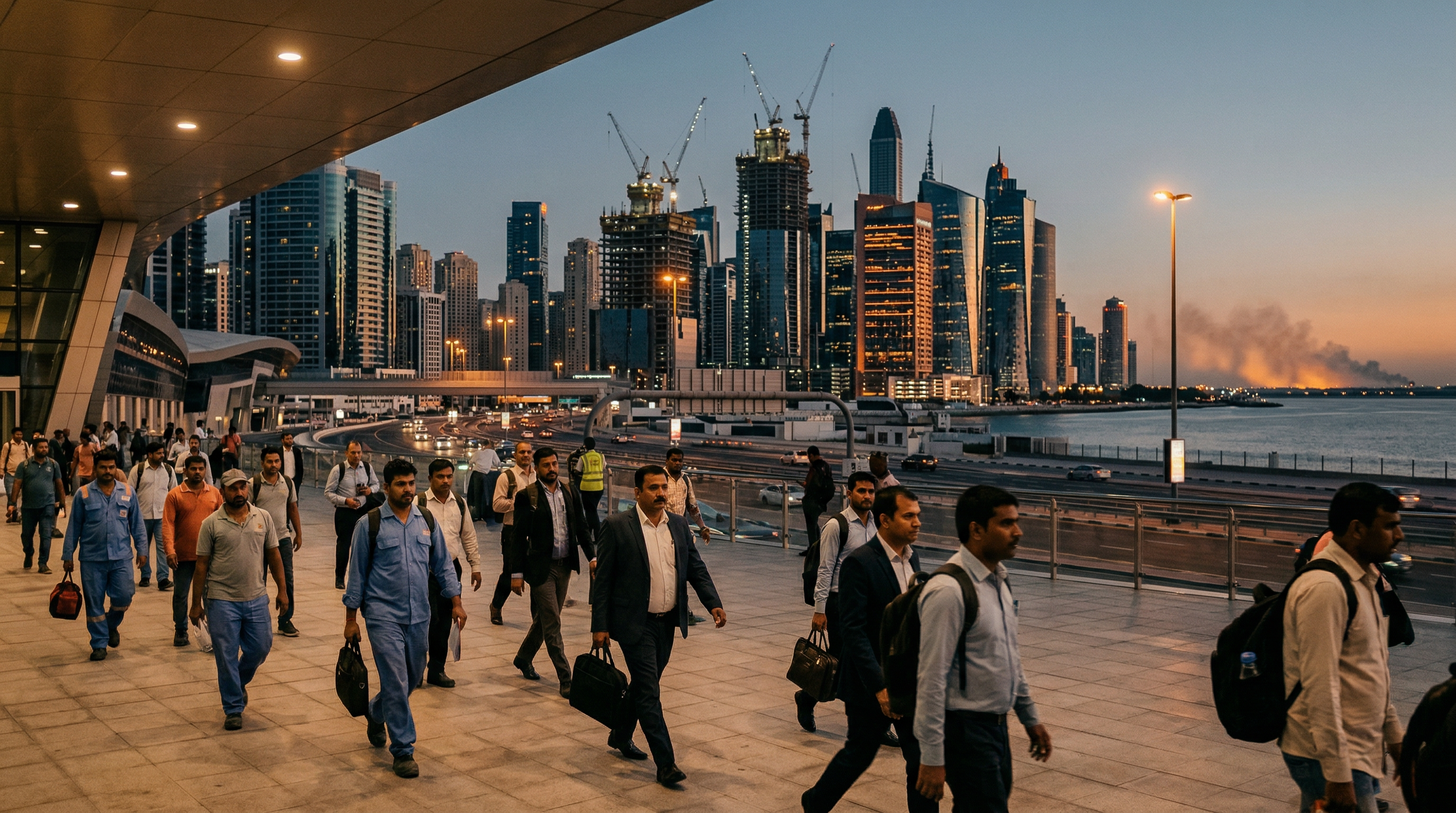
Nine million. That is the number scrolling across every Indian news ticker since Operation Epic Fury lit up the skies over Tehran on February 28. Nine million Indians living and working across the six Gulf Cooperation Council nations -- from construction labourers in Sharjah to software engineers in Doha to surgeons in Riyadh. Nine million reasons for a nation to panic.
And panic it has. The Cabinet Committee on Security convened within hours. The Ministry of External Affairs activated a Special Control Room. IndiGo announced ten relief flights from Saudi Arabia. SpiceJet scrambled additional capacity from the UAE. Air India Express resumed Muscat routes by March 3. Television anchors, never ones to let a crisis pass unmonetised, deployed their gravest tones: What about our people?
The concern is legitimate. The panic, however, is premature.
Here is why -- and here is what India should actually be doing with this moment instead of merely bracing for an evacuation that may never come.
The Calculus Behind the Chaos
Start with what Iran is actually doing, as distinct from what it could do.
Following the coordinated US-Israeli strikes under Operation Epic Fury, Iran's retaliation has been fierce but calibrated. The Islamic Revolutionary Guard Corps has targeted US military assets across the region -- bases in Bahrain, Qatar, Kuwait, and the UAE. Missiles have struck near airports that host American military infrastructure. Drones have been launched in salvos designed to overwhelm rather than devastate.
But look at the pattern more carefully. Iran's stated position is that it is attacking "American soil" on GCC territory -- not GCC nations themselves. The distinction may sound academic when hotel windows are shattering in Dubai and residential buildings in Bahrain are taking collateral damage. It is not. It is the most consequential distinction in the entire conflict.
When Iran conducted its retaliatory strikes against Israel in April 2024, it telegraphed the attack 72 hours in advance through diplomatic back-channels. The goal was to demonstrate capability while avoiding the kind of mass civilian casualties that would trigger an irreversible escalation. The same logic -- messier, bloodier, but structurally identical -- is at work in the Gulf today.
The GCC nations understand this calculus. Several GCC countries, including long-time hosts of US military bases, communicated to Tehran that neither their territory nor their airspace would be used to launch offensive operations against Iran. They were committed to neutrality -- not out of love for Tehran, but out of self-preservation. The UAE did not spend decades building Dubai and Abu Dhabi into global cities to watch them become collateral damage in someone else's war. Qatar did not host a World Cup to see its airports turned into targets. Saudi Arabia's entire Vision 2030 -- the most ambitious economic transformation in Gulf history -- depends on stability.
Does this mean Indian workers are perfectly safe? No. Collateral damage is real. Several hundred missiles and drones have been launched, killing at least four people and injuring over a hundred across the region. Airports in Kuwait and Abu Dhabi have been hit. The Strait of Hormuz is under de facto closure. Commercial flights are disrupted. The situation is dangerous.
But it is not the indiscriminate hellscape that twenty-four-hour news coverage suggests. Iran is fighting within understood boundaries -- not because it is kind, but because it is rational. A multi-front war against the United States, Israel, and the entire GCC would be suicidal, and Tehran's leadership, whatever else they may be, are not suicidal. Iran is a civilisation that has survived millennia by knowing when to fight and when to endure.
India's nine million are not in immediate danger of being targeted. They are in the discomfort zone -- disrupted flights, closed airspace, anxious days. India must plan for contingencies, certainly. But the tone of national discourse should be strategic, not hysterical.
Press for Resolution, Not Neutrality
The most urgent thing India can do right now has nothing to do with evacuation flights. It has to do with the telephone.
India must press all parties -- Washington, Tehran through back-channels, every GCC capital, and the broader international community -- for a quick resolution to this conflict. This is not optional diplomacy. It is existential.
The Iran-US war carries the potential to trigger a global recession if the Strait of Hormuz remains closed for more than a few weeks. Oil has already breached $82 a barrel, with analysts warning it could hit $100. India's $242 billion annual oil import bill -- already grotesque -- will balloon further. But the economic damage extends beyond energy. The Gulf accounts for 17 per cent of India's total exports, 55 per cent of its crude supplies, and a significant share of the record $135 billion in remittances that flowed into India in FY2025.
In the worst case, prolonged hostilities risk drawing in other powers, turning a regional conflagration into something far more dangerous. That scenario is not fantasy. It is the scenario that every foreign ministry in every major capital is gaming right now.
India's voice carries weight. It is the world's most populous democracy, a major energy importer with genuine relationships on both sides, a nation that maintains diplomatic channels with Washington, Tehran, Riyadh, and Abu Dhabi simultaneously. Few countries occupy that position.
Silence was appropriate in the opening hours. But continued silence becomes complicity in prolonged destruction. India should be on the phone to Washington demanding de-escalation, communicating through back-channels with Tehran, and coordinating with every Gulf capital on conflict containment. The world's fifth-largest economy cannot afford to be a spectator in a war that directly threatens its economic vitals and nine million of its citizens.
The Defence Commerce Opening
Now for the part that nobody in Delhi is talking about, but should be.
The United States is facing a shortage of air defence interceptors. This is not speculation -- it is documented reality. Patriot missile stockpiles have fallen so low that Pentagon officials have expressed concern about future US military operations being jeopardised. Lockheed Martin has increased production to 500 PAC-3 MSE interceptors annually and plans to raise output to 650 by 2027, but the consumption rate in the current conflict is outpacing production. A plan to triple output to 2,000 missiles per year exists on paper, but will take years to materialise.
This is a massive opening for India.
India should immediately call every GCC nation -- the UAE, Oman, Qatar, Bahrain, and yes, even Saudi Arabia despite its traditional Pakistan defence ties -- and offer to deploy defensive anti-missile systems on a barter or commercial basis. The offer must be explicitly defensive. No offensive weapons. No mission creep. Air defence systems designed to protect civilian populations and critical infrastructure from the very missiles currently raining down on Gulf cities.
The strategic logic is compelling. India's defence exports grew from $200 million in 2014 to $2.6 billion in 2024 -- a thirteen-fold increase, but still a fraction of what the market can absorb. The BrahMos supersonic cruise missile has already been exported to the Philippines under a $375 million contract, with Vietnam, Indonesia, and Gulf nations expressing interest. The Akash surface-to-air missile system was delivered to Armenia in November 2024 under a $720 million deal. DRDO's broader air defence ecosystem -- including the Akash-NG and the Medium Range Surface-to-Air Missile programme -- is maturing rapidly.
India can offer better quality air defence at competitive prices. It should do so in collaboration with Israel, which has the Iron Dome and David's Sling systems, and with Russia, which supplies the S-400. This is not about ideology. This is about filling a gap that the world's largest defence exporter cannot currently fill -- and getting paid handsomely for doing so.
BrahMos export projections are expected to cross $3 billion by 2026. A Gulf air defence contract cycle, catalysed by this crisis, could accelerate India's trajectory from the world's largest arms importer to a serious arms exporter in a single crisis cycle. The target of Rs 50,000 crore in annual defence exports by 2029 suddenly looks not ambitious but conservative.
The Bigger Picture: A Region in Transformation
Step back from the missiles and the diplomacy for a moment and consider what this conflict reveals about the Gulf's trajectory.
The GCC monarchies are playing safe not because they are weak, but because they are thinking long. The UAE's tolerance agenda is not cosmetic -- non-oil sectors now account for over 77 per cent of the country's real GDP, a remarkable transformation for a petrostate. Saudi Arabia's entertainment sector liberalisation, its women's rights reforms, its massive investment in tourism and technology under Vision 2030 are strategic investments in a post-radical future, even if the kingdom remains constrained by traditional and religious currents that limit the pace of change. Bahrain's interfaith dialogue initiatives, Qatar's cultural infrastructure investments -- these are not public relations exercises. They are bets on a different kind of Middle East.
This war, terrible as it is, may accelerate that trajectory. A weakened theocratic establishment in Iran, an emboldened secular constituency across the region, and the demonstrated bankruptcy of proxy warfare as a strategy could produce the most progressive Gulf in a generation -- if the aftermath is managed correctly.
India, with its nine million citizens embedded in every layer of Gulf society -- from boardrooms to hospital wards to construction sites to university lecture halls -- is not a bystander to this transformation. It is a stakeholder. The remittance flows, the trade corridors, the people-to-people connections, the shared commercial interests -- these are not liabilities to be evacuated. They are assets to be leveraged.
What Delhi Should Actually Do
The prescription is four-fold.
First, press for resolution with the urgency of a nation whose economic arteries are being squeezed. Deploy every diplomatic channel available. India's non-aligned tradition gives it credibility with both sides. Use it.
Second, make the defence commerce call. The Gulf needs air defence systems right now, not in three years when Lockheed's production lines catch up. India has systems ready for export. The conversation should have started yesterday.
Third, prepare contingency evacuation plans -- but do not activate them prematurely. India's track record here is strong. Operation Raahat in 2015 evacuated 4,640 Indians and 960 foreign nationals from Yemen. The Vande Bharat Mission during COVID was one of the largest repatriation exercises in human history. The institutional muscle exists. Deploy it when needed, not when television ratings demand it.
Fourth, think beyond the crisis. India's nine million in the Gulf are positioned at the intersection of the most significant geopolitical and social transformation the region has seen in decades. Delhi should be thinking about how to deepen India's stake in the post-conflict Gulf -- through trade agreements, defence partnerships, educational exchanges, and investment corridors -- not merely about how to get people home.
The nine million question is real. But the answer is not panic. The answer is strategy.
This analysis draws on reporting from CNN, Al Jazeera, CNBC, Business Standard, The Tribune, and the House of Commons Library. India's Ministry of External Affairs Special Control Room for the Gulf crisis can be reached at the numbers published on the MEA website.