By BarathVector Editorial — 2026-02-19
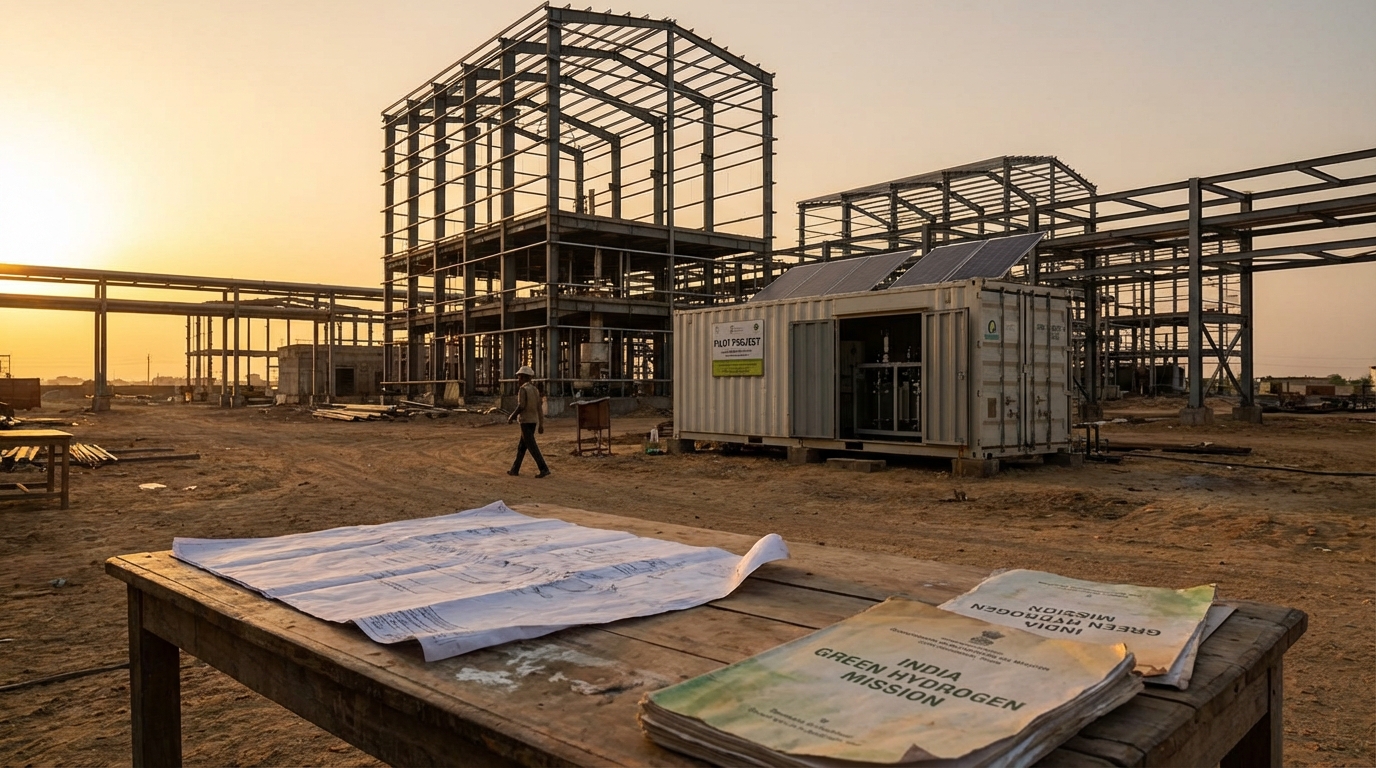
As of August 2025, 94% of India's announced green hydrogen pipeline had not moved beyond the announcement stage. That single statistic is the story of the National Green Hydrogen Mission — not the ambition, which is genuine, but the widening gulf between what India has declared and what it has built.
The Mission, launched in January 2023, targets 5 million metric tonnes per annum (MMTPA) by 2030. Independent assessments now place the realistic outcome at roughly 0.5 MMTPA. India already consumes around 5 MMTPA of grey hydrogen — almost entirely in refineries and fertiliser plants — at $2.30–2.50/kg. Green hydrogen currently costs $3.08–4.40/kg to produce. Closing that gap to the Mission's $1.50–2.00/kg target by 2030 is not impossible. But it requires a functioning policy apparatus. That apparatus has significant gaps.
The European Obstacle Is Real — and Secondary
When Indian industry discusses the hydrogen trade with Europe, the conversation centres on Brussels. The EU's Renewable Fuels of Non-Biological Origin (RFNBO) rules impose three demanding conditions: additionality (new, dedicated renewable capacity per project), temporal correlation (monthly matching until 2029, hourly from 2030), and geographical correlation. As of February 2026, there is no mutual recognition agreement between India's Green Hydrogen Certification Scheme (GHCI) and any EU-recognised certifier. The Carbon Border Adjustment Mechanism will apply to hydrogen-derivative products. An EU-India Task Force on Green Hydrogen is a stated goal, not a concluded framework.
These are genuine barriers. They are not the primary reason India's ambitions are stalling.
The Certification Gap India Created for Itself
The GHCI was launched in April 2025 — twenty-seven months after the Mission itself was announced. This is not a minor sequencing error. Certification is the foundational step for project bankability, offtake agreements, and export credibility. Arriving 27 months late meant that India spent most of the Mission's early period with no auditable proof-of-origin framework in place.
Worse, the scheme that eventually emerged does not mandate hourly matching or strict additionality — the precise criteria the EU requires for RFNBO status. Indian producers who want to sell into Europe now face dual certification: GHCI compliance plus an EU-recognised scheme such as ISCC EU or CertifHy. They bear that cost themselves. Of the 87 Indian standards for green hydrogen that exist on paper, testing laboratories are operational for only six. Standards without testing infrastructure are aspirational documents, not enforceable frameworks.
Electrolyser Capacity, On Paper
The SIGHT Programme has awarded 3,000 megawatts of electrolyser manufacturing capacity to fifteen firms. NITI Aayog's 2030 deployment requirement is 20 gigawatts — meaning India has covered roughly 15% of what it needs, assuming awarded capacity is actually commissioned rather than merely allocated. Core components — polymer membranes, iridium catalysts — remain largely foreign-sourced. Domestic manufacturing depth is shallow.
The Renewables Additionality Problem
India crossed 50% non-fossil installed capacity in June 2025 — a real milestone. It is not, however, what the EU's additionality rule is asking for. That rule requires each green hydrogen project to be powered by newly built, dedicated renewable capacity, not grid access to an increasingly clean system. Electrolyser capacity factors in current Indian models range from 25% to 75%; curtailment risk for grid-connected configurations runs between 25% and 45%. Projects relying on grid electricity rather than captive renewables will not qualify as RFNBOs regardless of how the national grid evolves.
Ports That Cannot Yet Carry the Weight
Kandla, Tuticorin, and Paradip have been designated Green Hydrogen Hubs. Kandla operates a 140 tonne per year pilot and a 750 cubic metre methanol bunkering facility. AM Green and the Port of Rotterdam signed an MoU in May 2025 for up to 1 MMTPA of hydrogen derivatives annually. A transoceanic ammonia supply chain operating at commercial scale requires liquefaction terminals, dedicated berths, cryogenic handling, and compatible shipping fleets. The MoU and the infrastructure are not the same thing. The NTPC Pudimadaka Hydrogen Hub, which broke ground in January 2026 with $21.6 billion invested and a 2.5 MMTPA green chemicals target, is the most serious project on the horizon — and commercial exports are well beyond 2030 on any realistic timeline.
The Mandate That Does Not Exist
The most consequential policy gap is the absence of Hydrogen Purchase Obligations. India's refineries and fertiliser plants consume approximately 5 MMTPA of grey hydrogen annually — replacing it with green would single-handedly meet the 2030 target. The India Hydrogen Alliance called for 10% HPOs for existing plants in May 2025. No such mandate has been issued. Without enforceable domestic offtake, the $80 billion or more in announced investments risks becoming stranded — not because Europe blocked it, but because there was no domestic market to provide the revenue floor that project finance requires. The SECI green ammonia auction of mid-2025, covering 724,000 TPA across thirteen fertiliser plants, is a step forward — voluntary, limited, and not a substitute for a mandate.
What Competitors Understand
Morocco launched its National Hydrogen Strategy in 2021, two years before India's NGHM. Six projects with $32.8 billion in combined investment received firm land allocation and approval in March 2025. Moroccan producers pre-certify through the MED-GEM Network, directly aligned to EU standards from the outset. Chile's Corfo-backed projects are operational, with certification designed around RFNBO alignment rather than retrofitted to it. Australia's Guarantee of Origin scheme was built for international interoperability; several Australian projects have reached Final Investment Decision. These countries began with attainable targets and built upward. India announced an extraordinary number and is working backward from it toward the systems that should have come first.
What India Must Do
January 2026 brought real momentum: the Pudimadaka groundbreaking, Reliance's pilot electrolyser at Jamnagar using Danish Stiesdal technology, and hydrogen diplomacy at Davos with Belgium, Oman, Kuwait, and Jordan. Budget 2026-27 allocated INR 600 crore to the NGHM — set against the INR 19,744 crore total Mission outlay, that figure speaks for itself.
The path is not mysterious. Mandate HPOs for the refinery and fertiliser sectors — even 5% transforms project finance prospects. Align GHCI additionality and temporal correlation to RFNBO criteria, or accept permanent dual-certification costs. Commission testing infrastructure for the 81 standards that exist only on paper. Negotiate bilateral Guarantee of Origin mutual recognition with the EU rather than waiting for a multilateral framework. Ring-fence Pudimadaka from the delays that have consumed similar Indian infrastructure ambitions before it.
India has the renewables, the engineering talent, and the industrial base. The question is whether the policy architecture will be built honestly enough to match the ambition. Ninety-four percent stranded is not a Brussels problem. It is a New Delhi problem, and it is fixable.