By BarathVector Editorial — 2026-05-27
Neighbourhood Deep: India Must Learn to Work With Governments It Did Not Choose
On December 31, 2025, Subrahmanyam Jaishankar walked across a waiting room in Dhaka's parliament building and shook hands with Pakistan's National Assembly Speaker Ayaz Sadiq. Both men were there to attend the funeral of Khaleda Zia, Bangladesh's former prime minister. The handshake lasted seconds. It dominated South Asian commentary for days.
The symbolism was unmistakable — and it arrived in a neighbourhood that India had, for years, treated as a managed space of loyal incumbents and predictable governments. Khaleda Zia's funeral, attended by the very leader whose ouster New Delhi had once cheered, in a city where India's standing had cratered over the previous eighteen months, was not the neighbourhood India had planned for. It was the neighbourhood it got.
That gap — between the neighbourhood India plans for and the one it must actually operate in — is the central problem with Neighbourhood First in 2026.
The Doctrine and Its Flaw
Neighbourhood First was announced with genuine ambition in 2014. The idea was straightforward: India cannot be a global power if its immediate periphery is unstable, resentful, or increasingly Chinese. Prioritise the neighbours. Show up. Build connectivity. Deliver on promises that previous governments had let drift.
The instinct was right. The execution calcified into something narrower. Over a decade, Neighbourhood First became, in practice, incumbent-first — a doctrine that prioritised specific leaders over the societies those leaders governed. Sheikh Hasina in Dhaka. Whichever Kathmandu coalition happened to be friendly. Mohamed Muizzu's predecessors in Malé before he pivoted toward Beijing. The relationships were maintained through the person in office, not through the deeper tissue of trade, transit, people-to-people movement, and institutional trust that would survive any particular government's exit.
The flaw became visible when the incumbents fell. Hasina was ousted in August 2024 following a student-led uprising that killed over a thousand people. India's historically close relationship with the Awami League — and the perception that New Delhi had enabled her government's increasingly autocratic tendencies — became a liability in precisely the moment India most needed goodwill in Dhaka. For eighteen months, an unelected interim government under Muhammad Yunus governed Bangladesh while New Delhi recalibrated, visa services were disrupted, and Hasina's extradition became a standing demand from a country India could not afford to alienate.
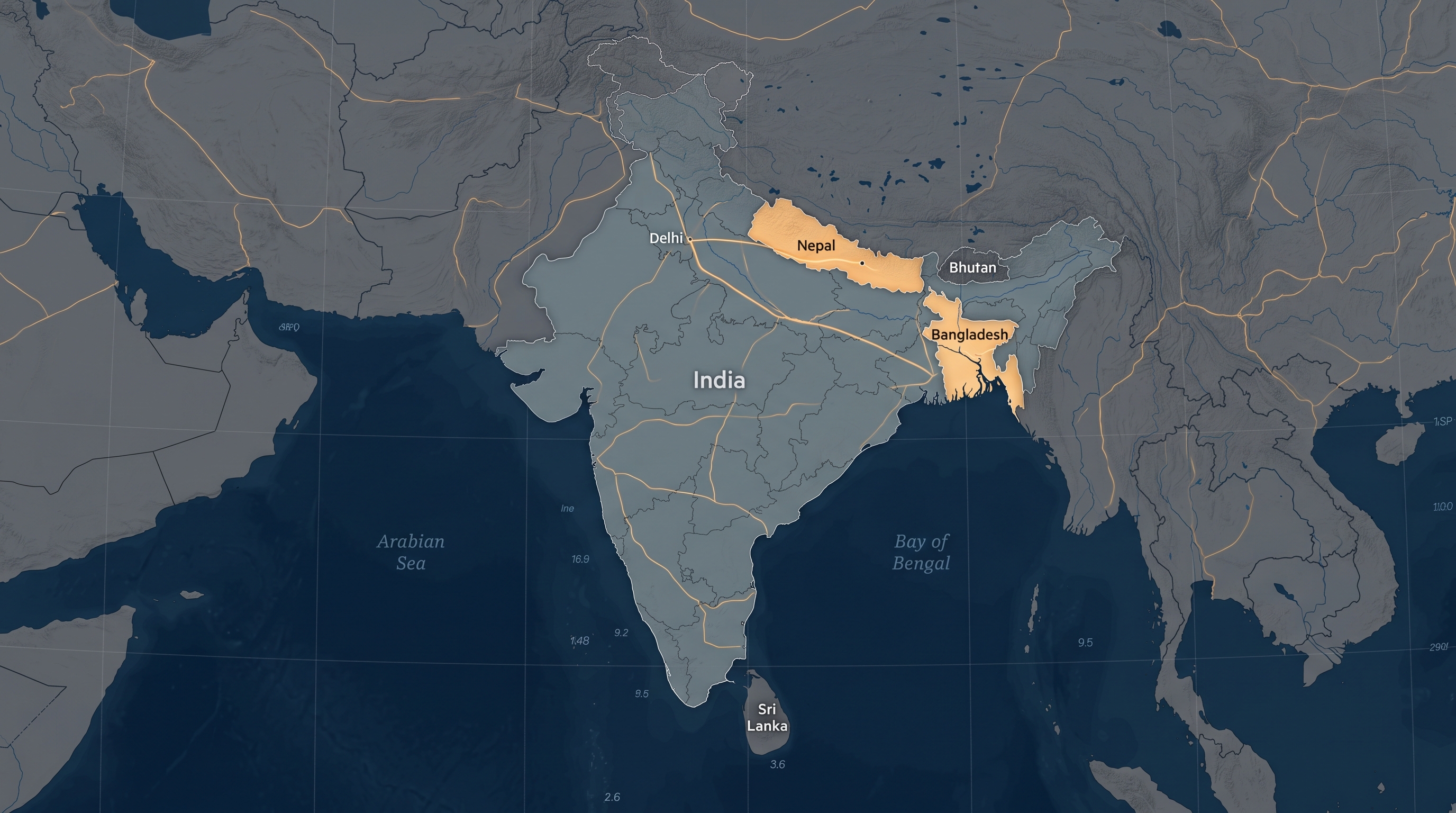
Then, on February 12, 2026, Bangladeshis voted — and gave the Bangladesh Nationalist Party, led by Tarique Rahman returning from exile in London, a commanding majority. The BNP's historical relationship with India is complicated, to put it charitably. As Chatham House noted in February 2026, the reset India wants will be easier said than done. New Delhi is now attempting to build a working relationship with a government whose instincts are not naturally pro-India and whose voter base spent eighteen months blaming India for Hasina's excesses.
Nepal's version of the same story arrived on March 5, 2026. Youth protests had toppled KP Sharma Oli's government in September 2025. Early elections handed an unprecedented two-thirds majority to the Rastriya Swatantra Party — a political newcomer led by Balen Shah, a 35-year-old structural engineer and former Kathmandu mayor. Shah, as mayor, had displayed a "Greater Nepal" map in his office claiming territories that include Kalapani and Lipulekh — areas India administers and Nepal contests. He beat Oli in Oli's own constituency. India now faces a generational reset in Kathmandu with a leader who campaigned on renegotiating the 1950 Treaty of Peace and Friendship and who carries a popular mandate that New Delhi cannot ignore.
Both resets, in short, involve governments India did not choose, did not cultivate, and now must engage on terms those governments — not India — will largely set.
The Chinese Dimension
China did not make these governments. But China has positioned itself to benefit from every moment of Indian discomfort in the neighbourhood — and does so with the patience of a state that operates on decade-long timelines.
Beijing's Belt and Road courtship of Kathmandu predates the current government. It will outlast it. The Teesta River Management Project — which India had long promised to fund — remains incomplete, and China has formally bid to take it over. BRI infrastructure proposals continue to circulate in Kathmandu's political economy regardless of which coalition holds office. With a new government that ran explicitly on sovereignty and equal treatment from larger neighbours, the Chinese offer of loans-without-conditions carries a different kind of appeal than it did under governments more dependent on Indian goodwill.
In Dhaka, the calculation is similar. The Rahman government inherits a country with significant Chinese investment, a 1996 Ganga water treaty expiring in December 2026 that will require difficult negotiations with India, and a domestic political base that has no particular reason to give New Delhi the benefit of the doubt. Beijing, which backed both the Hasina government and the interim period without major disruption, is better placed for continuity than India is.
The pattern — Indian relationship-building that depends on specific incumbents, Chinese infrastructure and loan offerings that survive any particular government — is not an accident. It is the structural consequence of India substituting personal diplomacy for deep engagement. As Gateway House's 2026 foreign policy outlook observed, India's neighbourhood challenges in this cycle stem partly from an over-reliance on bilateral leader relationships at the expense of institutional depth.
This is also the argument made in more detail in our earlier analysis of India's compartmentalised China policy: the question of whether India can use its regional engagements to peel neighbours away from Beijing's gravity will ultimately be answered not by diplomatic signals but by the depth of connectivity India has actually built.
What Reset Actually Requires
A genuine reset cannot be managed from Jaishankar's travel schedule alone. Three things need to change.
First, accept that every neighbour will have governments India did not pick. Indian foreign policy machinery rewards relationship-building with incumbents — state visits, infrastructure MOUs, bilateral announcements ahead of elections. It needs a parallel function: maintaining working relationships with opposition parties, civil society, and business communities in neighbouring countries, so that when governments change, India is not starting from zero. New Delhi congratulated Balen Shah promptly and signalled warmth toward his India visit invitation. That is a start. It is not a system.
Second, build connectivity that cannot be reversed by a change of government. The Bangladesh-India Friendship Pipeline — supplying around 180,000 tonnes of diesel annually from the Numaligarh refinery — kept flowing through the Yunus interim period and into the Rahman government. Energy infrastructure is stickier than diplomatic communiqués. The Teesta project, had India completed it, would have been similarly sticky. The standard for neighbourhood investment needs to be: would this survive a hostile government in Dhaka or Kathmandu? If not, it is goodwill spending, not strategic infrastructure.
Third, engage the South Asian citizen, not just the South Asian state. Indian soft power in the neighbourhood — Bollywood, cricket, language, cultural familiarity — is substantial and systematically underused. Young Bangladeshis who grew up watching Indian television did not suddenly stop watching after Hasina fell. Young Nepalis who travel to India for education and health care have material interests in the relationship that no government can entirely override. The connectivity agenda that Neighbourhood First always promised — road, rail, power, digital — generates the kind of people-to-people economic stake that makes relationships resilient. The agenda exists on paper. The execution has been uneven, conditional, and too often held hostage to political temperature.
The Funeral in Dhaka
Return for a moment to the waiting room in Dhaka's parliament building. Jaishankar's handshake with Pakistan's National Assembly Speaker was remarkable for what it revealed about the neighbourhood India now inhabits. A funeral that gathered India, Pakistan, and the full South Asian diplomatic community in the same room in a city that eighteen months earlier had been posting "India go home" graffiti is a neighbourhood in genuine flux. It is also a neighbourhood where India has, arguably, more structural interests at stake than any other external power.
The structural interests are not served by mourning the loss of friendly incumbents. They are served by building the kind of depth — in trade, transit, energy, education, institutional links — that survives the loss of friendly incumbents. That is the transition from Neighbourhood First to something more durable: Neighbourhood Deep.
The doctrine does not need to be retired. It needs to grow up. The neighbours will keep having elections. Some of those elections will produce governments that New Delhi finds uncomfortable. The question India needs to answer — before the next Dhaka funeral, not after — is whether its relationships in the neighbourhood are deep enough to survive that discomfort intact.
At the moment, the honest answer is: not yet.
BarathVector covers India's strategic affairs with the conviction that honest analysis serves the national interest better than comfortable consensus.