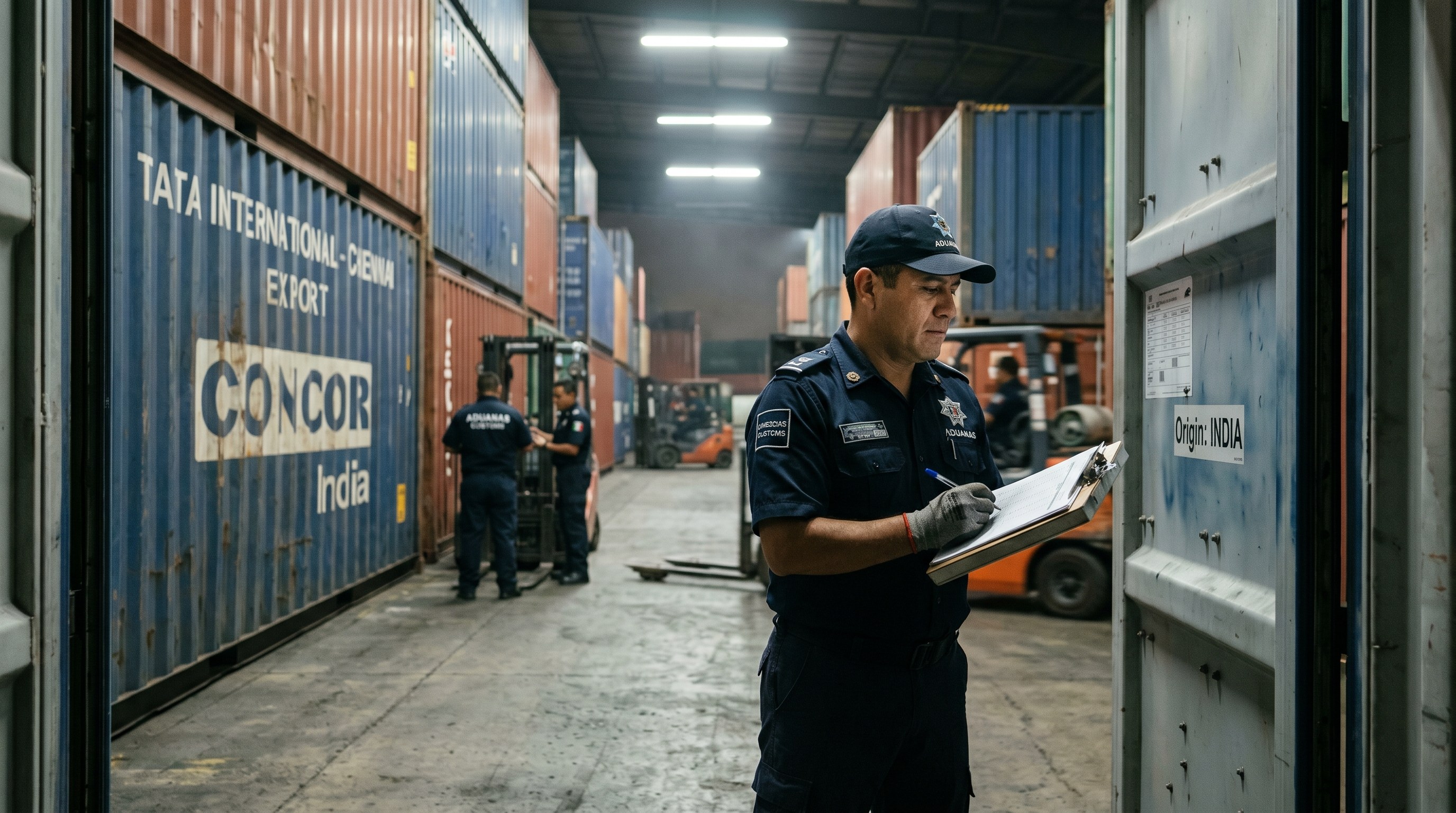
By Ramachandran Rajeev Kumar — 2026-05-01
Mexico's Tariffs on India: The Hit Indian Press Forgot to Cover
The story is six pages of customs schedules. The cost runs into hundreds of millions of dollars.
In early February 2026, while Indian commentary was consumed with the Trump trade deal, the Mexican government published a customs decree raising import tariffs on a range of products from countries with which Mexico does not have a free-trade agreement. India was prominently named.
The decree did not make the front pages in Delhi. It barely made the financial pages. Al Jazeera ran the story at length. The Mexican specialised trade press ran it. The Indian press, looking elsewhere, mostly missed it.
That is a problem. Because the Mexican tariffs are not a footnote. They are the second hit in a one-two combination, and Indian exporters are still adding up the bruises.
What Mexico did
The Mexican decree raised duties across roughly five hundred product categories. The largest tariff increases — in the 25 to 50 percent range — landed on:
- Textiles and apparel — finished garments, cotton fabric, synthetic fibres
- Steel and steel products — including hot-rolled coil, rebar, and certain structural shapes
- Footwear — across most leather and synthetic categories
- Chemicals — particularly intermediate organic chemicals and pharmaceutical inputs
- Plastics and plastic articles
India is a major exporter to Mexico in nearly every one of these lines. By Mexican customs data, India ranked among Mexico's top ten import sources in textiles and chemicals before the decree. After the decree, the Indian market share is forecast to drop sharply as Mexican importers either substitute toward FTA partners or absorb the cost and pass it on.
Why Mexico did it
Two reasons. The first is domestic. Mexican manufacturers, particularly in textiles and steel, have been losing share for years to Asian imports — Chinese, Indian, Vietnamese, Bangladeshi. Mexican unions and industry associations have been lobbying loudly for protection. The decree is, in part, the Sheinbaum government's response to that domestic pressure.
The second reason is strategic, and this is the part that affects India directly. Mexico is the United States' most important manufacturing partner under the USMCA agreement. The Trump administration has been pushing Mexico hard to align its external trade posture with US policy — particularly on Chinese imports, but also more broadly on transhipment of Asian goods that enter the US market through Mexican processing.
The Mexican decree is, in this reading, a partial alignment move. By raising tariffs on India, Vietnam, China, and others, Mexico is signalling to Washington that it will not be a back door for Asian goods to enter the North American market. India happens to be in the basket because India happens to be a significant exporter in the relevant categories.
The compounding hit
This is where the Indian press underplayed the story. The Mexican tariffs do not stand alone. They compound with several other trade pressures hitting Indian exporters simultaneously:
- The 18 percent US tariff under the February 2026 framework
- The CBAM costs on steel and related categories entering the EU from January 2026
- The Mexican tariffs on textiles, steel, footwear, and chemicals
- A general slowdown in EU demand that has nothing to do with India but that lands in the same export ledger
Indian exporters are now navigating four simultaneous pressures across their three largest market regions. None of the four is catastrophic on its own. The combination is.
Indian textile industry associations have been quietly running the math: a typical mid-sized Indian apparel exporter that ships to the US, the EU, and Mexico now faces a cost stack of 18 percent on the US lane, 8 to 12 percent on certain CBAM-adjacent EU products, and 25 to 35 percent on the Mexican lane. The exporter that was operating on 12 to 18 percent gross margins last year is now operating below cost on at least one of the three lanes.
That is what the headline numbers do not capture. The exporter does not get to choose which tariff to pay. The exporter pays all of them, on different shipments, across the same fiscal quarter.
What India can actually do
The Indian government's response options are narrower than they would be in a single-country trade dispute:
- WTO challenge against Mexico — possible but slow; the Mexican decree was crafted within WTO-permissible bounds, and a challenge would take years
- Bilateral pressure — India and Mexico have a workable diplomatic relationship but no FTA, which limits Delhi's pressure points
- Trade diversification toward Latin America more broadly — Brazil, Argentina, Chile have all expressed interest in deeper Indian trade ties; this is a multi-year project, not a quarterly fix
- Production cost reduction at home — the cleanest medium-term answer; Indian textile and steel costs are higher than they need to be, and the tariff pressure is forcing the conversation
The realistic answer is a combination: file the WTO challenge for the record, push diplomatically through specific Mexican trade ministry channels, accelerate the Latin America diversification, and use the cost pressure to force domestic productivity investment that should have happened anyway.
The press question
The deeper question is why the Indian press did not cover this aggressively in February.
Part of the answer is bandwidth. The Trump trade framework dominated the news cycle for weeks, and the Mexican decree appeared in the same window. Part of the answer is geographic distance — Mexico does not feature in Indian foreign-affairs coverage with anything like the regularity of the United States, the European Union, China, or West Asia.
But part of the answer is a structural blind spot. Indian financial journalism is excellent on the bilateral US story and decent on the bilateral EU story. It is much weaker on the secondary tariff effects in Latin America, Africa, and Southeast Asia — precisely the markets where Indian exporters increasingly diversify when the primary markets get expensive.
The Mexican story is the canary. If Brazil follows suit, or if Argentina raises tariffs in solidarity with Mexico's manufacturing constituencies, the Indian export ledger gets noticeably worse. That second-order risk is what Indian commentary should be tracking, and largely is not.
This is the gap. We can close it.
BarathVector covers Indian trade exposure across all major and secondary markets. Subscribe for the weekly briefing.