By Ramachandran Rajeev Kumar — 2025-12-27
Knowledge City: Tamil Nadu's Audacious Bid to Become the Global South's Education Capital
When will India stop sending its brightest minds abroad and start attracting the world's best to its shores?
The Vision
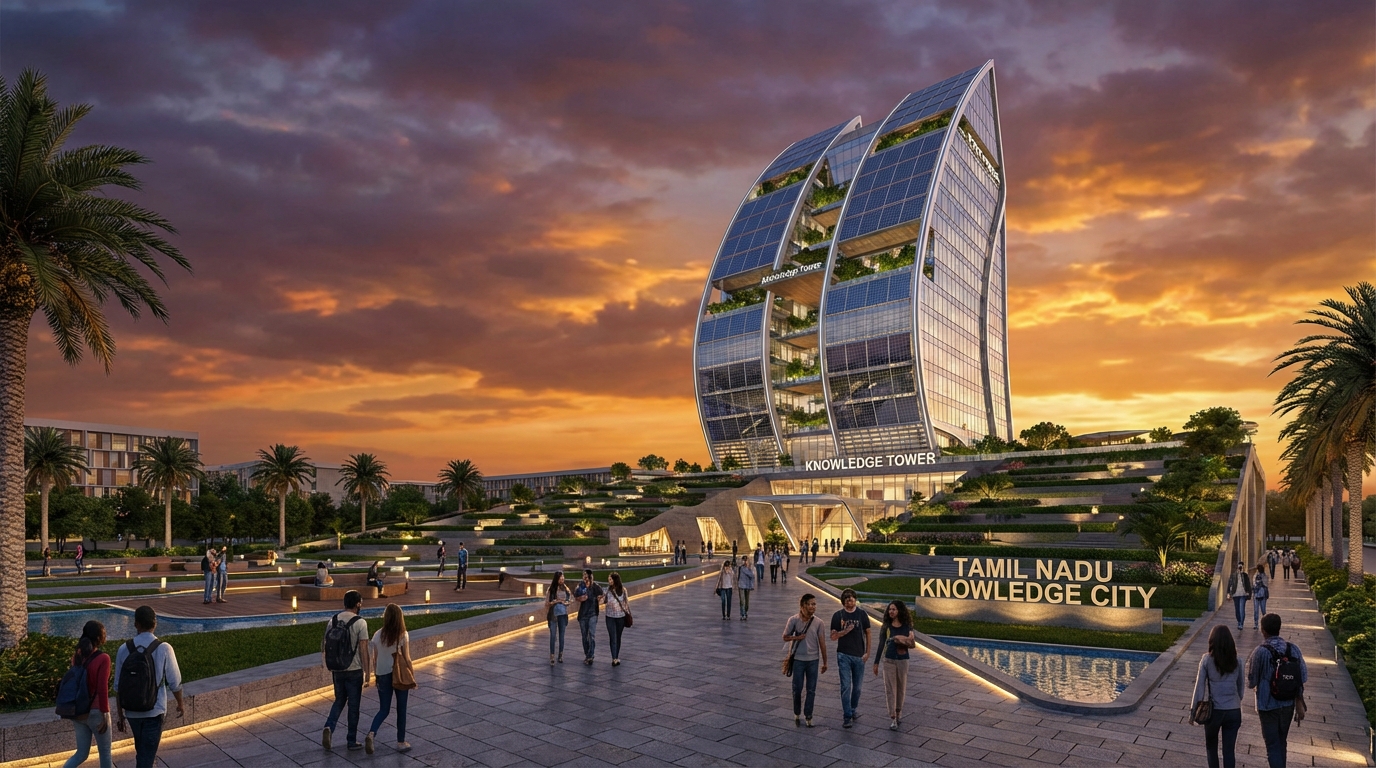
Somewhere on the outskirts of Chennai, earth-movers are preparing the ground for what could be India's most ambitious education project since the establishment of the IITs. Knowledge City, an 870-acre purpose-built education, research, and innovation district managed by the Tamil Nadu Industrial Development Corporation (TIDCO), aims to do something no Indian state has successfully done before: create a world-class hub that international universities and research institutions actively want to be part of.
The scale is staggering. With 55% of the land dedicated to universities and research facilities, Knowledge City is designed to rival global education cities like Singapore's one-north or Dubai Knowledge Park - but at a scale unmatched anywhere in India.
The timing isn't accidental. With the India Global Education Summit scheduled for January 2026, the Tamil Nadu government is positioning this project as the centrepiece of its internationalisation strategy. The summit, organised by the National Indian Students and Alumni Union (NISAU) UK, is expected to bring together education institutions, investors, and policymakers from across the globe.
But can bureaucratic India really compete with Singapore's one-north, Dubai Knowledge Park, or Qatar's Education City? That's the ₹10,000 crore question.
What Is Knowledge City?
Unlike scattered education zones that many Indian states have attempted, Knowledge City is designed as a full ecosystem - not just a campus. The master plan includes:
International Branch Campuses: Dedicated plots for global universities to establish full-fledged campuses, research labs, or joint degree programmes with Indian partners.
R&D and Innovation Hubs: Purpose-built facilities for industry-academia collaboration, startup incubators, and corporate research centres.
The Knowledge Tower: A plug-and-play facility offering ready-to-use spaces for global institutions wanting to test the Indian market before committing to full campuses.
Student Housing and Residential Zones: On-site accommodation solving one of the biggest logistical challenges for international education hubs.
Retail, Hospitality, and Sports Complexes: Creating a live-work-learn environment rather than a sterile academic precinct.
The location is strategic: minutes from Chennai International Airport, adjacent to the city's IT corridor and industrial clusters. This co-location with technology, engineering, healthcare, and advanced manufacturing sectors is designed to create natural industry-academia synergy from day one.
Why Tamil Nadu?
The choice of Tamil Nadu isn't merely political convenience. The state has structural advantages that no other Indian state can match:
#1 in India for Higher Education: Tamil Nadu leads the country with a Gross Enrollment Ratio of 51% - the highest in India - and hosts over 3,588 higher education institutions.
Industrial Depth: With 130+ Fortune 500 companies and deep ecosystems in automotive, electronics, healthcare, and pharmaceuticals, the state offers natural industry-academia collaboration pathways.
Global Connectivity: Chennai's 400+ daily flights make it one of India's most connected cities - critical for international faculty, students, and partnerships.
Urbanisation and Talent: At 48% urbanisation with a young, skilled, English-proficient workforce, Tamil Nadu has the absorptive capacity for international-grade education.
Policy Continuity: Unlike some states where political transitions disrupt projects, Tamil Nadu's investment in education has been bipartisan for decades.
Diaspora Connection: NISAU UK's involvement brings the Tamil diaspora into the equation - a community with significant wealth, professional networks, and emotional connection to the region.
The Competition India Has Ignored
While India has debated education policy in committee rooms, its neighbours have built:
Singapore's one-north: A 200-hectare development that has attracted MIT, INSEAD, and Duke-NUS. Today, it's a global benchmark for biomedical research and technology innovation.
Dubai Knowledge Park: Established in 2003, it now hosts over 500 education and training providers, including branches of University of Wollongong, Heriot-Watt, and Amity.
Qatar Education City: Home to branch campuses of Northwestern, Georgetown, Carnegie Mellon, and Texas A&M. Qatar's oil wealth funded the facilities; international brands brought the prestige.
Malaysia's EduCity: Attracting Newcastle, Southampton, and Raffles institutions to Johor.
India, with its massive student population and hunger for quality education, has no equivalent. Every year, hundreds of thousands of Indian students spend billions of dollars abroad - money that could have stayed home if credible options existed.
The NISAU Factor
The National Indian Students and Alumni Union might seem an unlikely catalyst for a government infrastructure project. But NISAU represents exactly what Knowledge City needs: a bridge between Indian ambition and international credibility.
NISAU's network includes:
- Over 200,000 Indian alumni of UK universities
- Established relationships with UK universities seeking international expansion
- Understanding of what international institutions need to feel comfortable in India
The India Global Education Summit (28-29 January 2026) is designed to be more than a conference. It's a marketplace - bringing potential partners to Chennai, showing them the vision, and letting TIDCO pitch directly.
The expected attendance of Tamil Nadu's Chief Minister signals the political seriousness. In India, nothing moves faster than a project with CM-level visibility.
What Could Go Wrong
Let's be honest about the risks:
Regulatory Uncertainty: India's foreign university framework remains unclear. The UGC's various regulations have created a patchwork that deters many institutions. Without clear, stable rules, Knowledge City could become another real estate project with an education label.
Execution Gaps: Indian infrastructure projects are notorious for cost overruns and delays. A project that looks like a construction site for years loses its appeal to international partners.
Quality Control: If the bar is set too low to fill spaces, Knowledge City could become home to second-tier institutions that damage the brand.
Local Resistance: Educational exclusivity sometimes faces backlash. Tamil Nadu's proud vernacular tradition could clash with English-medium international institutions.
Competition from Existing Hubs: Why would a UK university choose Chennai over Dubai, which has a two-decade head start, zero taxes, and proven track record?
The Opportunity
Despite the risks, the timing is arguably right:
Post-Covid Recalibration: International universities learned during the pandemic that over-reliance on Chinese students is risky. India, with its massive English-speaking population, is the obvious diversification play.
Geopolitical Realignment: Western institutions are actively seeking alternatives to China. India's democratic credentials and alignment with Western interests make it attractive.
Domestic Demand: India's middle class wants international exposure but can't always afford full overseas study. Hybrid models - Indian campus, international degree - could be hugely popular.
Government Push: The National Education Policy 2020 explicitly encourages foreign university branch campuses. Tamil Nadu is simply moving faster than other states.
The Bottom Line
Knowledge City is either a visionary project that positions Tamil Nadu as India's education gateway - or it's another grandiose plan that will be remembered mainly for its foundation stone.
The difference will come down to execution. Can TIDCO deliver world-class infrastructure on schedule? Can the Tamil Nadu government provide genuine regulatory clarity? Can NISAU deliver the international partnerships it's promising?
January 2026 will be the first real test. If the India Global Education Summit can announce even two or three serious institutional commitments - not MoUs for further discussion, but actual investment decisions - it will signal that Knowledge City is more than brochureware.
For India, the stakes are larger than one project. Every year, the country exports over 750,000 students and billions of dollars to foreign universities. A successful Knowledge City wouldn't just help Tamil Nadu - it would prove that India can finally compete for global education investment.
The foundations are being laid. Now comes the hard part.
India's education sector stands at a crossroads. Projects like Knowledge City will determine whether the next generation studies the world - or whether the world comes to study in India.