By Ramachandran Rajeev Kumar — 2025-12-30
Khalida Zia (1945-2025): The End of Bangladesh's Iron Lady
By Ramachandran Rajeev Kumar
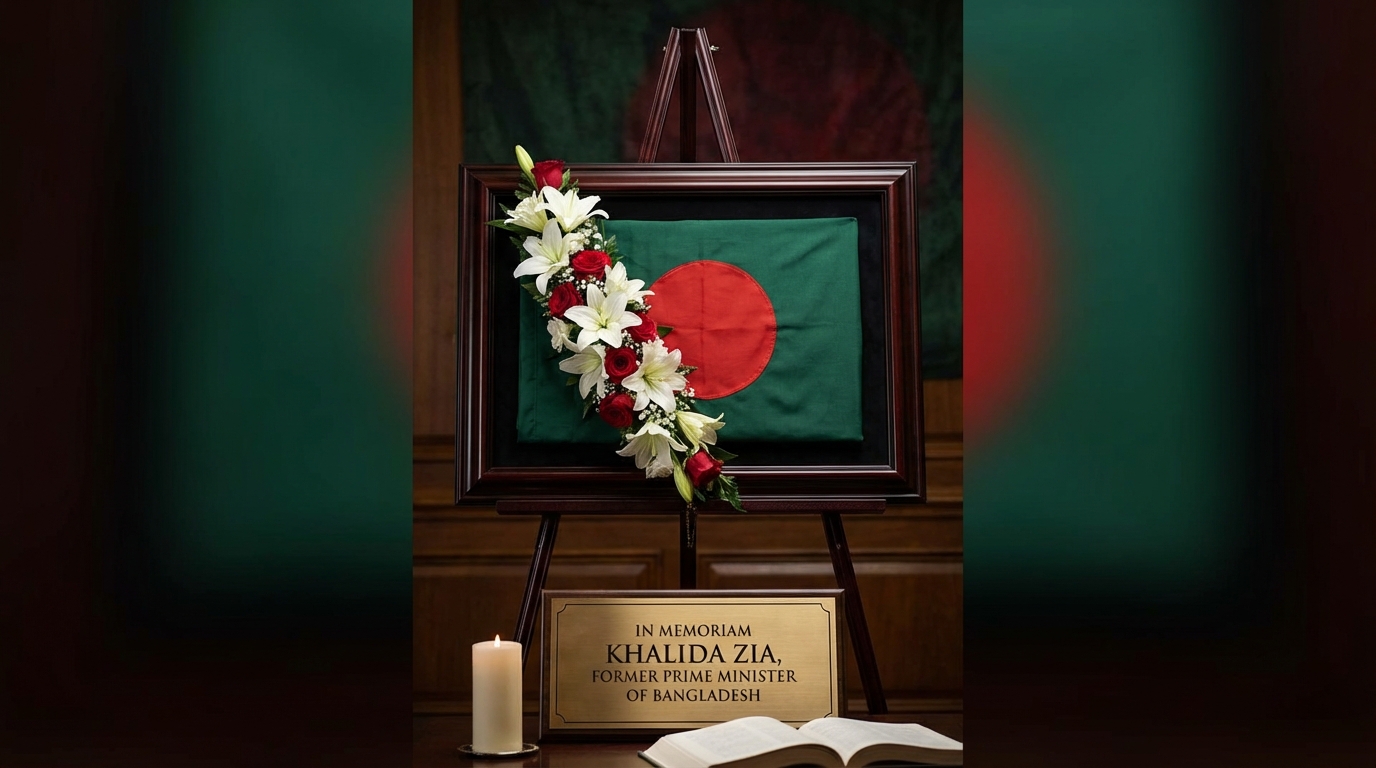
Begum Khalida Zia died at 6 a.m. on December 30, 2025, at Evercare Hospital in Dhaka. She was 80 years old.
With her passing ends not just a political career spanning four decades, but an era. For thirty years, Bangladeshi politics was defined by the bitter rivalry between two women: Khalida Zia of the Bangladesh Nationalist Party (BNP) and Sheikh Hasina of the Awami League. The "battling begums," as the world called them.
Now one is dead. The other is in exile, sentenced to death in absentia.
Bangladesh enters 2026 with both the women who dominated its modern history removed from the stage.
From Widow to Prime Minister
Khalida Zia's political career began with tragedy.
In 1981, her husband, President Ziaur Rahman, was assassinated in a failed military coup. Zia had led Bangladesh through turbulent times, founding the BNP and attempting to build a moderate political alternative to the Awami League's secularism.
His widow, Khalida, had no political experience. She was a homemaker who had spent years as First Lady, not as a politician.
But Bangladesh in the 1980s was ruled by General Hussain Muhammad Ershad, and opposition required a rallying figure. The BNP needed a leader who could inherit Zia's legacy. Khalida stepped into the void.
She joined the BNP as an ordinary member in January 1982. By August 1984, she was chairperson.
What followed was nearly a decade of resistance against Ershad's military rule. Khalida was detained seven times. She led street protests, survived house arrests, and refused to compromise with the autocratic government.
In 1990, in an ironic twist of history, Khalida and Sheikh Hasina joined forces. The two women, whose families had been on opposite sides of Bangladesh's founding conflicts, united to bring down Ershad. Their "Dhaka Siege" program in November 1990 forced the general to resign.
Democracy returned. And with it, the rivalry that would consume both women for the rest of their lives.
The Battling Begums
In 1991, Bangladesh held its first free election. Khalida Zia won, becoming the first female Prime Minister in Bangladesh's history and only the second in the Muslim world after Benazir Bhutto.
Sheikh Hasina became Leader of the Opposition.
Thus began a pattern that would repeat for three decades: one in power, one in opposition, neither willing to accept the other's legitimacy.
The pattern was brutal:
- When Khalida was PM (1991-1996), Hasina led street protests and boycotts
- When Hasina was PM (1996-2001), Khalida led street protests and boycotts
- When Khalida returned (2001-2006), Hasina accused her of corruption and terrorism
- When Hasina dominated (2009-2024), Khalida was convicted, imprisoned, and silenced
The rivalry was personal. Khalida's husband had been a rival of Sheikh Mujibur Rahman, Hasina's father. The founding father of Bangladesh was assassinated in 1975; Zia was accused of benefiting from the aftermath. The wounds ran generational deep.
The two women spoke to each other only through intermediaries. They attended the same events but occupied different spaces. Even their body language radiated contempt.
But they also needed each other.
Each defined herself against the other. Khalida was not-Hasina: conservative where Hasina was secular, Pakistan-friendly where Hasina was India-aligned, nationalist where Hasina claimed Mujib's liberation legacy.
Without the other, neither's political identity made complete sense.
The Corruption Convictions
Khalida's second term (2001-2006) was marred by accusations of corruption and, more seriously, allegations of complicity in political violence.
In 2004, a grenade attack on an Awami League rally killed over 20 people and wounded hundreds. Sheikh Hasina narrowly survived. Years later, Khalida's son, Tarique Rahman, was convicted in absentia and sentenced to life imprisonment for the attack.
After 2007, when an army-backed caretaker government took over, both Khalida and Hasina were briefly jailed on corruption charges. But Hasina returned to win the 2009 election. Khalida never recovered.
In 2018, Khalida was convicted of embezzling charitable funds and sentenced to 17 years in prison. Her supporters called it political persecution. Her critics called it justice delayed.
She remained under house arrest, her health deteriorating, her party fractured, her sons in exile.
The Final Release
In August 2024, everything changed.
Mass student protests against Sheikh Hasina's government spiraled out of control. Hasina's security forces killed hundreds. The army withdrew support. On August 5, 2024, Sheikh Hasina fled to India.
Within hours, Khalida Zia was released from house arrest.
The moment was bittersweet. Khalida was 79, frail, suffering from advanced cirrhosis, diabetes, and heart problems. She could barely walk. The woman who had once led millions in street protests emerged in a wheelchair.
She had outlasted her rival. But she was too ill to savor the victory.
Muhammad Yunus, the Nobel laureate economist, was appointed to lead an interim government. Khalida's BNP, though the largest opposition party, was not given power. The country was to be run by technocrats until elections could be held.
Khalida spent her final months watching from the sidelines as Bangladesh grappled with its future.
What She Leaves Behind
Khalida Zia's legacy is contested.
Her supporters remember:
- The woman who stood against military dictatorship
- The first female Prime Minister who proved women could lead in a Muslim-majority nation
- The leader who never bent to Hasina's dominance
Her critics remember:
- The corruption that marked her governments
- The alliance with Jamaat-e-Islami, including figures accused of war crimes during the 1971 Liberation War
- The political violence that scarred her era
Both views contain truth. Khalida was neither saint nor villain. She was a politician who played by the brutal rules of Bangladeshi politics, and those rules destroyed both her and her rival.
What Her Death Means for Bangladesh
Khalida's death comes at a precarious moment.
Bangladesh is being run by an unelected interim government. Sheikh Hasina is in exile in India, still commanding Awami League loyalists from abroad. The BNP, though finally free of persecution, lacks a clear leader.
The immediate question: Who leads the BNP now?
Khalida's son, Tarique Rahman, has been the de facto leader from exile in London. He remains convicted of the 2004 grenade attack and other charges. Whether he can return and contest elections depends on the interim government's willingness to clear his legal path.
The longer question: Can Bangladesh escape the "battling begums" pattern?
For thirty years, every election was a referendum on Khalida vs. Hasina. Every government was defined by which begum was in and which was out. The country's institutions, its judiciary, its election commission, its security forces, all were bent to serve this rivalry.
With Khalida dead and Hasina exiled, Bangladesh has an opportunity to build something different. Whether it will take that opportunity is uncertain.
What Her Death Means for India
For India, Khalida's death is a complicated moment.
The BNP has historically been less friendly to India than the Awami League. Khalida's governments were seen as closer to Pakistan and more tolerant of Islamist forces that India views with suspicion.
But the current situation is worse than any BNP government.
India-Bangladesh relations in 2025 have been described as at their lowest point in decades. The Yunus interim government has publicly criticized India for sheltering Sheikh Hasina. India has expressed concerns about attacks on Hindu minorities in Bangladesh. The two countries' diplomats have been summoned repeatedly.
Khalida's death doesn't change this dynamic directly. But it may accelerate Bangladesh's political timeline. Elections cannot be delayed indefinitely. When they come, India will face a Bangladesh whose political landscape has been fundamentally reshaped.
The "India-friendly" Awami League is in exile. The BNP, if it wins, will bring leaders less sympathetic to Indian interests. And lurking behind both is the question of Islamist parties and their role in any future government.
PM Modi's condolence message was appropriately diplomatic. But the subtext is concern: Bangladesh is unstable, its politics are in flux, and India's leverage has never been weaker.
The Final Chapter
Three days of state mourning have been declared. Khalida will be buried beside her husband, Ziaur Rahman, whose assassination launched her political career four decades ago.
The funeral prayers will be held in front of Parliament, the building where she once commanded majorities and later watched her rivals dismantle everything she built.
Her rival, Sheikh Hasina, is reported to be in India, monitoring events from exile. The woman who defeated Khalida again and again, who imprisoned her, who seemed to have won permanently, now watches from afar as her nemesis receives a state funeral.
The battling begums dominated Bangladesh for thirty years. Neither won. Both lost everything.
Khalida lost her freedom, her health, her chance to see her sons, and finally her life.
Hasina lost her power, her country, her legacy, and faces a death sentence if she returns.
Bangladesh lost decades that could have been spent building institutions instead of destroying them in the service of a rivalry that consumed everything it touched.
The Lesson
The tragedy of the battling begums is not that one was right and one was wrong. It's that both were willing to burn the country down rather than share it.
Every boycott, every street protest, every election rigged or stolen, every opponent jailed or exiled, it all served the rivalry. Bangladesh's democracy was a casualty of two egos that could not coexist.
Now both are gone from the stage. One to the grave, one to exile.
The question for Bangladesh is whether it can build something better, or whether new battling figures will emerge to continue the pattern.
Khalida Zia is dead. The system she helped create lives on.
Begum Khalida Zia (15 August 1945 - 30 December 2025) served as Prime Minister of Bangladesh from 1991-1996 and 2001-2006. She is survived by her sons Tarique Rahman and Arafat Rahman Koko.