By Ramachandran Rajeev Kumar — 2025-12-25
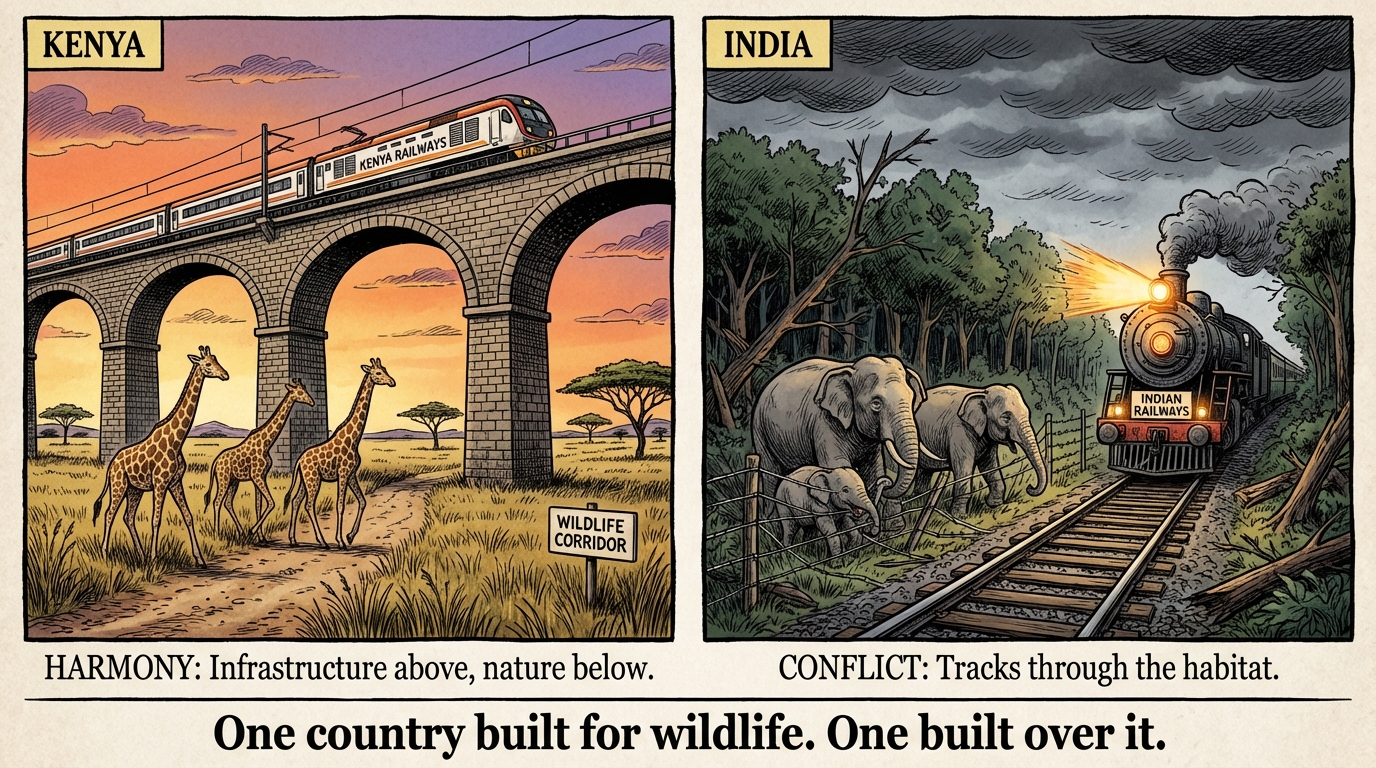
Kenya Built for Giraffes, India Builds Over Elephants
By Ramachandran Rajeev Kumar
Two railways, two philosophies: Kenya elevated for wildlife, India plows through
At 2:17 AM on December 20, 2025, a Rajdhani Express traveling from Mizoram to Delhi encountered approximately 100 wild elephants crossing the tracks in Assam's Hojai district.
The driver did everything right. He spotted the herd. He applied emergency brakes.
It wasn't enough.
Seven elephants died - three adults and four calves. One calf survived, injured. Five train coaches and the engine derailed. Mercifully, none of the 650 passengers were hurt.
This was not an accident. This was inevitability dressed up as tragedy.
The Numbers That Should Shame Us
Let's be clear about what we're dealing with.
| Statistic | Number |
|---|---|
| Elephants killed by trains in India (2009-2020) | 186 |
| Elephants killed by trains since 2020 | 86+ |
| Average elephants killed per year | 20 |
| India's share of world's wild Asian elephants | 60% |
| Elephant corridors mapped in India | 150+ |
| Corridors legally protected from development | Almost none |
Twenty elephants die under Indian trains every year. That's one every eighteen days. For a nation that worships Ganesha, we have a peculiar way of treating his living relatives.
The Hojai tragedy occurred in an area that was not designated as an elephant corridor - despite local residents warning authorities for years about herds regularly crossing those tracks.
This is the pattern: elephants walk where they've always walked. We lay tracks through their paths. They die. We express shock. We promise action. Nothing changes. Repeat.
Meanwhile, in Kenya
Here's what sustainable railway development actually looks like.
When China built Kenya's Standard Gauge Railway (SGR), they faced a choice: the cheapest route ran straight through Nairobi National Park and the Tsavo conservation area - home to elephants, giraffes, lions, and zebras.
They could have done what India does: lay the tracks, express regret when animals die, install some sensors, call it progress.
Instead, they built something remarkable:
The Kenya SGR Wildlife Infrastructure:
| Feature | Specification |
|---|---|
| Ground-level wildlife crossings | 14 |
| Underground culverts | 150 |
| Elevated track through Nairobi National Park | 6+ km at 6.5 meters high |
| Special giraffe arches | 7.5 meters tall |
| Noise-dampening barriers | 5.9 km of sound walls |
Read that again. They built 7.5-meter arches specifically so giraffes could walk under the railway without ducking.
The SGR features a three-dimensional wildlife corridor: underground passages for smaller animals, ground-level crossings for medium-sized wildlife, and elevated tracks where the railway passes through sensitive areas.
The result? The Kenya SGR is United Nations-certified as a model of sustainable infrastructure.
Research tracking GPS-collared elephants from 2016-2019 found that eight of ten monitored elephants successfully used the underpasses. The infrastructure works. Animals cross safely. Trains run on schedule.
The Cost Argument Is a Lie
The inevitable response from Indian Railways: "We can't afford such expensive solutions."
Let's examine that claim.
India's Railway Investment (2024-25 Budget): Rs 2.52 lakh crore ($30+ billion)
Cost of Wildlife Crossings: A fraction of track-laying costs, especially when designed into new projects from the beginning.
Cost of the Hojai Accident:
- 5 coaches derailed
- Engine damaged
- Track repairs
- Service disruption across Northeast
- Veterinary and burial operations
- Inquiry costs
- Reputation damage
Cost of 186 elephant deaths (2009-2020): Incalculable. These are endangered animals. India hosts 60% of the world's remaining Asian elephants - an estimated 27,000-30,000 individuals. We are literally killing our heritage.
The Kenya SGR cost $3.8 billion for 472 km. India's Mumbai-Ahmedabad bullet train project costs $20+ billion for 508 km. We have the money. We choose not to spend it on wildlife.
The AI Bandage
After every tragedy, Indian Railways points to technology solutions.
The latest is the Intrusion Detection System (IDS) - an AI-powered system using Distributed Acoustic Sensing to detect elephant movement near tracks and alert drivers.
According to Northeast Frontier Railway, this system saved 160 elephant lives in 2025.
That's genuinely good news. But here's the problem: 7 still died in Hojai.
Technology is a bandage. The wound is infrastructure that ignores wildlife.
The IDS gives drivers warnings. But a Rajdhani Express traveling at 130 km/h cannot stop in time when it encounters a herd of 100 elephants at 2 AM. Physics doesn't care about your sensors.
Kenya didn't rely on sensors to warn animals away from trains. They built infrastructure that made collisions physically impossible. Elephants walk under the tracks. Giraffes walk under the tracks. Trains pass above. No conflict.
That's engineering. That's planning. That's what we're not doing.
The Corridor Fiction
India has mapped over 150 elephant corridors - traditional routes that herds have used for generations to move between forest patches, water sources, and feeding grounds.
Mapping is not protecting.
Most corridors have zero legal protection. Roads, railways, mines, and townships slice through them with impunity. Environmental impact assessments are either skipped or ignored.
The Hojai accident site? Not a designated corridor. But elephants crossed there regularly. Locals knew. Forest officials knew. Railways knew.
The problem is that elephants don't read maps. They walk where their ancestors walked. When we fragment their habitat with farms, roads, and railways, they improvise new routes. Our "corridor maps" are snapshots of behavior that changes as we destroy habitat.
Kenya's approach: identify where wildlife needs to cross, then design infrastructure around those needs. Build underpasses. Elevate tracks. Create buffers.
India's approach: build tracks wherever convenient, slap on some sensors, express condolences when animals die.
The Guwahati-Jogighopa Precedent
To be fair, not all Indian officials are blind to this.
Railways and wildlife officials recently agreed to declare a 164-km stretch between Siliguri and Alipurduar as an "elephant corridor" with a speed restriction of 45 km/h for all trains.
This is progress. Slower trains mean more reaction time. More reaction time means fewer deaths.
But speed limits are enforcement nightmares. Drivers under pressure to maintain schedules will violate them. Sensors will fail. Animals will die.
The only permanent solution is infrastructure that separates wildlife from trains entirely. Underpasses. Overpasses. Elevated tracks through sensitive zones.
If China can build 7.5-meter giraffe arches in Kenya, India can build elephant underpasses in Assam.
Development vs. Destruction
India is not poor. India is not technologically backward. India builds bullet trains, launches satellites, and constructs the world's largest statue.
The question isn't capability. It's priority.
When we plan infrastructure, wildlife is an afterthought - a problem to be managed with sensors and speed limits after the tracks are laid. Environmental clearances are obstacles to be circumvented, not guardrails to be respected.
The Deepar Beel case is instructive. The Guwahati-Jogighopa railway was laid straight through this Ramsar wetland site, shrinking the waterbody and fragmenting animal corridors. Experts objected. Environmentalists protested. The railway was built anyway.
India's National Wildlife Action Plan explicitly states that railways must bypass national parks, sanctuaries, and wildlife corridors. The policy exists. Implementation doesn't.
What Must Change
1. Mandatory Wildlife Impact Assessment for All Rail Projects
No new railway line should be approved without comprehensive study of wildlife movement patterns. Not just designated corridors - actual animal behavior.
2. Design Standards for Wildlife Crossings
Indian Railways should adopt design standards similar to Kenya's SGR: minimum specifications for underpasses, overpasses, and elevated sections through wildlife areas.
3. Legal Protection for Corridors
Mapped elephant corridors must have legal protection equivalent to reserve forests. No exceptions for "development projects."
4. Retrofit Existing Danger Zones
Identify the deadliest sections - Assam, West Bengal, Odisha, Uttarakhand - and retrofit them with crossing infrastructure. Yes, it's expensive. So is extinction.
5. Speed Limits That Are Actually Enforced
Until infrastructure is built, enforce 45 km/h limits through all elephant areas - with automated monitoring and penalties for violations.
The Elephant in the Room
There's a deeper issue here, and it's uncomfortable.
India treats wildlife as an obstacle to development. Kenya - with Chinese engineering help - treated wildlife as a design constraint to be solved.
The difference is philosophical, not financial.
We can build Vande Bharat trains. We can build metros in twenty cities. We can plan hyperloops and bullet trains. But we cannot seem to build an underpass that lets elephants walk safely from one forest patch to another.
This isn't about elephants vs. development. That framing is false. Kenya proves you can have modern railways AND living wildlife. The SGR runs on schedule. The elephants cross safely. Both coexist.
India has 7,000 wild elephants in Assam alone - one of the highest concentrations anywhere on Earth. This is not a burden. This is a treasure. A nation that cannot protect its treasures is a nation that has lost its way.
The Real Tragedy
Seven elephants died last week. Including four calves.
In a few months, this will be forgotten - until the next herd walks onto the next track and the next Rajdhani applies emergency brakes that cannot stop 650 passengers in time.
We will express shock. We will promise inquiries. The Chief Minister will tweet condolences. Nothing will change.
Unless we decide that elephants matter. That coexistence is possible. That development without destruction is not utopia but engineering.
Kenya built for giraffes.
When will India build for elephants?
Ramachandran Rajeev Kumar is the founder of BarathVector.
Sources referenced:
- Northeast India Broadcast: NFR saved 160+ elephants in 2025
- Xinhua: Kenya SGR wildlife infrastructure
- Deccan Herald: Hojai accident details
- Wildlife Trust of India: Elephant corridor mapping
- Wiley Online Library: Kenya SGR underpass effectiveness study