By Ramachandran Rajeev Kumar — 2026-04-08
Iran's Ten-Point Proposal Is Not a Peace Plan. It Is a Map of What Iran Believes It Can Hold.
A 45-day ceasefire is a tactical pause. A 10-point permanent settlement is a strategic claim. Iran rejected the first not because it wants to keep fighting, but because it learned from Gaza and Lebanon that temporary truces are preludes to resumed operations. The real question is not whether Iran's counter-proposal is serious. It is whether anyone at the negotiating table possesses both the authority and the incentive to enforce what it demands.
By Ramachandran Rajeev Kumar
On 6 April 2026, Day 38 of the war that began with American and Israeli strikes on Iranian territory, three countries -- Egypt, Pakistan, and Turkey -- presented both Washington and Tehran with a draft proposal for a 45-day ceasefire. Within hours, Iran rejected it. Not with silence or equivocation, but with a structured 10-point counter-proposal calling for a permanent end to the war.
President Trump called it a "significant step" but "not good enough." Iran's Foreign Ministry spokesman Esmail Baghaei called the original American position "extremely excessive, unusual, and illogical." By 7 April, Trump was threatening the "complete demolition" of every bridge and power plant in Iran if his 8 p.m. Eastern deadline passed without agreement. Iran's President Masoud Pezeshkian was announcing that 14 million Iranians had volunteered to sacrifice their lives in defence of their country.
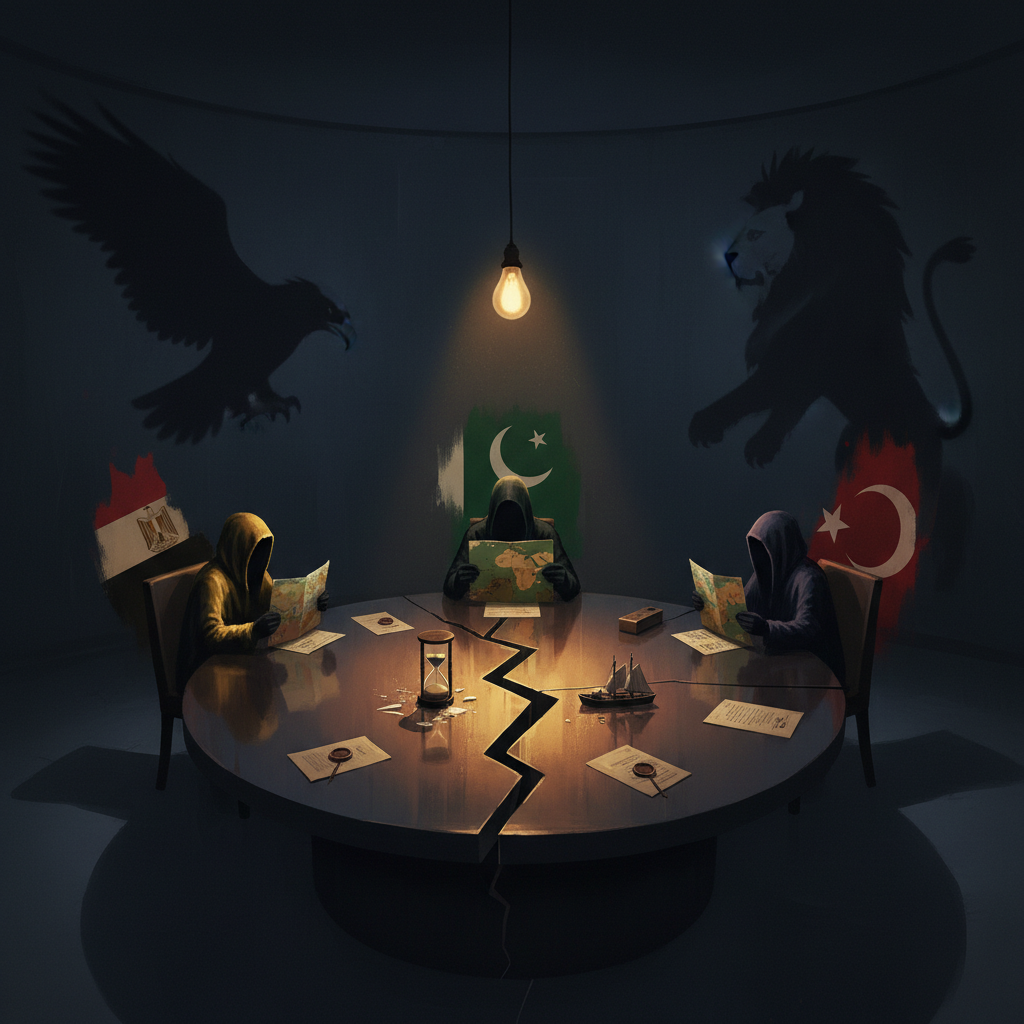
Between these two positions lies the entire architecture of modern Middle Eastern diplomacy: maximum threat, maximum defiance, and a mediation triangle that may lack the structural capacity to bridge either.
This article examines what Iran's 10-point proposal actually demands, why Tehran rejected the ceasefire, what each mediator brings to the table and wants from it, and what India's conspicuous absence from the mediation effort reveals about the limits of its multi-alignment strategy.
The war in forty days
A brief accounting is necessary to understand the diplomatic terrain.
On 28 February 2026, the United States and Israel launched approximately 900 strikes in 12 hours against Iranian military infrastructure, air defences, missile sites, and leadership targets. Supreme Leader Ali Khamenei was killed in an Israeli air attack on his compound -- the single most consequential targeted assassination in the Middle East since the killing of Qassem Soleimani in 2020. Defence Minister Aziz Nasirzadeh, IRGC Commander Mohammad Pakpour, Defence Council Secretary Ali Shamkhani, and at least four senior intelligence officials were killed in the same wave. A missile struck a girls' school adjacent to a naval base in Minab, near Bandar Abbas, killing approximately 170 civilians.
Iran's retaliation was immediate and unprecedented in scope. Tehran launched 438 ballistic missiles, over 2,000 drones, and 19 cruise missiles -- not only at Israel and American military positions, but at every Gulf Cooperation Council state: Bahrain, Jordan, Kuwait, Qatar, Saudi Arabia, and the United Arab Emirates. International airports in Dubai, Abu Dhabi, and Kuwait were struck. The American consulate in Dubai and the embassy in Riyadh were hit by Iranian drones. A drone struck Britain's Akrotiri base on Cyprus. Iran closed the Strait of Hormuz, through which approximately 20 percent of global oil passes daily.
The human cost: over 1,900 killed in Iran. At least 1,400 killed in Lebanon, where Israel simultaneously expanded operations against Hezbollah. Over one million displaced. At least 13 American service members killed, with approximately 200 wounded -- figures the Pentagon disclosed in stages and which investigative reporting suggests may undercount the actual toll.
On 8 March, Mojtaba Khamenei -- the late Supreme Leader's son -- was elected to succeed his father, receiving allegiance from the IRGC, the presidency, and the senior clerical establishment. A new supreme leader, a devastated military infrastructure, a closed strait, and a global economic shockwave. That is the ground on which three countries are attempting to build a ceasefire.
What the 45-day ceasefire proposed
The Egypt-Pakistan-Turkey draft, transmitted to both Washington and Tehran on 6 April, proposed a two-phase framework. Phase one: an immediate 45-day ceasefire during which the Strait of Hormuz would reopen and hostilities would cease. Phase two: substantive negotiations -- to be concluded within 15 to 20 days of commencement -- on a permanent settlement addressing the underlying causes of the conflict.
The proposal was, in its architecture, a confidence-building measure. Halt the shooting. Reopen the waterway. Create diplomatic space. Then negotiate the harder questions -- sanctions, security guarantees, regional arrangements -- under less immediate pressure.
It is a template with a long pedigree in Middle Eastern diplomacy. It is also a template with a long record of failure.
Why Iran said no
Iran's rejection was not reflexive. It was historically informed.
Tehran's stated rationale cited the precedent of temporary ceasefires in Gaza and Lebanon -- truces that, in Iran's analysis, served as operational pauses for Israel and the United States rather than genuine pathways to settlement.
The precedent is not imaginary. Since November 2024, despite an official ceasefire in Lebanon, Israel continued military operations nearly daily, killing approximately 500 people -- including 127 civilians -- while Hezbollah used the same pause to rebuild militant infrastructure and rearm. The ceasefire existed on paper. On the ground, it was a slower-burning version of the same war.
Iran's calculation is straightforward: a 45-day truce reopens the Strait of Hormuz -- Tehran's single most powerful piece of leverage -- in exchange for a promise of future negotiations that neither the United States nor Israel has a structural incentive to conclude. Once the strait is open, the economic pressure on Washington evaporates. Once the economic pressure evaporates, the urgency to negotiate a permanent settlement disappears with it. Iran hands back its leverage and receives, in return, forty-five days during which the other side can reposition, resupply, and recalibrate.
Iran's Foreign Ministry called it a "regrouping window." That phrasing is not rhetoric. It is doctrine.
The ten points: what Iran demands
Iran's counter-proposal, delivered through Pakistani mediation on 6 April, contains ten clauses. Not all have been made public in full, but reporting from IRNA, Gulf News, Al Jazeera, Axios, and Xinhua allows reconstruction of the framework:
1. Permanent end to war. Not a ceasefire. Not a pause. A formal termination of hostilities between Iran and the United States, and between Iran and Israel.
2. No-future-attack guarantee. A binding assurance that Iran will not face military strikes going forward -- the single demand that, if enforceable, would represent the most significant security guarantee in the region since the Camp David Accords.
3. End to Israeli operations against Hezbollah. Iran conditions its own settlement on the termination of Israeli military operations in Lebanon -- linking the two conflicts explicitly and refusing to allow them to be addressed separately.
4. Complete sanctions removal. Lifting of all American economic sanctions on Iran -- not a phased drawdown, not partial relief, but full removal.
5. Reopening of the Strait of Hormuz. Iran agrees to restore shipping through the strait -- the concession Washington most urgently needs -- but only as part of a comprehensive package, not as a precondition.
6. Transit fee structure. Approximately $2 million per vessel transiting the strait. This is the clause that transforms a military concession into an economic instrument. Iran is proposing to monetise control of the waterway even after reopening it.
7. Revenue sharing with Oman. Distribution of collected shipping fees with Oman, which shares control of the strait. This clause serves a diplomatic function: it signals to Gulf states that Iran's management of the waterway can benefit regional actors, not just Tehran.
8. Infrastructure reconstruction funding. Collected revenues directed toward rebuilding war-damaged areas in Iran -- a mechanism that forces the international community to fund Iranian reconstruction indirectly, through shipping fees, rather than through direct aid that could be politically contested.
9. Safe passage protocols. Establishment of formal security corridors through the strait -- an offer of predictability that serves both commercial and diplomatic interests.
10. Regional hostilities framework. A broader agreement to reduce tensions beyond the immediate conflict -- the most ambitious and most vaguely defined clause, which implies a new regional security architecture without specifying its terms.
Taken together, the proposal is maximalist. It asks for everything Iran could want in a permanent settlement: security guarantees, economic relief, regional influence, and a revenue-generating mechanism that compensates for the sanctions it seeks to have lifted.
But maximalist is not synonymous with unserious. In any negotiation, the opening position defines the negotiating space. Iran's 10 points are not a final offer. They are a claim to the territory within which bargaining will occur.
Peace proposals as warfare
Here is the principle that both proposals -- the 45-day ceasefire and the 10-point counter -- make visible: peace proposals are themselves instruments of conflict. What you propose reveals what you believe you can hold.
The 45-day ceasefire says: we believe we can get the strait reopened without conceding anything permanent. The 10-point plan says: we believe our leverage is strong enough to demand a comprehensive settlement.
Both are tests of the other side's resolve. Neither is primarily about peace. Both are about establishing the terms under which the war -- whether military or economic -- continues.
Trump's response pattern confirms this reading. On 6 April, he called Iran's proposal a "significant step." On 7 April, he threatened to destroy "every bridge and power plant" in Iran within four hours. When asked whether the war was winding down or escalating, he said: "I don't know. I can't tell you. It depends on what they do." A leader who genuinely believed a peace deal was imminent would not simultaneously threaten civilisational destruction.
France understood this dynamic. Foreign Minister Jean-Noel Barrot warned that targeting civilian infrastructure is "barred by the rules of war, international law" and would trigger "a vicious circle of reprisals that would drag the region and the world economy into a vicious circle." France was not defending Iran. It was defending the principle that infrastructure destruction forecloses the diplomatic space in which any settlement must eventually be reached.
The mediation triangle: who brings what
The Egypt-Pakistan-Turkey triangle is not accidental. Each country occupies a specific structural position that makes its mediation plausible -- and each carries limitations that make the triangle, as currently configured, insufficient.
Pakistan: the backchannel operator
Pakistan has emerged as the primary interlocutor between Washington and Tehran -- a role that would have seemed implausible twelve months ago. Prime Minister Shehbaz Sharif and Field Marshal Asim Munir maintain direct and separate backchannels to both the Trump White House and President Pezeshkian. Munir, in particular, has spoken overnight with Vice President JD Vance, Special Envoy Steve Witkoff, and Iranian Foreign Minister Abbas Araghchi -- the kind of multi-directional access that makes real-time shuttle diplomacy possible.
On 7 April, Sharif publicly requested a two-week deadline extension from Trump, writing on X that "diplomatic efforts for peaceful settlement of the ongoing war in the Middle East are progressing steadily, strongly and powerfully." He simultaneously pressed Iran to reopen Hormuz as a goodwill gesture.
Pakistan's mediation credentials rest on three pillars. First, geographic proximity: Pakistan shares a 959-kilometre border with Iran through restive Balochistan. Instability in Iran directly threatens Pakistani security. Second, institutional relationships: the Pakistani military establishment maintains working relationships with both the Pentagon and the IRGC -- a dual access that civilian diplomats in most countries cannot replicate. Third, the Trump factor: Asim Munir has cultivated a relationship with the Trump administration that positions him, in Foreign Policy's assessment, as "a hard-power operator with direct access to the White House and a willingness to sell himself as useful."
What Pakistan wants from mediation is as important as what it offers. Successful brokerage would rehabilitate Pakistan's international standing after years of economic crisis, political instability, and diplomatic marginalisation. It would position Islamabad as a serious power in a region where it has been progressively sidelined by India's rising profile and Gulf states' own diplomatic ambitions. Mediation success would also create leverage with Washington -- diplomatic capital that Pakistan desperately needs as its IMF programme conditions tighten.
The limitation: Pakistan has no enforcement capacity. It can relay messages, draft proposals, and create diplomatic space. It cannot guarantee that either side honours its commitments. And Pakistan's own relationship with Iran is complicated by Balochistan -- where cross-border militant activity has produced Iranian strikes on Pakistani soil as recently as 2024.
Turkey: the NATO bridge
Turkey occupies the rarest position in this conflict: a NATO member with working relationships across both camps. Foreign Minister Hakan Fidan -- himself a former intelligence chief -- has led an intensive regional diplomatic campaign, hosting Iranian Foreign Minister Araghchi in Istanbul and engaging with Gulf leaders throughout the crisis.
Turkey's motivations are layered. Economically, Iran supplies roughly 15 percent of Turkey's natural gas through a pipeline agreement expiring in mid-2026. Every week the war continues, Turkish energy security deteriorates. Every $10 increase in oil prices adds between $3 billion and $5 billion to Turkey's current account deficit. President Erdogan's domestic political position -- always sensitive to economic conditions -- cannot absorb a prolonged regional war without consequences.
Strategically, Turkey's deepest concern is Kurdish. Reports that Washington and Jerusalem considered leveraging Iranian Kurdish groups as a ground component against Tehran set off alarms in Ankara. Any empowerment of Kurdish armed actors along Turkey's 350-mile border with Iran threatens to reignite the PKK conflict that Erdogan has spent decades suppressing. Turkey's mediation, in this reading, is partly prophylactic: better to broker a ceasefire than to allow a war that might arm your own adversaries.
What Turkey brings: NATO-compatible diplomatic infrastructure, institutional credibility with both Western and Muslim-majority audiences, and a foreign minister whose intelligence background gives him the operational literacy to handle backchannel negotiations that blur the line between diplomacy and intelligence work.
The limitation: Turkey-Iran relations, while functional, carry the weight of competing regional ambitions in Syria, Iraq, and the Caucasus. Erdogan is credible as a broker, but not as a guarantor. And his domestic political needs -- the compulsion to be seen as a major diplomatic actor -- can lead to overextension, where the appearance of progress matters more than its substance.
Egypt: the institutional mediator
Egypt brings something neither Pakistan nor Turkey can offer: institutional mediation experience. Cairo hosted nuclear talks between Iran and the International Atomic Energy Agency. Egypt is a guarantor of the US-brokered Gaza ceasefire. The Egyptian foreign ministry's mediation apparatus is the most established in the Arab world, honed through decades of Israel-Palestine diplomacy.
But Egypt's position in this specific conflict is structurally weak. President Sisi declared the country in a "state of near-emergency" as the war threatened an economy that depends on Suez Canal revenues, tourism, diaspora remittances, and gas exports -- all of which are being disrupted by regional instability. Egypt is mediating not from a position of strength but from a position of economic vulnerability. It needs the war to end because it cannot afford for the war to continue.
Egypt's diplomatic constraints are equally significant. Cairo lacks the leverage for meaningful pressure on either Washington or Tehran. Its role, as analysts have said, is limited to "facilitating coordination among Arab states and relaying messages." Egypt can host talks. It can propose frameworks. It cannot compel attendance, enforce outcomes, or threaten consequences for non-compliance.
What Egypt wants: economic stabilisation through restored regional calm, continued relevance in American strategic calculations (and the military aid that accompanies it), and the reputational capital that comes from successful mediation -- a currency Cairo has been accumulating since Anwar Sadat but spending at an accelerating rate.
The structural gap
The fundamental problem is not the quality of the mediators. It is the architecture of mediation itself.
None of these three countries -- individually or collectively -- possesses the enforcement capacity that a permanent settlement requires. A 45-day ceasefire can be monitored. A permanent end to war requires a guarantor willing to impose costs on the party that violates it. Egypt cannot impose costs on the United States. Pakistan cannot impose costs on Israel. Turkey, for all its NATO membership, has demonstrated no willingness to deploy its alliance position as leverage against Washington.
The one institution designed for precisely this role -- the United Nations Security Council -- demonstrated its dysfunction on 7 April, when Russia and China vetoed a watered-down resolution aimed at reopening the Strait of Hormuz. The original Bahrain-drafted resolution would have authorised "all necessary means" to ensure transit -- UN language that includes military action. After Russian, Chinese, and French opposition, the text was stripped of all offensive language and reduced to a diplomatic appeal. Russia and China vetoed it anyway. The vote was 11 in favour, 2 against, 2 abstentions.
The Security Council cannot act because its permanent members are on opposing sides of the conflict. The mediators cannot enforce because they lack structural power. The combatants cannot agree because their interests are genuinely irreconcilable at this stage. This is not a negotiating gap. It is a structural absence -- the missing institution between the proposal and the settlement.
India's silence and what it costs
India is conspicuously absent from the mediation table. For a country that imports approximately 85 percent of its crude oil, maintains critical energy relationships with both Iran and the Gulf states, and hosts the world's largest diaspora in the Middle East, this absence is not passive. It is a decision.
External Affairs Minister S. Jaishankar has made the position explicit: India does not see itself as a "broker" in complex geopolitical conflicts. When Pakistan's mediation role drew attention, Jaishankar dismissed Islamabad as a "dalal" -- a Hindi word meaning fixer or middleman, deployed with unmistakable contempt. India's stance, articulated across multiple statements, calls for "all sides to pursue dialogue and diplomacy" -- the diplomatic equivalent of wishing everyone well from a safe distance.
The strategic logic is defensible. India's multi-alignment depends on not being drawn into conflicts where it would have to choose between partners. Overt mediation carries the risk that failure would damage relationships with both sides. And India is not a net security provider in the region -- it cannot enforce outcomes any more than Egypt or Pakistan can.
But the cost is compounding. Foreign Policy described Pakistan's emergence as the primary backchannel between Washington and Tehran as "a stinging strategic setback for New Delhi." For a government that has invested significant political capital in isolating Pakistan diplomatically, watching Islamabad broker conversations between the world's most powerful military and the region's most defiant state represents a reversal of the narrative India has cultivated.
The deeper issue is not the diplomatic optics. It is the strategic substance. India's energy security, trade routes, and diaspora safety are directly affected by this war. The Strait of Hormuz closure has disrupted Indian oil imports. Indian workers in the Gulf face security risks from Iranian strikes on GCC states. And the longer India remains silent, the more the mediation architecture solidifies without Indian input -- creating precedents, relationships, and obligations from which India is excluded.
Quiet diplomacy -- the kind Jaishankar prefers -- works when the quiet conversations produce results that protect Indian interests. When they do not, silence is not strategy. It is absence.
What the reader should carry away
Five propositions:
First, Iran's rejection of the 45-day ceasefire is rational, not irrational. Temporary truces that require surrendering your strongest leverage -- in this case, the Strait of Hormuz -- in exchange for promises of future negotiation are structurally disadvantageous to the party with less conventional military power. Iran learned this from watching Gaza and Lebanon. The lesson is not obscure.
Second, Iran's 10-point proposal is maximalist but not unserious. It defines the negotiating space Tehran believes its leverage justifies. The transit fee structure and Oman revenue-sharing clauses are particularly revealing: they show Iran thinking not just about ending the war but about building an economic architecture that survives the settlement. That is the mark of a state planning for the long term, not a state bluffing.
Third, the mediation triangle of Egypt, Pakistan, and Turkey is structurally necessary and structurally insufficient. Each country has access that the others lack. None has enforcement capacity. Together, they can create diplomatic space but not fill it. A permanent settlement requires a guarantor -- and no guarantor currently exists.
Fourth, India's absence from the mediation table is defensible in the short term and costly in the medium term. Multi-alignment only works when you are present at the tables where alignment is being reconfigured. The Iran war is reconfiguring the Middle Eastern diplomatic order. India is watching from the stands.
Fifth, peace proposals are themselves a form of warfare. What you demand at the negotiating table reveals what you believe you can hold on the battlefield and in the economic arena. Iran's ten points are not a wish list. They are a strategic map. Reading them as demands to be rejected or accepted misses the point. Read them as intelligence -- as a declaration of where Iran believes its leverage lies. That is where the real negotiation begins.
Ramachandran Rajeev Kumar is Chief Executive of Aarksee Group of Companies, a Saudi Arabia-based conglomerate operating across carbon markets, green sciences, technology, and media. He writes on geopolitics and strategic foresight for BarathVector.
BarathVector | Global Strategy | 8 April 2026
Sources:
- Iran 10-point peace plan specifics -- Al Jazeera, 7 April 2026; Gulf News, 7 April 2026
- Iran rejects 45-day ceasefire -- Axios, 6 April 2026; Times of Israel, 6 April 2026
- Two-phase ceasefire draft proposal -- Axios, 6 April 2026; NPR, 6 April 2026
- Pakistan-backed 45-day ceasefire proposal -- Iran International, 6 April 2026
- Pakistan mediation role and Asim Munir backchannels -- Foreign Policy, 3 April 2026; The Diplomat, April 2026
- Sharif deadline extension request -- Axios, 7 April 2026; Geo.tv, April 2026
- Turkey mediation and Fidan diplomatic campaign -- Atlantic Council, March 2026; Arab Center DC, March 2026
- Turkey-Iran 350-mile border and Kurdish concerns -- FDD Analysis, March 2026; Modern Diplomacy, March 2026
- Turkey energy dependency on Iran (15% natural gas) -- SpecialEurasia, January 2026
- Egypt mediation credentials and economic pressure -- Responsible Statecraft, April 2026; Times of Israel, April 2026
- Egypt Suez Canal revenue concerns -- Asharq Al-Awsat, March 2026
- India's calculated silence -- Asia Times, March 2026
- India missing from mediation table -- Asia Times, March 2026; The Wire, April 2026
- Jaishankar "dalal" remark -- Republic World, April 2026
- Pakistan mediation as setback for India -- Foreign Policy, 3 April 2026
- Trump "significant step" and "not good enough" -- Axios, 6 April 2026
- Trump "winding down or escalating" -- NBC News, April 2026
- Trump infrastructure threats -- France 24, 6 April 2026; Time, 6 April 2026
- France warning on civilian infrastructure -- France 24, 6 April 2026; France at UN, April 2026
- Pezeshkian 14 million volunteers statement -- NPR, 7 April 2026; Fortune, 7 April 2026
- Khamenei assassination and Mojtaba succession -- Wikipedia (2026 Iran war); Al Jazeera, 1 March 2026
- Iranian retaliatory strikes scope (438 ballistic missiles, 2,000+ drones) -- Wikipedia; Breaking Defense, March 2026
- US service members killed (~13-15) -- Wikipedia; Time, March 2026; The Intercept, 1 April 2026
- Lebanon ceasefire violations since November 2024 -- Wikipedia (Twelve-Day War ceasefire)
- Russia-China veto of Hormuz resolution -- PBS, 7 April 2026; Al-Monitor, 7 April 2026
- UNSC Resolution 2817 condemning Iran attacks -- UN Press, March 2026
- Iran war overview and timeline -- Wikipedia (2026 Iran war); Britannica