By Ramachandran Rajeev Kumar — 2026-01-15
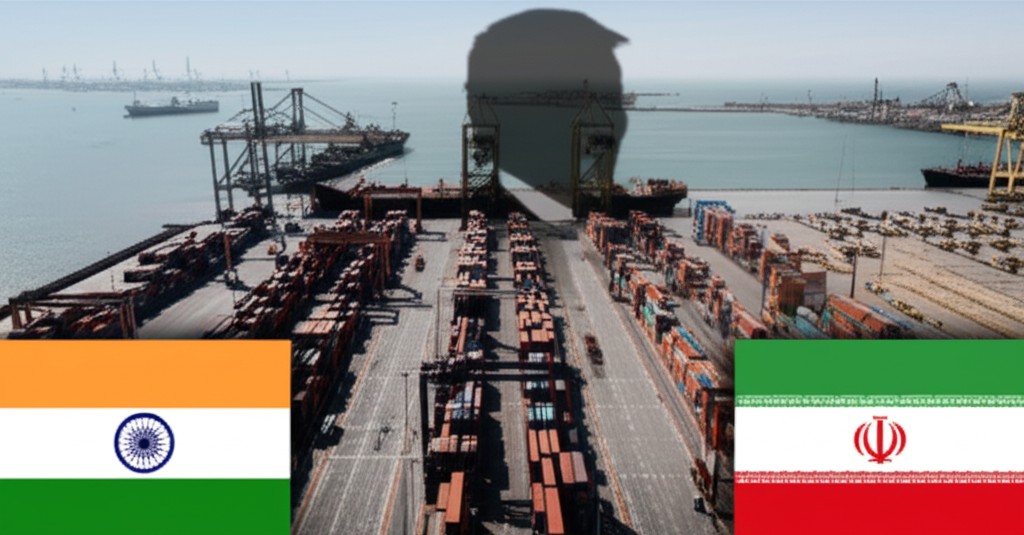
On January 12, 2026, President Trump announced that "any country doing business with the Islamic Republic of Iran will pay a Tariff of 25% on any and all business being done with the United States of America." The order, which Trump described as "final and conclusive," creates a stark binary choice for India: absorb potential tariffs that could reach a cumulative 75% on exports (adding to the existing 50% baseline), or walk away from a half-billion-dollar strategic investment in the Chabahar Port that took a decade to operationalize.
India's immediate response has been calibrated caution. Government sources insist the impact will be minimal, noting that India-Iran bilateral trade stood at just $1.68 billion in 2024-25—barely 0.15% of India's total global trade. Iran doesn't feature in India's top 50 trading partners.
But this framing deliberately misses the point. The Iran question isn't about trade volumes. It's about strategic depth, regional access, and whether India will sacrifice long-term geopolitical positioning for short-term tariff relief. And unlike Russia—where India held firm against Western pressure—Iran represents a softer, more vulnerable target in India's foreign policy architecture.
The real test isn't economic. It's strategic.
The Chabahar Conundrum: India's $500M Eurasian Bet
India's investment in Chabahar isn't a routine commercial port deal. It's a multi-decade strategic project designed to bypass Pakistan for access to Afghanistan, Central Asia, and Eurasia. Since 2016, India has committed $500 million to develop the Shahid Beheshti terminal: $370 million in direct investment, $250 million in credit lines, and $120 million from India Ports Global Limited (IPGL) for equipment.
In May 2024, India and Iran signed a 10-year agreement formalizing IPGL's management of the terminal. Work is underway to expand capacity from 100,000 to 500,000 TEUs and complete the 700-km Chabahar-Zahedan railway line, both due for completion by mid-2026. After years of sanctions-related delays and stops-and-starts, Chabahar was finally becoming operational.
Then came Trump's tariff bomb—just as Iran's domestic situation spirals into chaos.
The timing creates a perfect storm. India's current US sanctions waiver for Chabahar operations expires in April 2026, exactly when the railway connection is scheduled to be completed. Iranian Foreign Minister Abbas Araghchi arrived in Delhi on January 15-16 specifically to discuss waiver renewal. Now, with Trump's tariff threat looming and Iran convulsed by protests, India faces the question: Is Chabahar worth 25%—or potentially 75%—tariffs?
The strategic answer should be an emphatic yes. Here's why.
The Regime Change Factor: Betting on the Morning After
As of January 2026, Iran is experiencing its most severe internal crisis since 1979. Protests that erupted in late December 2025 over economic conditions have spread across all 31 provinces, turning into a broader challenge to clerical rule. The rial has collapsed, inflation exceeds 50%, and Tehran faces water shortages. Iranian officials themselves describe the regime as being in "survival mode".
On January 9, Supreme Leader Ali Khamenei took a hardline stance against protesters, triggering an internet blackout and security crackdown. The regime's regional proxies—Hezbollah, Assad's Syria—lie shattered. Analysts at Brookings openly ask: "Has the new Iranian revolution begun?"
For many Western policymakers, this chaos validates walking away from Iran. Let the regime collapse; deal with whoever comes after.
This is precisely backwards.
If Iran's regime does fall—whether in six months or six years—India wants to be the partner that stayed during the crisis, not the one that bailed when things got difficult. History shows that post-revolutionary governments remember who stood with them when nobody else would. The United States abandoned Iran after the 1979 revolution and spent the next 40 years locked out. Does India want to repeat that mistake?
Consider the counterfactual: If Iran transitions to a reformist or moderate government in 2027-2030, who will have leverage? China, which never left? Russia, which stayed through sanctions? Or India, which walked away in 2026 for tariff relief?
The smartest bet is to maintain strategic presence precisely because the regime is unstable. Post-revolutionary Iran—whether reformist, nationalist, or even monarchist—will need partners who didn't abandon it. India's Chabahar investment gives it a seat at that table. Walking away forfeits it.
The Russia Comparison: Where India Drew the Line
To understand why Iran is different, compare it to Russia.
When the West demanded India cut ties with Russia after the Ukraine invasion, India refused. The reasons were clear and non-negotiable:
- Defense dependency: Approximately 60% of India's military equipment is of Russian origin (90% of Army equipment specifically)
- Strategic partnership: Decades of defense cooperation, technology transfers, and geopolitical alignment
- Respect for autonomy: Russia doesn't lecture India on democracy or domestic policy
Russia is existential to Indian security. Iran is not.
But that's exactly why the Iran test matters. Walking away from Russia would have signaled weakness. Walking away from Iran would signal pragmatism—but it would also signal that India's foreign policy has a price tag, and America knows how to calculate it.
The difference is this: Russia is a core strategic partner India must protect. Iran is a strategic opportunity India should protect because it can afford to. Surrendering on Iran doesn't make India look pragmatic; it makes India look transactional. And transactional powers don't command strategic respect.
The Pivot Cost: What India Loses vs. What It Gains
Let's run the numbers.
If India Pivots Away from Iran:
Immediate Gain:
- Avoidance of 25% tariffs on $78 billion in annual exports to the US (though cumulative tariffs could reach 75% given existing 50% baseline)
Immediate Losses:
- $500M Chabahar investment write-off (sunk cost, unrecoverable)
- Railway connection to Zahedan (700 km of tracks, completed mid-2026) becomes unusable
- 10-year IPGL management agreement rendered meaningless
Strategic Losses:
- Afghanistan access: With Taliban ruling Afghanistan and Pakistan blocking overland routes, Chabahar is India's only reliable gateway to Kabul. Lose it, and India is boxed out.
- Central Asia connectivity: The International North-South Transport Corridor (INSTC) depends on Chabahar. Without it, India has no direct link to Kazakhstan, Uzbekistan, or Turkmenistan.
- Energy diversity: Over-reliance on Gulf Arab states and US LNG makes India vulnerable to single-supplier leverage
- China fills the vacuum: Beijing would immediately step in to manage Chabahar, turning India's strategic asset into China's—right next to Gwadar in Pakistan
If India Stays the Course:
Immediate Cost:
- 25% tariffs (though negotiations could reduce or delay implementation via waivers)
Strategic Gains:
- Chabahar remains operational and Indian-influenced
- Signal to Russia (and the world): India doesn't buckle to US unilateral pressure
- Hedge against regime change: India positioned as partner-of-choice for post-revolutionary Iran
- Energy diversity maintained
- Central Asia and Afghanistan access preserved
The irony here is almost poetic. India built Chabahar specifically to counter Gwadar—the Pakistani port China developed to dominate the Arabian Sea. Walking away from Chabahar hands it to China, making Chabahar the next Gwadar. India would have spent $500 million to build China's next strategic asset.
The Negotiation: Why Trump's Bluff Can Be Called
Here's the reality Trump's advisors know but won't say: India's Iran relationship is already minimal and shrinking.
India-Iran trade is $1.68 billion—0.15% of India's global commerce. India's oil imports from Iran dropped to near-zero after US sanctions reimposition. The relationship is largely confined to Chabahar and limited bilateral trade. India isn't propping up Iran's economy the way China ($25-30 billion in annual trade) or Turkey ($4-5 billion) are.
This creates negotiating leverage. India can offer symbolic gestures:
- Reduce the already-minimal oil imports to zero
- Increase US LNG purchases (already planned)
- Cooperate on intelligence regarding Iran's regional activities
In exchange, India requests:
- Exemption for Chabahar operations (already waived until April 2026, just extend it)
- Tariff relief or phase-in period
- Recognition of India's unique regional access needs
Trump's tariff announcement is designed for domestic consumption—to show he's "tough on Iran." But applying it to India, a Quad partner and critical Indo-Pacific ally, undermines US strategic interests. The Trump administration has previously issued "national security waivers" to close allies. India should demand one.
If Trump refuses, India should call the bluff. The US needs India in the Indo-Pacific far more than it needs India to walk away from Chabahar. Imposing 75% cumulative tariffs on a Quad ally over a $1.68 billion Iran relationship would be geopolitical malpractice.
The Triple Balance: How India Should Thread the Needle
India's challenge is managing three simultaneous relationships:
- US Pressure: "Choose us or face economic pain"
- Russian Friendship: "Don't abandon strategic autonomy"
- Iranian Pragmatism: "We need each other for regional access"
The solution is not binary—it's layered:
- To the US: "We'll cooperate on limiting Iran's malign regional influence, but Chabahar is a connectivity project, not a sanctions-busting scheme. You've already waived it before; extend the waiver."
- To Russia: "We're not abandoning strategic autonomy. We're managing American pressure without surrendering core interests—just as we did on oil imports."
- To Iran: "Our Chabahar investment is long-term. We're not walking away because of temporary US pressure or internal instability."
This approach preserves India's strategic autonomy, maintains Chabahar access, and avoids a full-blown tariff war with the US. It requires diplomatic skill, not surrender.
The Bottom Line: Strategic Depth vs. Tariff Relief
The Iran test boils down to one question: Is India a South Asian power content to manage its immediate periphery, or a Eurasian power building strategic depth across regions?
If India walks away from Chabahar because of tariff threats, it's choosing the former. It's saying: "Our foreign policy has a price, and America controls the payment terms." That's not strategic autonomy—it's strategic vulnerability packaged as pragmatism.
The smart play is to stay, negotiate, and refuse to treat Chabahar as expendable. Trump's tariff threat is a bluff designed to extract symbolic concessions, not to rupture US-India ties. India's Chabahar investment is a multi-generational bet on Eurasian connectivity. Walking away now—precisely when Iran is unstable and potentially transitioning—would be the ultimate strategic own-goal.
Russia taught us India won't compromise on core security interests. The Iran test asks: Is regional access and strategic depth a core interest?
The answer should be yes. Stay. Negotiate. Don't fold.
Because the tariff relief isn't worth what India would lose: a seat at the table when the Middle East is redrawn, a gateway to Central Asia, and the credibility that comes from refusing to be bought off with short-term economic carrots.
India's choice will define whether it's a rule-taker or a rule-shaper in the emerging multipolar order. Choose wisely.
Sources: