By BarathVector Editorial — 2026-05-27
The Permanent Weapon: A Year On, the Indus Treaty Is Still in Abeyance
On April 23, 2025 — the morning after twenty-six people were murdered at Pahalgam — India announced it was placing the Indus Waters Treaty in abeyance. The announcement came fast, before the funerals, before the names of the dead had been fully confirmed. It was also, in retrospect, the most consequential single decision of the entire crisis that followed.
The missiles and the strikes came and went in four days. The treaty suspension has not gone anywhere.
Thirteen months on, India has reiterated its position with no ambiguity: the Indus Waters Treaty remains in abeyance until Pakistan takes what New Delhi calls "credible and irreversible steps" to end support for cross-border terrorism. Pakistan disagrees with that framing. On May 15, 2026, the Court of Arbitration at The Hague issued an award on maximum pondage limits — supplemental to an earlier ruling on the treaty's general interpretation. India's Ministry of External Affairs rejected it the next day as the product of an "illegally constituted" tribunal: the award was "null and void," and the decision to hold the treaty in abeyance "remains in force." Delhi has never recognised the court's jurisdiction, and it has not returned to the treaty framework.
The military deterrence calculus from that crisis — what it bought, what it cost, what it failed to solve — has been examined in this desk's anniversary piece. This piece examines the other weapon. The slow one. The one still deployed.
What the treaty actually is
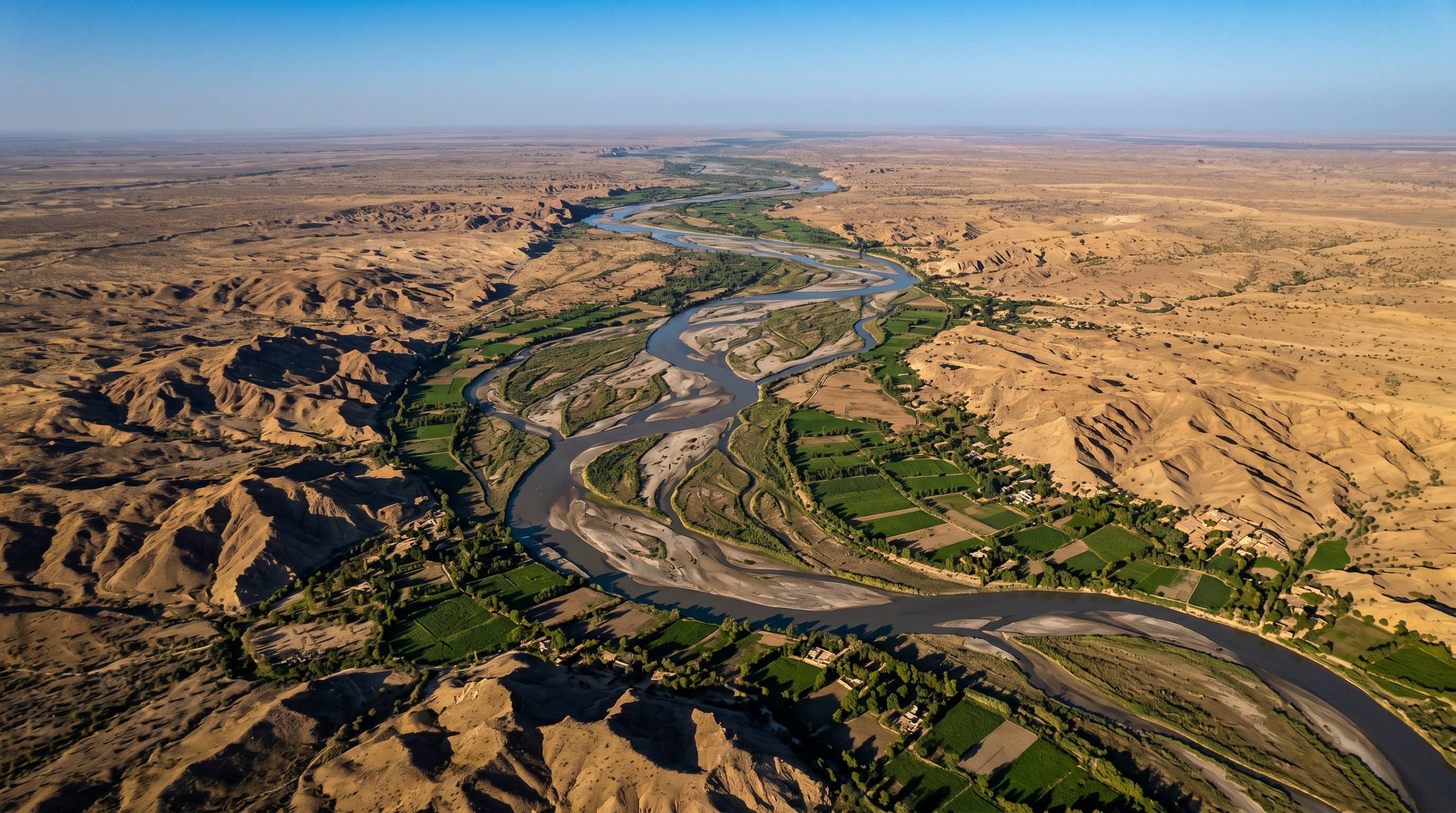
The Indus Waters Treaty was signed in 1960 after nine years of negotiation brokered by the World Bank. Its basic architecture divided the six rivers of the Indus basin into eastern and western allocations: India received the three eastern rivers — Ravi, Beas, Sutlej — largely free of constraint. Pakistan received the bulk of the western rivers — Indus, Jhelum, Chenab — which together supply more than 80 percent of Pakistan's agricultural water. The treaty survived three wars, two nuclear tests, and sixty-five years of mutual hostility. Its longevity was, for most of that period, cited as proof that even adversaries can maintain functional arrangements on existential shared resources.
That framing no longer holds. India's suspension has turned the treaty's longevity into a liability for Islamabad — because the longer Pakistan has operated on the assumption of guaranteed western river flows, the more structurally dependent its agriculture has become on those flows, and the more destabilising any real interruption would be. The treaty made Pakistan's food system contingent on Indian goodwill. India held that goodwill in suspension for thirteen months and counting.
For 240 million people in Pakistan's Punjab, Sindh, and Khyber Pakhtunkhwa — the farmers, the labourers, the families that sit at the end of irrigation channels fed by rivers originating in Indian-controlled territory — the treaty is not an abstraction. It is the water that arrives each season.
Why water is a different kind of weapon
The deterrence ledger this desk published earlier this month dealt with the kinetic dimension of India's response to Pahalgam: the precision strikes, the missile exchange, the four-day war that ended in a ceasefire. That ceasefire, as the Washington Post noted on May 5, 2026, is "holding, so far" — while both militaries spent the intervening year preparing to strike "faster and farther" the next time, as Foreign Affairs assessed. The military track is loud, escalatory, and legible to every intelligence service on the planet.
Water is none of those things. Water works slowly, quietly, and inside a legal grey zone India has been careful to exploit. The suspension is not a clean violation — India argues the abeyance is itself a treaty mechanism, a response to Pakistan's breach through state-sponsored terrorism. Pakistan calls that bad faith. Neither position has been settled by any forum both sides recognise as legitimate. That ambiguity is the point. Pakistan cannot retaliate against a treaty suspension the way it might retaliate against a missile strike. International tribunals are available — Pakistan has used them — but India does not accept the jurisdiction. Water leverage is deniable in a way that military force is not, and that deniability is precisely what makes it attractive as a long-cycle pressure instrument.
India has also moved on the infrastructure side. The government has accelerated Rs 2,600 crore worth of hydropower and river-management projects on the Chenab system in Jammu and Kashmir and Himachal Pradesh — the beginning of a decade-long effort to build the storage and diversion capacity that would give the suspension real physical teeth.
The gap between the threat and the capability
Here is the uncomfortable truth that honest analysis cannot skip.
India currently cannot stop the western rivers from flowing into Pakistan. The infrastructure does not exist. According to the Centre for Strategic and International Studies, India in the short term lacks the dams, reservoirs, and canal systems needed to withhold or divert significant Indus flows. Existing hydropower developments on the western rivers would only marginally increase storage capacity, with major projects stretching to 2032 and beyond at the earliest. Building the full system — the one that would give India genuine physical leverage over seasonal flows — would take a decade or more, by the assessment of most independent analysts.
This is not a minor caveat. It means that India's current suspension of the treaty is primarily a legal and psychological instrument, not a physical one. The water continues to flow. The threat of future interdiction is real, but it is a threat measured in years, not weeks. Pakistan's agricultural calendar is not yet at India's discretion — and everyone in Rawalpindi and Islamabad who reads a hydrology brief knows this.
The Rs 2,600 crore Chenab acceleration is signal as much as substance. It says: we intend to close the gap. But closing the gap takes the kind of sustained, unglamorous infrastructure investment — terrain-challenging dam construction in J&K and Himachal, environmental clearances, resettlement, technical complexity — that India has historically started and stalled. The credibility of the water weapon, over the medium term, depends entirely on whether India actually builds what it says it will build. Leverage that is never exercised because the infrastructure was never completed is not leverage. It is a bluff with a decade-long expiry clock.
The mirror problem — and why China changes everything
There is a harder version of this argument that Indian strategic commentators have been reluctant to say aloud.
India is not only an upstream nation. It is also a downstream one.
The Brahmaputra — which India knows as the Brahmaputra and China knows as the Yarlung Tsangpo — enters Indian territory from the Tibetan plateau, passing through Arunachal Pradesh before flowing into Assam and then Bangladesh. China sits upstream. And China has been building on that position with a speed and ambition that makes India's Chenab projects look tentative by comparison.
In July 2025, Chinese Premier Li Qiang presided over the groundbreaking ceremony for the Great Bend dam on the Yarlung Tsangpo at Medog in Tibet — a project projected at 60 gigawatts of generation capacity and a cost of approximately 1.2 trillion yuan. It would, if completed, be the largest hydropower project in human history. The dam sits at the point where the river bends sharply before descending into Indian territory. China has not shared hydrological data with India since 2022 — a withdrawal of transparency that the CENJOWS research centre has described as a form of psychological pressure on a lower riparian state.
India is responding. In April 2026, the Cabinet Committee on Economic Affairs approved Rs 40,176 crore for two major hydropower projects in Arunachal Pradesh, part of a broader initiative to develop more than 200 dams across the northeast. The strategic logic is plain: if India controls the Brahmaputra's flow within its own territory before it crosses into Bangladesh, it improves its position relative to China's upstream control. It also raises India's downstream profile in a basin where Bangladesh is even more vulnerable than India. The upstream-downstream dynamic this desk discussed in the China doctrine piece is not confined to the Himalayan LAC. It runs through every major trans-boundary river in the subcontinent.
The point is this: the logic India is deploying against Pakistan — upstream state uses treaty suspension and infrastructure investment to pressure a downstream adversary — is precisely the logic China is deploying against India. Every argument India makes for the legitimacy of water as strategic leverage is an argument that China can and does use in its own defence. India cannot establish the normative precedent that upstream coercion is acceptable statecraft and then be surprised when it is applied to Indian territory.
This is not a reason for India to reinstate the treaty tomorrow. Pakistan's use of the Pahalgam attack as cover for what it denies doing is a real grievance, and India's strategic patience with six decades of state-sponsored terrorism has run out. But it is a reason to be honest about what kind of world India is helping to build — and to reckon that the country with the largest hydraulic engineering programme on earth sits upstream of the Brahmaputra basin.
What credible leverage actually requires
Water leverage becomes real under three conditions, all of which India only partially meets.
The first is physical capacity. A decade of sustained build-out on the western rivers — surviving election cycles, budget pressures, and the terrain complexity of J&K dam construction — is required to close the gap between the legal suspension and any physical ability to regulate flows. This has not been India's historical pattern on large J&K infrastructure. The Chenab acceleration is signal as much as substance; leverage that is never exercised because the infrastructure was never completed is a bluff with an expiry clock.
The second is legal cover. India's rejection of the Court of Arbitration's jurisdiction leaves it exposed to a narrative of treaty flouting. That narrative is manageable while India's cross-border-terrorism framing stays central. The moment the discussion shifts to pure hydrology — which is where multilateral development bank conversations live — India's position becomes harder to defend in exactly the forums whose financial support the Chenab projects need.
The third, and hardest, is strategic consistency. India will eventually need a framework with China on the Brahmaputra. When that moment comes, India will need to argue for equitable utilisation, prior notification of major projects, and hydrological data-sharing — the same principles it is currently setting aside with Pakistan. The argument will be structurally weaker for having spent the intervening years normalising upstream coercion as legitimate statecraft.
None of this demands immediate reinstatement. Pakistan must first demonstrate that the infrastructure of cross-border terrorism that produced Pahalgam is being dismantled. That condition is reasonable and has not been met. But the water weapon is not free. Its moral cost is real — 240 million people downstream did not order the Pahalgam attack. Its strategic cost is the world it normalises. And its practical cost is a decade of construction that has to actually happen, not just be announced in press releases.
Thirteen months on, the treaty is still in abeyance, the Chenab projects are under way, the Yarlung Tsangpo dam is rising upstream of Arunachal Pradesh, and the western rivers flow as though nothing has changed.
Everything has changed. The question is whether India is building fast enough, and carefully enough, to be in a position to live with what it has set in motion.
BarathVector covers India's strategic affairs with the conviction that the country is best served by readers who are told what is, not what flatters.