By Ramachandran Rajeev Kumar — 2026-04-08
The Neighbour's Hose: Why India's Return to Iranian Oil Was Never Really a Choice
India did not choose to buy Iranian oil. The architecture of sanctions, war, and supply disruption chose for India. When the house you built catches fire, you do not ask permission to use the neighbour's hose. You use it, and you deal with the conversation about property lines afterwards. That is what happened in the first week of April 2026, and the conversation about property lines has only just begun.
By Ramachandran Rajeev Kumar
On 4 April 2026, India's petroleum ministry confirmed what energy tracking firms had already reported: Indian refiners had purchased Iranian crude oil and liquefied petroleum gas for the first time since May 2019. The initial consignment -- 44,000 metric tons of LPG loaded on a sanctioned vessel -- was modest by the standards of a country that imports 4.2 million barrels of crude per day. But the symbolism was not modest at all. For seven years, India had maintained a perfect zero on Iranian oil imports, absorbing the cost of compliance with American secondary sanctions even as it quietly sustained $3 billion in annual bilateral trade through non-oil channels. That zero is now broken.
The instinct in many quarters will be to frame this as defiance. India standing up to Washington. Delhi choosing Tehran. Strategic autonomy flexing its muscles. That framing is wrong -- or at best, incomplete. The more honest reading is that Washington created a set of conditions under which compliance became more expensive than non-compliance, and India -- like any rational state actor operating under energy duress -- adjusted.
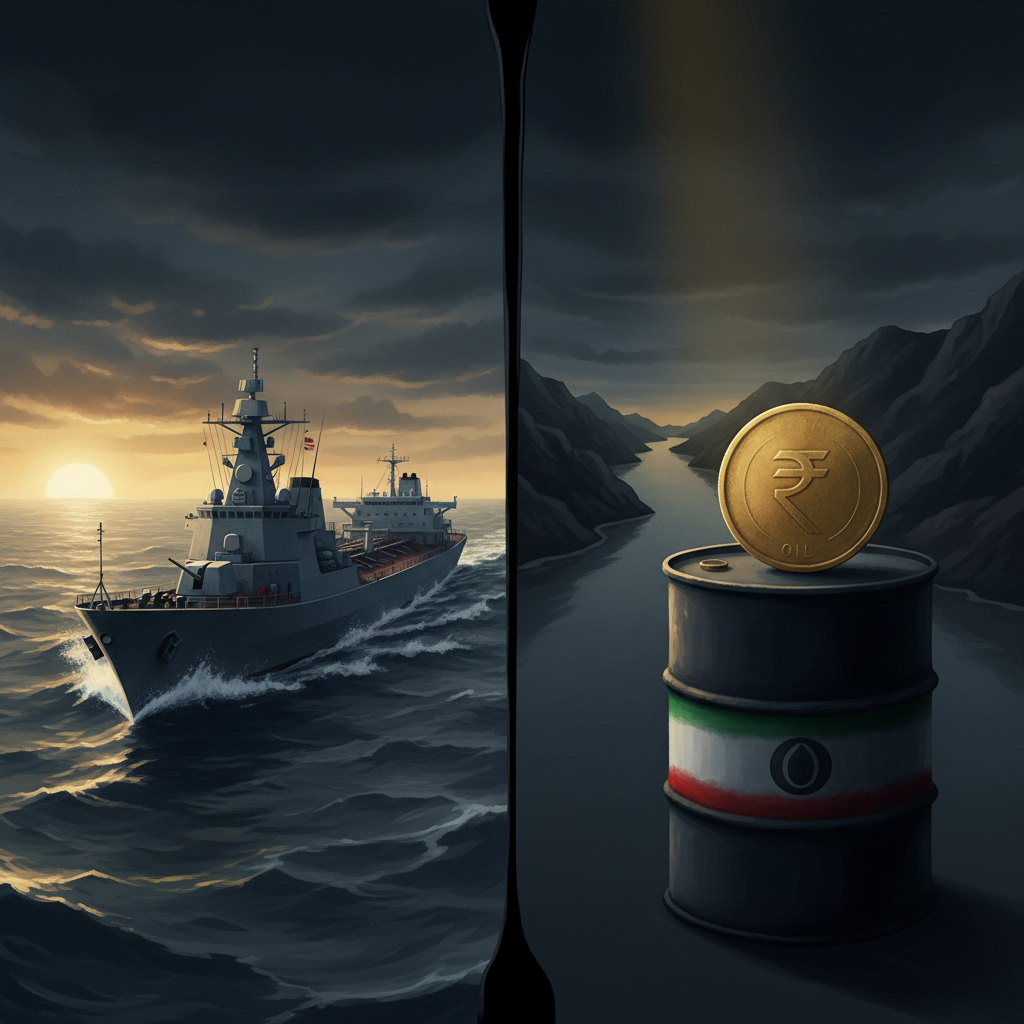
Three days earlier, on 1 April, the International Energy Agency had characterised the Strait of Hormuz closure as "the largest supply disruption in the history of the global oil market." India's crude basket had surged from $69 per barrel in February to $113 per barrel in March -- a 64 percent increase in thirty days. Five Indian Navy warships were running escort operations through hostile waters under Operation Urja Suraksha. And the White House, far from objecting, had itself issued a 30-day waiver permitting the purchase of Iranian crude at sea.
The question is not whether India defied America. The question is whether America, having lit the fire, is now handing out the hoses.
The seven-year zero and what it cost
A brief accounting of what India gave up between 2019 and 2026 to maintain its Iranian oil abstinence.
At peak, in 2018, India imported 620,000 barrels per day of Iranian crude. Iran was India's third-largest oil supplier. Indian refiners -- Indian Oil Corporation, Bharat Petroleum, Hindustan Petroleum, Mangalore Refinery and Petrochemicals, and Reliance Industries -- had configured their operations around Iranian heavy crude grades that offered favourable pricing and reliable supply. The payment infrastructure was built: UCO Bank operated a rupee-denominated channel that had processed over Rs 1 lakh crore in Iranian oil transactions since 2012, routing 45 percent of payment in rupees (which Iran used to buy Indian rice, pharmaceuticals, and machinery) and the remainder through a complex circuit involving Turkey's Halkbank, the Reserve Bank of India, and the UAE's central bank in dirhams.
When the first Trump administration revoked the sanctions waiver in May 2019, India complied. Imports dropped from 268,000 barrels per day in the January-May 2019 window to zero. The UCO Bank channel went dormant. The refiners reconfigured for Iraqi, Saudi, and Russian crude. The compliance was real, and it was costly: Indian refiners lost access to discounted Iranian grades, Iran lost its second-largest customer, and bilateral trade cratered to a shadow of its former self.
What survived was instructive. According to Iran's Chamber of Commerce, annual bilateral trade remained at approximately $3 billion even during the zero-oil years, with 70 percent attributed to Iranian exports to India -- largely petrochemicals, fertilisers, and agricultural products routed through mechanisms that did not trigger OFAC sanctions. India continued operating Chabahar port under a specific waiver. The International North-South Transport Corridor working groups continued to meet. The diplomatic channel remained open.
India did not sever the relationship. It put the most visible part of it -- oil -- into hibernation, and waited.
Seven years is a long time to wait. The wake-up call came not from Delhi but from the Strait of Hormuz.
The supply crisis that broke the calculus
On 28 February 2026, the United States and Israel began combat operations against Iran. By the first week of March, Iran had effectively closed the Strait of Hormuz to most commercial shipping. Tanker traffic through the strait -- which in normal times carries roughly 20 percent of the world's oil supply -- dropped to near zero.
For India, the arithmetic was immediate and brutal. Eighty-five percent of India's crude is imported. A significant share of that arrives through or near the Strait of Hormuz. The Indian crude basket, which had been stable at $69 per barrel in February, hit $113 by March -- a price level that transmits directly into inflation, the fiscal deficit, fertiliser subsidies, and the price of cooking gas in 300 million Indian kitchens.
The government's response was operational before it was diplomatic. On 9 March, Pakistan launched Operation Muhafiz-ul-Bahr, deploying naval assets to escort Pakistani National Shipping Corporation vessels. India followed within days with Operation Urja Suraksha -- over five frontline warships, including destroyers and frigates, stationed east of the Strait of Hormuz, escorting more than twenty Indian-flagged cargo ships through the northern Arabian Sea. It was the first time since the Tanker War of the 1980s that South Asian navies had conducted escort operations in the Gulf of Oman.
The naval deployments told a story that the diplomatic language was still trying to obscure. India was not watching the crisis from a distance. India was in the water, burning fuel, deploying men, and absorbing risk to keep its energy supply chain alive. Under those conditions, the question of whether to buy Iranian oil -- available, proximate, and offered at a discount -- was not a question of principle. It was a question of survival arithmetic.
The waiver that was not quite permission
On 6 March, the White House issued a 30-day waiver permitting India to continue purchasing Russian oil without triggering the secondary tariff mechanism that had been imposed earlier in the year. A separate, less publicised, waiver permitted the purchase of Iranian crude at sea -- a category that covered oil already loaded on tankers, including those operated by Iran's shadow fleet.
The waivers are revealing. They reveal that Washington understood the supply crisis was real, that allied and partner nations could not simply absorb a 64 percent price surge and maintain domestic stability, and that the sanctions architecture -- designed to coerce in peacetime -- was becoming a liability in wartime. You cannot simultaneously bomb a country's infrastructure, close its strait, disrupt global supply, and then sanction your own partners for buying whatever oil they can find. The physics of coercion breaks down when the coercer is also the arsonist.
But waivers are not policy. They are temporary. The 30-day Russian oil waiver expires on 5 April. The Chabahar port waiver expires on 26 April. The Iranian crude waiver's precise terms and duration remain opaque. Each waiver is a ticking clock, and each clock's expiry is a new decision point at which Washington can reimpose the full weight of its sanctions apparatus.
This is the structural problem India faces. The waivers create a corridor of permission, but the corridor is narrow, temporary, and subject to the domestic political calculations of a White House that has already imposed a total tariff of 50 percent on India -- 25 percent reciprocal, 25 percent additional -- partly to pressure Delhi on Russian oil imports. The Office of Foreign Assets Control has sanctioned 14 additional shadow fleet tankers and is actively targeting non-US entities that facilitate Iranian oil transactions, including shipping companies, financial institutions, and insurers operating within dollar-denominated systems.
India is walking through a door that Washington opened, knowing that Washington can close it at any moment, for any reason, or for no reason at all.
The payment question: how does money move?
When India last bought Iranian oil at scale, the payment architecture was the UCO Bank rupee mechanism. The system worked as follows: Indian refiners deposited rupees into accounts held by Iranian banks at UCO Bank, a state-run lender deliberately chosen for its minimal exposure to the American financial system. Iran used the rupee balances to purchase Indian goods -- rice, wheat, pharmaceuticals, machinery, textiles. At peak, this channel processed more than Rs 1 lakh crore.
The 2026 resumption raises the question of whether the old infrastructure can be reactivated, or whether a new mechanism is required. The options are not unlimited.
Dollar settlement is excluded by definition -- any dollar-denominated transaction touching an Iranian counterparty triggers OFAC jurisdiction. Euro settlement is impractical since the European banking system has been even more compliant with American sanctions than Asia's. Yuan settlement is theoretically possible -- China has been paying for Iranian crude in renminbi for years -- but India has no interest in deepening its exposure to the Chinese currency system at a moment when the bilateral relationship carries its own strategic tensions.
That leaves the rupee channel, potentially supplemented by a dirham circuit through the UAE, as it was in the 2012-2018 period when $1.65 billion was routed through the Reserve Bank of India to the UAE central bank in three equal instalments. India and Iran formalised a rupee-based payment framework in late 2018, just months before the waiver was revoked. The infrastructure exists. The question is whether activating it in 2026 draws the same American response it would have drawn in 2023 -- or whether the supply crisis has created a political environment in which Washington chooses not to see what it cannot afford to punish.
Bloomberg reported on 4 April that India had acknowledged the Iranian purchases and dismissed payment difficulties. The petroleum ministry's language was carefully transactional: crude supplies were "fully secured" for the coming months. No mention of rupees, no mention of UCO Bank, no mention of the mechanism. The silence on method is itself a signal. India is buying. India is paying. India is not advertising how.
Posture three arrives ahead of schedule
The day after the oil purchase was confirmed, BarathVector published an analysis of India's three available postures on the Iran question. Posture one was conditional continuity -- keep Chabahar through legal distancing, negotiate each waiver cycle. Posture two was strategic de-risking -- accept arm's-length engagement, diversify corridors away from Iranian soil. Posture three was declared autonomy -- state publicly that India's engagement with Iran in non-sanctioned categories is a matter of national interest.
That assessment judged posture one as failing on its own terms and posture three as "the option no government wants to exercise until the cost of not exercising it exceeds the cost of doing so."
That threshold was crossed faster than anyone -- including, quite possibly, South Block -- expected. The oil purchase is not a rhetorical statement of autonomy. It is an operational one. Indian refiners are processing Iranian crude. Indian warships are escorting tankers. Indian banks are settling transactions. The facts on the water are ahead of the policy on paper.
This does not mean India has formally adopted posture three. No minister has stood at a podium and declared that secondary sanctions against Indian operators would be treated as an act affecting the broader bilateral relationship with Washington. The petroleum ministry's language remains studiously technical. But the gap between what India is doing and what India is saying is itself a form of communication -- directed at Washington, at Tehran, and at the Gulf states watching from the sidelines.
The S-400 precedent and its limits
India has defied American sanctions before. The most cited precedent is the S-400 purchase from Russia, completed under the first Trump administration despite explicit American warnings that the Countering America's Adversaries Through Sanctions Act (CAATSA) could be triggered. India bought the system, absorbed the diplomatic displeasure, and moved on. Washington chose not to impose CAATSA sanctions. The bet paid off.
The S-400 precedent is comforting but imperfect. It was a one-time procurement decision -- a fixed quantity of hardware at a fixed price. The Iranian oil question is a recurring flow. Every tanker is a new transaction. Every cargo is a new potential sanctions trigger. Every payment is a new exposure point. The S-400 required one act of political will. Iranian oil requires continuous political will, renewed with every shipment, sustained through every news cycle, defended against every executive order.
The sanctions environment has also thickened since 2019. The 2026 executive order authorises tariffs against countries that purchase Iranian goods or services, direct or indirect. OFAC's targeting of non-US entities -- shipping companies, insurers, financial intermediaries -- means that the sanctions reach extends not just to the buyer but to the entire supply chain around the buyer. An Indian refiner processing Iranian crude may be insulated from direct sanctions if a waiver holds. The Indian shipping company that carried it, the Indian insurer that covered it, the Indian bank that settled it -- each faces a separate calculus.
The S-400 was a bullet India could bite once. Iranian oil is a meal India must chew indefinitely.
What the Gulf states are not saying
Absent from the public record is any reaction from Saudi Arabia or the UAE to India's Iranian oil purchases. This silence is not diplomatic courtesy. It is the sound of governments consumed by their own crisis.
Saudi Arabia and the UAE have their own Hormuz problem. Both have invested in bypass pipelines -- Saudi Arabia's East-West Pipeline (5 million bpd capacity) and the UAE's Habshan-Fujairah Pipeline (1.5 million bpd) -- but these carry a fraction of pre-crisis volumes and have themselves been targets of Iranian-aligned strikes. The Chatham House assessment from March said the Iran war is "exacting a heavy toll on Gulf oil and gas exporters." The Arab Center in Washington published an analysis arguing that the conflict marks "the end of the US-Gulf oil for security deal."
Gulf states that cannot secure their own exports are in no position to object to India securing its own imports. If anything, the shared vulnerability creates a quiet solidarity. India's naval deployments in the Gulf of Oman protect not just Indian-flagged vessels but the broader principle that commercial shipping in international waters should not be hostage to a conflict India did not start, did not want, and cannot end.
Pakistan's parallel crisis
Pakistan's experience illustrates what happens to an energy-dependent economy that lacks India's naval reach and diplomatic weight. Pakistan imports over 80 percent of its oil. More than 60 percent of its LPG comes from Iran. LNG shipments crashed from twelve per month in January 2026 to two in March. Petrol prices jumped 20 percent in a single week. The government imposed sweeping austerity measures.
Pakistan launched Operation Muhafiz-ul-Bahr on 9 March to escort its own shipping, but the Pakistan Navy lacks the blue-water capacity to sustain prolonged Gulf operations. The Iran-Pakistan gas pipeline -- contracted to carry 750 million cubic feet per day, equivalent to more than seven LNG cargoes per month -- remains incomplete after decades of false starts. Had it been functional, Pakistan's energy crisis would have been severe. Without it, the crisis is existential.
India's position is better, but not by as much as New Delhi might like to believe. The difference is not structural immunity. It is operational capacity -- warships, refinery flexibility, payment infrastructure, diplomatic bandwidth -- that buys time. Time is not a solution. It is the interval in which solutions must be found.
The real question Washington must answer
The conventional framing puts the burden on India: is Delhi defying Washington? Will India pay a price? Can the relationship absorb another friction point?
The more consequential framing puts the burden on Washington: did the United States create the conditions under which its own partners had no rational choice but to buy Iranian oil?
The answer is plainly yes. The US-Israel war on Iran closed the Strait of Hormuz. The closure triggered the largest supply disruption in global oil market history. The disruption drove India's crude basket up 64 percent in one month. The price surge threatened the fiscal and political stability of the world's fifth-largest economy and third-largest oil importer. Under those conditions, India's purchase of available Iranian crude -- including crude that Washington itself waived for purchase -- is not defiance. It is energy triage.
The deeper problem for Washington is that the sanctions architecture was designed for a different world. It was designed for a world in which the United States could punish Iran without disrupting global supply, coerce partners without threatening their stability, and maintain the dollar's centrality in energy trade without offering an alternative when the system breaks. That world ended on 28 February 2026. The sanctions remain. The world they were designed for does not.
Every executive order that widens the sanctions perimeter, every tariff that compounds the cost of compliance, every OFAC designation that reaches deeper into allied supply chains -- each is a test of how much coercion the partnership can absorb. India absorbed the S-400 test. India absorbed the Russian oil friction. India is now absorbing the Iranian oil question. The question is not whether India will break. It is whether the tests will ever stop, and if not, whether India will conclude that the cost of perpetual accommodation exceeds the cost of declared independence.
What the reader should carry away
India's return to Iranian oil is not a policy choice made in a seminar room. It is an operational response to a supply crisis of historic proportions, enabled by American waivers, executed through infrastructure that was never fully dismantled, and defended by Indian warships in the Gulf of Oman. The framing of "defiance" flatters both sides -- it makes India look braver and America look more betrayed than the facts warrant.
The specific things to watch:
- The waiver clock. The Chabahar waiver expires 26 April. The Iranian crude waiver's terms are opaque. The Russian oil waiver has already lapsed. Each expiry is a decision point where Washington can reimpose the full sanctions apparatus -- or quietly extend. Watch what Washington does, not what it says.
- The payment mechanism. If UCO Bank's rupee channel is reactivated at scale, it signals that India is building for sustained Iranian imports, not a one-off emergency purchase. If payments remain ad hoc and opaque, India is buying time without committing to a structure.
- Refiner behaviour. IOC, BPCL, HPCL, and Reliance Industries all processed Iranian crude before 2019. Which refiners are buying now, and at what volume, will indicate whether this is a trickle or a reopened pipeline. The 44,000 metric tons of LPG is a signal. The crude volumes, when they emerge, will be the substance.
- The BRICS summit. India hosts BRICS in September 2026. The agenda will inevitably include energy payment alternatives. Whether India uses that platform to formalise non-dollar oil settlement mechanisms -- or keeps the conversation informal -- will signal how far posture three extends.
- Gulf state silence. If Saudi Arabia and the UAE continue to say nothing about India's Iranian purchases, it means the old Gulf-US security compact is too damaged to enforce energy discipline. If they object, it means the compact has residual life. Silence, so far, speaks volumes.
The seven-year zero was not a natural state. It was a maintained state, held in place by American leverage and Indian compliance. The supply crisis of 2026 has broken the maintenance. India is back in the Iranian oil market -- cautiously, operationally, without fanfare. Whether it stays depends on whether the conditions that drove it back change faster than the habits it is now rebuilding.
When the house catches fire, you use the neighbour's hose. The fire is still burning. The hose is still running. The conversation about property lines will happen -- but not today.
BarathVector | Global Strategy | 8 April 2026