By Ramachandran Rajeev Kumar — 2026-05-30
Ninety Kilometres of Haryana: What India's Hydrogen Train Actually Proves
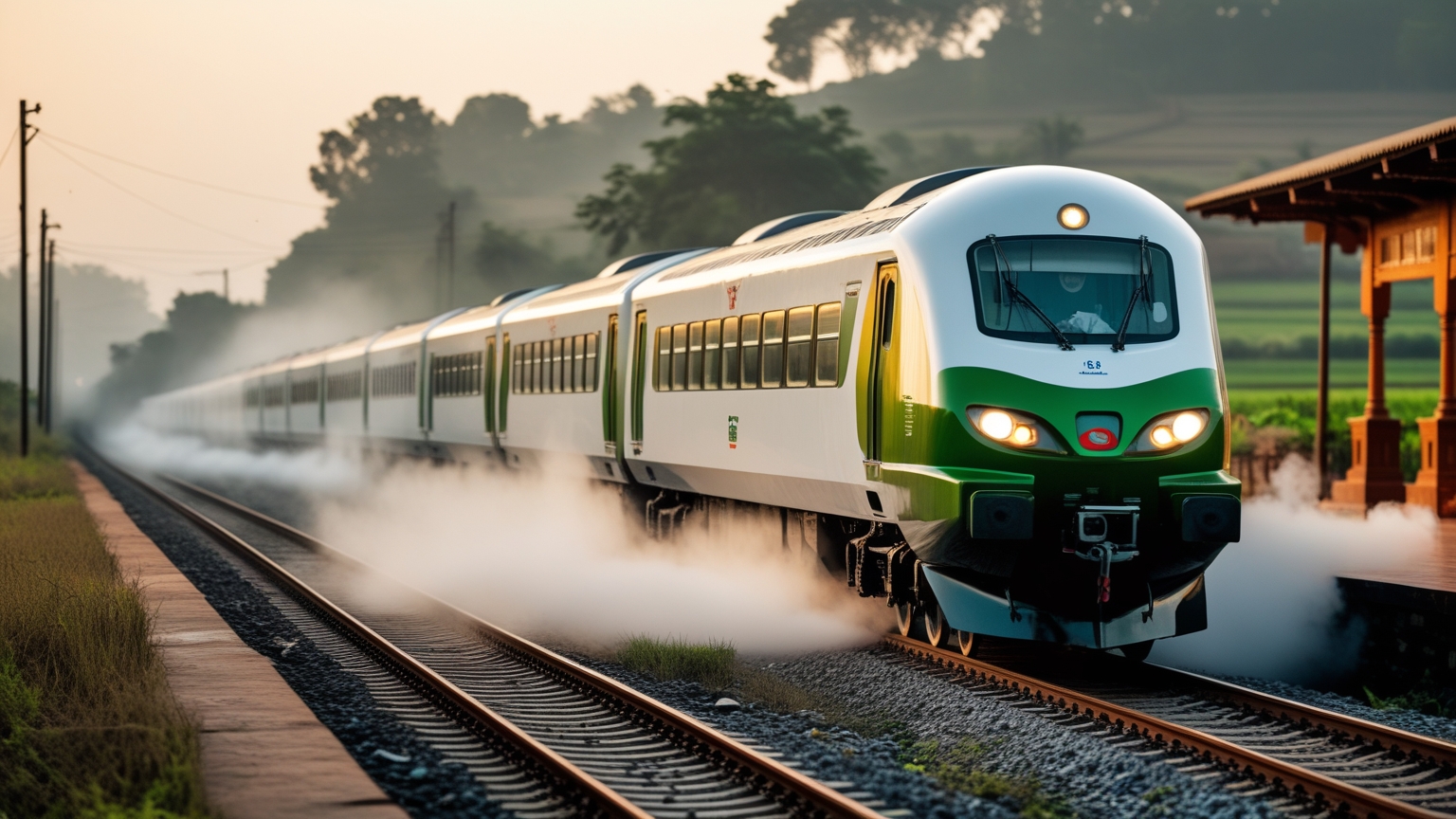
Two driving power cars rated at 1,200 kilowatts each. Ten coaches. A top speed of 75 km/h. A tailpipe that emits water vapour and nothing else. This is India's first indigenous hydrogen fuel-cell train, built at the Integral Coach Factory in Chennai, cleared by Indian Railways on 27 May 2026 for the 90 km stretch between Jind and Sonipat in Haryana. It has already passed oscillation trials. The hydrogen storage and refuelling plant at Jind has its safety licence from PESO. The thing is real, it is Indian, and it is about to carry passengers.
Now the uncomfortable part. Germany — which put the world's first commercial hydrogen passenger train into service — pulled most of its fleet in late 2024 and signalled that future orders will lean battery-electric. Japan's prototype began fare-paying tests in 2022 and never scaled. The supplier that built the fuel-cell stacks for the German train sold off the division after $657 million in losses.
So India is mass-producing, at home, a technology that two of the countries it is benchmarking against are walking away from. That sounds like a mistake. It is not. But understanding why it isn't a mistake matters more than the launch photographs — because the answer reveals exactly what New Delhi is actually buying, and what it is not.
The number that explains the strategy
Indian Railways has already electrified roughly 97 per cent of its broad-gauge network. That is the single most important fact in this story, and almost no coverage leads with it. The overhead-wire programme is, for practical purposes, finished. What remains is the awkward residue: branch lines with thin ridership, hill sections where stringing catenary through tunnels and gradients is brutally expensive, heritage routes where the wires would deface the very thing tourists come to see.
On those lines, the incumbent is not an electric train. It is a diesel one.
This is the hinge the German comparison turns on. In Lower Saxony, hydrogen lost to battery-electric because the alternative was a clean, wired grid running underneath. In rural Haryana and on the Kalka–Shimla type sections India has in mind, there is no wire to fall back on. The choice is not hydrogen versus electric. It is hydrogen versus diesel — and against diesel, a train that emits water wins on every axis except cost.
That reframing is the whole game. India is not betting that hydrogen beats electrification. It is betting that hydrogen beats the diesel locomotives still hauling passengers on the 3 per cent of the network that wires will never economically reach.
What the commuter on the Jind line actually gets
Strip away the energy-sovereignty rhetoric and ask the question that matters to a passenger boarding at Jind: does this change my journey?
In the near term, barely. The train tops out at 75 km/h on this corridor — respectable for a branch line, unremarkable as a number. The commuter gets a quieter coach, no diesel fumes on the platform, and a ride that is no slower than what they had. That is a genuine improvement in the daily texture of a journey, and it should not be dismissed. Clean air at a small-town railway platform is not an abstraction to the people who breathe it.
But the honest framing is that the immediate beneficiary is not primarily the commuter. It is the decarbonisation ledger — and, more pointedly, India's industrial capability. The person this train serves most is not yet on the platform. It is the engineer at ICF who now knows how to integrate a fuel-cell propulsion system into a rolling coach, and the supply chain that will have to learn to make the stacks, the storage tanks, and the electrolysers at scale. That is the asset being built here. The train is the by-product.
The cost wall nobody on the dais mentions
Here is where the analysis has to get hard, because the brochures will not.
Green hydrogen — the kind made by splitting water with renewable electricity, the kind that makes this train genuinely zero-carbon — currently costs ₹300 to ₹400 per kilogram in India. The train consumes roughly 900 grams of hydrogen per kilometre. Do the arithmetic and the fuel bill per kilometre lands well above what diesel costs today, before you account for the capital.
And the capital is steep. Under the Hydrogen for Heritage programme, each train is estimated at around ₹80 crore, with ground infrastructure adding ₹60–70 crore per route. The Jind–Sonipat pilot alone — a retrofit of an existing DEMU rake plus its refuelling plant — came in at ₹111.83 crore. The 2023–24 budget earmarked about ₹2,800 crore for 35 such trains, with a further ₹600 crore for hydrogen infrastructure. These are not commuter-rail economics. They are a research-and-development line item wearing a passenger train's clothes.
There is a second trap, quieter and more dangerous: the colour of the hydrogen. A fuel-cell train is only as clean as the gas it burns. If the hydrogen is "grey" — stripped from natural gas, the cheapest and most common method — then the train simply relocates the emissions from the tailpipe to the reformer, and the zero-emission claim collapses into accounting theatre. The genuinely green path runs through electrolysers like the 1 MW plant in Jhajjar, which produces around 420 kg of hydrogen a day running flat out. That is enough for a single train on a short route. Scaling to 35 trains, let alone a network, means scaling green-hydrogen production and the renewable power behind it by orders of magnitude. The train is the easy part. The fuel is the mountain.
Why build it anyway
A flat news brief stops at the caveats and calls the project premature. That is the lazy read, and it is wrong.
Every transformative energy technology was uneconomic on its first day. Solar was a curiosity priced for satellites before two decades of manufacturing scale drove the cost of a panel down by more than 90 per cent. The point of a pilot is not to be cheap. It is to build the muscle — the engineering know-how, the safety codes, the domestic supply chain, the regulatory templates — that makes the next unit cheaper. India learned this with the solar mission and is now the cheapest place on earth to deploy a panel. The hydrogen train is the same wager, placed early and deliberately.
The energy-sovereignty logic compounds it. India imports the overwhelming majority of the crude that becomes diesel. Every litre burned on a branch line is a litre bought in dollars from a volatile market — the same vulnerability laid bare every time the Strait of Hormuz makes the news. Hydrogen made domestically from Indian sun and Indian water is not just cleaner. It is a hedge against the import bill and the geopolitics attached to it. That is a strategic asset diesel can never be, at any price.
So the right verdict is neither the breathless one nor the cynical one. India's hydrogen train will not transform how most Indians travel. It is expensive, the fuel is expensive, and the green-hydrogen supply chain that justifies the whole exercise barely exists yet. All of that is true, and all of it should be said plainly.
It is also a deliberate, clear-eyed down-payment on a capability India will need — built indigenously, on a route where it actually makes sense, while the cost curve is still high enough that early movers earn the learning. Germany could afford to walk away because it had wires underneath. India is building the option it does not yet have. Ninety kilometres of Haryana is a short distance to run a train. It is a reasonable distance to run an experiment that the rest of the network may one day depend on.
The water vapour trailing off the Jind line is, for now, mostly symbolic. Whether it becomes substantial depends entirely on what India does about the electrolysers — not the trains. Watch the fuel, not the photo-op.