By Shibu Daniel — 2025-12-22
The $2.24 Billion Sword: How Indian Shrimp Farmers Are Fighting Trump's 50% Tariffs
The Indian shrimp industry's response to hefty US tariffs of up to 50% could provide the blueprint for diversification against geopolitical shocks.
When Donald Trump returned to the Presidency, pundits believed India might be best placed to placate the new administration. The previous Trump term had built on two decades of careful diplomacy, enhanced by personal rapport between the two leaders - something PM Modi has been particularly skilled at cultivating.
So it came as an unpleasant surprise when Trump posted on Truth Social calling India a "dead economy" and announced tariffs of up to 50% - among the highest imposed on any country. While pharma and electronics received exemptions, agricultural exports did not.
India's Shrimp Empire
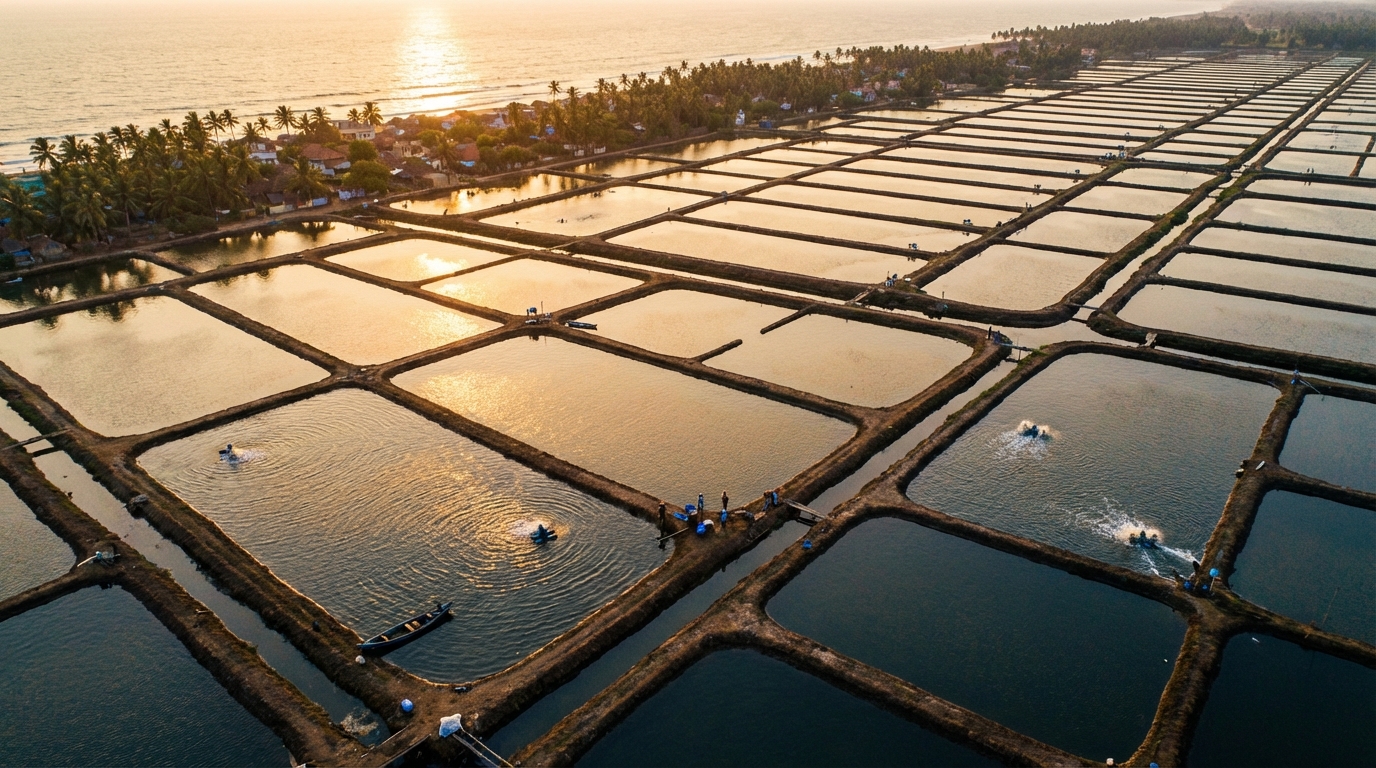
India has been one of the largest exporters of farmed shrimp in recent years - a position frequently challenged by Ecuador, another giant producer. The industry is largely concentrated in Andhra Pradesh, with operations in neighboring Tamil Nadu and an emerging cluster around Gujarat.
What makes Indian shrimp unique is its export dependency. Unlike other major producers, almost all produce is exported with negligible local consumption. This made the US market - with its enormous size and less stringent compliance requirements compared to the EU - the ideal destination.
| Market | Challenge |
|---|---|
| United States | Now facing up to 50% tariffs |
| European Union | One of world's toughest compliance regimes |
| China | COVID-era inspections disrupted Indian imports |
The Perfect Storm
The industry's troubles began before Trump's inauguration. Indian producers depend heavily on imported broodstock from the US - specifically the Pacific Whiteleg Shrimp, an exotic species from the Americas. These are bred in high-end Specific Pathogen Free (SPF) facilities, certified free of pathogens that devastated earlier Indian Ocean species.
Ecuador, by contrast, works with locally bred broodstock through decades of selective breeding - the species is native to their environment. This genetic advantage began paying dividends in the early 2020s.
The productivity crisis:
- Annual yields declining across Asia, including India
- Ecuadorean production surging due to successful local adaptation
- Indian farms operate at higher densities but facing diminishing returns
- Ecuadorean industry consolidated into larger, better-capitalized companies
- Indian production remains fragmented among individual farmers
When the tariffs hit, the impact was immediate. Orders collapsed as traders couldn't afford the steep discounts American buyers demanded. Unsold inventory crashed domestic prices below farmers' profit margins.
Why This Time Is Different
India and Ecuador have faced anti-dumping duties before. Ecuador weathered Chinese anti-dumping duties when China was their biggest market - exports simply shifted to Vietnam, which serves as a processing hub for multiple markets including China.
But the current situation feels existential for three reasons:
- Scale: 50% tariffs are exceptional; anti-dumping duties have historically been far lower
- Disparity: Tariffs disproportionately affect India while competitors face much lower duties
- Timing: Indian farmers were already struggling with falling production
There is no rulebook for riding out the Trump wave - something most industries and countries are still grappling with.
The Free Market Response
Indian farmers and traders have shifted course rapidly.
Species diversification: The declining productivity of Pacific Whiteleg had already sparked a resurgence of Black Tiger Shrimp - a native Indian Ocean species commanding premium prices. Resilient SPF strains now offer wider profit margins.
Processing expansion: India has finally invested in downstream processing plants, capturing value that previously went to foreign processors.
Market diversification: When tariffs hit, free market dynamics kicked in:
- Exports redirected to EU, China, and Japan
- Some traders absorbed partial impact to retain US customers, hoping for eventual trade deal relief
- Thawed China relations opened that market to Indian products
- The upcoming India-EU trade deal could provide further relief
Yet the free market cannot solve everything. Credit stress, inventory losses, and small farmer insolvency remain critical unsolved issues.
Lost Opportunities
Nothing could have prepared Indian farmers for 50% tariffs - Trump 2.0's unpredictability is its most predictable feature. But the industry did miss vital opportunities:
Negligible domestic consumption: India is exceptional among major shrimp producers for not developing local demand. China successfully marketed farmed shrimp as a premium protein. In Kerala, where seafood is a staple, there's still skepticism around farmed shrimp despite declining natural populations.
Late downstream integration: While Vietnam and Ecuador built processing capacity, India exported raw product for processing abroad - losing significant revenue in the value chain.
The Way Forward
The Indian shrimp industry may be one of the country's most underrated success stories - perhaps because it's concentrated in specific regions. But the numbers speak:
| Metric | Value |
|---|---|
| Total shrimp exports | $5 billion |
| US market alone | $2.24 billion |
| Employment | Thousands of individual farmers |
The industry largely stood on its own feet, facing trials from insufficient biosecurity training, the famous disconnect with academia and R&D that plagues Indian agriculture, and brutal wipeouts from nature's fury. Traders succeeded by riding free market waves - something forced upon them by the absence of local demand.
The Bigger Picture
News reports indicate India has resisted American pressure to open agriculture and dairy markets - among India's most protected sectors. Trump himself just spent $12 billion bailing out soy farmers after China switched to Brazilian producers.
But consider this: India exports less agricultural produce than the Netherlands - a country slightly bigger than Kerala with half Delhi NCR's population. Even accounting for Dutch advantages in re-exports through Rotterdam and high-value horticulture, this highlights Indian agriculture's relative underproductivity.
The shrimp industry's forced embrace of free markets and diversification offers lessons for Indian policy-makers. Incentivizing farmers to diversify from MSP crops while maintaining food security guard-rails remains a tall order - but the shrimp farmers are showing one way it can be done.
Shibu Daniel covers trade policy and India's export industries. Edited by BarathVector Editorial.