By BarathVector Editorial — 2026-02-19
When JD Vance flew into Paris in February 2025 and warned that "excessive regulation would kill a transformative industry," he was delivering a message, not opening a negotiation. The United States and United Kingdom both declined to sign the joint declaration at the Paris AI Action Summit -- a 61-nation communique on "Inclusive and Sustainable AI for People and the Planet." India, which co-chaired the summit alongside Emmanuel Macron, signed without hesitation.
That single moment encapsulates everything India is attempting in global AI governance. It is not America's partner, not Europe's student, and not China's rival. It is, with considerable deliberateness, building a third lane.
The Paris Moment
The Paris declaration was the third in a series that began at Bletchley Park in 2023, continued in Seoul in 2024, and landed in New Delhi in February 2026 as the AI Impact Summit -- the first major global AI convening hosted in the Global South. Over 110 countries attended, approximately 20 heads of state, roughly 45 ministers, and a front row of Silicon Valley principals: Sam Altman, Sundar Pichai, Dario Amodei, Demis Hassabis. Microsoft announced $17.5 billion in Indian AI infrastructure investment at the Summit. Total commitments across the event reached $200 billion.
India's co-chairmanship of Paris and its hosting of New Delhi are not coincidences. They reflect a calculated campaign, running since India joined the Global Partnership on AI as a founding member in 2020 and served as GPAI Lead Chair in 2024, to occupy institutional ground before that ground hardens into permanent structures controlled by others.
What India Is Building at Home
The domestic architecture is moving in parallel. The IndiaAI Mission carries a budget of INR 10,371.92 crore -- approximately $1.14 billion over five years. It has deployed over 38,000 GPUs at INR 65 per hour, roughly 72 US cents, approximately one-third the global average compute cost. The target is 58,000 GPUs total. These are not vanity numbers. Affordable public compute is the precondition for any serious domestic AI ecosystem.
The model layer is following. BharatGen, Sarvam-1, and Everest 1.0 represent early bets on indigenous foundation models. Bhashini, covering 20 Indian languages across 350-plus AI models with more than a million downloads, is the linguistic infrastructure layer. AIKosh has catalogued over 9,500 datasets and 273 sectoral models. UIDAI has partnered with Sarvam AI to enable voice-based Aadhaar verification in 10 Indian languages, hosted within sovereign infrastructure.
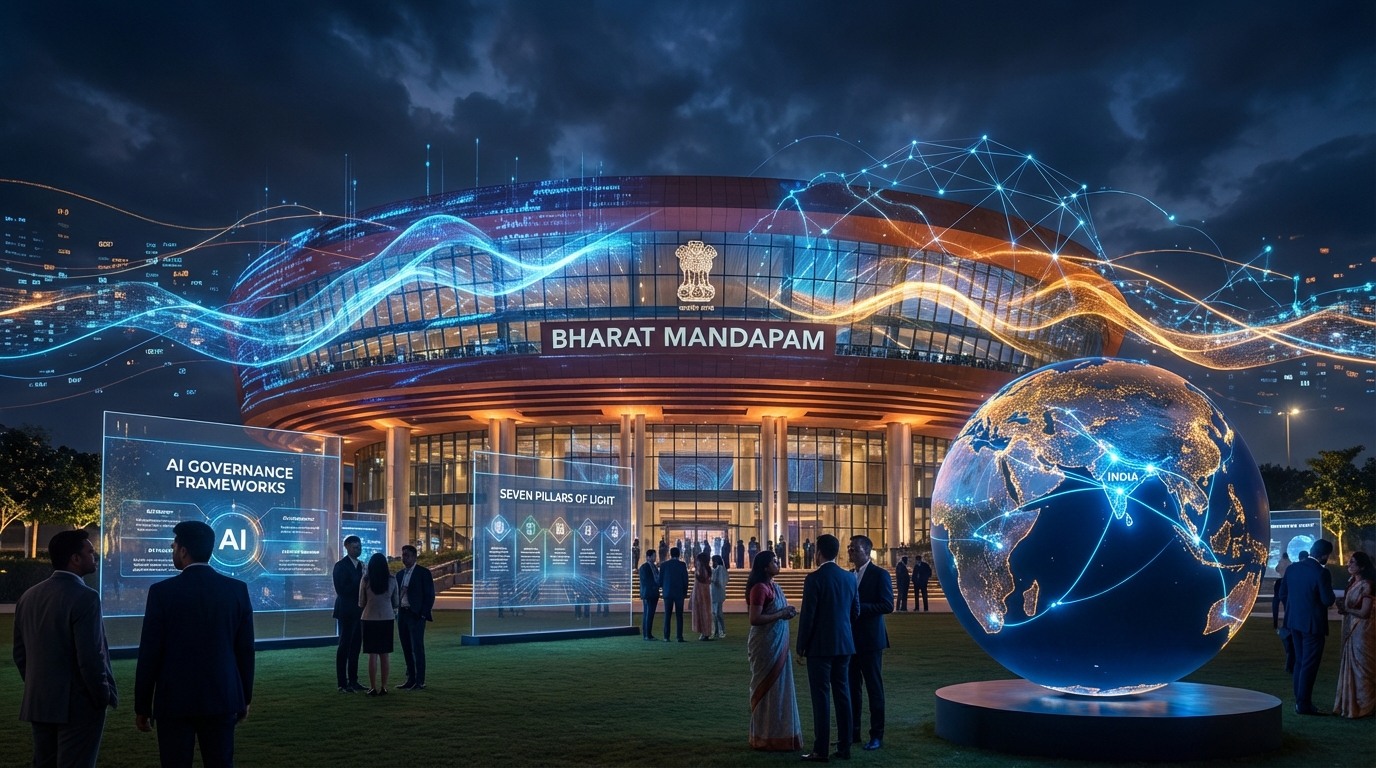
On governance, the Ministry of Electronics and Information Technology released its AI Governance Guidelines in November 2025. They are voluntary. They are principle-based. IT Secretary S. Krishnan was direct about the philosophy: "India has consciously chosen not to lead with regulation but to encourage innovation while studying global approaches." The framework is organised around seven principles -- described as "seven sutras" -- including Trust is the Foundation, People First, Innovation over Restraint, Fairness and Equity, Accountability, Understandable by Design, and Safety, Resilience and Sustainability. The EU AI Act's mandatory risk classification regime was examined and explicitly set aside. One binding measure did arrive in February 2026: the SGI Rules require mandatory labelling of AI-generated content, but that is a disclosure obligation, not a restrictions regime.
MeitY's Abhishek Singh has stated that India is "three to five years away from full-stack AI sovereignty" across compute, models, data, and semiconductors. The phrase "full-stack sovereignty" is doing real work here. It is not autarky. It is the capacity to make independent choices at every layer of the stack.
The Third Way Thesis
India's most underappreciated argument is not about regulation or investment. It is about governance architecture as a public good.
The Aadhaar-UPI-DigiLocker stack is the foundational proof of concept. A government-designed but open, interoperable digital identity and payments infrastructure that scaled to a billion users without becoming a monopoly platform. MOSIP -- the Modular Open Source Identity Platform, developed in Bengaluru -- has now been deployed in more than 20 countries across Asia and Africa. These are sovereign systems, not Indian systems, built using Indian methodology.
At the AI Impact Summit, Prime Minister Modi framed the convergence of Digital Public Infrastructure and artificial intelligence as "the next major step for inclusive development." The pitch to Africa, Southeast Asia, and Latin America is explicit: India built sovereign digital infrastructure at scale under resource constraints, and the playbook is transferable. The "AI Commons" concept India is advocating -- treating compute capacity, datasets, and models as global public goods rather than proprietary assets -- is a direct response to the concentration of AI capability in a handful of American and Chinese corporations. India backed the Current AI Foundation at Paris, the $400 million French-led endowment for AI as public goods, alongside Google and Salesforce.
The Rest of the World summarised the New Delhi summit as India pitching "a third way beyond US and China." That framing is accurate, though it understates the ambition. India is not simply positioning between two poles. It is attempting to export a governance philosophy.
The Sovereignty Paradox
The tension at the centre of this strategy is not hidden. Microsoft's $17.5 billion infrastructure commitment is the largest single foreign investment in Indian AI to date. $200 billion in total Summit commitments flows predominantly from the same multinationals whose data practices, model architectures, and market power represent precisely the dependencies India's sovereignty agenda is designed to reduce.
India needs that capital to build the compute base that would eventually reduce its need for that capital. It is a sequencing problem with a tight window. The DPDP Act 2023 and the requirement that DPI run within sovereign infrastructure are the legal instruments for managing the dependency. Whether they are sufficient -- whether India can attract the investment while retaining the governance autonomy -- is the open question that the next five years will answer.
What the Bet Means
India's wager is that governance leadership and model leadership are separable, and that the former matters more in the long run than the latter. The countries that set the norms, shape the institutions, and build the shared infrastructure will have more durable influence than those that merely ship the fastest models.
The US-UK refusal in Paris was a bet in the opposite direction: that speed and scale are sufficient, that governance frameworks are constraints rather than assets, and that the rules of the road can be written unilaterally by those who move fastest.
India signed the Paris declaration. It hosted New Delhi. It is spending $1.14 billion on public compute infrastructure and writing voluntary governance principles while larger powers argue about whether principles are worth writing at all.
That is not fence-sitting. It is a strategic calculation about where durable influence in AI actually comes from -- and a statement that India intends to be present when those rules are made, on terms it helped author.