By Ramachandran Rajeev Kumar — 2026-01-01
India's Coming of Age: How the Ukraine War Reshaped a Nation's Destiny
The gamble that will define India's place in the 21st century world order
When Russian tanks rolled into Ukraine on February 24, 2022, few predicted that the conflict would become a crucible for India's geopolitical identity. Three years later, as the dust settles on one of the most turbulent periods in post-Cold War history, it is clear that India has emerged fundamentally transformed - not despite its controversial stance, but because of it.
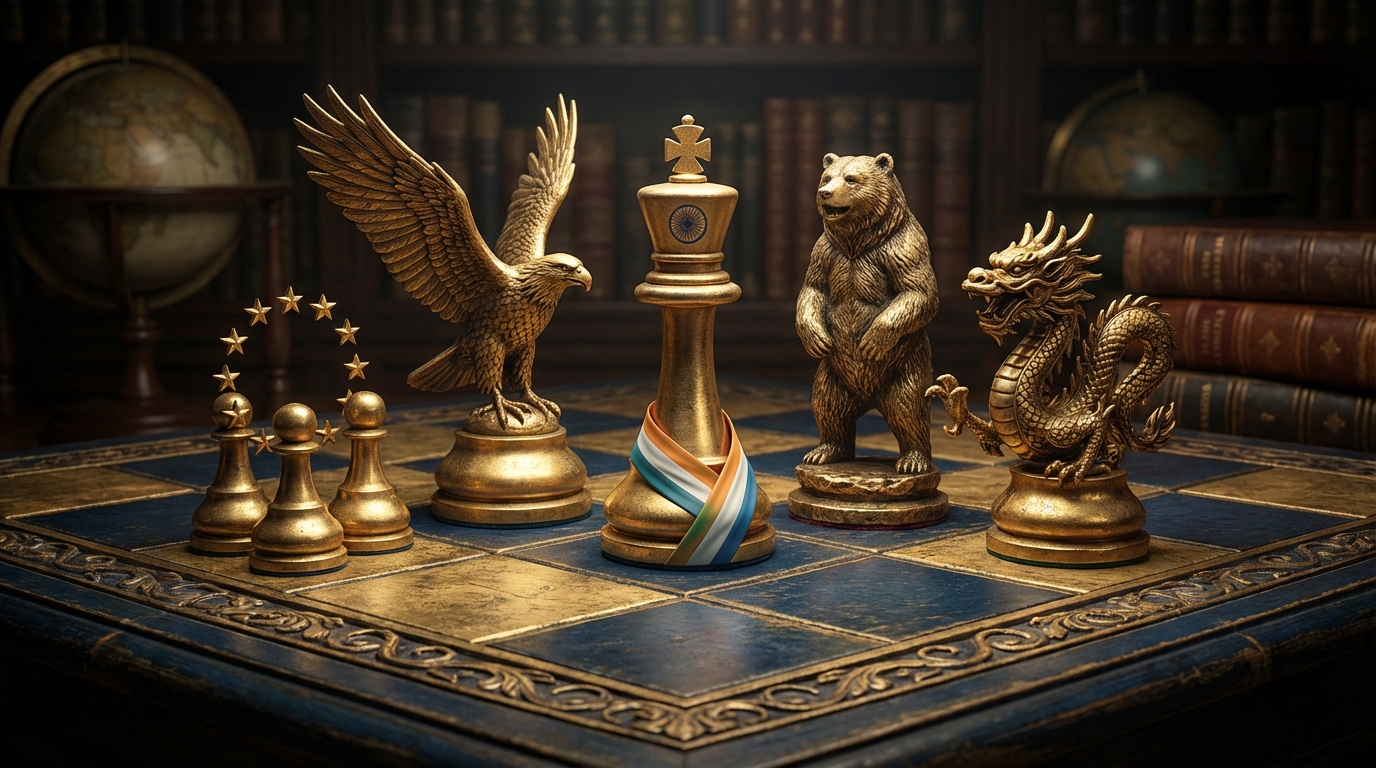
India took a gamble. It rejected the easy path of Western alignment for the harder road of true strategic autonomy. The consequences of this choice will echo for decades, reshaping relationships with every major power and positioning India as the voice of a restless Global South.
The Gamble: Strategic Autonomy vs. Easy Alignment
The easy path was clear: join the Western chorus condemning Russia, align with the "rules-based international order" narrative, and reap the rewards of American approval. Many in New Delhi's strategic establishment counseled this approach. The Biden administration, after all, had shown unprecedented warmth toward India - the Quad was flourishing, technology transfer was accelerating, and the Initiative on Critical and Emerging Technology (iCET) promised a new era of defense cooperation.
India chose differently.
From the first UN vote on Ukraine, India abstained. It continued purchasing Russian oil even as Western sanctions multiplied. It proceeded with the S-400 missile system delivery despite CAATSA threats. It hosted Russian Foreign Minister Lavrov while Western capitals shunned him.
The official explanation - that India favored "dialogue and diplomacy" - was dismissed by critics as diplomatic evasion. The real reasons ran deeper: sixty years of defense dependence on Moscow, the China threat requiring Russian cooperation, and a fundamental belief that great powers should not dictate sovereign choices.
What looked like fence-sitting was actually a calculated bet on a multipolar future.
For Trump's America: A Costly Error
The consequences for US-India relations have been severe, particularly under the Trump 2.0 administration.
On April 2, 2025 - what the White House grandly called "Liberation Day" - President Trump imposed sweeping tariffs that would eventually total 50% on Indian exports. The rationale was explicit: India was "funding Putin's war" through oil purchases. Trump's trade advisor Peter Navarro went further, controversially calling the conflict "Modi's war."
The numbers tell a damning story:
| Metric | Before Tariffs | After Tariffs |
|---|---|---|
| Indian exports to US | $86.5 billion | Projected $50 billion |
| Tariff rate | ~3% average | 50% |
| Key sectors hit | Textiles, gems, shrimp | 70% collapse projected |
Trump called India a "tariff king" and "dead economy" - rhetoric that would have been unthinkable under Biden or even during his own first term.
Yet here lies the paradox: even as economic relations cratered, strategic cooperation continued. In October 2025, the US and India renewed their 10-year Defense Framework Agreement. American MQ-9B SkyGuardian drones were delivered. GE engine technology transfer for the Tejas Mk-2 proceeded.
The message from New Delhi was clear: India would not be bullied into abandoning strategic autonomy, but it would also not abandon partnerships that served its interests.
Trust, however, is now fractured. It may recover partially, but never to pre-2025 levels. The Trump administration demonstrated that America can and will weaponize trade policy against democratic partners who exercise independent foreign policy judgment. This lesson will not be forgotten.
For Putin's Russia: A Friend That Stayed
For Moscow, India's stance has been a solace amid isolation.
While Europe severed energy ties and the West imposed unprecedented sanctions, India became Russia's lifeline. The oil trade tells the story:
| Period | Russian Oil Share | Volume |
|---|---|---|
| Pre-war (2021) | ~2% | <0.1 million bpd |
| November 2025 | ~38% | 1.9 million bpd |
India saved billions through discounted Russian crude - approximately $12 per barrel below Brent benchmark. These savings helped contain domestic inflation and stabilize the rupee during volatile periods.
But the relationship is not without strain. Defense supplies, Russia's traditional card, have become unreliable:
- S-400 squadrons 4 and 5, originally scheduled for 2024, are now delayed to 2026
- Russian spare parts production was halted in December 2025
- The Rupee-Ruble trade mechanism largely failed - Russia accumulated billions in rupees it cannot spend
Putin's visit to New Delhi in December 2025 - the 23rd annual summit - sought to address these concerns. Twenty-nine agreements were signed, focusing on diversifying beyond energy and defense into labor mobility, shipbuilding, and economic cooperation.
The signal to the West was unmistakable: India will not isolate Moscow, regardless of pressure.
For Russia, this friendship demonstrates that the world is not uniformly aligned against it. The Indo-Russian partnership creates possibilities for a third pole in global politics - a non-Western but not anti-Western alignment that the Global South can gravitate toward.
For Xi's China: A Rethink Required
The Ukraine war has catalyzed an unexpected thaw in India-China relations.
For years, Beijing viewed New Delhi through a dismissive lens - a Western puppet, a pushover, a thorn to be managed rather than respected. The 2020 Galwan clash reinforced mutual hostility.
But three years of observing India's strategic autonomy have forced a recalibration.
In October 2024, a breakthrough patrolling agreement at Depsang Plains and Demchok ended four years of standoff. In August 2025, Foreign Minister Wang Yi visited Delhi - direct flights resumed, and the Kailash Mansarovar Yatra was confirmed for 2026. At the SCO Summit in Tianjin, Modi and Xi met and termed each other "development partners."
What changed? Mutual economic constraints and a shared challenge from Trump's tariffs created unexpected common ground. Both nations face American pressure to decouple. Both recognize that prolonged hostility serves neither.
China is beginning to understand what India has always known: India as a friend is better for both countries - stable and sustainable for centuries. Short-term affairs with military regimes or despots may offer quick gains, but long-term partnerships require mutual respect.
This does not mean border tensions are resolved or strategic competition has ended. It means China is rethinking whether treating India as an adversary serves its interests.
For Munir's Pakistan: A Hardened Shell
India's posture toward Pakistan has transformed.
The Pahalgam terror attack on April 22, 2025 - which killed 26 civilians - triggered Operation Sindoor, the most significant India-Pakistan military exchange since Balakot. On May 7, Indian forces launched precision strikes on nine terrorist infrastructure sites in Pakistan-occupied Kashmir and Pakistani territory.
The operation made history: India's S-400 systems achieved their combat debut, reportedly intercepting a Pakistani AEW&C aircraft at 300 kilometers range - the most significant surface-to-air engagement in decades.
The message was unmistakable: India has hardened its shell.
The era of Gandhian softness and Nehruvian unwarranted decency is over. The tolerance for Pakistani drama and decades of terrorist-harboring has evaporated. The military establishment in Rawalpindi now understands that further provocations will invite massive retaliation.
Post-Sindoor, India is negotiating for additional S-400 systems and reportedly exploring Su-57 fifth-generation fighters. The defensive posture is becoming increasingly assertive.
For Europe: A Reliable Partner, On Indian Terms
The European Union finds itself in an awkward position.
Having locked horns with Russia - a decision that, to the Indian mind, makes little strategic sense given Europe's historical ties to Moscow - the EU now seeks India as a partner in its "de-risking from China" strategy.
FTA negotiations accelerated through 2025, though the December deadline was missed. Sticking points remain: the Carbon Border Adjustment Mechanism (CBAM), automotive market access, and agricultural subsidies.
Yet the EU remains India's largest trading partner in goods. Both sides recognize the relationship's importance.
India is acceptable as a long-term partner, but only if Europe does not demand abandonment of national interests. The lesson of the Trump tariffs applies equally: India will not sacrifice strategic autonomy for economic access.
For the Global South: A Third Path
Perhaps the most significant outcome of India's Ukraine stance is its emergence as the voice of the Global South.
The "Voice of Global South Summit" initiative brought together 120+ developing nations to discuss shared concerns: food security, energy access, debt distress, and climate justice. At the G20 in Johannesburg, India positioned itself as a consensus builder, advancing developmental agendas while major powers bickered.
Modi's 2025 itinerary read like a Global South roadmap: Ghana, Trinidad and Tobago, Argentina, Brazil, Namibia. At the Ethiopian parliament, he declared: "The Global South is writing its own destiny."
For nations caught between American pressure and Chinese loans, India offers a third path. The message is simple: strategic autonomy is possible. Major powers can be engaged simultaneously without submission to any.
If proper interfacing is achieved, the Russia-India partnership - potentially expanded to include willing Global South nations - could grow as strong as the Western and Chinese poles economically. With imagination, perhaps stronger.
The Multipolar Bet
India's gamble was premised on a belief that the unipolar American moment is ending and the bipolar US-China confrontation will not define the 21st century.
The evidence increasingly supports this view. American pressure pushed India closer to Russia. American tariffs accelerated the China thaw. American heavy-handedness strengthened Global South solidarity.
India has not "won" in any simple sense. The tariff damage is real. Export sectors are bleeding. The rupee touched 90 against the dollar. Trust with Washington is damaged.
But India has demonstrated something more valuable than short-term economic gain: that a democratic developing nation can chart its own course among great powers, absorb pressure from the world's largest economy, and emerge with its sovereignty intact.
The Long Game
History will judge whether India's gamble was wise. The immediate costs are visible. The long-term benefits remain speculative.
But consider the alternative. Had India joined the Western chorus on Ukraine, what would it have gained? Temporary American approval that could evaporate with the next administration. Rupture with a sixty-year defense partner. Vulnerability to Chinese pressure without Russian support. Loss of credibility in the Global South.
Instead, India chose the harder path. It absorbed the tariffs. It endured the rhetoric. It maintained relationships in all directions.
In doing so, India came of age.
The nation that spent decades as a "swing state" in great power competition has become something more: an independent pole in world politics, a voice for those without voice, and a model for sovereign decision-making in an age of pressure.
The Ukraine war did not create this India. It revealed it.
The author is Founder & Editor-in-Chief of BarathVector.