By Ramachandran Rajeev Kumar — 2025-12-28
India-Oman CEPA: The Third Trade Deal of 2025 Deepens West Asia Pivot
By Ramachandran Rajeev Kumar
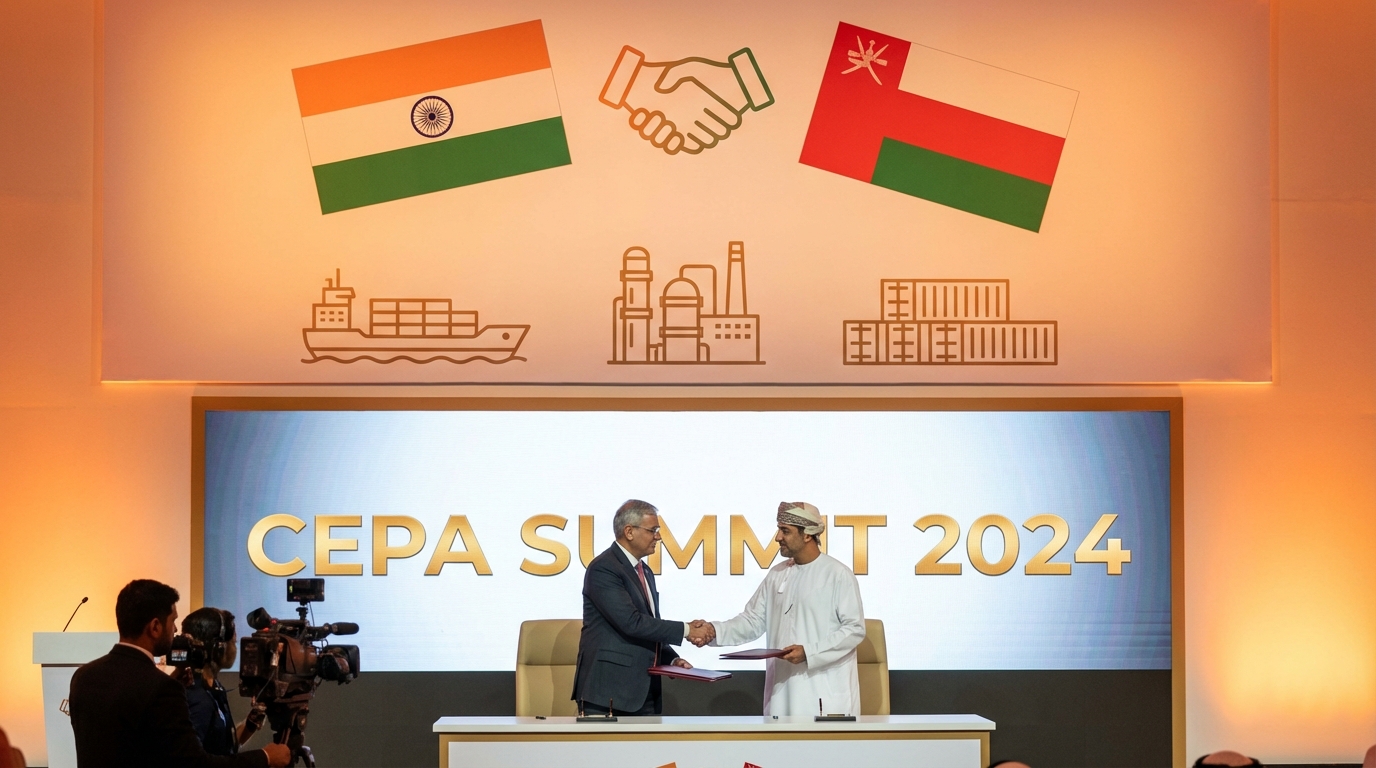
On December 18, 2025, as American tariffs continued squeezing Indian exports, New Delhi quietly signed a trade agreement that tells a larger story about India's evolving economic strategy.
The Comprehensive Economic Partnership Agreement (CEPA) with Oman is India's third major trade deal this year, following the EFTA agreement (Switzerland, Norway, Iceland, Liechtenstein) in October and the New Zealand FTA earlier. But this one carries special significance: it deepens India's pivot toward West Asia at precisely the moment when traditional Western markets are becoming hostile.
What India Gets
The numbers are striking.
Oman has offered zero-duty access on 98.08% of its tariff lines, covering 99.38% of India's exports. Immediate tariff elimination applies to 97.96% of products from day one.
For Indian exporters battered by 50% US tariffs, this is a lifeline.
Sectors with full tariff elimination:
- Gems and jewellery
- Textiles and apparel
- Leather and footwear
- Pharmaceuticals and medical devices
- Engineering products
- Automobiles
- Agricultural products
- Plastics and furniture
These are precisely the labour-intensive sectors that employ millions of Indians and have been hit hardest by Trump's tariff wall.
Services: The Real Prize
While goods get the headlines, the services chapter may prove more consequential.
For the first time, Oman has made commitments across 127 services sub-sectors, including:
- Computer and IT services
- Business and professional services
- Research and development
- Education and healthcare
- Audio-visual services
The agreement permits 100% Foreign Direct Investment by Indian companies in major Omani services sectors through commercial presence. This opens doors for Indian IT giants, consultancies, and healthcare providers to establish operations in the Gulf.
The AYUSH Breakthrough
In a first-of-its-kind provision, Oman has made comprehensive commitments on traditional medicine across all modes of supply.
This opens significant opportunities for India's AYUSH sector (Ayurveda, Yoga, Unani, Siddha, Homeopathy) to establish clinics, train practitioners, and export wellness products to Oman and potentially use it as a gateway to the broader GCC market.
Given the Gulf's growing interest in wellness tourism and alternative medicine, this could become a sleeper success story of the agreement.
Professional Mobility: Workers Win
For the 900,000+ Indians working in Oman, the CEPA brings concrete improvements:
| Provision | Before | After |
|---|---|---|
| Intra-Corporate Transferee quota | 20% | 50% |
| Contractual Service Supplier stay | 90 days | 2 years (extendable to 4) |
| Professional entry conditions | Restrictive | Liberalized for accountants, architects, medical professionals |
This isn't just bureaucratic fine print. It means Indian professionals can build longer-term careers in Oman, companies can move talent more flexibly, and the remittance pipeline strengthens.
The Strategic Context
Why does this matter beyond the trade numbers?
First, diversification. The US absorbed $77 billion of Indian exports in FY25. With 50% tariffs now in place, that market is bleeding. India needs alternatives, and the Gulf Cooperation Council countries collectively represent a $200+ billion trade corridor.
Second, the Gulf pivot. This is India's second CEPA with a GCC nation, following the UAE agreement in February 2022. Together, they signal a systematic effort to lock in preferential access to the energy-rich, import-dependent Gulf market.
Third, timing. The agreement comes just as Russia's Putin visited India, promising continued oil supplies despite US pressure. The message to Washington is unmistakable: India has options.
What India Protected
Not everything is on the table. India excluded sensitive items:
- Dairy products
- Tea, coffee, rubber, tobacco
- Gold and silver bullion
- Certain metal scrap categories
These exclusions protect domestic farmers and prevent the agreement from becoming a conduit for circumventing other trade restrictions.
The Numbers So Far
Bilateral trade between India and Oman rose from $8.9 billion in FY24 to $10.6 billion in FY25, a healthy 19% growth even before the CEPA takes effect.
For Oman, this is historic: it's the Sultanate's first bilateral trade agreement since its deal with the United States in 2006. The symbolism isn't lost on anyone.
What Comes Next
The CEPA now enters the ratification process. Once implemented, expect:
- Export surge in textiles, gems, and pharma as tariffs drop
- Services expansion as Indian IT and healthcare companies eye Omani operations
- AYUSH pilot projects testing the Gulf's appetite for traditional Indian medicine
- Labour mobility improvements for the Indian diaspora
The real test will be implementation. India's FTA with ASEAN taught hard lessons about agreements that look good on paper but fail in practice due to non-tariff barriers and bureaucratic friction.
The Bigger Picture
Three major trade agreements in one year. EFTA, New Zealand, Oman. Negotiations continuing with the UK, EU, and Australia.
As the United States retreats into protectionism, India is methodically building an alternative trade architecture. The strategy isn't subtle: if America wants a trade war, India will trade with everyone else.
The India-Oman CEPA is one more brick in that wall.
Whether it's enough to offset the damage from American tariffs remains to be seen. But at minimum, it demonstrates that India is not standing still.
The India-Oman CEPA was signed on December 18, 2025, and awaits ratification by both parliaments.