By BarathVector Editorial — 2026-01-17
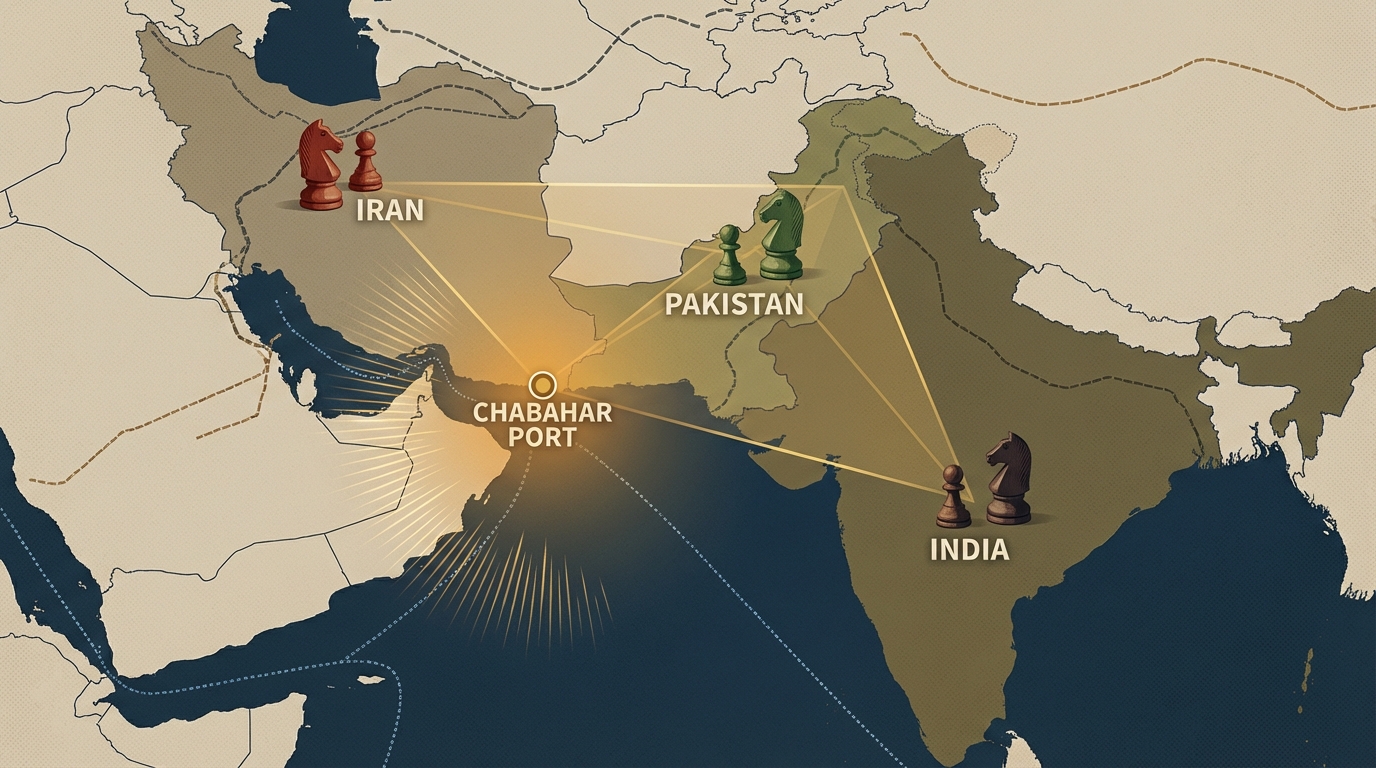
As Iran's streets burn for the twentieth consecutive day and the death toll climbs into the thousands, a question haunts South Block in New Delhi: What happens to India's $21 billion Iran bet if the regime falls—and Pakistan helps bring it down?
The Islamic Republic faces its gravest crisis since 1979. Over 50,000 protesters have been arrested. Drones hunt civilians in city squares. The Grand Bazaar of Tehran—historically the regime's backbone—has joined a nationwide general strike. And in Washington, President Donald Trump has warned he will "come to the rescue" if the crackdown continues.
For India, this is not just another Middle Eastern crisis. It is an existential question about connectivity, energy security, and the future of its most ambitious infrastructure gamble: the Chabahar Port.
The Golden Era: When the Shah Was India's Friend
To understand India's Iran anxiety, one must revisit a forgotten friendship.
Under Mohammad Reza Shah Pahlavi, India and Iran shared a relationship built on pragmatism and oil. Prime Ministers Nehru and Indira Gandhi valued Tehran as a trusted neighbor. By 1974, Iran supplied nearly 60% of India's crude oil imports—10 million tonnes out of 17 million.
The landmark India-Iran Trade Agreement of 1974 cemented this bond, offering India favorable terms, credit financing, and energy stability during the oil crisis years.
But the relationship was never simple.
The Shah, despite his warmth toward New Delhi, was also Pakistan's largest bilateral donor. Iran backed Islamabad in both the 1965 and 1971 wars, even providing sanctuary to Pakistan Air Force jets. On Kashmir, the Shah openly accused India of aggression on international platforms.
Yet cracks appeared toward the end. In 1974, Iran refused to attend an Islamic summit in Lahore after Pakistan invited Libya's Gaddafi. That same year, Tehran dismissed Islamabad's appeal to condemn India's nuclear test—a subtle signal of shifting alignments.
Then came 1979. The revolution swept away the Pahlavis, and Western capitals recoiled. But New Delhi stayed. India recognized that Iran's geography—gateway to Afghanistan, Central Asia, and the Persian Gulf—was too important to abandon over ideology.
That strategic patience is now being tested like never before.
Pakistan's Calculation: The Devil's Bargain
Officially, Pakistan opposes regime change in Iran. Foreign Minister Ishaq Dar has called for "restraint and dialogue." Islamabad fears the chaos that would spill across its 909-kilometer border with Iran—refugees, weapons proliferation, and emboldened Baloch separatists.
But geopolitics rarely respects official positions.
Pakistan is caught between a rock and a hard place. The Trump administration has imposed 50% tariffs on Pakistani exports and is reportedly demanding access to Pakistani airspace and bases for potential operations against Iran. Islamabad's military is already overstretched—managing tensions with India, the Taliban insurgency, and internal unrest.
If Washington increases pressure, Pakistan faces a choice:
Option A: Maintain neutrality. Risk American fury, continued tariffs, and potential sanctions for "aiding" Iran by refusing cooperation.
Option B: Facilitate regime change. Provide airspace, intelligence, or logistical support. Become America's indispensable partner in the operation—and gain a seat at the table when a new Iran emerges.
History suggests Pakistan knows how to play this game. In the 1980s, Islamabad was Washington's frontline ally against the Soviets in Afghanistan. That partnership delivered billions in aid, F-16s, and strategic relevance. A similar calculation could drive Pakistan toward Option B—especially if the alternative is economic strangulation.
The question for India: What happens if Pakistan chooses to help, and the regime actually falls?
Three Irans: Scenarios for the Day After
Scenario 1: The Return of the Shah
Reza Pahlavi, son of the deposed monarch, has emerged as the most visible opposition figure. From his Maryland home, he has laid out a clear foreign policy vision:
- Immediate recognition of Israel ("Cyrus Accords")
- Termination of Iran's nuclear program
- End to support for Hezbollah, Hamas, and Houthis
- Full normalization with the United States
- Iran as a "stabilizing force" in the Middle East
A Pahlavi restoration would likely be pro-Western, pro-Israel, and focused on reintegrating Iran into the global economy.
India's position: Mixed. The Shah-era relationship was warm but complicated by Iran's support for Pakistan. A restored monarchy might continue that pattern—especially if Pakistan helps enable the restoration. India's Chabahar investments could be honored, but New Delhi would not be the favored partner.
Pakistan's gain: If Islamabad facilitates the transition, it earns gratitude from both Washington and the new Iranian court. The US-Pakistan relationship resets to 1980s levels. Kashmir advocacy finds new ears in Tehran.
Scenario 2: Secular Democratic Republic
This is what 89% of Iranians say they want, according to recent surveys.
A coalition called "Solidarity for a Secular Democratic Republic" has been advocating for exactly this outcome since 2023. Their platform:
- Complete separation of religion and state
- Free elections and independent judiciary
- Free press and civil liberties
- No nuclear weapons
- Regional non-interference
The People's Mojahedin Organisation (MEK), led by Maryam Rajavi, has also positioned itself for this moment, claiming networks across all 31 provinces. A US House resolution backed by 222 members explicitly supports Iranians' right to establish "a democratic, secular, and non-nuclear Republic of Iran."
India's position: Potentially the best outcome. A secular democracy would have no ideological baggage with any neighbor. Chabahar agreements—signed with "the Iranian state" rather than any particular regime—would likely be honored. Economic pragmatism would drive policy. India's technical expertise in port operations and infrastructure would be valued.
Pakistan's position: Complicated. A democratic Iran might not automatically favor Pakistan, especially if Islamabad is seen as having supported the old regime or delayed supporting the revolution. Democratic governments tend to make decisions based on economic interest rather than gratitude politics.
The Shia factor: Iran would remain a Shia-majority nation (90-95% of population). A democratic government would reflect this demographic reality but without theocratic overlay. This could actually improve relations with India, which has the world's third-largest Shia population (40-50 million). Cultural and religious tourism could flourish. The sectarian card that the Islamic Republic sometimes played would be off the table.
Scenario 3: Prolonged Chaos
If neither monarchists nor democrats can consolidate power, Iran could descend into prolonged instability—competing factions, regional fragmentation, perhaps even civil conflict.
India's position: Catastrophic. Chabahar operations would be disrupted. The International North-South Transport Corridor (INSTC) would be paralyzed. The $21 billion in committed investments would be at risk. Humanitarian crisis would demand attention.
Pakistan's position: Also catastrophic. Refugee flows across the border. Weapons proliferation. Baloch separatists gaining sanctuaries. This is precisely the scenario Islamabad fears most—and why its official position opposes intervention.
India's Strategic Response: Four Paths Forward
New Delhi cannot control events in Tehran. But it can position itself for multiple outcomes.
Path 1: The Quiet Pivot
Without abandoning official neutrality, India could establish quiet contact with opposition groups—monarchists, democrats, and diaspora networks. This hedges against being caught flat-footed if the regime falls.
Risk: If the regime survives, these contacts could poison the relationship.
Precedent: India maintained back-channels with the Afghan Northern Alliance even while recognizing the Taliban government in the 1990s. That investment paid off in 2001.
Path 2: Double Down on Chabahar
India's strongest card is that it has already invested when others wouldn't. The Shahid Beheshti terminal is operational. Port equipment worth $24 million has been delivered. A 10-year contract is in place.
New Delhi could argue to any successor regime: "We built this. We ran it when you were under sanctions. We are your natural partner."
Risk: Pakistan could offer a counter-deal, positioning Gwadar as an alternative with Chinese backing.
Path 3: Washington Engagement
India is not just an Iran stakeholder—it is a Quad partner, a major defense customer, and a strategic counterweight to China. New Delhi could negotiate directly with Washington for a role in post-regime reconstruction, regardless of Pakistan's involvement.
Leverage: The US needs India more than it needs Pakistan in the broader Indo-Pacific competition. India can remind Washington that sidelining New Delhi in favor of Islamabad would be strategically counterproductive.
Path 4: Economic Muscle
Any new Iranian government will need reconstruction capital. The Islamic Republic leaves behind a shattered economy—40% currency devaluation, hyperinflation, crumbling infrastructure.
India's $700 billion foreign exchange reserves and technical expertise in infrastructure make it a natural reconstruction partner. If India moves fast with investment commitments, it could leapfrog any advantage Pakistan gains through political positioning.
The View from Islamabad
Pakistani strategists are not blind to these dynamics. Several calculus points drive their thinking:
The China Factor: Beijing has invested heavily in Pakistan through CPEC. But China has also cultivated Iran—signing a 25-year strategic partnership in 2021. A post-regime Iran might be more open to Chinese investment without sanctions constraints. Pakistan cannot assume it will be China's only regional partner.
The India Factor: Every scenario where India gains in Iran is a scenario where Pakistan's relative position weakens. This creates incentive to either block Indian gains (by capturing the new regime's gratitude) or ensure chaos (where nobody wins).
The Domestic Factor: Pakistan's own population is divided. Shia minorities (15-20% of population) have cultural and religious ties to Iran. Supporting regime change could inflame domestic sectarian tensions.
The Afghanistan Factor: Iran has been a partner in managing Afghanistan's western border. A collapsed or hostile Iran would add another front to Pakistan's already overwhelming security challenges.
Expert Perspectives
Dr. C. Raja Mohan, Senior Fellow, Asia Society: "India's Iran policy has always been about geography, not ideology. Whoever rules Tehran, India needs access to Afghanistan and Central Asia. The question is whether New Delhi has done enough relationship-building with alternative Iranian power centers."
Amb. Talmiz Ahmad, Former Indian Ambassador to Saudi Arabia: "The Chabahar investment was always a long-term strategic bet. Its value transcends any particular Iranian government. What India must avoid is being seen as nostalgic for the Islamic Republic when Iranians themselves have rejected it."
Dr. Madiha Afzal, Brookings Institution: "Pakistan's room for maneuver is extremely limited. The military is overstretched, the economy is fragile, and public opinion opposes intervention. But American pressure has a way of creating facts on the ground that force choices nobody wanted to make."
The Bottom Line
India's Iran gamble was never about the Islamic Republic. It was about Iran's geography—the only land route to Afghanistan and Central Asia that bypasses Pakistan.
If the regime falls, that geography remains. The ports remain. The roads remain. The strategic logic remains.
What changes is the competition for influence with whoever inherits Tehran.
If Pakistan positions itself as the midwife of regime change, it gains first-mover advantage with the new government. If India remains passive, it risks being sidelined—again—just as it was when the Shah fell in 1979 and India failed to anticipate the revolution.
The best outcome for New Delhi? A secular, democratic Iran that makes decisions based on economic rationality rather than ideological alignment or gratitude politics. In that scenario, India's investments, technical expertise, and economic muscle would speak louder than Pakistan's political positioning.
The worst outcome? A Pahlavi restoration enabled by Pakistani cooperation, where the new Shah remembers who helped him return—and who sat on the fence.
The protests continue. The drones circle. The clock is ticking.
India's Iran policy was built for a world that may no longer exist in six months. The question is whether New Delhi can adapt fast enough to the world that is coming.
What should India's Iran strategy be? Share your views in the comments below.
Sources:
- The Diplomat - Trump's Iran Sanctions Complicating India's Multi-alignment
- Vision IAS - US Tariff Threat on India-Iran Ties
- The Express Tribune - Can Pakistan Afford Regime Change in Iran?
- National Interest - Why Pakistan Does Not Want Iran's Government to Fall
- IMPRI - India-Iran Strategic Dynamics
- Daily Jagran - Reza Pahlavi and India Relations