By Ramachandran Rajeev Kumar — 2026-01-08
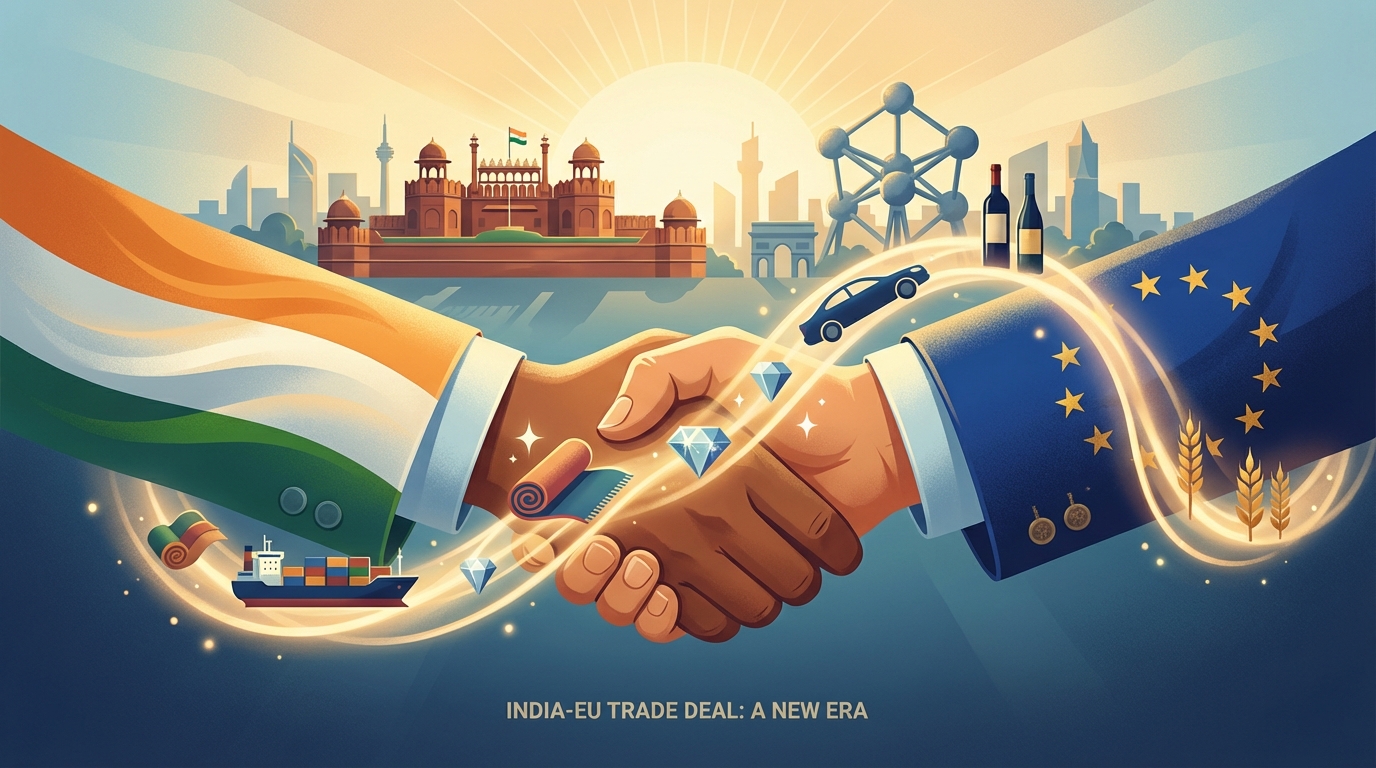
The Brussels Breakthrough: India's Biggest Trade Deal is Within Reach
After 14 rounds and a decade of false starts, the India-EU Free Trade Agreement is finally entering the home stretch. Here's why this time is different.
When Commerce Minister Piyush Goyal landed in Brussels this morning for two days of talks with EU Trade Commissioner Maroš Šefčovič, he carried with him the weight of a decade's worth of diplomatic ambition—and the tantalising prospect of closing the largest free trade agreement in India's history.
The India-EU FTA, if concluded, would link the world's most populous nation with its wealthiest single market. It would cover bilateral trade worth $136.5 billion and growing. It would reshape supply chains from Stuttgart to Surat, from Milan to Mumbai.
And for the first time in the tortured history of these negotiations, both sides sound like they actually mean it.
The Long Road to Brussels
The India-EU trade talks have a history of heartbreak.
First launched in 2007, negotiations sputtered through seven inconclusive rounds before collapsing entirely in 2013. The gaps were simply too wide: Europe wanted access for its luxury cars, wines, and cheeses; India wanted protections for its farmers and market access for its labour-intensive exports. Neither side budged. The talks died quietly, mourned by few.
Then came the relaunch.
In June 2022, against the backdrop of Russia's invasion of Ukraine and a global reckoning with supply chain vulnerabilities, India and the EU announced they would try again. This time, the motivation was different. This wasn't just about tariffs. It was about strategic alignment in an increasingly fractured world.
Since then, the negotiating teams have met fourteen times. European Commission President Ursula von der Leyen and Prime Minister Narendra Modi publicly committed to concluding the deal by the end of 2025. That deadline slipped, but the momentum didn't.
"The negotiations have entered the most difficult stage," Commerce Secretary Rajesh Agrawal acknowledged in December. "But both sides are engaged to bridge the differences."
In diplomatic parlance, "most difficult" often means "almost there."
What's Actually on the Table
The India-EU FTA is ambitious precisely because of the asymmetries it must bridge.
The EU wants:
- Reduced tariffs on automobiles (currently 60% in India versus 6.5% in Europe)
- Better access for wines and spirits (facing over 100% duties)
- Market entry for European dairy and agricultural products
- Strong intellectual property protections and regulatory alignment
India wants:
- Zero-duty access for textiles, leather goods, gems, jewellery, and handicrafts
- Recognition of its services expertise, particularly IT and professional services
- Protections for its micro, small, and medium enterprises
- Exemptions or transition periods for the EU's Carbon Border Adjustment Mechanism (CBAM)
The gaps are real but not insurmountable. The automobile industry, often cited as the toughest nut, has already seen movement. India has signalled willingness to phase down tariffs over an extended period—long enough for domestic manufacturers to adjust, short enough to satisfy European automakers eyeing India's fast-growing middle class.
On wine and spirits, the numbers look dramatic (100%+ tariffs), but the actual trade volumes are modest. This is a symbolic concession India can make without disrupting domestic markets significantly.
The real complexity lies in CBAM—the EU's carbon border tax that threatens to impose 20-35% levies on Indian steel, aluminium, and cement exports starting this year. India has pushed back hard, arguing that the mechanism unfairly penalises developing economies still building their industrial base. But here too, negotiators are exploring transition periods and exemption corridors.
Why This Time is Different
Three factors distinguish 2026 from 2013.
First, geopolitics has concentrated minds. The Russia-Ukraine war exposed Europe's dangerous dependence on Russian energy and Chinese manufacturing. India, with its massive consumer market, growing industrial capacity, and democratic governance, suddenly looks like an essential partner rather than a difficult negotiation.
For India, the calculus is equally clear. With the United States under Trump imposing tariffs and pressuring allies, with traditional suppliers like Russia, Iran, and Venezuela under various forms of sanctions or chaos, Europe represents stability. The EU plays by rules. It honours agreements. In a world of transactional disruption, that matters.
Second, the economic logic has become undeniable. EU-India trade has grown 90% over the past decade even without a free trade agreement. Bilateral trade in services reached $59.7 billion in 2023. European companies are already heavily invested in India; Indian IT firms are deeply embedded in European enterprises. An FTA would formalise and accelerate what's already happening organically.
Third, both governments have political capital to spend. Modi's BJP won a historic third term in 2024. Von der Leyen secured her second Commission presidency. Neither leader faces imminent elections. Both can absorb the domestic criticism that any trade deal inevitably generates.
The Prize
If concluded, the India-EU FTA would be transformative for both parties.
For India, it would mean preferential access to a market of 450 million affluent consumers. It would boost labour-intensive exports—textiles, leather, gems—that create jobs in India's heartland. It would attract European investment in manufacturing, potentially accelerating the "China plus one" shift that many companies are pursuing. And it would cement India's position as a reliable partner for the democratic world's supply chains.
For Europe, it would mean access to the world's fastest-growing major economy. It would open opportunities for European automakers, luxury brands, and agricultural exporters. It would provide an alternative to China-dependent supply chains. And it would strengthen ties with a partner whose strategic importance is only growing.
The numbers tell the story. EU-India bilateral merchandise trade stood at $136.5 billion in FY2024-25. India's exports to the EU totalled $75.85 billion; imports from the EU were $60.68 billion. With an FTA eliminating barriers, both figures could surge.
The Path Forward
Goyal's Brussels visit this week is not expected to produce a final agreement. Trade deals of this complexity don't close in two-day meetings. But it could—and should—produce a breakthrough on the remaining contentious issues.
The minister has already signalled flexibility. India is no longer demanding blanket exclusions for sensitive sectors. Instead, it's negotiating transition periods, tariff-rate quotas, and safeguard mechanisms that allow gradual adjustment. This is the language of deals that get done.
For their part, European negotiators have acknowledged that India's concerns about CBAM and agricultural protections are legitimate. The EU's own farmers have benefited from decades of protection; demanding immediate liberalisation from India would be hypocritical.
The target now is a framework agreement by mid-2026, with implementation beginning in 2027. It's ambitious but achievable.
The Bigger Picture
In a world fragmenting into blocs and spheres of influence, the India-EU FTA represents something increasingly rare: a deal built on mutual benefit rather than coercion, on rules rather than power.
It won't solve all problems. European carmakers will still face stiff competition from Chinese EVs regardless of Indian tariffs. Indian textile exporters will still need to meet demanding quality and sustainability standards. The CBAM will still impose costs on carbon-intensive industries.
But it will create a framework for managing these challenges together. It will lock in market access that can't be revoked by a single election or a presidential tweet. It will bind two of the world's largest democracies in a web of commercial interdependence that makes conflict costlier and cooperation easier.
Piyush Goyal is in Brussels this week with a mandate to close. Maroš Šefčovič has the same instructions from von der Leyen. The gaps remain, but they've never been narrower.
India's biggest trade deal is within reach. It's time to grab it.
Ramachandran Rajeev Kumar is the Founder and Editor-in-Chief of BarathVector.