By Ramachandran Rajeev Kumar — 2026-01-13
By Ramachandran Rajeev Kumar
Something remarkable is happening in India's relationship with Europe—and it's happening fast.
On January 26, 2026, India will host two European Union chiefs as the guests of honor at its Republic Day parade: Ursula von der Leyen, President of the European Commission, and António Costa, President of the European Council. The next day, India and the EU will hold a summit focused on finalizing a long-pending Free Trade Agreement.
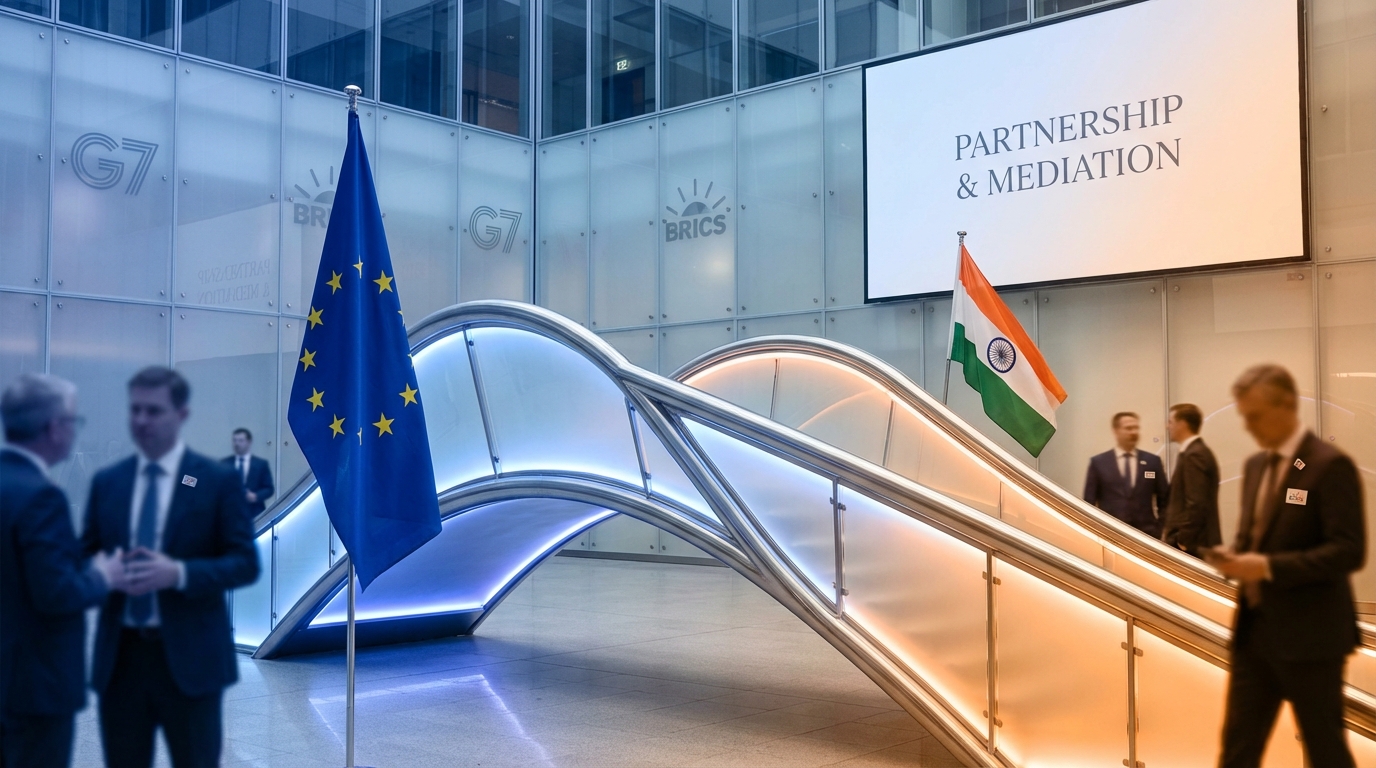
One month later, French President Emmanuel Macron will arrive in New Delhi for the AI Impact Summit, where he has explicitly called for India to serve as a "G7-BRICS bridge"—a mediator between the developed West and the rising Global South.
Just last week, German Chancellor Friedrich Merz visited Gujarat, where India and Germany signed 19 memoranda of understanding covering defense cooperation, technology transfer, and economic ties, marking 25 years of strategic partnership.
Read those dates again: late January, mid-February, early January. This is not business as usual. This is a full-court press.
Europe is courting India like never before. And the reason is simple: India has become indispensable.
Not because India is the largest democracy (though it is). Not because India is a rising economic power (though it is). But because India occupies a unique position in a fractured world—maintaining deep ties with both the West and Russia, trusted by both the Global North and the Global South, capable of bridging divides that no one else can.
While America threatens India with tariffs, Europe is extending partnership. And in that contrast lies a story about India's rising strategic value—and the new geopolitical role it is being asked to play.
The Unprecedented Honor: Two EU Chiefs at Republic Day
Let's start with the symbolism.
India's Republic Day parade on January 26 is the country's grandest annual spectacle—a display of military might, cultural diversity, and national pride. The chief guest at this parade is always significant, a marker of which relationship India wants to showcase.
This year, India is hosting both the President of the European Commission (Ursula von der Leyen) and the President of the European Council (António Costa). This is unprecedented. Not one European leader, but two—representing the EU's executive and political leadership.
The last time India invited multiple leaders was 2018, when all ten ASEAN nation heads attended as a bloc. That was a statement about India's Look East policy. This year's invitation to EU leadership is a statement about India's Look West policy—or more precisely, its Europe policy.
Why both leaders? Because the EU wants to be seen as a unified political and economic bloc in its engagement with India, not a collection of individual member states. The joint presence signals: Europe is serious about India.
And what are they serious about? Trade, technology, and geopolitics.
The India-EU summit on January 27 will focus on finalizing a Free Trade Agreement that has been in negotiation for over a decade. Both sides are now pushing to conclude it—India needs European investment and technology, Europe needs Indian markets and an alternative to China.
But beyond trade, there's a deeper strategic calculation: Europe needs India as a bridge to Russia.
Macron's Bridge: The G7-BRICS Mediator
One month after the Republic Day celebrations, French President Emmanuel Macron will land in New Delhi for the AI Impact Summit on February 19-20.
This is the first global AI summit hosted in the Global South—a symbolic choice that positions India as the voice of developing nations in the most critical technology conversation of our time. But Macron's visit is about more than artificial intelligence.
In confirming his attendance, Macron made a striking statement: he called for India to serve as a "G7-BRICS bridge."
Think about what that means.
G7 = the world's advanced democracies (US, UK, France, Germany, Italy, Canada, Japan). BRICS = the rising powers (Brazil, Russia, India, China, South Africa, now expanded to include Iran, Egypt, UAE, Ethiopia).
These two blocs represent opposing visions of global order. The G7 wants to preserve the Western-led, rules-based international system. BRICS wants to build an alternative centered on multipolarity and non-Western leadership.
And Macron is explicitly asking India to bridge them.
Why India?
Because India is the only major power that belongs to both worlds:
- India is a democracy aligned with Western values (rule of law, free markets, human rights).
- India is also a Global South leader with deep ties to Russia, China, and the developing world.
- India maintains strategic autonomy—it doesn't take orders from Washington or Beijing.
Europe, specifically France, recognizes that the world is fracturing into competing blocs—and that fragmentation is dangerous. If the West and the Rest become two separate, hostile camps, global cooperation on climate, trade, pandemics, and technology becomes impossible.
So Europe is looking for a mediator. And it has chosen India.
The Germany Signal: Defense and Technology
While France focuses on AI and strategic vision, Germany is focused on substance: defense cooperation and industrial technology.
Last week's visit by German Chancellor Friedrich Merz to Gujarat resulted in 19 memoranda of understanding covering:
- Defense cooperation: Joint production, technology transfer, and strategic coordination. This is a big deal—Germany has historically been cautious about defense exports and cooperation, constrained by its pacifist post-WWII constitution. Deepening defense ties with India signals Germany is pivoting toward a more assertive strategic posture in the Indo-Pacific.
- CEO Forum: A structured platform for German and Indian business leaders to facilitate investment. Germany is Europe's largest economy and a manufacturing powerhouse (automotive, machinery, chemicals). India wants that technology and capital.
- Visa-free transit: Making it easier for skilled Indians to travel to Germany and the EU. This is not just about labor mobility—it's about recognizing India's growing role in global innovation and knowledge work.
Germany's message is clear: India is our anchor in Asia.
For decades, Germany bet on China as its manufacturing hub and export market. That bet has soured. China's authoritarianism, IP theft, and aggressive trade practices have made Germany realize it needs an alternative. India is that alternative—democratic, English-speaking, rules-abiding, and hungry for investment.
But there's a deeper layer: Germany needs India's help with Russia.
The Russia Question: Why Europe Needs India
Here's the uncomfortable truth that European diplomats acknowledge privately but rarely say publicly: Europe will eventually need to reengage with Russia.
Not now, not soon, but eventually. The war in Ukraine will end—whether through negotiated settlement, frozen conflict, or Russian exhaustion. And when it does, Europe will face a choice: permanent hostility with Russia, or some form of managed relationship.
Permanent hostility is unsustainable. Russia sits on Europe's border. Russia supplies energy (though less than before). Russia has veto power at the UN Security Council. Russia has nuclear weapons. Russia has influence in Central Asia, the Middle East, and Africa.
Europe can't wish Russia away. At some point, there will need to be dialogue.
But Europe can't lead that dialogue. The wounds are too fresh. The moral credibility is too compromised (Europe bought Russian gas for decades while lecturing others about democracy). The domestic politics are too toxic (no European leader can be seen "appeasing" Putin).
Enter India.
India maintained ties with Russia throughout the Ukraine war. India didn't sanction Russia. India bought Russian oil at a discount (helping Russia's economy but also keeping global oil prices lower, which helped Europe too). India abstained on UN votes condemning Russia.
From Europe's perspective, India's Russia relationship is both frustrating and useful.
Frustrating because Europe wishes India would take a harder line against Moscow. Useful because India is one of the few major powers that can still talk to both Moscow and the West.
If and when there's a negotiated settlement in Ukraine—or a post-war reconstruction effort—who will mediate between Russia and the West? Not the US (too adversarial). Not China (too self-interested). Not Middle Eastern states (too small).
India.
And Europe knows this. That's why Macron is calling for India to be a "G7-BRICS bridge." That's why Germany is deepening strategic ties. That's why the EU is sending both its presidents to Republic Day.
Europe is positioning India as the indispensable mediator for the next phase of global politics.
The India-Europe Convergence: Why Now?
But why is this convergence happening now?
Three reasons:
1. Trump 2.0 Makes America Unreliable
Trump's second term has reminded Europe that the US is an unpredictable partner. One day, Trump threatens NATO allies. The next day, he imposes tariffs on European goods. Europe can't build a stable strategy around a volatile partner.
India, by contrast, is consistent. India's foreign policy is rooted in strategic autonomy, national interest, and long-term thinking. Europe finds that refreshing.
2. China Is a Threat, Not a Partner
For two decades, Europe treated China as a lucrative market and manufacturing base. That's over. China's support for Russia, its aggressive trade practices, and its authoritarianism have made clear that China is a strategic competitor, not a partner.
Europe needs an alternative to China. India is the only country with the scale, democratic values, and growth potential to fill that role.
3. The Global South Is Rising—And India Leads It
Europe's influence in the Global South is waning. African, Asian, and Latin American countries are asserting their own interests, not following Western leadership.
Europe recognizes it can't engage the Global South alone. It needs a partner who has credibility in the developing world. India—as the chair of the G20 in 2023, a leader in vaccine diplomacy, and a voice for climate justice—has that credibility.
So Europe is courting India not just as a bilateral partner, but as a gateway to the Global South.
What India Offers Europe (And What Europe Offers India)
Let's be clear about the transactional benefits for both sides.
What India Offers Europe:
- Alternative to China: Manufacturing, supply chains, market access, democratic values
- Bridge to Russia: Mediation, dialogue channels, eventual reengagement
- Gateway to Global South: Credibility, leadership, influence in Africa and Asia
- Technology partnership: AI, semiconductors, green energy, space
- Security cooperation: Indo-Pacific stability, counterterrorism, maritime security
What Europe Offers India:
- Technology transfer: Germany's manufacturing, France's defense tech, EU's green energy expertise
- Investment: Europe is already India's largest source of FDI; this will grow
- Market access: EU FTA would give Indian goods preferential access to 450 million consumers
- Global legitimacy: Europe's endorsement strengthens India's claim to be a leading power
- Leverage against Trump: If the US is unreliable, Europe gives India options
This is not charity. This is strategic convergence.
The Contrast With America: Partnership vs. Ultimatums
Compare Europe's approach to India with America's:
America under Trump:
- Threatens 25% tariffs on Indian exports if India doesn't comply on Iran
- Demands India stop buying Russian oil or face consequences
- Treats India as a junior partner who should follow US diktat
- Transactional, unpredictable, bullying
Europe:
- Invites Indian leaders to summits and state visits
- Proposes trade agreements and technology partnerships
- Treats India as a strategic equal and bridge-builder
- Long-term, respectful, collaborative
One approach assumes hierarchy. The other assumes partnership.
India has historically bristled at being told what to do. The Non-Aligned Movement, strategic autonomy, and Panchsheel—all of India's foreign policy traditions are rooted in the principle of sovereign equality.
Europe's approach respects that. Trump's doesn't.
So it's no surprise that India is gravitating toward Europe—not because India is anti-American (it's not), but because Europe offers what India values: partnership without patronizing.
India's Bridge Role: Opportunity and Risk
But here's the complication: being a bridge is both an opportunity and a risk.
Opportunity: India gains leverage. If both the West and Russia need India's mediation, India can extract concessions from both sides. Europe needs India to talk to Russia? India gets European technology. Russia needs India's diplomatic cover? India gets discounted oil and defense tech. This is the advantage of non-alignment in a multipolar world.
Risk: Bridges get walked on from both sides. If India mediates between Russia and the West, both sides will pressure India to tilt their way. The West will demand India be tougher on Russia. Russia will demand India resist Western pressure. India becomes everyone's pressure point.
Balancing this will require exceptional diplomatic skill. India must maintain credibility with both sides without being captured by either.
Can India pull this off?
History suggests yes. India navigated the Cold War by maintaining ties with both the US and the USSR without joining either camp. India traded with both Israel and Arab states when they were mortal enemies. India maintains ties with Iran and Saudi Arabia despite their rivalry.
But the current moment is more complex than the Cold War. The fracturing of global order is deeper. The technology and security stakes are higher. The demands on India will be more intense.
What India Should Do: Leverage the European Opening
Here's how India should play this:
1. Finalize the EU FTA Fast
The India-EU Free Trade Agreement has been negotiated for 13 years. It's time to close it. Europe is motivated—India should push for maximum concessions on goods, services, and investment, then sign.
An EU FTA gives India preferential access to 450 million consumers and $18 trillion in GDP. That's strategic gold.
2. Deepen Defense Ties With France and Germany
France is offering Rafale jets, submarine technology, and space cooperation. Germany is opening up defense collaboration. India should take both—and push for co-production and technology transfer, not just purchases.
This diversifies India's defense sourcing away from Russia while maintaining the Russia relationship.
3. Embrace the Bridge Role—But Set Terms
Macron wants India to be a G7-BRICS bridge. India should accept—but make clear this isn't charity work.
India will facilitate dialogue between West and Russia if both sides respect India's autonomy. India won't be pressured or coerced. India will mediate on India's terms.
4. Use Europe as Leverage Against Trump
Every time Trump threatens India with tariffs, India should remind him: "We have options. Europe is offering us partnership. What are you offering?"
The more Europe courts India, the less India depends on the US. That gives India negotiating leverage with Trump.
Conclusion: The Bridge India Didn't Ask For—But Should Embrace
India didn't seek to be a bridge between the West and Russia. It didn't campaign to mediate between G7 and BRICS. It didn't ask Europe to court it this aggressively.
But geopolitics has thrust this role upon India—and India should embrace it.
Being a bridge is not weakness. It's power. Bridges are indispensable. Bridges have leverage. Bridges shape which connections are made and which are broken.
Europe recognizes India's unique position and is betting on India to navigate a fractured world. That bet comes with trade deals, technology transfer, investment, and strategic partnership.
India should take the bet—and then use it to extract maximum value from all sides.
The European embrace is not just about Europe. It's about India's rise as a global power that can no longer be ignored, pressured, or sidelined.
And that embrace is just beginning.
Ramachandran Rajeev Kumar is the founder and editor-in-chief of BarathVector. He writes on geopolitics, India's strategic choices, and the emerging global order.