By Ramachandran Rajeev Kumar — 2025-12-12
In the cold heights of the Himalayas, where the air is thin and political posturing is thick, something interesting happened this year. India and China—two civilizational giants who have spent the better part of the last century eyeing each other with a mixture of suspicion and grudging respect—are talking again. Not because they've discovered newfound affection. But because, frankly, they've run out of better options.
Analysis: Call it what you will: a thaw, a reset, a recalibration. The truth is simpler and more pragmatic. This is tactical convenience, not genuine reconciliation. Both sides are driven by economic necessity and, let's be honest, pressure from Washington's increasingly erratic tariff tantrums.
From "Bhai-Bhai" to "Bye-Bye" to "Let's Talk"
The story of India-China relations reads like a Shakespearean tragedy with occasional comic relief.
In 1954, Nehru and Zhou Enlai smiled for cameras, proclaiming Hindi-Chini Bhai-Bhai—Indians and Chinese are brothers. The Five Principles of Peaceful Coexistence (Panchsheel) were signed with flourish. Meanwhile, Chinese engineers were quietly building a road through Aksai Chin, a piece of land India considered its own. So much for principle number one: "Mutual respect for territorial integrity."
The 1962 war shattered Indian illusions. Over 1,300 Indian soldiers died. Nearly 4,000 were captured. Nehru, broken and bewildered, told the nation his heart went out to Assam. Many in the northeast heard it as abandonment. The Chinese took Aksai Chin, declared a unilateral ceasefire, and withdrew from the east—not out of magnanimity, but because they'd made their point.
What most people don't remember is 1967. Five years after the humiliation, India got a measure of redemption at Nathu La and Cho La. Modernized troops, better leadership, and a point to prove. Result: over 300 Chinese casualties against 88 Indian. India held Sikkim. The Chinese learned that the Indian soldier, properly equipped and motivated, was not to be underestimated.
The Long Cold Peace (1967-2020)
For the next five decades, the relationship operated on autopilot: occasional skirmishes, diplomatic summits, growing trade, and that nagging border dispute that nobody could resolve but everyone agreed to manage.
Rajiv Gandhi's 1988 visit to Beijing was the diplomatic breakthrough—agreeing to disagree on the border while expanding everything else. Smart move. The 1993 and 1996 agreements created mechanisms to keep soldiers from shooting each other. A gentleman's agreement, essentially, that lasted until gentlemen stopped honoring it.
Then came 2020. Galwan Valley. Hand-to-hand combat with clubs wrapped in barbed wire. Twenty Indian soldiers dead. Beijing admitted to four casualties (international estimates suggest significantly more). The first fatal clash in 45 years. The "Wuhan Spirit" and "Chennai Connect" of the Modi-Xi era evaporated faster than a puddle in the Thar Desert.
December 2025: The "Visa Détente"
Fast forward to now. Modi met Xi in Tianjin in August 2025. Direct flights resumed in October. On December 12, India fast-tracked business visas for Chinese technicians—because Indian electronics factories couldn't run without them. Ten days later, China launched an online visa system for Indians.
Key Facts — December 2025
| Aspect | Status |
|---|---|
| Diplomatic | Thawing — Tianjin Summit, visa reforms, WMCC meetings resumed |
| Border | Stable but militarized — 50,000+ troops on each side |
| Trade | $138 billion total, $99 billion deficit (India) |
| Connectivity | Direct flights resumed, online visa system launched |
| Trust Level | Low — "Trust but verify" approach |
Let that sink in. India-China trade is at record highs. The deficit is approaching $100 billion. And there are still over 100,000 soldiers staring at each other across the Line of Actual Control.
This is not normalization. This is compartmentalization on steroids.
The Real Question: Is Interdependence Healthy?
Here's where things get nuanced.
Opinion: A certain amount of interdependence is healthy—if it comes with mutual respect and cleared hurdles. The problem is that India and China were once competing as near-equals. That's no longer true. China's single-party efficiency left India's democratic chaos in the dust. Today, China's economy is five times larger. India still buys 97% of its antibiotics and 82% of its solar cells from China.
That's not partnership. That's dependency.
But here's the thing: both countries need each other to grow. There's enough space in Asia for two giants without suffocating or tripping one another. The real question is whether they're mature enough to share that space.
The Pakistan Problem
The greatest hurdle isn't the border. It's not even the trade deficit.
It's China's steadfast support for Pakistan.
Opinion: This is where strategy meets absurdity. What exactly does China gain from backing a country that has become a strategic liability for everyone who feeds it? Pakistan's policies aren't just an Indian headache—history shows it bites every master that extends a hand.
China wants India with buying power, not another economy holding a begging bowl like its western neighbor. India would happily trade with China if there were no existential threat. The math is obvious. The politics, apparently, less so.
What Does the West Want?
And here's the uncomfortable truth that nobody in Washington or Brussels wants to hear: keeping India and China divided serves Western interests.
"A strong, unified Asia? That's the West's 'not happy syndrome.' As long as Delhi and Beijing are suspicious of each other, neither can challenge the Western-led global order effectively."
The US tariffs on Indian goods—50% under Trump's latest round—practically pushed India toward this tactical engagement with China. Irony is apparently alive and well in geopolitics.
The Shanghai Incident: A Reality Check
Just when things seemed to be warming up, an Indian citizen from Arunachal Pradesh was detained for 18 hours at Shanghai Airport. Her "crime"? Her passport listed her birthplace—a region China calls "South Tibet."
India protested. China doubled down. The message was clear: functional cooperation (trade, visas) is one thing. Territorial sovereignty is non-negotiable.
This is the fundamental contradiction of India-China relations in 2025. You can have direct flights and visa apps while still claiming the other country's territory as your own.
Trust But Verify
So where does this leave us?
The October 2024 patrol agreement at Depsang and Demchok was real progress. Indian soldiers resumed patrolling to points that had been blocked since 2020. But the troops haven't gone home. The infrastructure of war remains.
Analysis: The appropriate approach: trust but verify. Don't mistake tactical accommodation for strategic trust. Every handshake should be accompanied by a satellite check of the border. Every trade deal should come with supply chain diversification. India needs Chinese technicians today; it shouldn't need them forever.
The Bottom Line
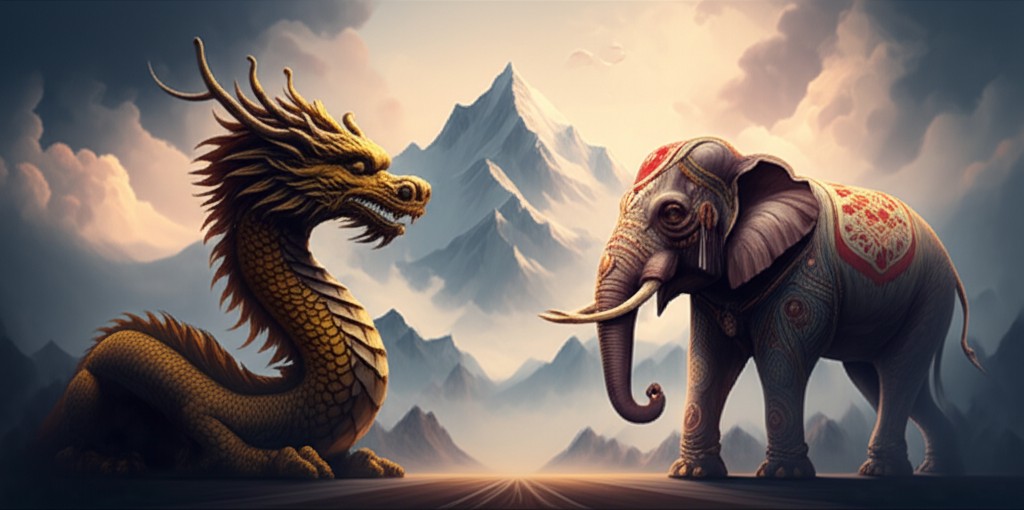
December 2025 marks a moment of managed competition, not resolution. The dragon and the elephant are dancing—but it's more two-step than tango. Neither leads. Both watch their feet. And neither has forgotten the last time someone stepped on the other's toes.
The relationship will warm. Trade will grow. Flights will fly.
But until China stops playing both sides with Pakistan, until the border is genuinely demilitarized (not just de-escalated), and until both nations find the maturity to be partners rather than rivals—this remains what it is.
Tactical convenience.
Nothing more. But for now, nothing less either.
Sources: Ministry of External Affairs (India), Economic Times, Drishti IAS, The Diplomat, Observer Research Foundation, LA Times, Atlantic Council, IBEF, Hindustan Times, India Today. Historical data verified through multiple academic sources. Trade figures from official government statistics. Research conducted via Gemini Deep Research (December 2025).