By Ramachandran Rajeev Kumar — 2026-06-23
India's Cooling Crisis Is Being Built Into Its Walls
India’s heat strategy has to start before the air conditioner is switched on: in building codes, materials, shading, ventilation and enforcement.
By Ramachandran Rajeev Kumar
India's next cooling crisis is being poured in concrete today.
The Hindu's Tuesday piece on the hidden climate cost of everyday life in India captured a truth that is easy to miss: climate change is not only an event outside the home. It enters through power bills, water stress, health costs, work hours and the temperature of the room a family sleeps in. A separate report from Hankyoreh English, citing the World Meteorological Organization, said Asia is warming faster than the global average.
For India, the most practical question is not whether more people will buy air conditioners. They will. The question is how much cooling India can avoid needing in the first place.
Buildings lock in demand
India is still building the cities and homes that will define its 2050 energy demand. Apartment blocks, offices, malls, schools, hospitals and small houses going up now will stand through hotter decades. If they are designed badly, they will trap heat badly. If they trap heat badly, families and businesses will cool them mechanically. If millions of buildings do that at once, the grid will carry the cost.
That is the hidden climate bill in construction.
A poorly oriented building with dark roofs, weak insulation, exposed glass and no shading is not just uncomfortable. It is an energy contract signed for decades. Every summer, it asks the grid for help because the design failed first.
The cheapest unit of cooling is the one a building never needs.
Passive design is not nostalgia
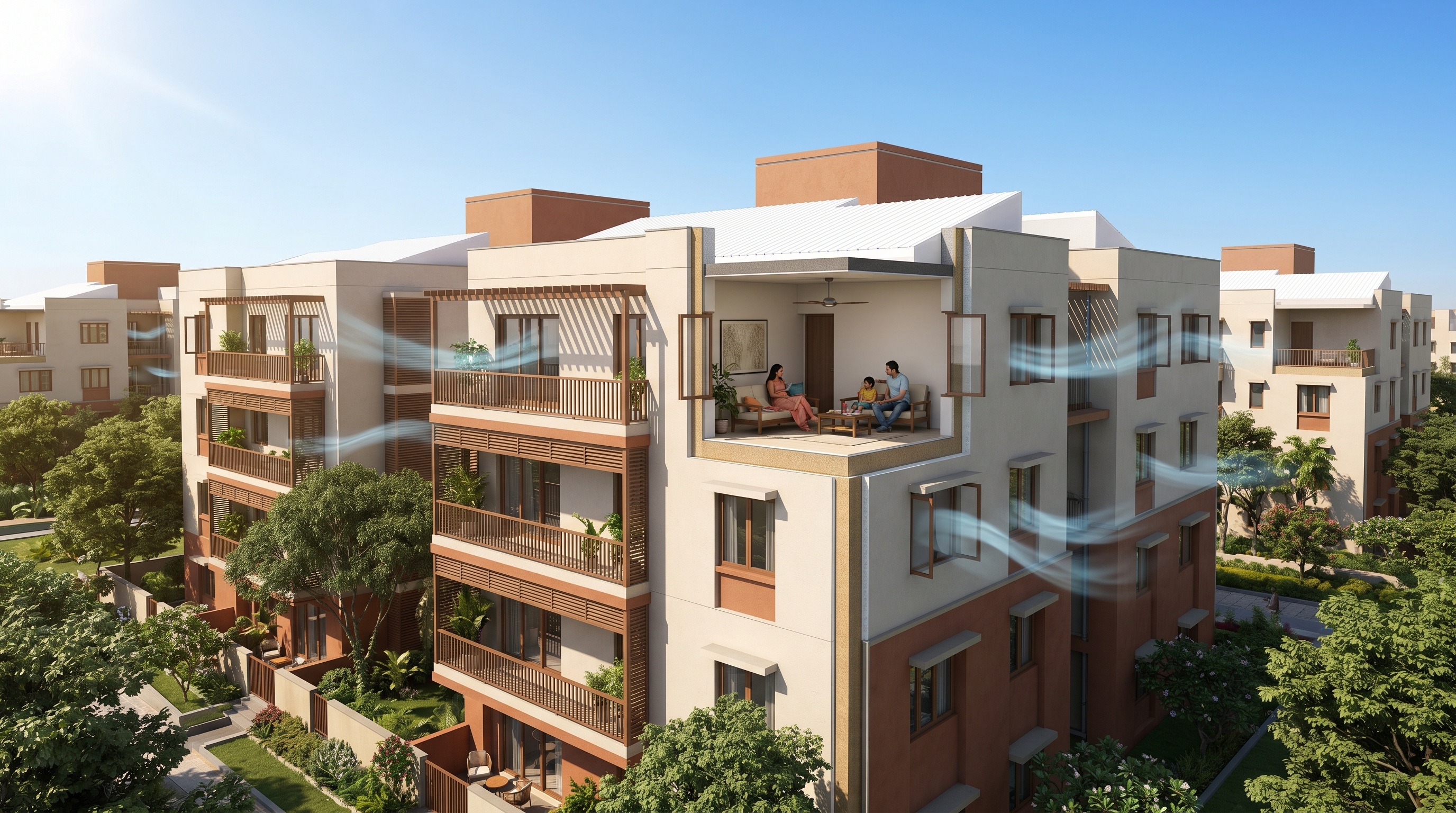
Passive cooling is sometimes treated as old-fashioned. That is a mistake. Orientation, shading, ventilation, insulation, thermal mass, reflective roofs, shaded courtyards, verandas, tree cover and smarter glazing are not romantic ideas. They are engineering choices.
A building that blocks harsh sun, allows cross-ventilation and reduces heat gain can cut peak cooling demand before an air conditioner starts. This does not mean India should reject modern cooling. Heat can kill. Hospitals, schools, offices and homes will need mechanical systems. The point is that mechanical cooling should be the second line of defense, not the first and only line.
If the building is wrong, the AC becomes a rescue device for bad design.
Standards must reach real India
India already has policy tools, including the Energy Conservation Building Code for commercial buildings and Eco-Niwas Samhita for residential energy efficiency. The problem is not the absence of ideas. It is adoption, enforcement and reach.
Large commercial projects can be regulated more easily. The harder challenge is residential construction, smaller developers, informal housing, rental housing and local building permissions. A standard that applies only to premium projects will not solve a mass cooling problem.
States and cities need to make thermal performance part of ordinary approvals. Builders should have clear requirements for roofs, walls, windows, shading and ventilation. Buyers and tenants should be able to see energy performance in plain language. Public housing should lead by example because low-income families are least able to buy their way out of heat.
Equity is the core issue
Cooling is becoming a class divide. Wealthier families can install ACs, inverters and backup power. Poorer families endure heat in rooms built with little thought for thermal comfort. Outdoor workers and informal settlements face the worst exposure.
Better construction standards are therefore not a luxury climate policy. They are a public health policy and a household-cost policy. A cooler home reduces electricity bills, sleep stress and heat risk. At national scale, it reduces peak power demand and the need for expensive generation at the hottest hours.
India's energy transition will be harder if new buildings keep increasing cooling demand faster than clean power can catch up.
Start at the design stage
The climate debate often moves toward grand targets. Buildings require smaller, enforceable decisions: roof reflectance, window-to-wall ratios, shaded facades, ventilation paths, insulation values, local materials, tree cover, urban heat maps and building inspectors who check the work.
These decisions sound mundane because they are. That is why they matter. A country does not become heat-resilient only through summits. It becomes heat-resilient when a family in Nagpur, Chennai, Jaipur or Kolkata can sleep in a room that was designed for the climate it actually lives in.
India's heat strategy has to begin before the AC showroom.
It has to begin with the wall, the roof and the code.