By Ramachandran Rajeev Kumar — 2026-01-09
From Burning Fields to Highways: India's Bio-Bitumen Revolution
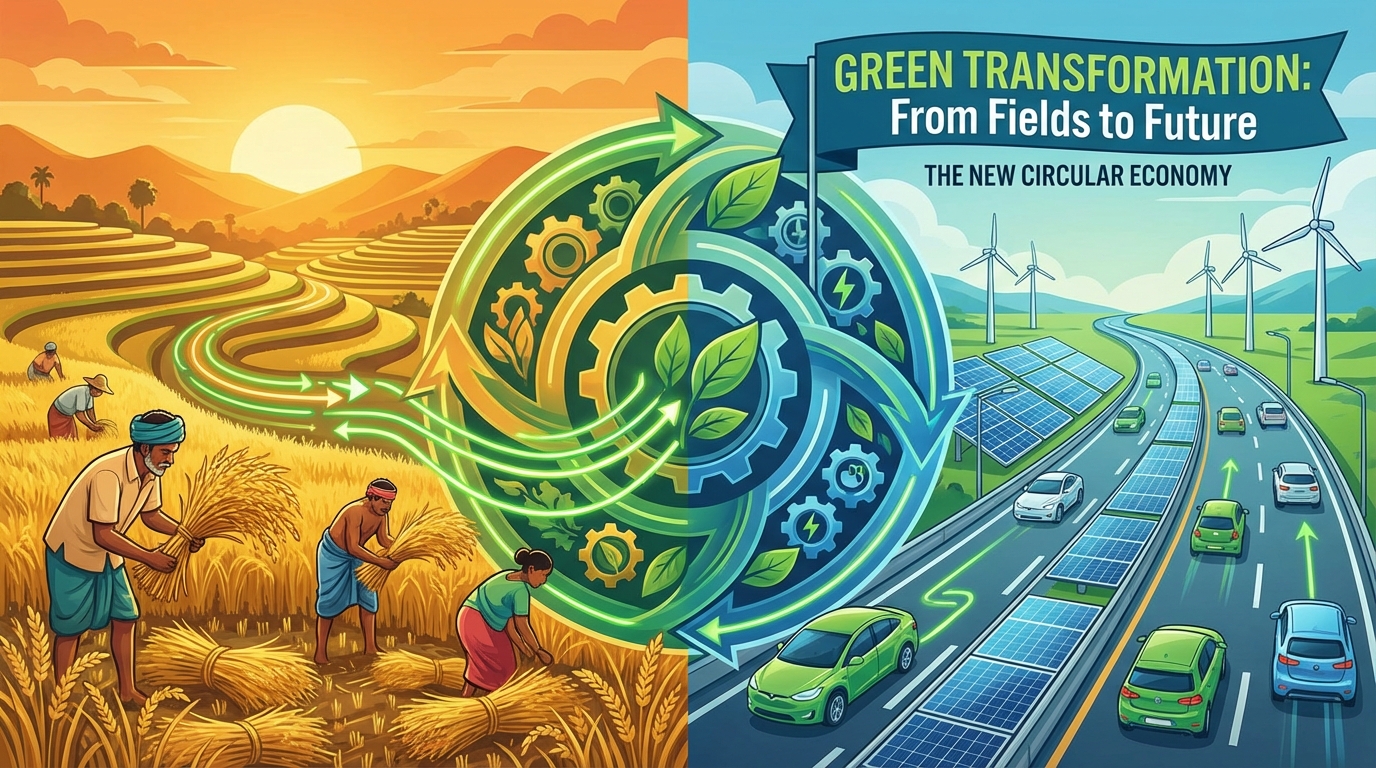
India becomes the first country to commercially produce bio-bitumen from rice straw, solving two problems at once: stubble burning and petroleum dependence.
Every winter, the skies over North India turn toxic. Farmers in Punjab and Haryana, racing to clear their fields before the next planting season, set fire to millions of tonnes of rice straw. The smoke blankets Delhi. Hospitals fill with respiratory patients. Headlines rage. Politicians promise solutions.
This week, one of those solutions may finally have arrived—from an unexpected source.
On January 7, 2026, India became the first country in the world to commercially produce bio-bitumen, a road construction material derived from agricultural waste. The technology, developed entirely by Indian scientists, transforms the very rice straw that farmers burn into a valuable industrial input.
It's the kind of innovation that sounds too good to be true. Which is precisely why it deserves serious attention.
What Is Bio-Bitumen?
Bitumen is the black, sticky substance that binds asphalt together. Every road, highway, and parking lot in the world depends on it. Globally, the bitumen market exceeds $70 billion annually.
Conventionally, bitumen is extracted from petroleum—a byproduct of oil refining. India imports nearly 50% of its bitumen requirements, spending approximately ₹25,000-30,000 crore annually on foreign purchases. Every road India builds sends money abroad.
Bio-bitumen changes this equation. Instead of petroleum, it uses pyrolysis—heating organic material in the absence of oxygen—to convert agricultural residue into bio-oil. This bio-oil can then be blended with conventional bitumen, replacing 20-30% of the petroleum-based material without compromising performance.
The source material? Rice straw. The same crop residue that currently chokes Delhi's air.
The Science Behind It
The technology was developed jointly by CSIR-Central Road Research Institute (CRRI) in New Delhi and CSIR-Indian Institute of Petroleum (IIP) in Dehradun—two of India's premier research institutions.
The process begins with post-harvest rice straw collection. The straw is pelletised for efficient handling, then subjected to pyrolysis at temperatures between 400-600°C. The resulting bio-oil is refined and blended with conventional bitumen in controlled proportions.
What makes this remarkable is the rigour of testing. Bio-bitumen has undergone comprehensive evaluation: physical characterisation, rheological analysis, chemical testing, and mechanical performance assessment. Tests for rutting resistance, cracking behaviour, moisture damage, and resilient modulus all confirmed that bio-bitumen meets or exceeds conventional specifications.
A 100-metre trial stretch has already been laid on the Jorabat-Shillong Expressway (NH-40) in Meghalaya. A one-kilometre section using 15% bio-bitumen is operational on the Nagpur-Mansar National Highway in Maharashtra. These aren't laboratory experiments—they're working roads carrying real traffic.
Two Birds, One Technology
The genius of bio-bitumen lies in addressing two seemingly unrelated problems simultaneously.
Problem One: Stubble Burning
India produces approximately 140 million tonnes of crop residue annually, with rice straw accounting for a significant portion. Farmers have traditionally burned this waste because disposal is expensive and time-consuming. The resulting air pollution costs the economy an estimated $30 billion annually in health impacts and productivity losses.
Multiple policies have attempted to curb stubble burning. Subsidies for agricultural machinery. Fines for violators. Public awareness campaigns. None have worked at scale because they treated stubble as a problem to be eliminated rather than a resource to be valued.
Bio-bitumen flips the script. If farmers can sell their rice straw to bio-bitumen producers, burning it becomes economically irrational. The waste transforms from liability to asset.
Problem Two: Import Dependence
India's infrastructure ambitions require massive quantities of bitumen. The Bharatmala Pariyojana aims to build 65,000 kilometres of national highways. State roads, urban infrastructure, and airport runways add to demand. Every tonne of bitumen imported represents foreign exchange spent and domestic capacity underutilised.
Replacing 20-30% of bitumen demand with domestically produced bio-bitumen would save ₹5,000-9,000 crore annually in import costs. It would create rural supply chains, industrial jobs, and technological capabilities. It would reduce India's exposure to global oil price volatility.
The Environmental Dividend
The climate implications are substantial.
Bio-bitumen production reduces greenhouse gas emissions by at least 70% compared to conventional petroleum-based bitumen. This accounts for avoided emissions from stubble burning, reduced petroleum refining, and the carbon sequestration potential of the pyrolysis process.
Moreover, pyrolysis yields multiple value streams beyond bio-bitumen: energy-efficient gaseous fuel, bio-pesticide fractions, and high-grade carbon suitable for batteries, water purification, and advanced materials. The process approaches zero-waste status—every input generates useful outputs.
As Science and Technology Minister Dr. Jitendra Singh noted: "India has entered into an era of clean, green highways."
From Lab to Road: The Technology Transfer
What happened this week was not a research breakthrough—the technology has been developing for years. It was something more significant: industrial-scale technology transfer.
CSIR formally transferred bio-bitumen production technology to commercial partners. Multiple industries have been onboarded for deployment. A patent has been filed. The pathway from laboratory innovation to market product is now clear.
This matters because India's history is littered with research achievements that never achieved commercial scale. Scientists develop promising technologies; companies lack incentive or capability to adopt them; innovations wither in institutional archives.
Bio-bitumen appears to be avoiding this fate. Road, Transport and Highways Minister Nitin Gadkari—known for his enthusiasm for alternative fuels and circular economy solutions—has championed the technology. The trial stretches have proven real-world feasibility. The economics work: bio-bitumen costs are competitive with conventional materials, especially when factoring in import savings.
CSIR Director General N. Kalaiselvi highlighted the speed of progress: "India has become the first country in the world to take bio-bitumen technology to industrial and commercial scale within the same year."
The Scaling Challenge
Enthusiasm should be tempered by realism. Bio-bitumen at commercial scale faces significant challenges.
Feedstock Collection: Rice straw is dispersed across millions of small farms. Collecting, transporting, and aggregating sufficient quantities for industrial production requires logistics infrastructure that largely doesn't exist. Farmers need reliable buyers; producers need reliable supply.
Quality Consistency: Agricultural residue varies in composition across regions, seasons, and crop varieties. Ensuring consistent bio-oil quality from variable feedstock requires robust processing systems.
Market Acceptance: Road contractors are conservative. They use materials with proven track records. Convincing them to adopt bio-bitumen—even at competitive prices—requires demonstration, training, and guarantee mechanisms.
Regulatory Framework: Standards for bio-bitumen in road construction need formalisation. Testing protocols, quality specifications, and procurement rules must be updated to accommodate the new material.
None of these challenges are insurmountable. But they require sustained attention from policymakers, industry, and researchers.
What This Represents
Beyond the specific innovation, bio-bitumen symbolises something important about India's technological trajectory.
This is not imported technology adapted for Indian conditions. It is not a joint venture with a foreign partner. It is not dependent on external expertise or licensing. CSIR-CRRI and CSIR-IIP developed bio-bitumen from fundamental research through industrial deployment using entirely Indian capabilities.
Gadkari framed it as "a transformative step towards the vision of Viksit Bharat 2047"—developed India by the centenary of independence. The framing is aspirational, but not empty. Bio-bitumen demonstrates that Indian science can solve Indian problems at Indian scale.
It also demonstrates that environmental and economic objectives need not conflict. Reducing air pollution while reducing import dependence while creating rural livelihoods while building infrastructure—these goals can align when technologies are designed with systemic thinking.
The Road Ahead
The next twelve months will determine whether bio-bitumen remains a promising pilot or becomes transformative infrastructure.
Success requires aggressive government procurement mandates—requiring bio-bitumen content in publicly funded road projects. It requires investment in collection and processing infrastructure across rice-growing states. It requires extension services to connect farmers with buyers. It requires quality certification systems that contractors can trust.
The pieces are in place. The technology works. The economics align. The policy support exists. What remains is execution—the hardest part of any innovation journey.
But this week, driving on a highway in Maharashtra or Meghalaya, you can drive on roads made partly from rice straw. Roads that were impossible a year ago. Roads that point toward a future where India's waste becomes India's infrastructure.
That's worth celebrating—and worth building on.
Ramachandran Rajeev Kumar is the Founder and Editor-in-Chief of BarathVector.