By Ramachandran Rajeev Kumar — 2025-12-28
India 2025: The Goldilocks Economy That Wasn't Quite Right
By Ramachandran Rajeev Kumar
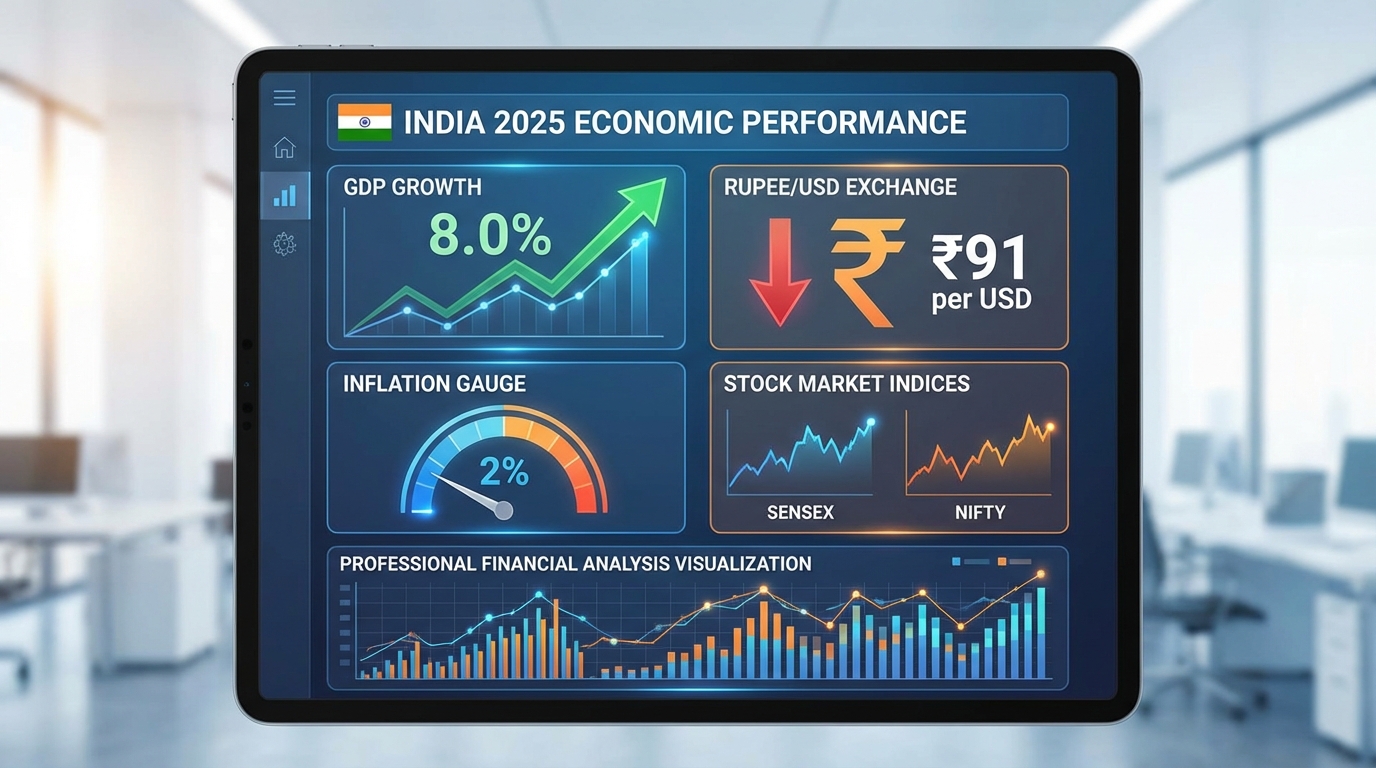
RBI Governor Sanjay Malhotra called it a "rare Goldilocks period" in October 2025. Growth at 8%, inflation at 2.2%. Not too hot, not too cold. Just right.
On paper, he wasn't wrong. India's macroeconomic indicators in 2025 would make most emerging economies green with envy.
But Goldilocks, as the story goes, was sleeping in someone else's bed. And when the bears came home, the comfortable narrative got complicated.
This is the story of India's 2025 economy: a year of paradoxes, where headline numbers sparkled while underlying vulnerabilities festered.
The Good: Growth That Defied Gravity
Let's start with what went right. India's economy grew at approximately 8% in the first half of FY2025-26, the strongest performance among major economies.
Key Growth Numbers:
| Metric | Performance |
|---|---|
| Q1 FY26 GDP Growth | 7.8% |
| Q2 FY26 GDP Growth | 8.2% |
| H1 FY26 Average | 8.0% |
| Global Ranking | 4th largest economy (surpassed Japan) |
In mid-2025, India quietly crossed a milestone: it surpassed Japan to become the world's fourth-largest economy by nominal GDP. Only the United States, China, and Germany now stand ahead.
The growth was broad-based. Services expanded at 9.2%, manufacturing at 8.1%. Government capital expenditure continued its march. Infrastructure spending remained robust.
The Better: Inflation Tamed
Perhaps more remarkable than the growth was what happened to inflation.
Headline CPI inflation declined for nine consecutive months, touching an 8-year low of 1.6% in July 2025 before edging up slightly to around 2.1% by August. For context, the RBI's target is 4% with a 2% tolerance band on either side.
Inflation didn't just fall. It crashed through the floor.
What drove the decline?
- Global commodity prices stabilized
- Food inflation moderated after monsoon concerns eased
- Base effects from 2024's high inflation worked in favour
- Government kept a lid on fuel prices
This gave the RBI room to do something it rarely does: cut rates aggressively.
The Rate Cut Bonanza
Throughout 2025, the RBI progressively eased its stance, delivering a cumulative 125 basis points in repo rate cuts. The policy rate dropped from 6.50% to 5.25%, the lowest since July 2022.
RBI Policy Moves in 2025:
| Date | Repo Rate | Change |
|---|---|---|
| Start of 2025 | 6.50% | - |
| February 2025 | 6.25% | -25 bps |
| April 2025 | 6.00% | -25 bps |
| June 2025 | 5.75% | -25 bps |
| August 2025 | 5.50% | -25 bps |
| December 2025 | 5.25% | -25 bps |
The December cut came with an upgraded GDP forecast: 7.3% for FY26, up from the earlier 6.8% estimate.
For borrowers, this meant relief. Home loan EMIs dropped. Corporate borrowing costs fell. The liquidity taps opened wider.
The Bad: The Rupee's Collapse
Now we come to the part the headline numbers don't capture.
The Indian rupee had its worst year in recent memory. It began 2025 at around Rs 85.6 per dollar. By early December, it had crashed through Rs 90, briefly touching Rs 91.14, a record low that required aggressive RBI intervention to arrest.
Rupee Performance 2025:
| Metric | Value |
|---|---|
| Start of Year | ~Rs 85.6/$ |
| December Low | Rs 91.14/$ |
| Year-to-Date Decline | ~4.9% |
| Status | Asia's worst-performing currency |
The rupee became Asia's worst-performing currency in 2025. Worse than the Thai baht. Worse than the Indonesian rupiah. Worse than currencies of economies far less robust than India's.
What happened?
Three forces converged:
The Trump Tariff Shock: The 50% tariffs on Indian goods announced in August 2025 rattled markets. Foreign investors, spooked by India's sudden vulnerability, fled.
Capital Flight: Foreign Portfolio Investors (FPIs) pulled out over $17-18 billion from equities in 2025. This wasn't profit-taking; it was a vote of no confidence.
Trade Deal Limbo: Unlike Japan, the UK, or even some Southeast Asian nations, India failed to secure a trade deal with the US. The lack of progress kept the rupee under persistent pressure.
The Tariff Wall
The defining external shock of 2025 was Trump's tariff assault on India.
It came in two waves. First, a 25% "reciprocal" tariff announced in early 2025. Then, an additional 25% penalty tied to India's continued oil imports from Russia. Together, a 50% duty wall, among the highest imposed on any US trading partner.
Impact Assessment:
| Metric | Estimate |
|---|---|
| GDP Impact | -0.4 to -0.6 percentage points |
| Sectors Most Hit | Textiles, gems, shrimp, rice |
| Sectors Protected | Pharma, electronics (exempt) |
The tariffs didn't kill India's exports outright. November 2025 actually saw exports to the US rebound to $6.92 billion. But the structural damage is real. Labour-intensive sectors that employ millions, like textiles and gems, face an existential threat.
The trade deal that could resolve this remains elusive. Agriculture is the sticking point. The US wants access for genetically modified crops and dairy. India's farm lobby resists. Neither side is blinking.
The Ugly: What Growth Didn't Fix
Here's the uncomfortable truth: 8% GDP growth doesn't automatically translate to 8% improvement in the average Indian's life.
Several indicators suggest the growth benefits were unevenly distributed:
Signs of Stress:
Household Debt Rising: Indian household debt continued its upward march, suggesting families are borrowing to maintain consumption rather than thriving on income growth.
Wage Stagnation: Despite headline growth, wage growth in many sectors remained flat. The formal-informal divide widened.
Direct Tax Collection Slippage: At various points in 2025, direct tax collection underperformed expectations, a sign that income growth wasn't matching GDP growth.
Stock Market Divergence: While the Sensex hit all-time highs above 86,000 in early December, it ended the year consolidating around 26,000 on the Nifty. The FPI exodus took its toll.
The GDP measures output. It doesn't measure who captures that output. And in 2025, the capture was concentrated at the top.
The Stock Market Story
The equity markets had a tale of two halves.
Early 2025: Sensex and Nifty surged to record highs. On December 1, the Sensex touched 86,159, an all-time high. Bank Nifty crossed 60,000 for the first time ever.
Late December: The indices retreated. The Nifty ended around 26,000, down from highs. FPI selling weighed heavily.
Market Metrics:
| Index | 2025 High | December Close |
|---|---|---|
| Sensex | 86,159 | ~85,000 |
| Nifty 50 | 26,326 | ~26,000 |
| Bank Nifty | 60,114 | ~59,000 |
| SIP Inflows | Rs 29,000 crore/month | Record |
The silver lining: Domestic retail investors proved their resilience. Monthly SIP inflows crossed Rs 29,000 crore, creating what analysts call a "permanent floor" for the market. This wall of domestic money absorbed over $20 billion in foreign selling earlier in the year.
The lesson: India's equity market is increasingly driven by domestic savers, not foreign speculators. That's structural strength, even if short-term volatility remains.
The Trade Diversification Pivot
Faced with hostile US trade policy, India didn't stand still. It pivoted hard toward alternative markets.
Trade Deals Signed in 2025:
- EFTA Agreement (Switzerland, Norway, Iceland, Liechtenstein) - October 2025
- New Zealand FTA - 2025
- India-Oman CEPA - December 2025 (98% duty-free access)
These deals won't fully replace the US market. But they demonstrate intent. India is building an alternative trade architecture, one that doesn't depend on Washington's goodwill.
The Oman deal is particularly significant. It's India's second CEPA with a GCC nation after the UAE agreement in 2022. The Gulf pivot is real.
What the RBI Got Right
Credit where due: the RBI navigated 2025 with skill.
When inflation collapsed faster than expected, it pivoted quickly to supporting growth. The rate cuts were well-timed. The liquidity injections (Rs 1 trillion in OMOs, $5 billion in forex swaps) were calibrated.
When the rupee crashed, intervention was swift and heavy. State-run banks sold dollars aggressively on behalf of the central bank, preventing a disorderly rout.
The RBI couldn't solve India's external vulnerabilities. But it managed what it could control.
The Verdict: 7 Out of 10
How do we score India's 2025 economy?
Strengths:
- GDP growth among the best globally
- Inflation under control
- Domestic consumption resilient
- SIP culture creating stable equity demand
- Trade diversification underway
Weaknesses:
- Rupee depreciation eroded purchasing power
- FPI exodus signalled external vulnerability
- Tariff wall unresolved
- Benefits of growth concentrated, not distributed
- Per capita income growth lagged headline GDP
The Goldilocks Assessment:
The porridge was the right temperature. But the bears were at the door.
India's 2025 economy was impressive by any emerging market standard. It was not impressive by the standard India needs to meet its Viksit Bharat 2047 goals. Growing at 6-8% while your currency loses 5% and your exports face 50% tariffs is running on a treadmill.
What 2026 Needs
For 2026, three things matter:
Trade Deal Progress: Whether with the US or alternatives, India needs to break the tariff deadlock. Manufacturing employment depends on export competitiveness.
Rupee Stability: The currency needs to find a floor. Continued depreciation will import inflation and erode real incomes.
Broad-Based Growth: GDP growth that doesn't translate to income growth for the median Indian is politically and economically unsustainable.
The Bottom Line
India's 2025 economy was a glass half full.
The optimist sees 8% growth, controlled inflation, and resilient domestic demand. The pessimist sees a crashing currency, hostile trade environment, and benefits that didn't reach the masses.
Both are right.
The Goldilocks economy wasn't quite right. The porridge was warm, but the house was still someone else's. India performed well within constraints it couldn't control. The question for 2026 is whether it can break those constraints.
For now, the growth story continues. Whether it becomes a prosperity story for 1.4 billion Indians remains the unfinished chapter.
As we close the books on 2025, India stands as the world's fourth-largest economy with fifth-world per capita income. Closing that gap is the work of the next two decades.