By BarathVector Editorial — 2026-03-04
The Hormuz Chokehold: Why India's Answer Lies 1,200 Kilometres East of Chennai
By BarathVector Editorial
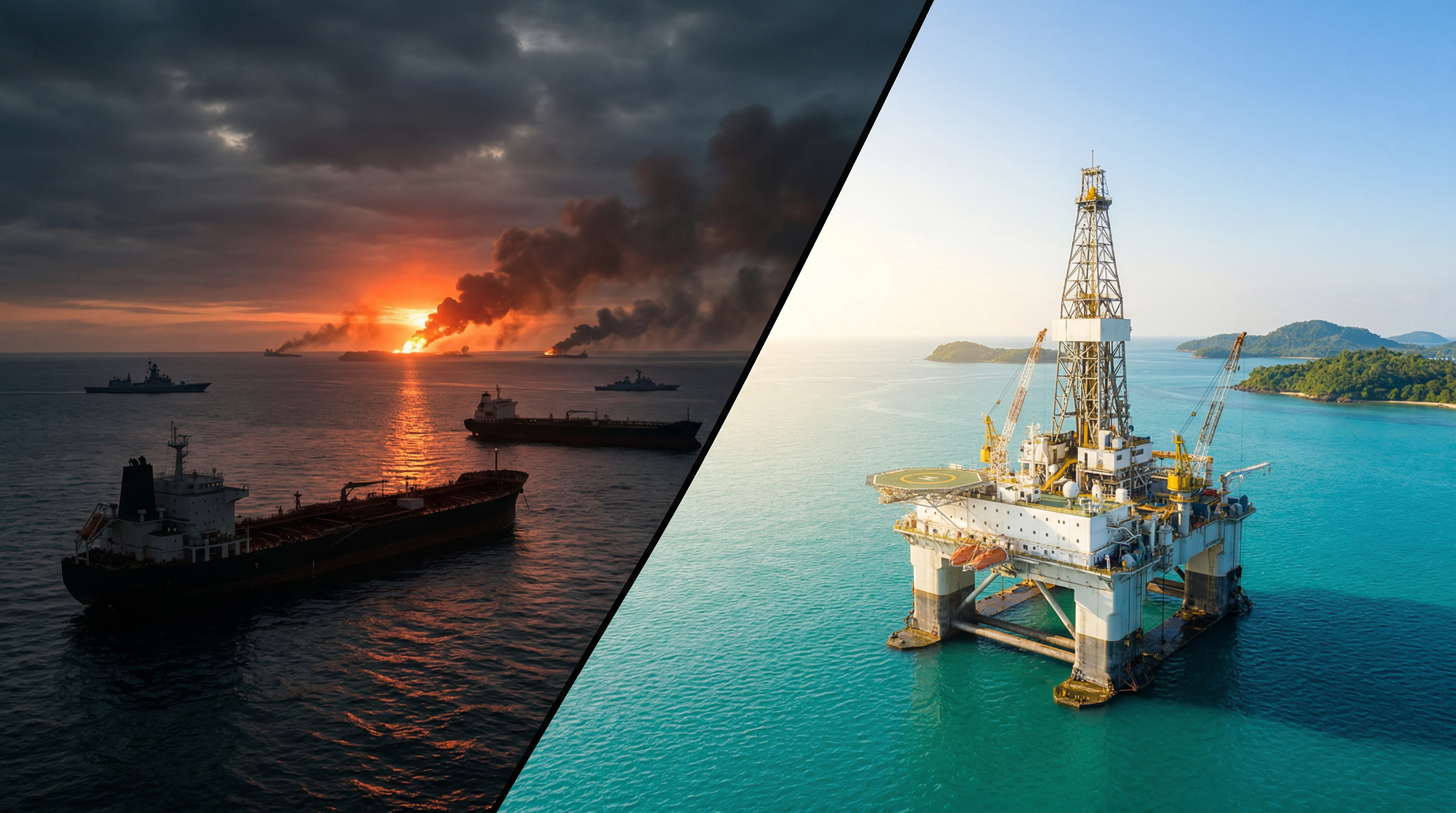
On March 2, 2026, the Sensex crashed nearly 2,700 points. Brent crude surged past $82 a barrel -- a 14-month high -- with analysts warning it could breach $100. The trigger was not abstract: Iran's Islamic Revolutionary Guard Corps formally confirmed the closure of the Strait of Hormuz, the 33-kilometre-wide passage through which roughly 20 per cent of global oil flows and over 40 per cent of India's crude imports transit.
For India -- a nation that imports 88.2 per cent of its crude oil -- the Hormuz shutdown is not a strategic hypothetical. It is a live emergency.
Yet somewhere in the Andaman Sea, approximately 1,200 kilometres east of Chennai, lies the beginning of an answer that India has been conspicuously slow to pursue.
The Anatomy of a Dependency
India's oil import bill in FY2025 stood at $242.4 billion. That figure alone represents a structural vulnerability of staggering proportions. But what transforms vulnerability into crisis is geography. Roughly half of India's crude imports transit through the Strait of Hormuz -- a chokepoint that has now gone from theoretical risk to operational reality.
The Middle East is not merely India's petrol pump. It accounts for 17 per cent of India's total exports, 55 per cent of its crude supplies, and 38 per cent of inward remittances, according to Jefferies. Nearly 9 million Indians live and work in the Gulf Cooperation Council states. In FY2025, remittances from overseas Indians hit a record $135.46 billion, a significant portion of which flows from the Gulf.
When Hormuz closes, India does not merely face higher fuel prices. It faces a compound crisis: energy supply disruption, trade route severing, remittance flow risk, and the economic cascading that follows when all three happen simultaneously.
The Reserve Bank of India held its repo rate at 5.25 per cent in February, after a 25-basis-point cut in December, banking on a softer inflation outlook and 7.4 per cent GDP growth. That outlook now looks quaint. Oil at $100 a barrel rewrites every macroeconomic assumption the RBI made six weeks ago.
The Discovery Nobody Is Talking About
In September 2025, at a Basin Analysis conference in Mumbai, Oil India confirmed something remarkable: the Sri Vijayapuram-2 well in the Andaman deepwater region had struck natural gas with approximately 87 per cent methane content, drilled at a water depth of 295 metres to a target depth of 2,650 metres. It was the first-ever confirmed hydrocarbon discovery in the Andaman-Nicobar Basin.
This was not a minor geological curiosity. The Directorate General of Hydrocarbons estimates the Andaman-Nicobar Basin holds approximately 371 million metric tonnes of oil equivalent. Four blocks covering 23,261 square kilometres have been allocated for exploration. ONGC has plans for 18 wells across six deepwater blocks, with an estimated investment of $1 billion. The Oilfields (Regulation and Development) Amendment Act 2025, which took effect in April 2025, opened 99 per cent of previously restricted areas in Indian waters for exploration, modernising the regulatory framework to recognise unconventional hydrocarbons including shale oil, tight gas, and gas hydrates.
On paper, this is precisely the kind of upstream breakthrough that nations dream of. In practice, India treated it as a footnote.
The Guyana Precedent
Compare India's response to what happened in Guyana -- a country with a population smaller than Pune's.
In May 2015, ExxonMobil announced the Liza discovery in Guyana's Stabroek Block. By December 2019 -- less than five years later -- first commercial oil was flowing. By November 2025, daily production from the Stabroek Block hit 900,000 barrels. Guyana now has four operational offshore projects, with a fifth and sixth expected online in 2026 and 2027. ExxonMobil projects total production capacity of 1.7 million barrels per day by 2030 from eight developments.
Guyana went from a country with zero oil production history to the world's largest per capita oil producer in under a decade. The reserves that launched this transformation? Comparable in scale to what India's Andaman Basin is believed to hold.
The difference was not geology. It was urgency. ExxonMobil moved with the speed and seriousness that a transformative discovery demands. Guyana's government, for all its institutional constraints, cleared regulatory pathways instead of creating them. The result: a small South American nation now wields energy sovereignty that the world's fifth-largest economy can only envy.
India's Prime Minister visited Guyana in late 2025, and Indian refiners are reportedly in talks for long-term crude supply agreements with the country. The irony is bitter: India is negotiating to buy Guyanese oil while sitting on a potentially Guyana-scale resource of its own.
The Bureaucracy Problem
The obstacle to India's energy self-reliance is not geological uncertainty. It is institutional inertia.
Consider the evidence. ONGC's Andaman deepwater blocks were awarded in June 2010 under the eighth round of the New Exploration Licensing Policy. Sixteen years later, the first stratigraphic well -- AND-P-1 -- was spudded in January 2026. Sixteen years from block award to first serious drilling activity. In the same timeframe, Guyana went from zero to nearly a million barrels a day.
The Open Acreage Licensing Policy, meant to streamline exploration bidding, tells a similar story. OALP-X, the tenth bidding round, has had its deadline extended four times -- from July 2025 to October 2025, then December, then February 2026, and most recently to May 2026. Each extension is attributed to companies needing more time to assess the regulatory changes under the Oilfields Amendment Act. What this means in plain language is that India reformed its laws but failed to create the ecosystem of clarity and confidence that would make those reforms actionable.
DGH approvals and Ministry of Environment clearances routinely take two to three years. For a nation facing an energy emergency, this pace is not merely bureaucratic sluggishness -- it is a form of strategic negligence.
The KG Basin offers a cautionary parallel. India's most promising domestic production zone has been plagued by delays, cost overruns, and regulatory disputes for over a decade. The infrastructure is there. The geology proved out. Yet output has repeatedly underperformed because the administrative machinery could not keep pace with the technical opportunity.
This is what Indian Babu Raj does to national security imperatives: it converts urgency into process, process into delay, and delay into irrelevance.
The Sequencing Argument
There will be voices -- there always are -- arguing that Andaman exploration conflicts with India's climate commitments. That deepwater hydrocarbon development contradicts COP pledges. That India should be investing in renewables, not fossil fuels.
This argument has the luxury of being philosophically coherent and practically catastrophic.
A country that cannot keep its lights on or its factories running serves nobody's climate goals. India's 1.4 billion people do not have the option of waiting for solar panels to replace crude oil in industrial feedstock, petrochemicals, aviation fuel, and heavy transport. The energy transition is real, necessary, and happening -- but it operates on a different timeline than the one imposed by a Hormuz closure.
The proper sequencing is straightforward: secure energy independence first, then invest the proceeds into the green transition. This is precisely what Norway did -- building the world's largest sovereign wealth fund on North Sea oil, then deploying that capital into renewable energy and climate leadership. It is what the Gulf states themselves are doing, channelling hydrocarbon wealth into solar farms and green hydrogen.
The alternative -- starving oneself into climate virtue while importing oil through the world's most dangerous chokepoint -- is not strategy. It is surrender dressed as principle.
Science must create solutions to counter the use of fossil energy for economic sustenance. That is the proper order of operations. You do not ask a nation to stop breathing while you develop a better pair of lungs.
What Must Happen Now
The Andaman Basin needs war-footing urgency. Not ten-year development timelines. Not four-time-extended bidding rounds. Not geological conferences where discoveries are announced and then forgotten.
First, fast-track exploration with a dedicated regulatory corridor. The Andaman Basin should be designated a national energy priority zone with compressed approval timelines -- months, not years. If India could build airports and highways on compressed schedules for the G20, it can do the same for its energy security.
Second, bring in world-class deepwater operators. ONGC signed an MoU with BP in July 2025 for Andaman Basin collaboration. That is a start. But India needs the Schlumbergers, the ExxonMobils, the Equinors -- companies with proven track records of taking deepwater discoveries from wellhead to production at speed. National pride cannot substitute for technical capability when you are drilling at 2,650 metres below the seabed.
Third, treat this as what it is -- India's energy independence moment. The discovery at Vijayapuram-2 is not a data point for a conference presentation. It is a signal that the Andaman Basin is hydrocarbon-bearing, that the geology supports commercial potential, and that the window of strategic relevance is now, not a decade from now.
Fourth, resolve the OALP paralysis. A bidding round extended four times sends exactly the wrong signal to international capital. Simplify terms, guarantee regulatory stability, and make India's upstream sector investable again.
The Deadline
The Hormuz crisis is not a warning. It is a deadline.
Every day that tanker traffic remains frozen in the Persian Gulf, India's strategic petroleum reserves deplete. Every $10 increase in Brent crude adds approximately $15 billion to India's annual import bill. Every week of Hormuz closure accelerates the compound economic damage -- from aviation fuel shortages to fertiliser production disruptions to the cascading inflation that hits the poorest hardest.
India has spent a decade treating energy diversification as a PowerPoint strategy. The Andaman Basin discovery offered a genuine path toward reduced dependency. The Oilfields Act 2025 provided the regulatory framework. ONGC and Oil India have the mandate. BP has signalled willingness to collaborate.
What is missing is the one thing that differentiated Guyana's story from every other country that found oil and went back to sleep: political will matched by institutional velocity.
The Hormuz chokehold will eventually ease. Geopolitics cycles. But India's structural dependency on imported crude -- and its structural inability to convert domestic discoveries into domestic production -- will persist long after this particular crisis fades.
The answer is 1,200 kilometres east of Chennai. The question is whether India has the nerve to go get it.
This analysis draws on data from the Directorate General of Hydrocarbons, Oil India Limited, ONGC, Rystad Energy, the Reserve Bank of India, and reporting by Business Standard, CNBC, Al Jazeera, The Week, OilPrice.com, and Spherical Insights.