By Ramachandran Rajeev Kumar — 2026-04-14
The Blockade Arrives at the Pump: Why India's Fuel-Price Shield Is Cracking in Week Seven
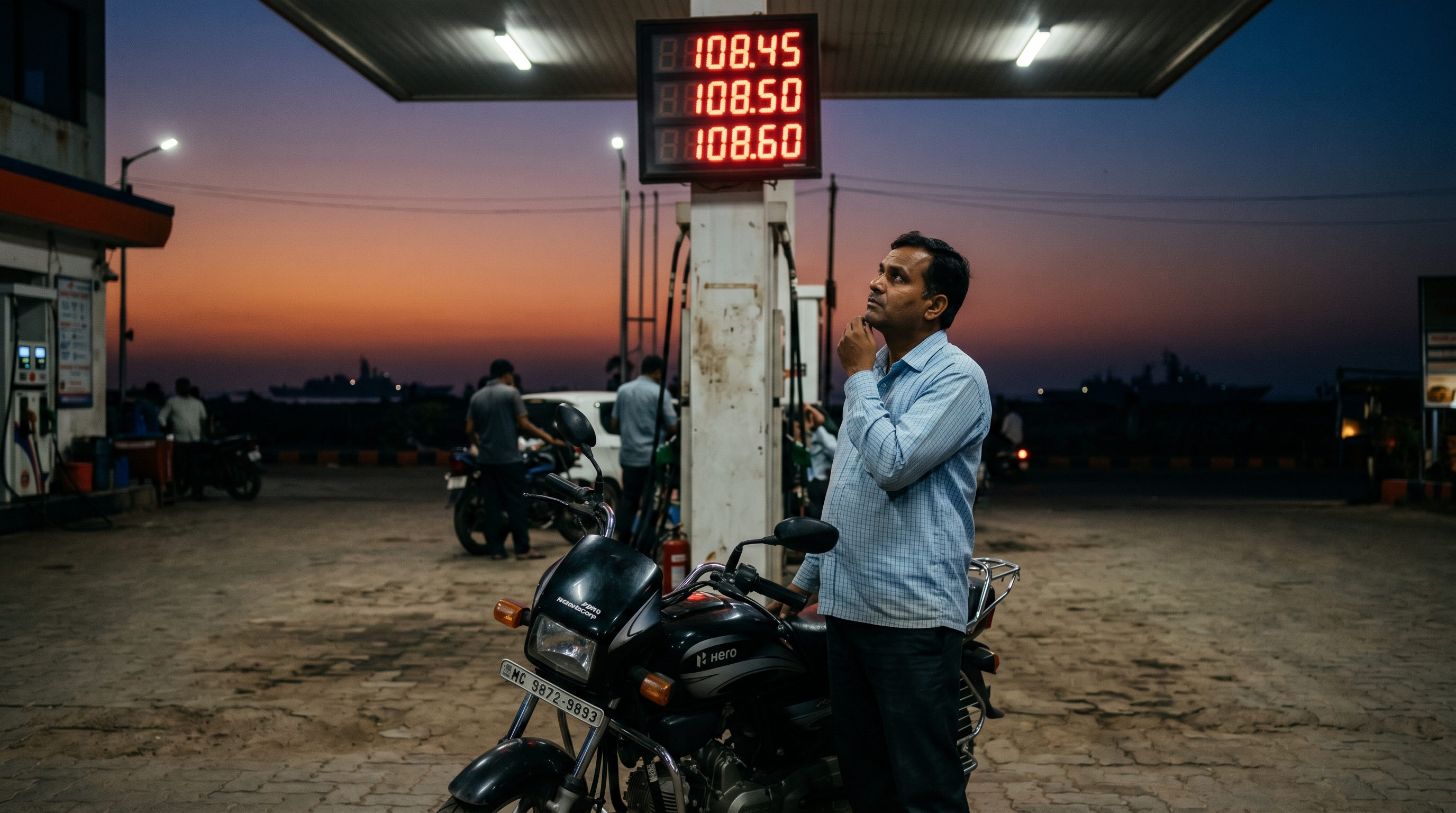
At the HPCL outlet on Mumbai-Agra Highway outside Nashik, the digital board flipped twice between Tuesday morning and Friday evening. Petrol at ₹102.14 on Tuesday. ₹104.06 by Wednesday night. ₹106.82 on Friday, a few hours after the afternoon television bulletins carried the line about American warships and Bandar Abbas.
Suresh Pawar sits on his Bajaj Pulsar at the third pump, watching the attendant pour ₹300 worth, a little under three litres at the new rate. He commutes 42 kilometres each way to a warehouse job in the MIDC. Six weeks ago, the same ₹300 filled his tank for four days. Now it lasts two. He has already cancelled the Tuesday visit to his sister in Malegaon; the rest of the month, he says, will go on what he calls "only-duty riding."
Across the road, at the Hero showroom, the manager Vivek Deshpande has stopped unloading the truck from Aurangabad. Four new Splendors have been sitting on the forecourt for nine days. "Customers come, see the price of petrol, and say they'll wait," he says. "Nobody waits for a two-wheeler. They're not waiting for the bike. They're waiting to see if this gets worse."
This is what Week Seven of the Hormuz crisis looks like from Nashik. Not in the headlines from Washington or the Pentagon briefings, but in the twenty-rupee gap between what a warehouse worker expected to spend on fuel this week and what the pump asked him for. And it is going to get worse, because the shield the Government of India built through six weeks of the crisis has finally begun to crack.
The numbers
India imports roughly 5 million barrels of crude a day, and about 85 per cent of what moves through the domestic economy, from a delivery truck to a power plant to a farmer's pumpset, starts as oil landed at an Indian port. When global benchmarks move, the Indian basket moves with them. There is no moat.
The Indian crude basket, a weighted average of Dubai, Oman and Brent, has been on a punishing trajectory. It spiked well above $150 on March 23 at the height of the early Iran war panic, settled around $115.75 when Delhi announced its excise cut after Ram Navami, and is now back at USD 120.84 per barrel on the Petroleum Planning and Analysis Cell board, according to the Government's own published data, with the BusinessUpturn analysis noting the seven-week arc from $63 to $146.
Brent itself is the tell. On April 12 the front-month contract closed at just under $100 a barrel as U.S. Navy blockade plans leaked. By April 13, with the blockade on the record and CNN confirming the Fifth Fleet's posture at Iranian ports, traders were no longer pricing a spike. They were pricing a floor.
The rupee has not helped. It has weakened to the mid-87s against the dollar through the quarter, which means every one-dollar move on the Indian basket lands with more force on the landed cost. At roughly 5 million barrels a day and an average basket of $110, the annualised import bill pushes past $200 billion. The delta between February's $69 basket and today's $120 basket, if it holds for a year, is the difference between manageable and ugly: roughly ₹8 lakh crore of additional outflow on a single commodity. That figure, put against the Union Budget's total capital expenditure outlay for the year, reads as a quiet confiscation of every school built, every road laid, every port dredged in the fiscal.
The consumer price index will show the trace. CPI printed 3.4 per cent in March, and economists now expect 3.8 per cent for April. May will be harder. Fuel and light inflation, which ticked up to 3.8 per cent in February, is the slow-burning number that feeds into transport, food and services with a lag of four to eight weeks.
Week Seven: what broke
For six weeks, the Government of India ran a bet, and the bet was that Brent would come down. It was not an unreasonable bet. Through late March and early April, the spot price had been easing off the March panic highs. The Strait remained contested but open. Iranian mine-laying in the shipping lanes had been managed by the coalition escort regime. Indian refiners kept loading, crude kept landing, and the government paid for the gap between world prices and pump prices out of three pockets: foregone excise, oil marketing company under-recoveries, and rerouted subsidies.
Then the bet lost.
The turn came on April 12, when CNBC reported that the U.S. Navy was preparing a formal blockade of Iranian ports. The next day CNN carried the same line with additional detail, describing a posture that ringed Bandar Abbas, Kharg Island, and the deepwater loading terminals Iran uses to move crude to willing buyers.
A formal blockade is a different animal from mine-laying and contested transit. Mines are deniable, episodic, and disruption-priced; traders add a risk premium and move on. A declared naval blockade of a producing country's export terminals is a structural removal of supply. It is a ceiling on what Iran can sell and a floor under what everyone else will charge. For India, which had quietly stepped up imports from Iran earlier in April through channels The Diplomat described as a nuanced accommodation, the blockade closes a lane that had been discreetly open.
It also closes the scenario on which the Treasury built its six-week shield. A government can absorb a spike. It cannot absorb a floor. Every paisa of excise it forgoes, every rupee of under-recovery it asks HPCL to carry, every crore it reroutes from subsidy heads, all of that is priced against a line in a monthly briefing that says, "Brent will come off this quarter." Week Seven erased the line. And with it, the quiet assumption that sat under every North Block calculation since late February — that the crisis had a back half, and the back half would be cheaper.
The three levers
Delhi now holds three levers, and each of them has a political price tag.
Lever one: another excise cut
The Centre has already done this once in this crisis. On March 27, it cut the special additional excise on petrol from ₹13 to ₹3 a litre and on diesel from ₹10 to zero, taking what the finance ministry called a "huge hit" on tax revenue. A2Z Taxcorp's parsing of the April notifications confirms that the structure has now been repeatedly rejigged, with a second round of adjustments on High-Speed Diesel on April 11.
Every one rupee off the excise on petrol costs the Centre roughly ₹13,000 crore in foregone revenue over a full year at India's current motor fuel consumption. On diesel, the multiplier is higher because volume is higher. The ₹10 cut already on the books is pricing the Centre something in the region of ₹2.5 lakh crore of foregone annual revenue if it holds for a year. Another ₹3 a litre on petrol plus further relief on diesel would erase most of the remaining headroom the Budget built on energy taxes.
And it still might not reach the pump. OMCs are already selling at a loss. A cut now would first plug their bleed, then maybe move the retail price. Suresh Pawar at Nashik would not see ₹3 off his board.
Lever two: the OMC balance sheet
The losses at HPCL, BPCL and IOCL are not theoretical. As of April 1, the three were collectively losing ₹24.40 per litre on petrol and ₹104.99 per litre on diesel at pre-excise-adjustment levels, with current under-recoveries holding in a ₹20-30 per litre band even after the excise cut on petrol. These are not OPEC-era oil-bond losses. These are real-time working-capital deficits. The same reporting puts IOCL's working-capital hole at ₹72,971 crore, HPCL's at ₹38,571 crore, and BPCL's at ₹17,840 crore.
The OMCs can carry these losses for another quarter, maybe two, before it shows up in three places: frozen capital expenditure on refining upgrades, delayed dealer payments, and depressed dividends to their majority shareholder, the Government of India itself. The lever works, in other words, only as long as the Centre is willing to watch public-sector balance sheets deteriorate in silence. At some point, the quarterly disclosures arrive. The UBS analysts who downgraded the OMC trio in March have company now.
Lever three: target the subsidy
The third lever is the honest one, and the hardest. Instead of blanket excise cuts that subsidise the SUV owner and the two-wheeler commuter equally, the Centre can target relief at households below a stated income line. Ujjwala showed this is operationally possible. A Direct Benefit Transfer of, say, ₹500 a month to ration-card-linked households during the crisis, paired with a deliberate pass-through of a ₹5 per litre hike at the pump, would move the fiscal weight off the Treasury and the OMCs and onto those who can absorb it: urban middle-class commuters, the upper-middle who drive cars, the industrial diesel buyer who can either pass the cost to his customer or hedge his fuel bill.
The political cost is immediate and visible. The benefit is deferred and statistical. This is why it has not been reached for.
Lever three is the one that actually exists as a long-term option. The real question is whether Delhi chooses it deliberately, before Levers one and two choose it for her by running out of room.
A fuel-tax doctrine
What the crisis has done, in seven weeks, is expose that India does not have a fuel-tax doctrine. It has a fuel-tax reflex. When global prices rise, the Centre cuts excise to hold pump prices flat. When they fall, excise is quietly restored and the Treasury collects the difference. The retail price at the pump moves in a narrow band that has more to do with state elections than with the Dubai-Brent-Oman weighted average. This served the political cycle. It did not serve the country.
The reform that Week Seven forces is a transparent, rules-based fuel-tax doctrine, one that decouples the rupee at the pump from the electoral calendar and the discretionary mood of North Block. The doctrine would have three pillars. First, a published crude-linked tax schedule that adjusts excise in a pre-announced band as the Indian basket moves, so that the pump price tracks the world within a capped range. Second, a counter-cyclical fuel stabilisation fund, built in cheap-oil years, that draws down in crisis. Third, a targeted DBT for fuel-stressed households so that the fiscal weight of any future Hormuz shock sits on the people most able to carry it, not on OMCs with no voting weight and no politics.
The Petroleum and Natural Gas Ministry should own the doctrine. The Finance Ministry should ratify it. And Parliament should legislate it, so no future government can quietly flip it back to discretion when the next election approaches.
This is not a radical demand. It is the minimum plumbing of a serious oil-importing economy. Japan has a strategic stabilisation mechanism. Even the United States, for all its shale comfort, maintains the SPR as an explicit policy instrument. India has built reserves at Visakhapatnam, Mangalore and Padur, but the doctrine around them is thin, and the tax mechanism around them is absent.
The real question Week Seven puts to Delhi is not whether to cut excise again or let OMCs bleed another quarter. Those are tactical. The question is whether the Government will now do what six weeks of absorption postponed: tell the country the truth about what a Hormuz blockade costs, and build the rules-based architecture that keeps the truth from becoming a surprise every time. Peace, prosperity and progress begin with that act of honesty. Suresh Pawar at the Nashik pump does not need a speech. He needs a doctrine that explains why his ₹300 lasts two days now, and a credible promise that the country is building the architecture to make sure the next shock is met with rules rather than reflex.