By Ramachandran Rajeev Kumar — 2026-05-01
Hormuz Holds India by the Throat. Only Delhi Can Talk to Both Sides.
Half of India's crude moves through a 21-mile-wide chokepoint. The Iran–Israel escalation is now an Indian problem.
If you want to understand why India's foreign policy looks the way it does in May 2026, look at a map.
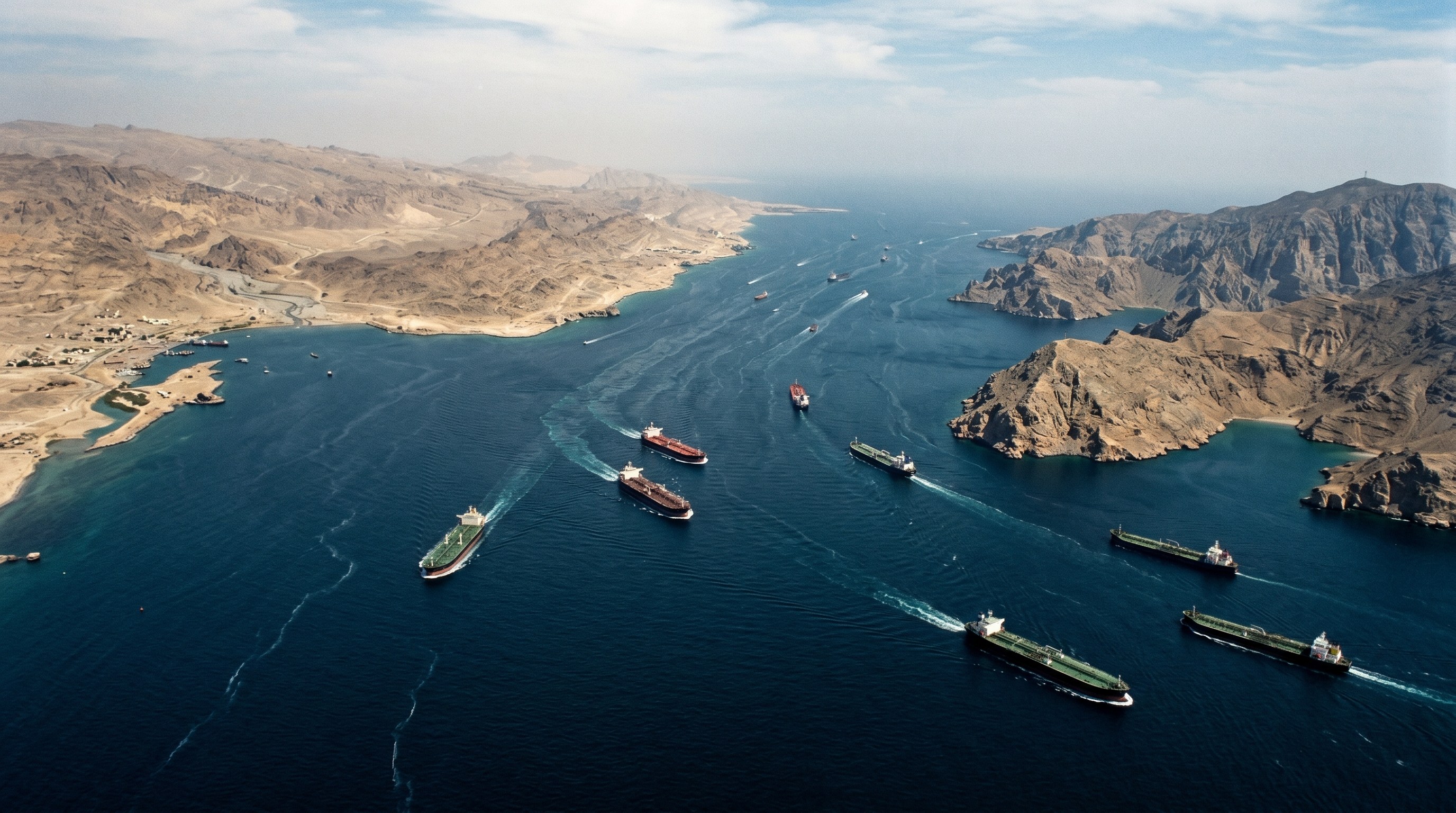
Specifically, look at the Strait of Hormuz — the twenty-one-mile-wide salt-water funnel between Iran and Oman through which roughly twenty percent of the world's crude oil and a third of the world's seaborne liquefied natural gas transits every day. Now look at India's energy ledger: forty to fifty percent of India's crude oil imports pass through that narrow strip of water. We import most of it from Saudi Arabia, the UAE, Iraq, and Kuwait — all loading at Gulf ports, all routing through Hormuz to reach Indian refineries on the western coast.
Now look at what is happening in the region.
The escalation
The Iran–Israel exchange that has been building since late 2025 has crossed several thresholds that nobody wanted crossed. Direct missile exchanges between the two states. Targeted strikes against Iran-backed militia infrastructure across Lebanon, Syria, and Iraq. Israeli covert action inside Iran that nobody officially confirms. Iranian retaliation through the proxy network and, increasingly, directly. The Houthi pressure on Red Sea shipping continues alongside.
The next escalation rung — and Iran has signalled this rung repeatedly — is the closure or contested militarisation of the Strait of Hormuz. Iran does not need to formally close it. It only needs to make the strait expensive enough that insurance markets price out commercial shipping. That has happened before, briefly, during the Tanker War of the 1980s. It can happen again.
If it does, the global oil price spikes overnight by twenty to forty dollars a barrel. India's import bill, already strained, rises by ten to twenty billion dollars in the first quarter of disruption. The rupee falls. Inflation jumps. The 2026 fiscal projection, already balancing on tariff and CBAM uncertainty, breaks.
This is not a hypothetical. This is the modal scenario that Indian energy planners are already gaming.
Why India is in a uniquely awkward position
Most countries can only choose a side in the Iran–Israel confrontation and accept the consequences. India cannot afford to.
Indian relationships with Israel are deep and strategic. Defence cooperation runs into the billions of dollars annually. Israeli technology underpins parts of India's intelligence and counterterrorism architecture. In February 2026, the partnership was formally elevated to a "Special Strategic Partnership" — a designation India uses sparingly.
Indian relationships with Iran are equally entrenched, just along different dimensions. The Chabahar port — India's strategic gateway to Central Asia and Afghanistan, bypassing Pakistan — is operated under a ten-year India–Iran agreement signed in early 2026. Indian oil companies have decades of trading and refining ties with Iran. The Indian diaspora in the Gulf, ten million strong, lives and works under Iranian and Saudi maritime decisions every day.
There is no third path. India cannot leave the region, cannot decouple its energy supply from the Gulf in any meaningful timeframe, and cannot afford to alienate either Tehran or Tel Aviv without paying immediate strategic costs.
What India can actually do
India's diplomatic position is unusual: it is the only major non-Western capital that maintains operational trust with both sides simultaneously. The United States cannot talk to Tehran. China is too transactional in the region to be trusted as an honest broker by either party. Russia is too closely aligned with Iran. The Gulf monarchies stand with Israel against Iran but cannot be seen brokering. The European Union is not taken seriously by Iran post-sanctions.
That leaves India.
What India is doing in practice, according to officials briefed on the conversations:
- Discreet shuttle messaging — carrying specific points between Tehran and Tel Aviv that neither side wants to be seen sending publicly
- Pressure on Iran to keep Hormuz open in exchange for India's continued purchases through Iranian-linked shipping channels
- Pressure on Israel to refrain from strikes that would cross the threshold of triggering an Iranian Hormuz response
- Coordination with the Gulf monarchies — Saudi Arabia, the UAE, Oman — to ensure that any Iranian Hormuz move triggers a unified Gulf-side response that gives Tehran a reason to back down
None of this is glamorous. None of it produces photographs. The work of mediation is the work of preventing the photograph that nobody wants to see.
The Chabahar fork
Chabahar is the place where India's mediator role has the most operational pull. The port — Iranian-owned, India-managed — is the only piece of Iranian critical infrastructure that the United States has agreed not to sanction, because Washington wants Indian access to Afghanistan and Central Asia outside Pakistani control.
That carve-out is the single most flexible piece of diplomatic real estate in the region. India can keep operating Chabahar even under maximum US sanctions on Iran. Iran knows this. Israel knows this. Washington knows this. The result is that Chabahar functions as a back-channel infrastructure — a literal place where Indian and Iranian officials sit in the same room every quarter to discuss operational issues, even when public Iran–West relations are frozen.
That back channel is the single most underrated asset in India's regional toolkit. In a Hormuz crisis, it is the room where the de-escalation conversation begins.
What to watch
Three signals over the next ninety days:
- Insurance market pricing on Hormuz transits — when war-risk premiums on oil tankers spike sharply, the market is pricing in a closure scenario, and Indian energy planners will be reading those numbers daily
- Iran's official rhetoric on the Strait — public threats are usually theatre; the dangerous moment is when the rhetoric goes quiet and the operational signals start
- Indian high-level visits — track who Jaishankar meets and where; the pattern reveals which capital India is currently leaning on
For now, the strait is open, the oil is flowing, and the diplomats are working. That is not nothing. But it is not stable either.
The geography has not changed. India's exposure has not changed. What has changed is that, for the first time in modern memory, India is the country that other capitals are calling when they need a message delivered. Strategic autonomy is not just buying weapons from whoever you want. It is being the country that everyone else needs in the room.
The price of that role is paid in sleep. Jaishankar has not had much of it lately.
BarathVector tracks India's role in the Middle East energy and security architecture. Subscribe for the weekly briefing.