By Ramachandran Rajeev Kumar — 2026-04-19
Heatwave as Policy Test: Why April's Warnings Are About Governance, Not Weather
The India Meteorological Department issued its April 2026 outlook on the third of the month. It carried the language that has, by long habit, come to sound like meteorological boilerplate: "above-normal temperatures likely over most parts of the country through April, May, and June; an increased frequency and intensity of heatwave conditions expected over the plains of north, central, and eastern India, and the northern parts of the peninsular region."
There was a time, not very long ago, when a sentence like that belonged to the weather bulletin and passed without further examination. That time has ended. Heat, in contemporary India, is not a weather story. It is a governance audit, and the audit runs every year between March and July.
What the IMD publishes is the question paper. What the states answer depends almost entirely on what they did with the previous year's answer sheet.
The shift in what "heatwave" now means
A generation ago, a heatwave in India was an event. One or two abnormal days, a few dozen heat-stroke cases in the worst-hit districts, and a return to seasonal normal. The framing was episodic.
That framing no longer fits the data. In the 2020 to 2025 window, heatwave days in the Indian subcontinent nearly doubled in number. The hottest ten days of the year, on a running ten-year average, are now 1.2 degrees Celsius warmer than they were in the 1990s. The heat-season window is expanding at both ends — the first heatwave day of the year is arriving earlier (by a week and a half over the past decade), and the last one is coming later (by two weeks). Nighttime minimum temperatures, which are what the body relies on to recover from daytime heat, are rising faster than daytime maxima.
Converting this from atmospheric physics to public health: the body does not have the time-window it used to have to recover. Construction workers, autorickshaw drivers, smallholder farmers, street vendors, and urban migrant labourers are the groups that have always been most exposed; the new variable is that exposure is now continuous rather than episodic, across four to five months of the year.
Central government data puts reported heat-related deaths in 2024 at roughly 700. Most credible epidemiological estimates, using excess-mortality methods, put the true number between six and ten times that. Mortality is only the tip of the health burden. The larger volume is in productivity loss, hospital admissions for dehydration and renal failure, and the attritional burden on an outdoor workforce that has few options to reduce exposure.
The spectrum of state readiness
This is where the governance audit begins, and where it matters to distinguish between states that have built adaptation capacity and states that are still improvising.
On the stronger end of the spectrum:
Ahmedabad, which in 2013 became the first Indian city to publish a comprehensive Heat Action Plan, now has a protocol tested by eleven consecutive summers. The plan includes early-warning SMS alerts keyed to the IMD forecast, modified school timings triggered at specific temperature thresholds, a dedicated hotline for heat-related distress, mapped cooling centres in every municipal ward, and protocols for modified working hours for street sweepers and municipal outdoor staff. The city's heat-attributable mortality has declined measurably over the decade. The plan is not a document; it is a machine, and the machine runs.
Telangana has built a statewide heat action framework that assigns specific responsibilities to district collectors, municipal commissioners, and primary health centres. Karnataka has mandated heat-stress protocols at major construction sites. Odisha runs one of the better real-time heat-alert dissemination systems, operated through its disaster management authority.
On the weaker end of the spectrum, many states still treat heatwave response as an annual SOP circular — issued from the state secretariat in mid-March, acknowledged by districts in early April, and implemented unevenly thereafter. The quality of implementation depends on the individual district magistrate and the municipal commissioner. Some are excellent. Many improvise.
The middle of the spectrum, where most of the population lives, is the interesting place. Most large Indian cities now have a Heat Action Plan on paper. Most of those plans were drafted in 2022 or 2023 after the Centre circulated a model framework. Research assessments of these plans — including a 2024 review by the Centre for Policy Research and a 2025 analysis by the India Meteorological Society — converge on a common finding: the plans are largely generic, inadequately funded, poorly integrated with urban water and public health systems, and not meaningfully updated year on year.
A plan that was drafted once and filed is a plan that has not been tested. A heatwave is a test.
What governance actually looks like for heat
The phrase "adaptation" can sound abstract. The operational content is not abstract at all.
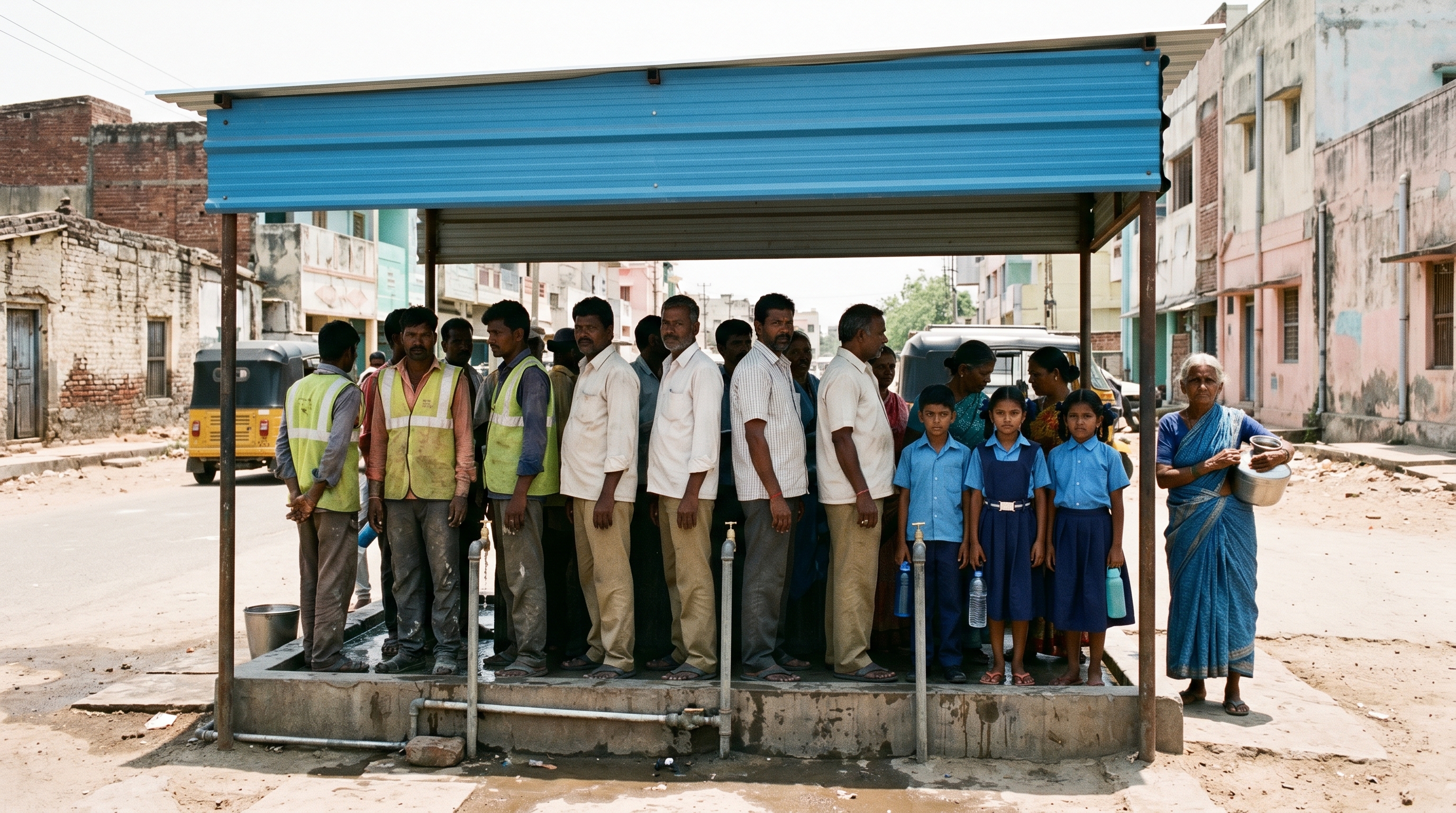
Water access is governance. The single most consequential variable in heat-related mortality is potable water availability at points where outdoor workers congregate — construction sites, market streets, auto stands, bus terminals, transit corridors. Cities that pre-position and maintain water access points measurably reduce heat deaths. Cities that do not, do not.
Shade is governance. Urban shade — tree cover, awnings, shade structures at bus stops and markets — is the cheapest and most effective passive cooling available. Cities whose tree cover has been systematically reduced over the last two decades (for road widening, for parking, for commercial development) are running their heat policy against a depleted asset base. Chennai, Hyderabad, Bengaluru, and Delhi have each lost meaningful canopy over the past fifteen years. Restoring canopy is a twenty-year investment. Not restoring it is a ten-year mortality bill.
Cooling centres are governance. A designated, signposted, air-conditioned or evaporatively cooled public space within walking distance of where people work outdoors is a direct intervention that saves lives. Very few Indian cities outside the top half-dozen have mapped, staffed, and operational cooling centres.
Modified work hours are governance. At a temperature above 40 degrees Celsius with high humidity, continuing construction activity, agricultural labour, or road work through the midday window is a policy choice. States and cities that enforce a mandatory midday break between 12 noon and 4 pm at listed worksite categories — and that compensate workers for the lost hours — protect the most vulnerable directly. States that do not, transfer the cost to the workers, who cannot absorb it.
Healthcare surge capacity is governance. The difference between a heat-season that produces 50 fatalities in a district and a heat-season that produces 300 is most often the difference between primary health centres that are pre-stocked with IV fluids, oral rehydration supplies, and cooling protocols, and PHCs that are not.
None of these interventions require new technology or new money at scale. They require an annual planning cycle, a clear line of accountability to a named official, a budget line that is protected from being raided for other purposes, and a post-season review that honestly catalogues what worked and what did not.
The climate-policy connection people keep missing
A common rhetorical framing treats climate policy and heat policy as separate. Climate policy is what happens at the Conference of the Parties. Heat policy is what happens in the municipal commissioner's office in May.
This separation is analytically convenient and practically wrong. The emissions India reduces or fails to reduce in the 2020s determines the heatwaves India experiences in the 2040s and 2050s. The heatwaves India experiences in the 2020s determine the adaptation capacity India must build, now, to protect its population over the next three decades.
The heat-adaptation investments that are cheapest today — tree cover, shade infrastructure, water access points, cooling centres, modified work hours, health-system surge capacity — become exponentially more expensive if deferred. The marginal cost of planting a tree today is small. The cost of not having the tree in 2040 is large.
This is why the heatwave season, year on year, is the most honest test of a state's climate governance. The emissions commitments are long-term and their verification is years out. The heat is here in April. Whether the ward office has water stocked, whether the municipal school has working ceiling fans, whether the construction site has pre-positioned ORS packets — these are observable this week. Every state has access to the model framework. The question is what each did with it.
What to watch this season
Three things are worth tracking over April, May, and June.
First, the number of states that issue binding mandatory midday-break notifications for listed outdoor work. Voluntary advisories are weaker than binding notifications, and the distinction matters more than it seems.
Second, the reporting discipline. States that publish real-time heat-attributable hospital admission and mortality data make themselves accountable. States that release only end-of-season aggregates, or release nothing, do not.
Third, the proportion of heat-related public spending that is pre-positioned versus reactive. A health budget that pre-stocks PHCs for the season is a different animal from one that opens an emergency line when the first deaths are reported.
The IMD does the forecast. It does not do the response. The response is a governance variable, and its quality will be visible by the end of June in the excess-mortality data. The states that have built adaptation capacity will show it in the numbers. The states that have not will show it in the same numbers.
Heat is the most unanswerable audit there is. It does not accept excuses. It does not accept that the plan is still being finalised. It does not accept that the budget is tight. It delivers its verdict in the morgue registers and the hospital admission logs, and the verdict is public by July.
April's IMD bulletin is the beginning of the test, not the middle of it. The middle of the test is what happens in the next ten weeks.
Sources: India Meteorological Department seasonal outlook for April-June 2026; National Disaster Management Authority Heat Wave Guidelines; Ahmedabad Heat Action Plan 2025 review; Centre for Policy Research assessment of Indian Heat Action Plans (2024); India Meteorological Society analytical review (2025); Press Information Bureau heat-related mortality releases (2024 and 2025); state disaster management authority public bulletins.