By Ramachandran Rajeev Kumar — 2026-04-14
The Reform That Arrived on a Monday: GST 2.0, the New Income Tax Law, and the Trader in Erode
The 1961 Income Tax Act is gone. A rationalised GST has been running since September. The reform that actually changes Monday morning for India's small businesses came into force this April, quietly, without a press conference loud enough to match its weight. The question the next six months answer is whether the portal and the paperwork keep the promise that the Gazette has already made.
By Ramachandran Rajeev Kumar
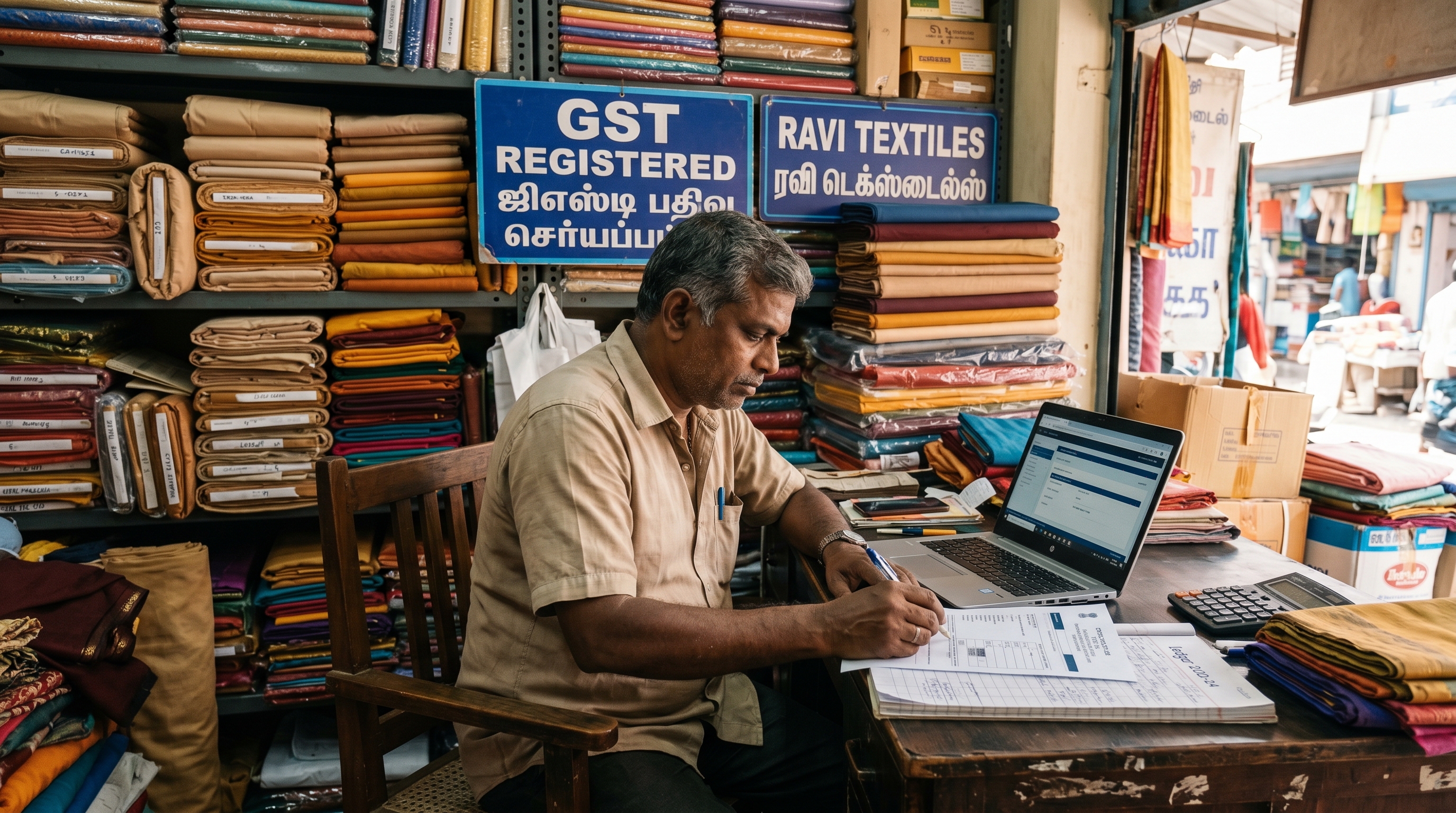
On the first working Monday of the new fiscal year, Selvakumar opened his shop on Perundurai Road in Erode at a quarter past seven. He runs a mid-sized cotton textile unit: 50 looms on the ground floor, a wholesale counter in front, a showroom for bedsheets and lungis on the side. He has been in the trade for 26 years. His father was in it for 32 before him. He employs 41 people.
On Sunday evening his chartered accountant, Balasubramaniam, had come by with a briefcase of papers and one small request: sit, have a coffee, and let us look at what changes from tomorrow. For most of the last decade, these meetings were grim. The file was thick. The provisos had provisos. Every returns cycle began with the same weary sentence from the CA: "Let us see what circular has come this week."
This Monday was different. The file was thinner. The language on the first page was something a shopkeeper could read without a lawyer beside him. The appeal window, should it ever come to that, was shorter. The GST rates on his primary stock had been settled since last September; the noise around them had finally died down.
Selvakumar is not a lobbying federation. He is not a tax columnist. He is one of 63 million small and medium enterprises that carry most of India's employment on their shoulders. The reform that matters in his life is the one that arrives on his counter, not the one that arrives on a prime-time panel.
And this April, for the first time in a long time, reform arrived on his counter.
What actually changed, plainly
Two laws now govern most of what Selvakumar owes the government. Both have changed in the last eight months. One is direct tax, the other is indirect. Together they cover close to every rupee that leaves his till in the government's direction.
Start with the Income Tax Act, 2025. Parliament passed the Bill on 12 August 2025. The President gave assent on 21 August. The Central Board of Direct Taxes notified the operating Rules on 20 March 2026. The Act came into force on 1 April 2026 (Income Tax Department).
Three changes are structural. The first is size. The 1961 Act ran to 819 sections and about 512,000 words. The 2025 Act runs to 536 sections across 23 chapters and roughly 260,000 words (ClearTax analysis; Tribune India reporting). Half the pages, half the words, one Act. That is not a cosmetic redraft.
The second is language. Provisos and explanations that used to live in footnotes have been folded into the main text. Narrative clauses have been replaced with tables and formulas. Obsolete provisions, a graveyard of amendments accumulated across six decades, have been removed outright. The 1961 Act had been amended, by most counts, more than 6,000 times. That version is now a historical document.
The third is process. Faceless assessment, faceless appeals, and faceless reassessment are now the default, not the exception. PAN and TAN continue as before. But the architecture under which a scrutiny notice is issued, contested, and resolved has been rewritten to prevent the small-taxpayer-versus-local-officer dynamic that produced a generation of grievance.
Now GST. The rationalised structure, popularly called GST 2.0, did not wait for April. The 56th GST Council meeting on 3 September 2025 cleared the rate overhaul; the new slabs took effect from 22 September 2025 (PIB release on the 56th Council; Business Standard coverage).
Three changes are worth a shopkeeper's time. First, the old 12 per cent and 28 per cent slabs were collapsed. Most items moved to 5 per cent or 18 per cent. A narrow 40 per cent bracket was created for tobacco, aerated drinks, and a specific list of luxury goods. The five-slab maze is now effectively a three-slab structure for everything that is not a sin good.
Second, items that had been trapped in the 28 per cent slab for no defensible reason (air conditioners, televisions above 32 inches, dishwashers, small cars, motorcycles) came down to 18 per cent. For a household in Erode, that is not a technicality. That is a price on the showroom floor.
Third, life and health insurance premiums were exempted from GST. A family buying a term cover no longer pays tax on the premium that buys the cover.
These are not concessions to a lobby. They are a structural rationalisation the system had owed its taxpayers since 2017.
Why this is actually reform
Most of what is called reform in India is re-announcement. A scheme is rebranded. A portal is relaunched. A circular is reissued with a new preamble. The vocabulary of reform has been diluted so thoroughly that the word itself has to earn its place every time it is used.
This one earns it.
The 1961 Act had been amended more than 6,000 times. Every Finance Act added sections, subsections, clauses, and provisos to a document that was already bending under its own mass. A generation of chartered accountants built practices around the exceptions to the exceptions. A generation of small businesses paid for it. The system had a name for the cost: "compliance burden". The name was polite. The cost was not.
GST 1.0, launched in 2017, had a similar trajectory. The four-slab structure with a cess on top, the classification disputes over whether a paratha was a paratha or a bread, the inverted-duty situations that accumulated input tax credit a business could never fully claim: these were not teething issues. They were design choices that needed to be revisited.
Revisiting them in legislation is what actually happened. The Income Tax Act, 2025 is a full replacement of a 1961 statute, not an amendment to it. GST 2.0 is a Council-approved rate overhaul that went live on a specific date, not a white paper. Both are on the Gazette. Both have operating Rules notified. Both have effective dates that have already passed.
This is the distinction worth keeping in mind. Reform-as-announcement can be taken back. Reform-as-law cannot, short of another Act of Parliament. What India's tax code looks like on 14 April 2026 is what it will look like when the next Budget is tabled. The base has moved.
The implementation risk
Law changes on a date. Administration changes on a curve.
The GSTN portal, which carries the weight of every registered business's monthly filing cycle, has been under strain for years. Technical glitches, API integration gaps, and stricter ledger validations have pushed filing deadlines against the wall in multiple months (startfilings.com analysis of 2026 portal changes). In April 2026 alone, GSTN issued an advisory making the pre-deposit percentage editable in appeal filings under Form APL-01, with effect from 6 April (TaxO advisory digest). That is a helpful change. It is also the third advisory in a fortnight, which tells its own story about how much still gets adjusted after the fact.
The CBIC and CBDT circular backlogs are the second worry. A new Income Tax Act of 536 sections is a starting point, not an ending one. Every section will, in practice, be interpreted through circulars and clarifications. The pace at which those clarifications arrive, and their quality, will determine whether the Act reads the same in April 2026 and April 2027.
The dispute-resolution timelines are the third. The 2025 Act reduces the appeals clock and extends faceless processes. But the actual record between 2020 and 2025 was a backlog of pending appeals that the faceless system was originally meant to clear and often did not. A faster clock on paper is a promise. Matching it in practice requires bench strength, IT capacity, and a political decision not to use pendency as a tool.
A useful reference point is GST 1.0 itself. When the regime launched in July 2017, nearly every filing cycle for the next 18 months produced a crisis. Deadlines slipped. Returns were simplified, then re-simplified. The business community learned to plan around the portal rather than trust it. It took roughly six filing cycles for the system to stabilise, and another six before planning-quality numbers could be trusted.
What would make GST 2.0 and the Income Tax Act, 2025 settle faster than GST 1.0 did? Three things. Portal uptime published as a monthly public metric, with penalties on GSTN for misses. A circular-issue clock: any clarification must come within a set number of days of the triggering event. And an appellate tribunal with sitting benches that actually sit.
None of these is a new idea. All three are administratively unremarkable. They would, collectively, decide whether the clarity in the Gazette survives first contact with the filing calendar.
What the trader does Monday morning
If you run a small business and you have been waiting for someone to tell you what, concretely, to do this week, here is the short answer.
First, open the GST portal and reconcile your input tax credit against the new ledger-validation checks that went live this April. The portal will now block a GSTR-3B filing if claimed ITC does not match eligible balances on the ledger (startfilings.com). Do this before the 20th. If your 2A and 2B are not cleaned up, your filing window will be the discovery window.
Second, pull the Income Tax Rules, 2026 notification dated 20 March 2026 and read the section-mapper alongside it. Most of the forms you file have changed. PAN and TAN continue, but the returns themselves are simplified and re-engineered, which means the line items are not in the places your accountant's muscle memory expects (Outlook Money on the 99-page CBDT transition FAQ).
Third, if you sell anything in the categories that moved from the 28 per cent slab to 18 per cent (air conditioners, televisions, dishwashers, small cars, motorcycles), reprice the shelf. Your invoice template must reflect the rate that applied from the date of supply, not the rate under which you purchased the stock. Input credit on older stock is claimable; the selling rate is the rate of today.
None of this is exotic. None of it requires a consultant you cannot afford. It does require a Monday.
Constructive close
Reform does not end with a press conference. It ends with paperwork that someone in Erode can file without a lawyer. That is the test the next six months will run.
The Gazette has already done its part. The Income Tax Act, 1961 is history. GST 2.0 is live. The structural simplification that a decade of tax professionals had assumed would never happen, because the politics were too hard and the institutional memory too thick, has in fact happened. It arrived not as a revolution but as a statute, which is how adult countries change direction.
What happens next is administration, and administration is where Indian reforms have most often gone to die. Circulars that take 18 months to arrive. Portals that crash on the 20th. Appellate benches that do not sit. A clock on paper that nobody is measured against in practice.
Say it plainly: the administrative culture of Indian tax has been adversarial for most of the years Selvakumar has been in business. The 2025 Act's shift to faceless default, combined with a rationalised GST, is the first serious attempt in a generation to change that culture through the design of the system itself, not through exhortation.
Whether it works is not a question of law. It is a question of whether the CBIC publishes a circular calendar, whether GSTN publishes an uptime dashboard, whether the appellate tribunals are staffed, and whether the first small-business complaint about the new system is answered in days rather than quarters.
If those four things happen, the trader in Erode will look back on April 2026 as the moment India's tax system began respecting his time. If they do not, he will remember it as the moment a good law was handed to a tired administration and slowly rubbed down to the shape of the old one.
The reform is in the Gazette. The next act is on the counter.
Ramachandran Rajeev Kumar is CEO of the Aarksee Group of Companies. He writes on India's policy and economy for BarathVector.