By Ramachandran Rajeev Kumar — 2026-02-15
Goodbye, South Block: India Moves Its Power Centre and Buries an Empire's Architecture
By Ramachandran Rajeev Kumar
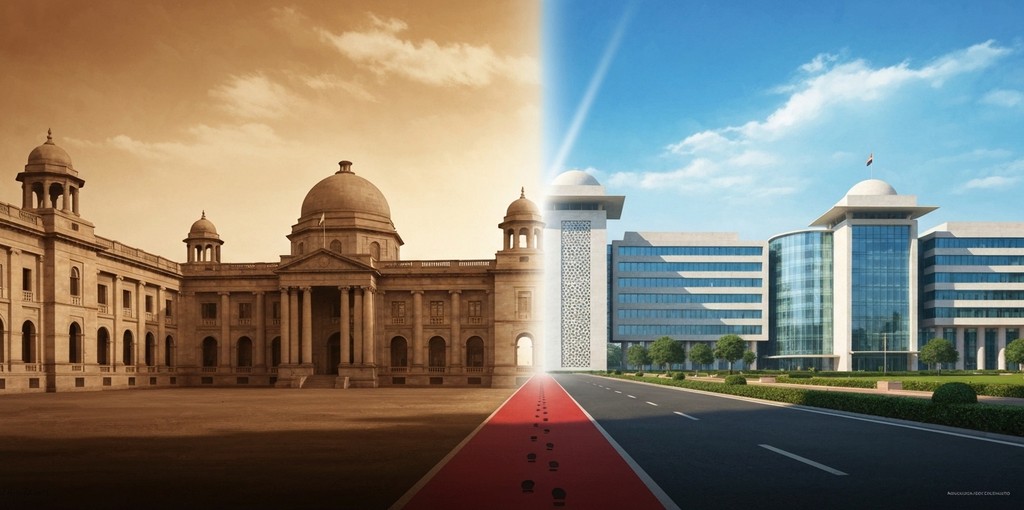
On February 13 -- the 95th anniversary of New Delhi's formal inauguration as India's capital in 1931 -- the Prime Minister walked into a building that no British architect had designed, no colonial viceroy had commissioned, and no imperial calculation had shaped. He walked into Seva Teerth -- literally, "a pilgrimage of service" -- and in doing so, closed a chapter that had been open since government departments first moved into Herbert Baker's sandstone corridors in the late 1920s.
South Block has housed India's most consequential decisions for nearly eight decades since independence. Wars were planned in its offices. Nuclear tests were authorised behind its doors. Sixteen Prime Ministers, from Nehru to Modi, governed from within walls that were built, quite explicitly, to remind Indians who was in charge.
That era is over. India's power centre now operates from a building designed by Bimal Patel of HCP Design -- the same architect who designed the new Parliament -- built by Larsen & Toubro at a cost of Rs 1,189 crore, situated not on Raisina Hill but on Kartavya Path, at ground level. The symbolism is not subtle. It is not meant to be. Power has descended from the hill. The inscription on the wall reads "Nagrik Devo Bhava" -- citizens akin to God.
What Seva Teerth Actually Is
The complex is not merely a new office building. It is an institutional reorganisation expressed in concrete and glass, spanning 2.26 lakh square feet across three interconnected structures.
Seva Teerth-1 houses the Prime Minister's Office. Seva Teerth-2 houses the Cabinet Secretariat. Seva Teerth-3 houses the National Security Council Secretariat and the Office of the National Security Advisor. These three organs -- which, in practice, run the country's strategic and administrative machinery -- are now physically consolidated for the first time. For decades, the PMO sat in South Block, the Cabinet Secretariat was scattered across multiple buildings, and the NSC operated from wherever space could be found. That separation created communication friction that no amount of digital connectivity could fully resolve.
Adjacent to Seva Teerth stand Kartavya Bhavan-1 and Kartavya Bhavan-2 -- "buildings of duty" -- which house eleven central ministries including Finance, Defence, Health, Education, and Law. A third Kartavya Bhavan was already inaugurated in August 2025, housing Home Affairs, External Affairs, and IT among others. When all ten Common Central Secretariat buildings are operational by mid-2027, the government expects to save Rs 1,500 crore annually in rent and maintenance -- the cost of running the world's fifth-largest economy from buildings designed for a different country's convenience.
The infrastructure is built to GRIHA green building standards, with rooftop solar, advanced HVAC, rainwater harvesting, and the kind of digitally integrated security architecture that a modern head-of-government complex requires. South Block, for all its gravitas, was a building from an era when the most sophisticated surveillance technology was a man with a notepad standing near a doorway.
The Herbert Baker Question
Critics of the Central Vista project -- and they are neither few nor quiet -- have argued that demolishing or repurposing Lutyens' architecture is an act of cultural vandalism. South Block, they contend, is a heritage structure. Baker's work, whatever the politics of its commissioning, is architecturally significant. Walking away from it is walking away from history.
The argument has merit in the narrow sense that good buildings should be preserved. But it collapses under the weight of its own implications. South Block was not built to celebrate Indian civilisation. It was built to house the administrative apparatus of an occupying power. Its proportions were designed to intimidate. Its placement, at the western terminus of Rajpath -- now Kartavya Path -- was calculated to project imperial authority along an axis that terminated at India Gate, a monument to Indian soldiers who died fighting British wars.
Preserving the building as a museum or cultural institution is entirely reasonable. Insisting that independent India must forever govern from within its walls is a peculiar form of architectural Stockholm syndrome.
Every major democracy periodically updates its governmental infrastructure. The United States has renovated the White House repeatedly. France moved several ministries out of historic Parisian buildings into purpose-built facilities. Germany, after reunification, commissioned an entirely new government quarter in Berlin. The notion that India alone must conduct 21st-century governance from 1930s offices, because those offices happen to be photogenic, confuses heritage conservation with administrative paralysis.
What South Block Represented
The more honest objection to Seva Teerth is not architectural. It is political. South Block, in the vocabulary of Indian governance, represented continuity. The same corridors, the same offices, the same weight of institutional memory pressing down from sandstone walls. Every new government inherited not just the machinery of state but the physical space in which that machinery had always operated.
There is comfort in that continuity. There is also constraint. The physical design of South Block -- long corridors, isolated offices, hierarchical spatial arrangements -- reflected a governance philosophy built on information control and access restriction. The Viceroy's office was designed to be difficult to reach. The Prime Minister's office inherited that design, and with it, an architecture of power that privileged gatekeeping over collaboration.
Seva Teerth, whatever its aesthetic merits, represents a different governance philosophy. Open-plan ministerial interaction spaces. Integrated crisis rooms. Secure but accessible meeting facilities. The building's design assumes that the people who run the country should be able to talk to each other without navigating a colonial obstacle course.
Whether this architectural philosophy translates into better governance is an empirical question that will take years to answer. But the aspiration -- that India should govern from spaces designed for Indian governance rather than British administration -- is difficult to argue against.
The Central Vista Controversy
Seva Teerth is one component of the broader Central Vista Redevelopment Project, conceived in September 2019, which has attracted criticism on grounds of cost, timing, and democratic process. The Supreme Court upheld the project in a 2:1 ruling in January 2021 -- Justice Sanjiv Khanna dissenting on heritage and public participation grounds. The project was advanced during the pandemic. Parliamentary consultation was limited. The budget -- estimated between Rs 13,000 crore and Rs 20,000 crore depending on which components are included -- is substantial.
These criticisms deserve engagement, not dismissal. Public infrastructure projects of this scale should be subject to rigorous cost-benefit analysis, transparent budgeting, and genuine parliamentary debate. The perception that the Central Vista was rammed through without adequate scrutiny has coloured public opinion in ways that the government's communication strategy has failed to address.
But the criticism of process should not obscure the question of substance. Did India need a new governmental complex? The answer, by any functional assessment, was yes. South Block was not merely old. It was inadequate -- in its security infrastructure, its communications systems, its energy efficiency, and its capacity to house the expanding apparatus of a government that administers 1.4 billion people.
The question was never whether to modernise. It was how, when, and at what cost. The government chose to answer all three simultaneously, with the predictable result that the ambition of the project outpaced the capacity for public persuasion.
The Name and What It Signals
Names matter in Indian politics, and the name Seva Teerth is doing considerable work. "Seva" -- service -- is the organising vocabulary of the current government's self-presentation. "Teerth" -- a place of pilgrimage -- elevates the concept from administrative duty to something approaching sacred obligation.
The companion buildings, Kartavya Bhavan -- "halls of duty" -- reinforce the message. The old terminology of "blocks" and "bhavans" named after generic virtues gives way to a nomenclature that explicitly frames governance as an act of devotion.
One can view this as either inspirational rebranding or rhetorical overreach, depending on one's political sensibilities. What is not in dispute is that the names represent a conscious break from the colonial nomenclature that persisted for eight decades after independence. North Block, South Block, Secretariat Building -- these were categories, not aspirations. Seva Teerth and Kartavya Bhavan are, at minimum, trying to be aspirations.
What Happens to South Block
South Block will not be demolished. Both North and South Block will be converted into the Yuge Yugeen Bharat National Museum -- a 155,000-square-metre institution that, if completed as planned, would be the largest museum in the world. India has partnered with France Museums Developpement for design and management expertise. North Block's conversion is targeted for June 2026. The Tribune noted with appropriate irony that the government is vacating these blocks 99 years after officials first moved in.
Baker's work will become visible to the public -- which is, ironically, more than it ever was while it housed the machinery of power. The entire Lutyens' governmental precinct will transition from a functioning administrative district to a heritage corridor: accessible, preserved, and no longer the nerve centre of a modern state trying to operate from Edwardian infrastructure.
The First Acts
What a leader does first in a new office is theatre. Modi is fluent in this language.
Within hours of inaugurating Seva Teerth, the Prime Minister signed four policy files from his new desk. PM RAHAT -- a cashless accident treatment scheme covering up to Rs 1.5 lakh. An expansion of the Lakhpati Didi programme, crossing three crore women and doubling the target to six crore. A doubling of the Agriculture Infrastructure Fund to Rs 2 lakh crore. And Startup India Fund of Funds 2.0, a Rs 10,000 crore corpus for deep-tech and early-stage ventures.
None of these required the new building. All of them required the new building's inauguration as a backdrop. The message was unambiguous: this office exists to serve, and here is the proof, signed on day one. Whether the substance matches the staging is, as always, a question for the coming months and years. But the staging itself was immaculate.
The Larger Pattern
India has been on an infrastructure redefinition spree. The new Parliament building, inaugurated in 2023, replaced a circular colonial structure with a triangular modern one. The Kartavya Path renovation transformed Rajpath from a ceremonial parade ground into a more public-facing national promenade. And now Seva Teerth completes the executive branch's architectural transition.
The pattern is unmistakable: India is systematically replacing the physical infrastructure of colonial governance with structures that reflect its current ambitions. One can debate the aesthetics, the cost, and the politics. But the direction -- towards self-designed, purpose-built, technologically current governmental infrastructure -- is the direction that every major democracy has eventually taken.
South Block served India well. It was never India's building. Seva Teerth is. That distinction matters more than any argument about sandstone.
The views expressed are those of the author and do not necessarily reflect the editorial position of BarathVector.