By Ramachandran Rajeev Kumar — 2026-04-14
The Reserve Walks Home: 220,000 Skilled Indians Are Returning. Will the Republic Use Them?
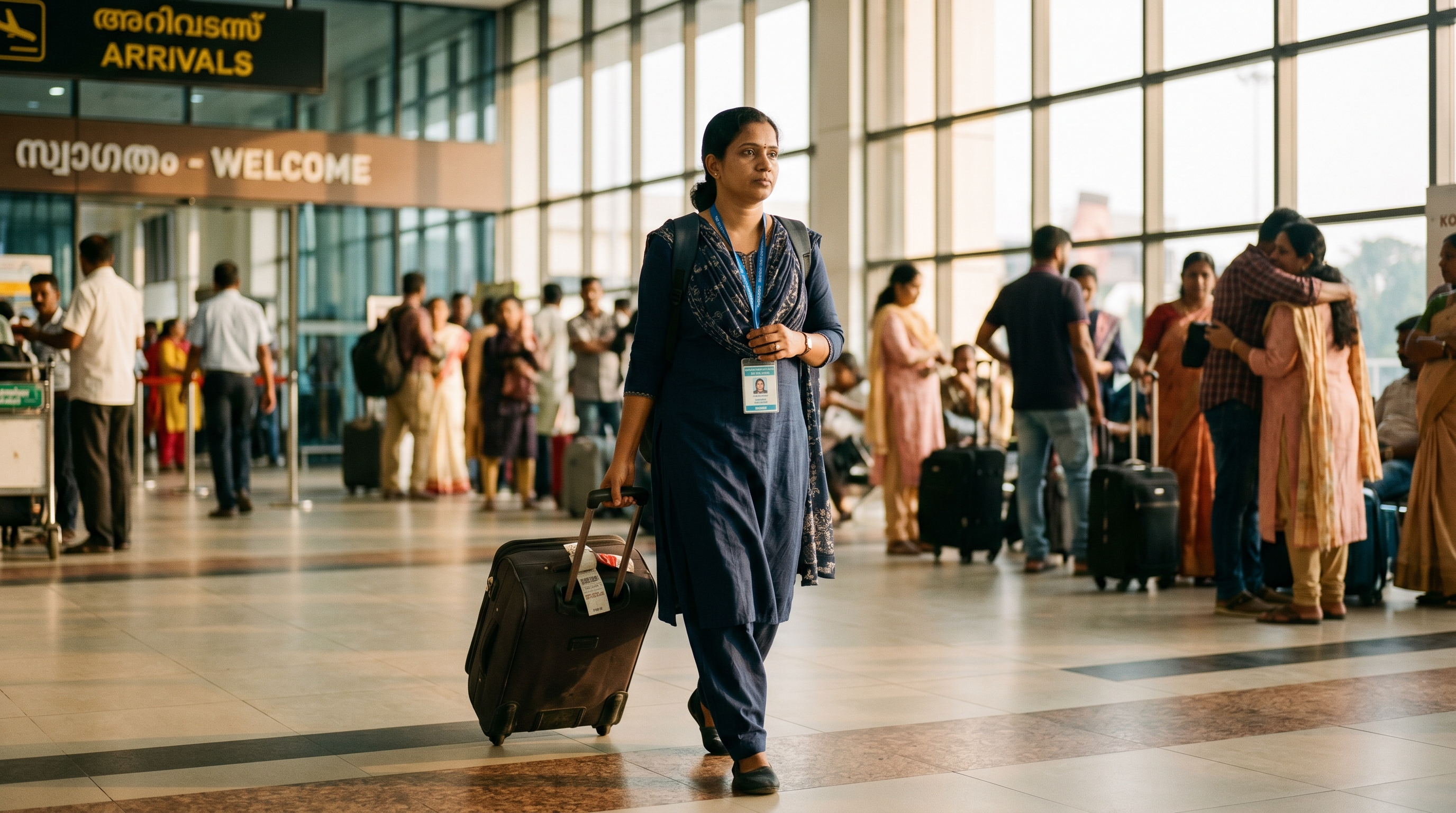
Sumathi Pillai is 41. For 12 years she worked the paediatric ward at a private hospital off Olaya Street in Riyadh. She earned in Saudi riyals, wired most of it to Kollam, and visited her two daughters twice a year. On March 19, 2026, a Ministry of External Affairs evacuation flight brought her back to Thiruvananthapuram. She carried one checked bag, a laminated copy of her Saudi Commission for Health Specialties licence, and a resignation letter she did not want to write.
Three weeks later she is at her mother's kitchen table in Kollam, three browser tabs open on a borrowed laptop. One is the Kerala Public Service Commission portal. One is a private-hospital chain in Kochi that has not replied to two applications. One is a returnee-registration form on the NORKA-ROOTS website that asks her to upload her certificates and wait.
She is not a humanitarian case. She is a trained critical-care nurse with international experience, a working command of Arabic, and the muscle memory of a tertiary hospital. On paper, India's health system cannot get enough of her. In practice, nobody in Delhi or Thiruvananthapuram has told her where to go.
Multiply her by 220,000.
The aggregate, and what sits inside it
Since February 28, 2026, when the widening conflict between Iran and a US-led coalition began disrupting the Gulf, India has brought home more than 220,000 of its nationals from the six Gulf Cooperation Council states -- Saudi Arabia, the United Arab Emirates, Qatar, Kuwait, Bahrain and Oman. The figure was confirmed in late March by Aseem Mahajan, joint secretary for the Gulf at the Ministry of External Affairs, during an inter-ministerial briefing. Earlier reporting on India's scramble for alternative oil supply noted the scale of the return movement as part of the broader shock to the Gulf corridor. [CNBC, April 2026]
It is the largest peacetime evacuation India has conducted since the 1990 airlift from Kuwait, which brought roughly 170,000 Indians home after Iraq's invasion.
The operation is running under the codename Operation Sindhu, first launched by the Ministry of External Affairs in June 2025 to evacuate Indians from Iran and Israel, and since expanded across the Gulf as the conflict widened. Air India, IndiGo and Indian Air Force C-17 rotations have flown out of Jeddah, Dammam, Dubai, Sharjah, Doha and Muscat. Naval vessels of the Western Fleet have assisted from the UAE coast. The airlift is, by the government's own account, not yet complete.
The state-wise distribution tracks the pre-war diaspora. Kerala is the largest receiver -- Malayali workers made up a disproportionate share of the GCC workforce, and the Kerala government's Department of Non-Resident Keralites Affairs (NORKA) has registered the heaviest intake. Andhra Pradesh, Tamil Nadu, Uttar Pradesh, Bihar and Telangana are the other principal receiving states, in broadly that order based on pre-war migration patterns; state-level returnee counts are still being reconciled across NORKA, APNRT and the corresponding Tamil Nadu and north Indian registries.
The composition matters more than the headline count. Treat it as undifferentiated labour and you will design the wrong policy. Inside the 220,000 are three overlapping cohorts:
- Licensed professionals -- nurses, paramedics, laboratory technicians, IT systems administrators, petroleum engineers, teachers, architects. Perhaps 45,000 to 55,000 people, most carrying certifications from Saudi, Emirati or Qatari licensing bodies.
- Skilled trades -- welders, pipefitters, electricians, HVAC technicians, heavy-equipment operators, hospitality supervisors, chefs, logistics coordinators. The largest slice -- roughly 110,000 to 130,000.
- Semi-skilled and construction -- scaffolders, drivers, cleaners, security guards. Around 40,000 to 55,000.
These ranges are editorial estimates, drawn from the known occupational mix of pre-war GCC migration. The MEA has not yet published an occupational breakdown of the returnee cohort; when it does, these bands should be replaced with official numbers.
The macro-economic story has already been written: Indian Gulf remittances, which stood at roughly USD 40-42 billion a year in recent cycles (Reserve Bank of India remittance surveys), are projected to contract sharply through 2026. Kerala, which drew an estimated 19 per cent of all Indian remittances, carries the heaviest fiscal exposure. Andhra Pradesh and Tamil Nadu follow.
But a repatriated nurse does not only stop sending money. She also starts earning, spending and training inside India -- if anyone lets her.
The 1990 airlift, and what it cost us for 20 years
There is precedent, and the precedent is not flattering.
When Saddam Hussein's forces rolled into Kuwait in August 1990, roughly 170,000 Indians were stranded. Between August and October, Air India flew 488 sorties from Amman, Jordan, to Mumbai -- an operation still listed by Guinness as the largest civilian airlift in history. The late K.P. Unnikrishnan, then minister for civil aviation, and Mathunny Mathews, the community leader who marshalled the Indian population on the ground, carried the operational load.
The airlift itself was a triumph of institutional will. What came after was not.
Three things went wrong. First, there was no absorption plan. Returnees were received, counted and sent home. Kerala, which took the largest share, had no state-level returnee agency in 1990 -- NORKA was only constituted in 1996 and NORKA-ROOTS in 2002, more than a decade later. By the time the machinery existed, the cohort had scattered.
Second, skill-recognition was never tackled. A Kuwaiti-trained electrician or hospital technician had no domestic route to have that experience counted against an ITI grade or a state trade certificate. Most re-entered the informal labour market at wages 40 to 60 per cent below what they had earned.
Third, once the Gulf reopened in 1991-92, a large share of the 1990 cohort simply re-migrated. India had, in effect, paid the cost of evacuation and received none of the developmental return. The 1990 returnees funded their own kitchens for two years, then went back. Kerala's remittance economy recovered, but the human-capital dividend was lost.
We are standing in 2026 with the same cohort, at roughly 30 per cent greater scale, and the institutional memory of that failure is not being invoked in any public document I have seen from North Block. It should be.
On the ground: what the states are actually doing
Kerala has moved first, as it usually does on migration.
NORKA-ROOTS, the welfare and rehabilitation arm, has opened district-level returnee registration centres and is running expanded versions of its Santhwana and NDPREM schemes covering medical emergencies and bridging grants for returnees. Chief minister Pinarayi Vijayan's office has signalled that Kerala will seek a substantial Centre-assisted returnee package in the 2026-27 state budget, on top of the state's own expanded NORKA allocation announced in the current fiscal. The final figure and fiscal architecture have not yet been notified.
Andhra Pradesh's Non-Resident Telugu Society (APNRT) is running returnee help desks at Visakhapatnam, Vijayawada and Tirupati airports and has announced a priority re-employment channel with the Andhra Pradesh State Skill Development Corporation. Tamil Nadu's Non-Resident Tamils' Welfare Board has set up 12 registration counters and committed to a skill-mapping drive, though as of early April it had not yet published its findings.
Uttar Pradesh and Bihar, which together account for perhaps a quarter of the returning population, are further behind. Neither state has a dedicated returnee agency of the NORKA type, and in both, returnees are being routed through generic employment exchanges that were not built for this workload.
The Centre's Ministry of External Affairs has run the evacuation creditably. The Ministry of Skill Development and Entrepreneurship has been quieter. No nationwide skill-mapping of the returnee population has been announced. No extension of the National Skill Qualifications Framework (NSQF) has been offered for Saudi or Emirati certificates, even though such equivalencing frameworks exist in draft form under earlier Indo-GCC labour mobility talks.
The cluster risk is already visible. In the first weeks of April, Kochi-area construction firms received a visible spike in walk-in applications from returned welders and supervisors. Wages for those grades slipped perceptibly over the same period. Without a distribution mechanism that moves returnees to where national infrastructure demand actually sits -- the dedicated freight corridors, the semiconductor fabs in Dholera and Sanand, the Vande Bharat maintenance depots, the Jal Jeevan Mission's final-mile plumbing and electrical work -- the reserve will pool in the Gulf-adjacent districts and drive local wages down without relieving national shortages.
Three things the Centre must do in the next 90 days
The policy question is not whether to help. It is whether to help at the level of individual grievance (a grant here, a loan there) or at the level of structural absorption. The latter is cheaper, faster and more durable.
1. A Skill-Equivalence Clearing House, under the Ministry of Skill Development, with a 30-day turnaround.
A single portal, staffed by assessors seconded from the Sector Skill Councils and the National Skill Development Corporation, that takes a Saudi, Emirati, Qatari or Kuwaiti certificate and issues an NSQF-level equivalence letter within 30 days of submission. The architecture already exists in the Recognition of Prior Learning (RPL) scheme; it has simply never been operationalised at GCC scale. Target: 150,000 equivalence letters issued by end-September 2026. A returnee walking into a state employment portal with an NSQF level-5 equivalence has a different labour-market position from one holding a foreign paper nobody reads.
2. A Gulf-Returnee credit window under MUDRA and Stand-Up India, with diaspora-specific underwriting.
A material fraction of GCC returnees come home with working capital -- terminal settlements, provident-fund transfers, savings. They are natural micro-entrepreneurs, particularly in the skilled trades (welding shops, HVAC contracting, hospitality vendors, IT maintenance micro-firms). The existing MUDRA loan ladder under-serves this cohort because its underwriting assumes domestic credit history. A Gulf-returnee window, with underwriting credits for documented overseas employment, terminal-benefit statements, and GCC labour-ministry records, could unlock Rs 5,000-8,000 crore of productive micro-credit within the year. Target: 50,000 loans sanctioned by December 2026. Owned by the Department of Financial Services, reporting to the Prime Minister's Office fortnightly.
3. A Receiving-State Returnee Deployment Dashboard, jointly owned by MEA, MoSDE and the states.
A live, public dashboard that maps registered returnees by skill, state of origin and current location against published manpower demand from national infrastructure programmes -- the DFC, the Bharatmala and Sagarmala projects, the semiconductor cluster, the PLI-linked factory build-outs, the Jal Jeevan Mission's residual state contracts. A returnee nurse in Kollam should be able to see, on a public site, that the new AIIMS outreach in Bilaspur has 180 open nursing posts and exactly what their credentialing path looks like. Transparency forces the states to compete for the reserve rather than sit on it.
Each of these is achievable in 90 days. None of them requires legislation. All of them require one thing that Indian bureaucracy is historically poor at: treating its returning diaspora as an input to production, not a recipient of relief.
The reserve, as infrastructure
India has spent the better part of a decade arguing that demographic dividend is about the young people who have never left. That is true and it is incomplete. A 41-year-old Kollam nurse with 12 years of Saudi tertiary-hospital experience is also the demographic dividend. A 34-year-old Sharjah-trained HVAC technician with three commercial-tower projects on his resume is the demographic dividend. They arrived skilled, at somebody else's training cost, and they walked back in through the same airports their children use.
The question is not whether India can afford to absorb them. India cannot afford not to.
Every working nurse matters because India's nurse-to-population ratio still sits below the WHO benchmark of three nurses per 1,000 -- a shortfall most states have not closed, and one the Indian Nursing Council and independent analyses have estimated at several hundred thousand additional nurses by 2030. Every working welder matters because the infrastructure build-out of the next five years is measured in kilometres of pipeline, kilometres of rail, square metres of semiconductor clean-room. Every mid-career supervisor matters because India's construction sector operates at a productivity roughly half of Malaysia's and a quarter of South Korea's, and supervisory skill is the single biggest closer of that gap.
The 1990 cohort was lost, and we paid for that loss in slow infrastructure and dependent households for 20 years. The 2026 cohort is larger, better-trained, and holding paper that an honest clearing house could translate into Indian employment inside a quarter.
Sumathi Pillai does not need sympathy. She needs a portal that tells her where Bilaspur is hiring, a certificate that matches what she actually knows how to do, and a phone number that answers when she calls. The republic has three months to build those three things. If it does, the reserve walks into the future it was trained for. If it does not, it walks back to Riyadh -- and next time, the ticket home might not be one we can afford.