By Ramachandran Rajeev Kumar — 2025-12-20
This article is sponsored content from Aarksee
The Next Century of Fossil Fuels: Why the World Still Needs Oil - And How to Make It Cleaner
The uncomfortable truth about energy transition isn't that fossil fuels will disappear - it's that they won't. The real question is whether we can make them compatible with a livable climate.
The International Energy Agency's World Energy Outlook 2025, released last month, delivered a sobering message that climate activists and energy executives alike are still processing: under current policies, global oil demand doesn't peak. It grows - to 113 million barrels per day by 2050, up from today's ~102 million.
This isn't denial. It's data.
The Numbers We Can't Ignore
The IEA models three scenarios, and only one shows the clean energy future we've been promised:
| Scenario | Oil Demand 2030 | Oil Demand 2050 | Temperature by 2100 |
|---|---|---|---|
| Current Policies (CPS) | 105 mb/d | 113 mb/d | 2.9°C |
| Stated Policies (STEPS) | 102 mb/d (peak) | Declining | 2.5°C |
| Net Zero (NZE) | Declining | 24 mb/d | 1.5°C |
The Net Zero scenario - the one that keeps warming to 1.5°C - requires oil demand to crash to just 24 million barrels per day by mid-century. That's an 80% reduction from current levels.
It also requires technologies that don't yet exist at scale, behavioral changes that have no historical precedent, and political will that has, so far, not materialized.
OPEC's response to the IEA report was pointed: they hope "we have passed the peak in the misguided notion of 'peak oil.'" Their World Oil Outlook projects that under realistic policies, oil production in 2050 will be 15% higher than any point in history.
The Hard-to-Abate Reality
Why won't fossil fuels simply fade away? Three words: aviation, shipping, and heavy transport.
Aviation Has No Battery
Commercial aviation requires energy densities that batteries cannot provide. A Boeing 787's fuel weighs about 100 tonnes. An equivalent battery pack - even with projected 2040 technology - would weigh over 1,000 tonnes. The plane couldn't get off the ground.
The solution: Sustainable Aviation Fuel (SAF) that drops into existing engines. Current SAF production: ~0.3% of aviation fuel demand. Required by 2050 for Net Zero: 100%.
Shipping Runs on Heavy Fuel
The global shipping fleet moves 90% of world trade on approximately 100,000 vessels, most burning heavy fuel oil. The IMO's 2050 decarbonization targets require either ammonia (which is toxic and requires new engines), methanol (which requires new infrastructure), or drop-in biofuels.
Trucks Need Range and Refueling Speed
Electric trucks work for local delivery. But for long-haul freight - the backbone of continental logistics - battery weight limits cargo capacity and charging time limits utilization. Diesel, or its bio-equivalent, remains essential.
Enter the Circular Carbon Economy
Saudi Arabia - the world's largest oil exporter - isn't betting on fossil fuel extinction. It's betting on transformation.
The Kingdom's Circular Carbon Economy (CCE) framework, endorsed by the G20 in 2020, offers a different path: don't eliminate fuels, reduce their emissions. The framework has four pillars:
| Pillar | Strategy | Technologies |
|---|---|---|
| REDUCE | Lower carbon intensity | Biofuels, efficiency, renewables |
| REUSE | Capture and repurpose CO2 | CCUS, enhanced oil recovery |
| RECYCLE | Convert CO2 to products | Synthetic fuels, chemicals |
| REMOVE | Extract from atmosphere | DAC, afforestation, blue carbon |
This isn't climate denial dressed in green language. It's a pragmatic acknowledgment that for many sectors, the choice isn't between fossil fuels and batteries - it's between high-carbon fossil fuels and low-carbon fossil fuels.
The Biocrude Solution
Biocrude is petroleum's lower-carbon cousin. Produced from organic feedstocks - algae, agricultural residue, municipal waste - it has the same chemical structure as fossil crude but a dramatically different carbon lifecycle.
When fossil crude burns, it releases carbon that was locked underground for millions of years - a net addition to the atmosphere. When biocrude burns, it releases carbon that was captured from the atmosphere months ago - a near-neutral cycle.
How It Works: Hydrothermal Liquefaction
The technology behind modern biocrude is called Hydrothermal Liquefaction (HTL). At 350°C and 200 bar pressure, wet organic matter transforms directly into crude oil in minutes, not millennia.
Key advantages over previous biofuel approaches:
| Feature | HTL Biocrude | First-Gen Biofuels |
|---|---|---|
| Feedstock drying | Not required | Required |
| Conversion efficiency | 40-50% | 10-20% |
| Output | Crude oil (refinery-ready) | Finished fuel only |
| Infrastructure changes | None | Often required |
The Economics of Blending
Biocrude doesn't need to replace fossil crude entirely to make a difference. Blending works.
| Blend Level | Carbon Intensity Reduction | Premium per Barrel |
|---|---|---|
| 5% biocrude | 3.5% | $1-2 |
| 10% biocrude | 7% | $2-4 |
| 20% biocrude | 14% | $4-8 |
These premiums reflect the base blending value. But the full economics are more compelling. At a 10% blend - technically validated and requiring no refinery modifications - the total value stack includes:
| Value Source | $/Barrel |
|---|---|
| Green premium (sustainability buyers) | $2.00-5.00 |
| Carbon credits (lifecycle reductions) | $2.50-4.00 |
| Regulatory compliance (FuelEU, CORSIA) | $1.00-3.00 |
| Total Additional Value | $5.50-12.00 |
A barrel of blended crude can command $5-12 more than conventional crude while producing 7% fewer lifecycle emissions.
Scale that across the 100+ million barrels consumed daily, and the impact is transformative.
From Lab to Refinery: The Aarksee Approach
Aarksee, a climate technology company based in the GCC, has developed biocrude specifically designed for drop-in compatibility with existing petroleum infrastructure.
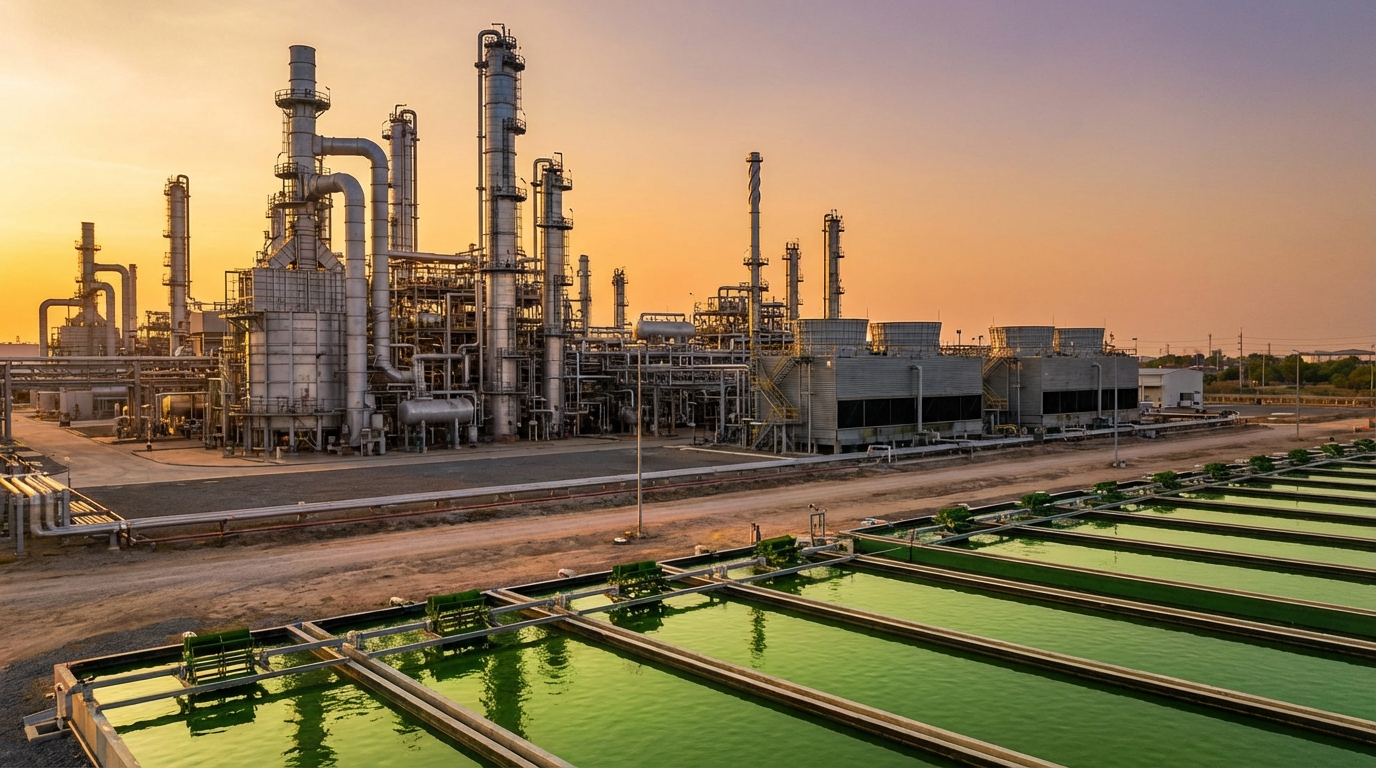
Their approach uses microalgae as the primary feedstock - organisms that can grow in seawater, consume CO2 from industrial flue gas, and convert sunlight into biomass at rates far exceeding terrestrial plants.
Technical Specifications
| Property | Aarksee Biocrude | Petroleum Crude | Compatibility |
|---|---|---|---|
| API Gravity | 18-25 | 25-45 | Refinery-compatible |
| Sulfur Content | <0.5% | 0.5-6% | IMO 2020 compliant |
| Carbon Intensity | <35 gCO2e/MJ | 80-95 gCO2e/MJ | 50-60% reduction |
The result: fuel that can flow through existing pipelines, be processed in existing refineries, and burn in existing engines - while cutting lifecycle emissions by half.
The India-GCC Corridor: A Biocrude Powerhouse
Two regions are emerging as the natural nexus for biocrude development: the Gulf Cooperation Council and India. Together, they present a uniquely complementary opportunity.
The GCC Advantage:
- Feedstock availability: Industrial CO2 from petrochemical facilities, seawater from desalination operations, sunlight in abundance
- Refining infrastructure: Over 10 million barrels per day of refining capacity already in place
- Strategic motivation: Vision 2030 goals require diversification beyond conventional oil
- Carbon credit potential: Projects qualify for international carbon crediting post-2027
The India Opportunity:
- Energy demand growth: India's oil demand is projected to grow faster than any major economy through 2040
- Refining expansion: India is adding 56 million tonnes of refining capacity, becoming the world's 4th largest refiner
- Policy momentum: The Private Nuclear Power bill signals openness to diverse energy solutions
- Manufacturing ambition: "Make in India" requires energy security - and cleaner energy credentials for export competitiveness
- Climate commitments: India's 2070 net-zero target requires decarbonization of hard-to-abate sectors
The Synergy:
The India-GCC energy corridor already moves 40% of India's crude imports. This infrastructure can carry biocrude blends with zero modification. GCC-produced biocrude, leveraging abundant sunlight and CO2 feedstock, can supply India's growing refineries while both regions earn carbon credits.
With the global SAF market projected to grow from $2 billion today to $25.6 billion by 2030 - a 65.5% CAGR - the commercial opportunity is as compelling as the climate case.
The Path Forward
The climate movement has often framed the energy transition as a binary choice: fossil fuels or renewables, combustion or electrification, the old world or the new.
Reality is messier. Airplanes will fly in 2050. Ships will sail. Trucks will haul freight. The carbon they emit depends entirely on decisions made today about fuel chemistry, not fuel elimination.
Three imperatives for the decade ahead:
1. Scale SAF Production
Current SAF production covers 0.3% of aviation fuel demand. Airlines have committed to 10% by 2030 and 100% by 2050. The gap is measured in billions of gallons.
Biocrude-derived SAF offers a pathway that doesn't require new feedstock supply chains (unlike crop-based biofuels) or massive renewable electricity (unlike e-fuels).
2. Mandate Blending
The EU's FuelEU Maritime regulation already requires lifecycle carbon reductions for shipping fuel. CORSIA requires SAF use for international aviation. These mandates create guaranteed demand - but only if supply materializes.
Policy should follow the lead: mandate modest blending requirements (5-10%) that existing infrastructure can deliver, then ratchet up as production scales.
3. Invest in Transition, Not Just Transformation
Electrification works brilliantly for passenger vehicles, heating, and grid power. It doesn't work for transcontinental flights or transoceanic shipping.
Climate capital should flow to solutions that address these gaps - including biocrude production, refinery integration, and certification infrastructure.
The Bottom Line
The IEA's World Energy Outlook isn't a prediction. It's a projection - a calculation of where we're headed if nothing changes.
But something can change. Not the existence of hard-to-abate sectors. Not the laws of physics that make batteries unsuitable for aviation. But the carbon intensity of the fuels those sectors burn.
Fossil fuels aren't disappearing by 2050. The question is whether they're 2025-carbon-intensity fossil fuels or 2025-reduced-carbon-intensity fossil fuels.
Biocrude offers an answer. Not a perfect answer - there are no perfect answers in energy transition. But a pragmatic one, deployable now, compatible with existing infrastructure, and capable of cutting lifecycle emissions by half.
The next century of energy won't be post-carbon. It will be low-carbon. And biocrude is how we get there.
About Aarksee
Aarksee is a climate technology company developing advanced biofuel solutions for hard-to-abate sectors. Their microalgae-to-biocrude technology converts CO2 emissions into drop-in petroleum substitutes, enabling existing refineries to produce lower-carbon fuels without infrastructure modifications.
The company holds 15 patent families covering HTL processes, photobioreactor systems, and biocrude formulations, along with 14 proprietary high-salinity algae strains optimized for GCC conditions.
Contact: info@aarksee.com | www.aarksee.com