By Ramachandran Rajeev Kumar — 2026-05-08
The Soft Underbelly: What the FII Exodus Tells Us About India's Real Vulnerabilities
Two numbers, set side by side, tell the story without commentary.
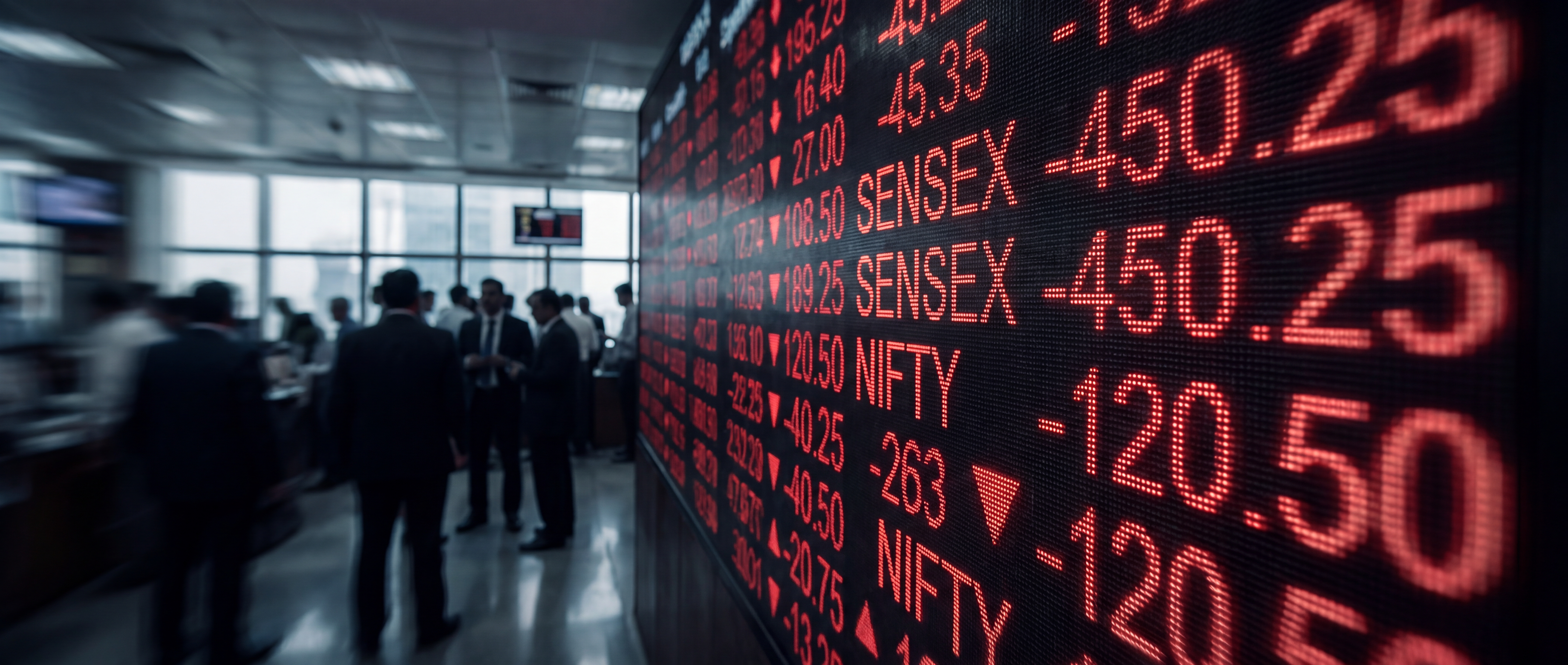
Foreign institutional investors have pulled a net 12.14 billion US dollars out of Indian equities in the months since the Iran war intensified. Goldman Sachs and Moody's have both cut their FY26 GDP growth forecasts to a 5.9 to 6 per cent range, down from earlier estimates that approached 7 per cent.
The headline narrative — the one our markets coverage has gravitated toward — is that this is a temporary risk-off episode and that India will reclaim its growth premium when West Asia settles. There is some truth in that. There is also something the narrative leaves out.
The Iran war did not create India's vulnerability. It exposed it.
The vulnerability, in three numbers
The first number is the energy import bill. India imports roughly 88 per cent of its crude oil. In a normal year that bill is approximately 135 billion US dollars. A 15-dollar move on Brent — which is well within the range that the Iran-Israel-Hormuz triangle can produce — adds another 18 to 20 billion dollars to the bill within twelve months. That is a current-account hit of roughly half a percentage point of GDP, before any second-order effects on inflation or consumption.
The second number is the foreign institutional investor share of free-float Indian equities. It sits in the high twenties as a percentage. That is, by emerging market standards, a high-quality sign — it reflects depth, liquidity, and the credibility of Indian listed corporate governance. It also means that when the global risk-off bell rings, the marginal seller of Indian equities is a foreign hand reading a Bloomberg headline in New York or Singapore, not an Indian household reading a Hindi business paper at home.
The third number is the rupee's structural beta to the dollar index. India has narrowed it considerably over the last decade through reserve accumulation and disciplined macro policy, but it has not eliminated it. A sustained risk-off episode produces a 2-to-4 per cent rupee depreciation, which feeds directly back into the energy import bill, into imported electronics inflation, and into the offshore corporate borrowing book.
These three numbers, combined, define the soft underbelly. They have been there for years. They will be there next year. They are the structural shape of an emerging economy that has not yet built the buffers of a developed one.
What the Iran war actually changed
The war did three useful things. It reminded foreign investors that India sits geographically close to a volatile region, even if its own foreign policy has been carefully insulated from the conflict. It reminded them that the rupee, despite its excellent run, is still a risk-on currency. And it reminded them that Indian retail demand — the great structural story of the past five years — is not immune to a 100-basis-point petrol price rise.
None of this was secret. Equity markets are good at forgetting. They needed to be reminded.
The reminder cost 12 billion dollars and 100 basis points of growth. That is a tuition fee. The question is what we do with the lesson.
The lessons, plainly
There are four, and only the first is on the radar of the public conversation.
One: a strategic petroleum reserve worth the name. India holds approximately 9.5 days of petroleum imports in its strategic reserve. The International Energy Agency floor, set for OECD economies, is 90 days. Even discounting heavily for the size and cost of building such a reserve in India, the gap between 9 days and 90 days is the difference between weathering a 90-day crisis and being forced to negotiate one's foreign policy at the first wobble. The current government's expansion plan is real, but it is not on a wartime timeline. It probably should be.
Two: rupee invoicing for crude. Russia accepts rupee payment for a fraction of its oil sales to India. The UAE, under the Local Currency Settlement framework, accepts a small but growing volume. The full architecture of rupee-invoiced oil — pricing benchmarks, settlement banks, insurance, sanctions-compliant routing — is still embryonic. A serious push here would lower the dollar elasticity of the energy bill substantially. It would also do quiet work on the rupee's internationalisation ambitions, which are otherwise running on slogans.
Three: a sovereign hedging programme. Major commodity-importing emerging economies — Turkey on natural gas, Mexico on crude — have, at various points, run sovereign hedging programmes that lock in import prices through derivatives. Mexico's hedge famously generated billions of dollars in the 2014-15 oil crash. India does not run such a programme at the sovereign level. The argument against has been that it is hard to do well and politically embarrassing if it loses money in a stable year. Both objections are weak compared to the upside in a crisis year.
Four: a domestic capital base that matches the equity float. The deepest insurance against FII risk-off events is a domestic institutional and retail base large enough to absorb the marginal foreign sale. India has made strides — the SIP book is one of the great quiet stories of the decade — but the absolute size of domestic mutual fund and pension capital is still a fraction of what a 4-trillion-dollar economy ought to support. The reform path is well known: deeper pension liberalisation, better insurance penetration, simpler retail tax treatment of equities. The political will to push it through has been intermittent.
The reframe the country needs
The reframe is uncomfortable, and it is necessary.
For the past five years, the dominant Indian self-image has been of a country that has decoupled from emerging-market fragility. That self-image has been earned. Reserves are at record highs. The current account is manageable. Inflation is anchored. Foreign direct investment has held up despite the global FDI slowdown. The country has handled three external shocks — the pandemic, the European energy crisis, and the China demand collapse — better than any of its peers.
But decoupling is a degree, not a binary. India remains a large net importer of crude oil, refined fuels, edible oils, fertiliser inputs, lithium, cobalt, semiconductors, and capital goods. Each of those import lines is a wire that connects our domestic price level to a foreign supply chain we do not control.
A 12-billion-dollar FII outflow is not a crisis. It is an X-ray. The X-ray shows that the wires are still there.
What this is not
This is not an argument for autarky. The economic case for openness has been settled in this country, and rightly so. The Indian export and capital-import story of the last decade is one of the great achievements of post-Independence economic policy, and there should be no nostalgia for the alternative.
But openness without buffers is a posture, not a policy. The Iran war is a reminder that the buffers are still under-built. The next exogenous shock will not announce itself politely. It may come from West Asia, from the South China Sea, from a sudden swing in US monetary policy, or from somewhere we have not yet learned to look.
The lesson of May 2026 is the lesson Indian policymakers privately know and publicly understate. We have built a remarkable economy. We have not yet built the floor under it. Twelve billion dollars in FII outflows, a 100-basis-point growth markdown, and a Brent price holding above 95 dollars are the bill for that postponement.
The question is whether the bill, this time, gets paid in the form of policy reform — or simply paid in the form of the next outflow.
BarathVector covers macro and markets with the conviction that the most useful business journalism tells readers what their portfolio is actually exposed to.