By Ramachandran Rajeev Kumar — 2026-03-18
The energy crunch accelerates: India paying for a war it didn't start
By Ramachandran Rajeev Kumar
On 13 March, Prime Minister Narendra Modi picked up the phone and called Iranian President Masoud Pezeshkian. It was their first conversation since Operation Epic Fury began on 28 February -- fifteen days of US-Israeli airstrikes on Iranian military facilities, nuclear sites, and leadership targets. Fifteen days during which the Strait of Hormuz, the 33-kilometre bottleneck through which one-fifth of the world's oil flows, had been choked nearly shut.
The official readout described the call in careful language: the safety of Indian nationals, the importance of dialogue, the need for "unhindered transit of goods and energy."
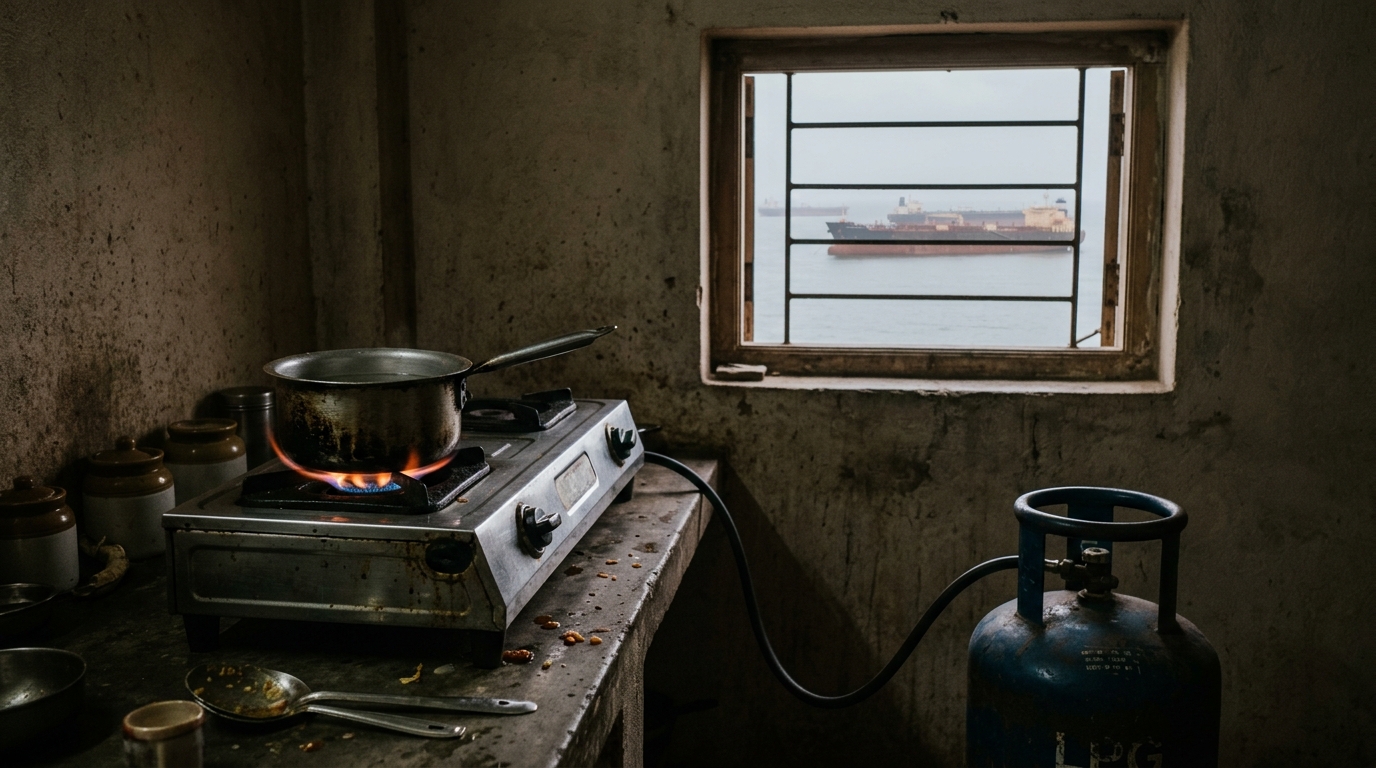
Strip away the diplomatic polish and the message was simpler. India's cooking gas supply was under threat. Modi was not calling about peace. He was calling about LPG.
The bottleneck
The numbers tell the story with uncomfortable clarity.
Twenty-two Indian-flagged ships are stranded on the western side of the Strait of Hormuz as of 18 March, carrying 1.67 million tonnes of crude oil, 3.2 lakh tonnes of LPG, and nearly 2 lakh tonnes of LNG. Six hundred and eleven crew members sit aboard those vessels, waiting for passage that may or may not come.
Tanker traffic through the strait is down sharply. Iran, which controls the northern shore, has been selectively allowing vessels through -- its own oil continues to flow -- while commercial shipping from other nations faces effective blockade. The result: the largest crude oil supply disruption in decades.
Brent crude, which sat at roughly $70 a barrel when the war began on 28 February, crossed $100 on 8 March and peaked at $126. The Indian basket -- the weighted average of crudes that India actually buys -- hit $142.69 on 16 March. That is more than double the pre-war price. It is 37 percent more expensive than Brent and 45 percent more expensive than WTI, because the grades India depends on flow through the very strait that is now contested.
Every $10 rise in crude costs India roughly $15 billion annually in additional import spending. At $143, that arithmetic becomes stomach-turning.
The kitchen counter
But the macroeconomic numbers, for all their scale, are abstractions. The price that matters is the one a family pays for a 14.2-kilogram cylinder of cooking gas.
On 7 March, Indian Oil Corporation raised the price of a domestic LPG cylinder by Rs 60 to Rs 913. Bharat Petroleum and Hindustan Petroleum followed within hours. It was the first hike for household consumers since April 2025 -- the government had held prices steady through an election year and beyond. The Hormuz crisis broke that restraint in ten days.
Commercial cylinders, used by restaurants and street-food vendors, saw steeper increases -- approximately Rs 114 per cylinder. The downstream effects are predictable. The price of a plate of food at a dhaba does not carry a footnote explaining Hormuz transit dynamics. It just goes up.
India imports roughly 60 percent of its LPG. The majority of that passes through the Strait of Hormuz. When the strait closes, there is no clever routing around the problem. LPG is not crude oil -- you cannot simply buy it from a different continent with a different shipping lane. The supply chain is narrow, the alternative sources are limited, and the more than 31 crore LPG consumers across the country -- including over 10 crore connections under Pradhan Mantri Ujjwala Yojana -- feel the pinch first.
Reports from across states describe the early signs of a pattern India has seen before: panic buying, black-market markups, long queues at distribution centres. The government has capped commercial LPG supply at 20 percent of the monthly average to prevent hoarding. That such a measure is necessary tells you the scale of the anxiety.
The phone calls that matter
The diplomatic machinery has been working. External Affairs Minister S. Jaishankar held four rounds of phone calls with his Iranian counterpart, Seyed Abbas Araghchi. The conversations produced a limited but real result: on 14 March, two Indian-flagged LPG carriers -- the Shivalik and the Nanda Devi, carrying a combined 92,712 metric tonnes of liquefied petroleum gas -- were granted safe passage through Hormuz.
Jaishankar was precise about what this meant and what it did not. "Iran hasn't received anything in return," he said. There is no blanket arrangement. No standing corridor. Every ship's passage is being negotiated individually, vessel by vessel, cargo by cargo. India is not buying a solution. It is renting one, trip by trip.
Finland's President Alexander Stubb put it more bluntly. Noting Jaishankar's direct engagement with Tehran, Stubb said India had the credibility to act as a neutral broker in the wider conflict. "We saw Jaishankar," Stubb said. "If India can get involved..."
The compliment is genuine. It is also a reminder of India's peculiar position: trusted enough by Iran to negotiate LPG passage, close enough to Washington to maintain strategic ties, yet unable to stop either side from fighting a war that is bleeding India's economy by the day.
The tax nobody voted for
Consider the arithmetic from an Indian household's perspective.
Petrol prices have not yet been officially revised -- the government is absorbing the shock through oil marketing companies that are now selling at a loss. But the buffer is finite. The last time crude stayed above $100 for an extended period (2022, after Russia's invasion of Ukraine), petrol crossed Rs 100 per litre in most cities. The current spike is steeper.
Diesel, which powers the trucks that move food across the country, is subject to the same pressure. When diesel prices rise, freight costs rise. When freight costs rise, the price of onions in Indore and tomatoes in Tirunelveli rises too. The connection between a blocked strait in the Persian Gulf and the cost of groceries in a Tier 3 town is direct, mechanical, and merciless.
In the United States, gasoline prices have jumped 74 cents per gallon since the war began -- the sharpest monthly spike since Hurricane Katrina in 2005. The 26.9 percent gain is already feeding into inflation indices. India faces the same imported inflation, compounded by the rupee's exposure to a widening current account deficit.
India imports between 85 and 89 percent of its crude oil. Roughly half comes from the Middle East, and a significant share transits Hormuz. The Petroleum Ministry has noted that India now routes 70 percent of crude imports outside the strait -- up from 55 percent before the crisis. That diversification is real and worth acknowledging. But the remaining 30 percent, plus the majority of LPG and a large share of LNG, still passes through the bottleneck.
The vulnerability is structural, not circumstantial. It does not matter which regime controls Iran, which coalition bombs whom, or which president calls which counterpart. As long as a third of India's energy supply passes through a 33-kilometre chokepoint controlled by a nation at war, Indian households pay a geopolitical tax they did not vote for and cannot influence.
Beyond the crisis
India's long-term energy strategy is not a mystery. Solar capacity is expanding. Strategic petroleum reserves exist, though they cover only about 9.5 days of consumption. Pipeline routes from Russia and Central Asia remain on drawing boards. The government has accelerated domestic LPG production by 25 percent to reduce import dependence.
These are real measures. They are also insufficient for the present moment.
The Hormuz crisis has exposed a gap between India's strategic ambition and its operational reality. The ambition says: energy independence, renewable transition, diversified supply chains. The reality says: 22 ships are stuck, LPG is up Rs 60, and a mother in Raipur is paying more for her cooking gas because two countries she has never visited are at war with a third.
Energy diversification is not a policy paper to be discussed at NITI Aayog conferences. It is a survival strategy for a nation that feeds 1.4 billion people with imported fuel. Every year that solar deployment lags behind target, every strategic reserve facility that stays on paper, every alternative shipping route that remains a proposal -- each delay converts directly into vulnerability. The next Hormuz crisis, or the one after that, will find India in the same position unless the structural dependency changes.
The war between the United States, Israel, and Iran is not India's war. India has no stake in its prosecution and no voice in its resolution. But India is paying for it -- in higher gas bills, in stranded ships, in the slow erosion of household purchasing power that hits hardest in the towns and villages where family budgets have no margin.
Modi's phone call to Pezeshkian was necessary. It secured two ships' worth of cooking gas. But the call itself is an admission: India's energy security, at this moment, depends on the willingness of a nation under bombardment to let Indian tankers through.
That is not a strategy. That is a prayer.
The author is CEO of Aarksee Group and writes on energy policy, geopolitics, and the intersection of global conflict with domestic economics.