By Ramachandran Rajeev Kumar — 2026-01-02
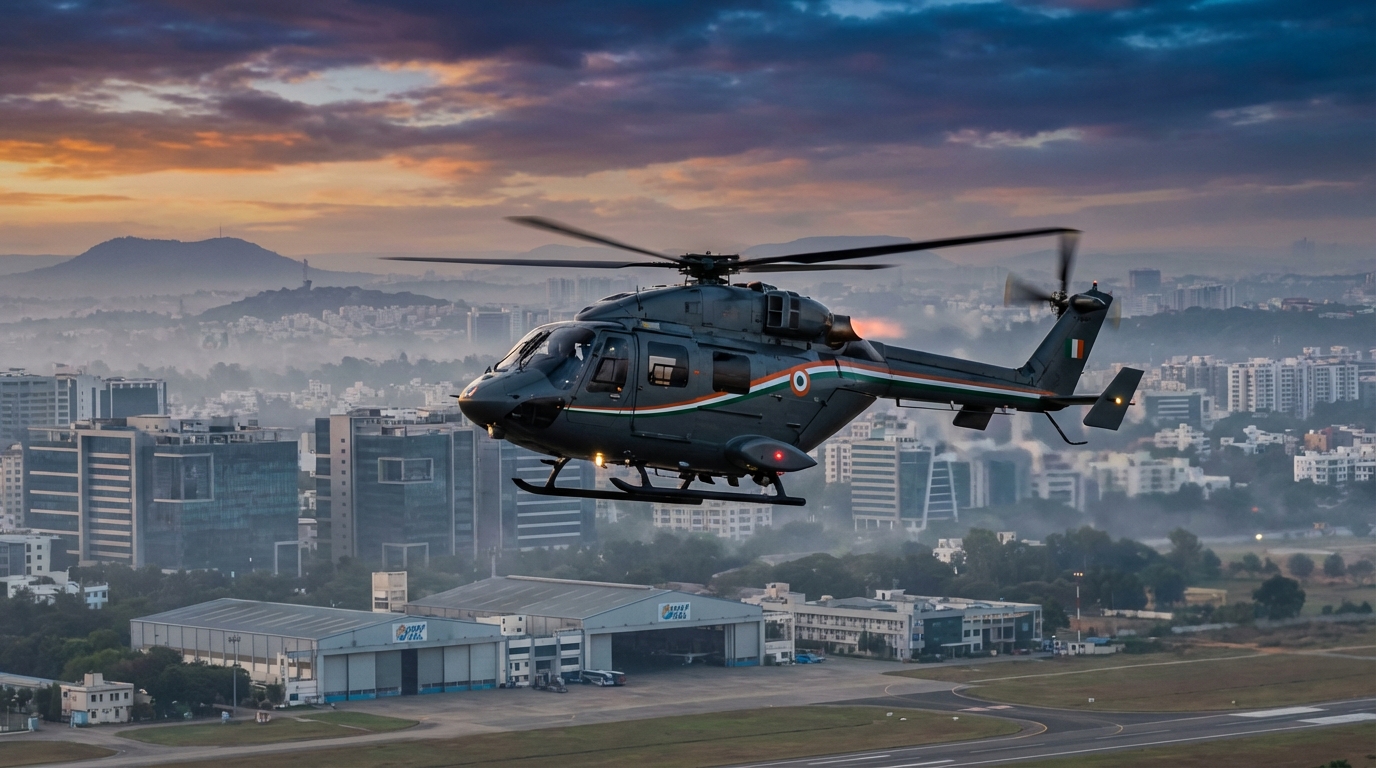
Dhruv NG: India's First Indigenous Helicopter Takes Flight
From importing everything to building our own turboshafts
On December 30, 2025, a helicopter lifted off from HAL's facility in Bengaluru. The event would have been unremarkable - helicopters take off every day - except for what was beating inside it.
The Shakti 1H1C engine.
India's first civil-certified indigenous turboshaft.
The Dhruv NG (Next Generation) is not just another helicopter. It is the culmination of four decades of effort, the answer to decades of dependency, and India's formal entry into the global civil rotorcraft market.
For a nation that has imported virtually every helicopter it flies - from Russian Mi-17s to American Chinooks to European Dauphins - this is a defining moment.
The Heart of the Machine
A helicopter is only as good as its engine. And for decades, this was India's Achilles heel.
The original ALH Dhruv, which entered service in 2002, relied on the French TM333 turboshaft. Every engine, every spare part, every maintenance cycle flowed through foreign suppliers. Pricing was dictated from Paris. Technology transfer was limited. India built the airframe; France controlled the soul.
The Shakti engine changed this.
Developed through a 50-year partnership between HAL and Safran Helicopter Engines (formerly Turbomeca), the Shakti represents a different bargain. Yes, it began as a joint venture. Yes, French technology was involved. But in September 2025, Safran agreed to 100% Transfer of Technology - including the "hot section" turbine blades and the Full Authority Digital Engine Control (FADEC) system that represent the most closely guarded secrets in aerospace.
By 2027-2028, India will manufacture the entire engine domestically. Not assembling. Manufacturing.
The numbers tell the story:
| Specification | Value |
|---|---|
| Power Output | 1,400-2,000 shaft horsepower |
| Indigenous Content (Current) | ~70% |
| Indigenous Content (Target) | 100% |
| Cost Reduction from Indigenization | Up to 30% |
| Special Capability | Hot-and-high operations to 20,000 feet |
That last specification matters. The Shakti was designed for the Himalayas - for Siachen and Ladakh, where thin air and extreme cold defeat lesser engines. No Western helicopter can match the Dhruv's performance in those conditions because no Western helicopter was designed for them.
What "Next Generation" Means
The Dhruv NG is not simply an upgraded ALH. It is a reimagined aircraft designed specifically for the civil market.
The differences are substantial:
Active Vibration Control System (AVCS): Helicopters vibrate. It's inherent to the physics of rotating blades. The AVCS uses counter-vibration technology to deliver what HAL calls a "jet-like smooth ride" - essential for VIP transport and medical evacuation where passengers include the injured or the important.
Glass Cockpit: The flight deck meets AS4 certification standards with synthetic vision, moving maps, and integrated displays. Pilots transitioning from Western helicopters will find familiar interfaces.
Crashworthiness: Self-sealing fuel tanks and crashworthy seats are standard. This isn't just a selling point - it's a certification requirement for civil operations and a genuine safety advance.
"On-Condition" Maintenance: Unlike military helicopters that follow rigid maintenance schedules, the Dhruv NG is designed for commercial operators who need flexibility. HAL offers Power-by-the-Hour (PBH) support - you pay for what you use, not what the manual prescribes.
The specifications position the Dhruv NG in a competitive sweet spot:
| Parameter | Dhruv NG | Airbus H145 | Leonardo AW109 |
|---|---|---|---|
| MTOW | 5,500 kg | 3,800 kg | 3,175 kg |
| Passengers | 12-14 | 8-10 | 6-7 |
| Service Ceiling | 6,000 m | 6,000 m | 4,600 m |
| Range | 630 km | 650 km | 800 km |
Medium helicopter capability at light twin pricing. Larger cabin than the competition. Superior high-altitude performance. And crucially, lower acquisition and operating costs.
The First Customer
On December 30, 2025 - the same day as the maiden flight - Civil Aviation Minister Kinjarapu Ram Mohan Naidu announced the launch customer: Pawan Hans Limited, in partnership with ONGC.
The contract is worth Rs 2,141 crore for four Dhruv NG helicopters over ten years. These will be used for offshore crew changes - ferrying oil workers to and from platforms in the Arabian Sea.
This is significant. Offshore operations are among the most demanding in civil aviation. They require reliability, safety certification, and the ability to operate in challenging conditions. For decades, this market was served exclusively by Bell, Airbus, and Leonardo helicopters.
Now, for the first time, an Indian-made helicopter will carry Indian workers to Indian oil platforms.
The symbolism is obvious. But the economics are equally important.
The Atmanirbhar Arithmetic
India operates approximately 250 civil helicopters, worth roughly Rs 5,000 crore. The market is projected to grow to 1,000 helicopters by 2035 as air taxi services, medical evacuation, and regional connectivity expand under schemes like UDAN 5.1.
Under the old model, every helicopter purchase meant foreign exchange outflow. Every maintenance contract enriched foreign OEMs. Every spare part was priced at whatever the supplier demanded, with no domestic alternative.
The Dhruv NG inverts this equation.
Acquisition costs: Indigenous production eliminates import duties, transportation costs, and currency fluctuation risks. HAL estimates 20-30% savings compared to equivalent foreign helicopters.
Operating costs: Domestic MRO (Maintenance, Repair, and Overhaul) means faster turnaround, lower spare parts costs, and no dependence on foreign supply chains. The 100% indigenous Shakti engine, once fully realized, amplifies these savings.
Subsidy retention: The UDAN scheme subsidizes regional air connectivity. Previously, these subsidies flowed to foreign manufacturers. Now they circulate within the Indian economy, building domestic capability.
Ecosystem development: Private firms like Godrej Aerospace, Tata Advanced Systems, and dozens of smaller suppliers are building capabilities to support the Dhruv program. This creates jobs, develops skills, and establishes an industrial base that can serve future programs.
The arithmetic is simple: every Dhruv NG sold is an Airbus or Bell or Leonardo not bought.
From Defense to Civil
HAL has built helicopters for decades - but always for the military. The transition to civil aviation is not trivial.
Civil certification requires a different mindset. The DGCA and EASA have standards that prioritize passenger safety, maintenance transparency, and operational reliability in ways that military specifications do not. A military helicopter can be grounded for repairs; a commercial operator needs guaranteed availability.
The Dhruv NG's path to certification reflects this learning curve:
| Date | Milestone |
|---|---|
| June 2023 | Restricted EASA type certificate |
| December 2024 | Pawan Hans contract signed |
| December 30, 2025 | Maiden flight + DGCA Type Certification for Shakti 1H1C |
| Q1/Q2 2026 | Full civil certification expected (after ~130 test flights) |
The Shakti engine's concurrent certification is the breakthrough. For the first time, India has a civil-certified indigenous turboshaft - the component that determines whether a helicopter can legally carry passengers for hire.
HAL is also building a new production facility in Tumakuru, Karnataka, specifically for scaled helicopter manufacturing. The target: 1,000+ helicopters over the next 10-15 years.
The Export Opportunity
A helicopter designed for the Himalayas has advantages in any challenging environment.
Hot-and-high performance is not just an Indian requirement. It matters in the Andes, the Ethiopian highlands, the mountains of Southeast Asia. Countries that operate in these conditions have limited options: expensive Western helicopters designed primarily for sea-level operations, or the Dhruv.
HAL is already pursuing export opportunities:
| Country | Status |
|---|---|
| Philippines | Strong interest for Coast Guard operations (via Indian Line of Credit) |
| Argentina | Letter of Intent signed (July 2023) for Dhruv and LUH |
| Ecuador | Previous operator; ongoing engagement |
| Target Regions | Southeast Asia, South America, Africa |
The export pitch is compelling: Indian helicopters cost less, perform better at altitude, and come without the political strings that sometimes accompany Western defense equipment. For nations seeking to diversify suppliers - or simply seeking value - the Dhruv represents an alternative that didn't exist a decade ago.
What Remains
The Dhruv NG is not the end of the journey. It is the beginning.
The Light Utility Helicopter (LUH) is in development - a smaller platform designed for roles the Dhruv is too large to serve. The Indian Multi-Role Helicopter (IMRH) is on the drawing board for the medium-heavy segment. Together with the Dhruv NG, these would give India a complete rotorcraft portfolio.
Challenges remain. HAL's reputation for delays and cost overruns is not unfounded. The original ALH Dhruv was sanctioned in 1984 and entered service in 2002 - an 18-year gestation that would be unacceptable in the commercial market. The Dhruv NG must prove that HAL can deliver on time and on budget.
Quality control is another concern. The military can absorb teething troubles; civil operators cannot. A single accident attributed to manufacturing defects would devastate export prospects and domestic credibility.
And the 100% indigenous Shakti engine is still two years away. Until then, some dependency on Safran remains.
The Larger Meaning
In 1947, India couldn't manufacture a bicycle. In 2026, it flies indigenous helicopters powered by indigenous engines certified to international standards.
This is not jingoism. It is simple fact.
The Dhruv NG represents something larger than a helicopter program. It represents the industrial maturation of a nation - the accumulated investment in engineering education, manufacturing capability, quality systems, and institutional knowledge that allows complex products to be conceived, designed, tested, and produced domestically.
Forty years ago, India began with a dream and a blank sheet of paper. Today, it has a flying helicopter and a full order book.
There will be setbacks. There will be critics. There will be those who point out that the Shakti engine began as a joint venture, that French technology seeded the program, that "indigenous" is a relative term.
They are not wrong. But they miss the point.
The point is trajectory. The point is that India is building capability, not just buying products. The point is that the next generation of Indian helicopters will be more indigenous than this one, and the generation after that more still.
The Dhruv NG is not the destination. It is proof that India is on the right road.
The Verdict
On December 30, 2025, a helicopter lifted off from Bengaluru. It carried no passengers, delivered no cargo, performed no mission.
But it proved something that generations of Indian engineers had worked to demonstrate: that India can build machines that fly, powered by engines that India makes, certified to standards that the world accepts.
Civil Aviation Minister Naidu called it a "defining moment." He was not exaggerating.
From import dependency to indigenous reliability. From purchasing capability to building it. From following the world to, perhaps, leading it.
The Dhruv NG has taken flight. And with it, a nation's ambitions.
The author is Founder & Editor-in-Chief of BarathVector.