By BarathVector Editorial — 2026-04-26
Delhi recorded its hottest day of 2026 on Saturday -- 42.8 degrees Celsius at Safdarjung, 5.1 degrees above normal. The India Meteorological Department has issued heatwave warnings for northwest and central India through the next three days. Millions will suffer. Some will die. Most will not make the headline count.
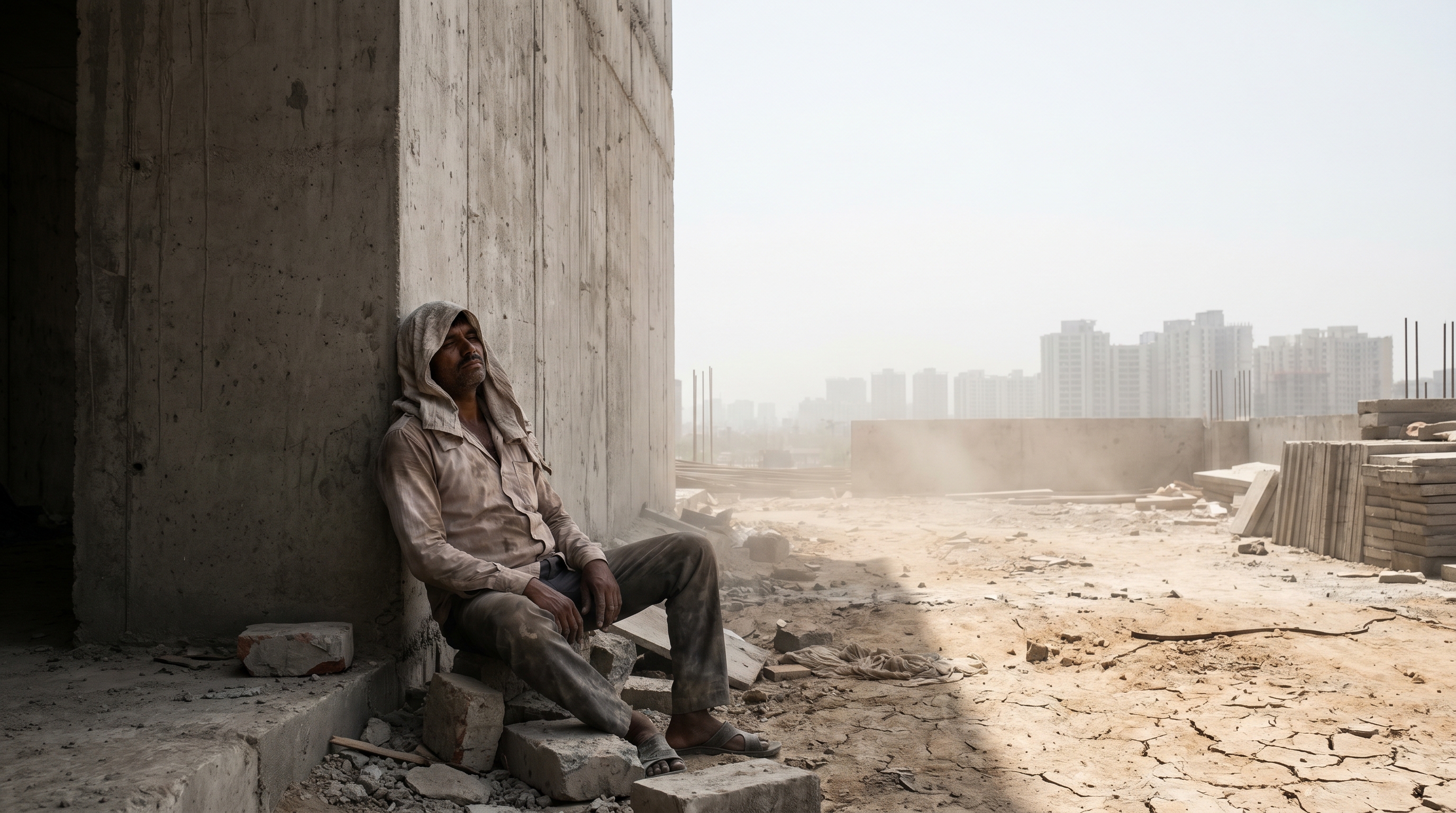
Heat kills differently from floods. Floods command photographs. Heat kills quietly -- in cramped rooms without coolers, on construction sites without shade, in the last row of buses where the air does not move. The people who absorb the consequences of India's climate failure are, with very few exceptions, people who did not cause it and cannot afford to escape it.
The convenient response and the honest one
The politically convenient response is to note the anomaly -- 5 degrees above normal, unusual for late April -- and schedule an awareness campaign. The honest response is harder and more useful.
India is a nation of 1.4 billion people still running roughly 70 percent of its electricity on coal. It imports over 80 percent of its crude oil from a geopolitically volatile region. It has committed to net-zero targets it will not reach by the methods currently proposed. It has signed every climate agreement worth signing. It has delivered less than it has signed.
This is not a counsel of despair. It is a statement of the gap between declaration and infrastructure, and that gap is exactly what needs closing.
What climate justice actually requires
Climate justice for India does not arrive through a finance minister's statement at COP. It does not arrive through a promise to plant a billion trees. It arrives when a working-class family in East Delhi can afford a solar rooftop. It arrives when clean energy is cheaper than the diesel generator their landlord currently charges them for. It arrives when the national grid is upgraded enough that renewables are reliable, not aspirational.
These are economic achievements before they are climate achievements. They require public investment, industrial policy, and the political will to prioritise distributed energy access over concentrated fossil fuel subsidy. They require an economy strong enough to fund grid infrastructure. And they require democratic accountability strong enough that a politician who promises air quality actually has to deliver it -- not in the next manifesto, but in the budget line items of the current term.
The test for India's political class
The heatwave is the test. Not the heatwave as spectacle, but the heatwave as verdict: this is what it feels like when energy policy is subordinated to political inertia.
India has the financial capacity to change. At $4 trillion GDP and 7.4 percent growth, it is the fastest-growing major economy in the world. The question is not whether India can afford the clean energy transition. The question is whether the democratic system is functional enough to demand it from the people who make budget decisions.
Delhi is burning. The answer to that question is not a press release.