By Ramachandran Rajeev Kumar — 2025-12-16
The 450 km³ Problem: Why Delhi Cannot Filter Its Way to Clean Air
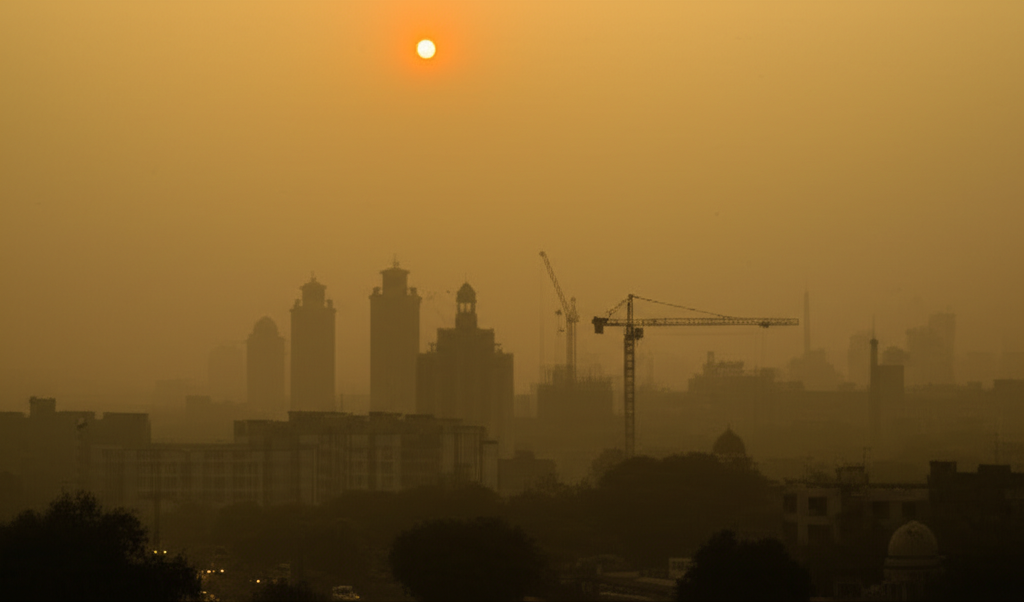
Every winter, Delhi transforms into a gas chamber. Every winter, the government responds with the same futile rituals. And every year, 54,000 people die from the toxic air they breathe.
The air you breathe in Delhi this December contains 300-500 micrograms of PM2.5 per cubic meter. The World Health Organization says 15 is safe. Delhi residents are breathing air that is 20 to 30 times more toxic than what the human body can safely process.
But here's what the politicians won't tell you: the solutions they're deploying are not just inadequate—they are physically impossible to work.
The Physics of a 450 Cubic Kilometer Catastrophe
Delhi's airshed—the volume of atmosphere that sits over the National Capital Region—spans approximately 450 cubic kilometers. Every day during winter, this massive atmospheric volume receives roughly 2,500 tonnes of particulate matter from vehicles, factories, construction sites, and the burning fields of Punjab and Haryana.
Now consider what Delhi is doing about it.
Smog Towers: The ₹20 Crore Monuments to Futility
Delhi has two smog towers—one at Connaught Place, another at Anand Vihar. Each cost approximately ₹20 crore to build and ₹15 lakh per month to operate.
What do they achieve?
According to IIT Bombay's independent study, the Connaught Place tower operates at 50% efficiency at source—but this drops to 30% at 50 meters and barely 10% at 500 meters. The Delhi Pollution Control Committee's own assessment is more damning: the towers reduce pollution by just 17% within a 100-meter radius.
To put this in perspective: if you wanted to meaningfully clean Delhi's air using smog towers, you would need approximately 40,000 of them. At ₹20 crore each, that's ₹8 lakh crore—roughly 20% of India's entire annual budget.
Even then, the math doesn't work. Professor Alastair Lewis, an atmospheric chemist, put it bluntly: "Static air cleaners cannot process enough city air, quickly enough, to make a meaningful difference to urban pollution."
The smog towers are not a solution. They are political theatre.
Smog Guns: Fighting a Wildfire with a Garden Hose
Delhi has deployed hundreds of smog guns—essentially industrial water sprayers mounted on trucks—to "suppress" particulate matter.
The science says this is absurd.
PM2.5 particles are 2.5 micrometers in diameter—30 times thinner than a human hair. Water droplets from smog guns are measured in millimeters—roughly 1,000 times larger. The physics of particle capture requires size compatibility. Spraying millimeter-scale water at micrometer-scale particles is like trying to catch mosquitoes with a fishing net.
Even if smog guns could theoretically capture some particles, they would need to spray continuously across the entire 1,484 square kilometer area of Delhi to have any measurable impact. The current deployment removes an estimated 0.0015% of airborne PM2.5.
Cloud Seeding: The Most Expensive Rain Dance in History
In November 2025, Delhi attempted cloud seeding—injecting silver iodide into clouds to induce artificial rainfall that would "wash" pollutants from the air.
It failed.
Cloud seeding requires specific meteorological conditions: clouds with sufficient moisture content at the right altitude and temperature. Delhi's November skies rarely meet these criteria. The attempt produced negligible rainfall and zero measurable impact on air quality.
Scientists called it "another gimmick in a series of similar unscientific ideas."
GRAP: The Fire Alarm That Rings After the House Burns Down
The Graded Response Action Plan (GRAP) is Delhi's tiered emergency response system. When pollution reaches "Severe" levels (AQI 401-450), GRAP Stage III kicks in. When it reaches "Severe+" (above 450), Stage IV is triggered.
The fundamental problem with GRAP is that it is reactive, not preventive.
By the time Stage IV is triggered, millions of people have already been breathing hazardous air for days. Banning construction or restricting trucks does nothing about the pollution already suspended in the atmosphere. Studies show GRAP achieves a maximum 8-15% reduction in ambient pollution—when you need 80-90% to bring AQI from 500 to safe levels.
GRAP is a fire alarm that rings after the house has already burned down.
Odd-Even: Reshuffling Deck Chairs on the Titanic
The odd-even vehicle scheme restricts cars based on license plate numbers on alternate days. In theory, this should halve vehicular emissions.
In practice, IIT Kanpur's analysis found that the "traffic intervention policy fails to mitigate air pollution."
Why? Because the scheme creates displacement, not reduction. People carpool, take taxis, or simply use two-wheelers (which are exempt). The total vehicle-kilometers traveled remains roughly constant. And vehicular emissions account for only 15-18% of Delhi's pollution anyway—so even a 50% reduction in car traffic would yield less than a 10% improvement in overall air quality.
Odd-even is reshuffling deck chairs on the Titanic.
The Chemistry They Don't Want You to Understand
Here's the scientific reality that makes Delhi's pollution crisis fundamentally different from what politicians claim:
35-45% of Delhi's PM2.5 doesn't exist at the point of emission.
This is called "secondary aerosol formation." When ammonia (NH₃) from agricultural activities and livestock waste mixes with nitrogen oxides (NOₓ) from vehicle exhausts, a chemical reaction occurs in the atmosphere:
NH₃ + NOₓ → NH₄NO₃ (ammonium nitrate particles)
These newly formed particles are PM2.5. They weren't emitted by any single source—they were created in the air itself through atmospheric chemistry.
This means that even if you could magically eliminate all direct PM2.5 emissions from Delhi's vehicles, factories, and construction sites, you would still have 35-45% of the pollution problem remaining—because the particles are forming overhead from precursor gases.
No smog tower can capture ammonia. No smog gun can prevent atmospheric chemical reactions. No odd-even scheme addresses the 240,000 tonnes of ammonia released annually from livestock and agricultural practices in the Indo-Gangetic Plain.
Delhi's pollution is not primarily an urban problem. It is a regional atmospheric chemistry problem that happens to concentrate over Delhi due to geography and meteorology.
The Temperature Trap: Why Winter Is 10 Times Worse
Delhi's pollution is a year-round phenomenon, but winter transforms it into a health emergency. The emissions don't increase tenfold in November—so why does the AQI?
The answer is temperature inversion.
During winter nights, the ground cools faster than the air above it. This creates a layer of cold, dense air at the surface, trapped beneath warmer air above. The normal atmospheric convection that disperses pollutants upward and outward simply stops.
The result is a "lid" at approximately 200-300 meters altitude that traps all emissions in a thin layer near the ground. Studies show this creates a 7.5x concentration increase compared to summer conditions with the same emission levels.
Delhi isn't producing more pollution in winter. It's trapping the same pollution in a smaller space.
The 8.2 Years They're Stealing From You
The University of Chicago's Air Quality Life Index calculates that Delhi's air pollution reduces average life expectancy by 8.2 years—the highest of any city on Earth.
This isn't a statistical abstraction. Here's the biological mechanism:
PM2.5 particles are small enough to penetrate the lung's alveoli—the tiny air sacs where oxygen enters the bloodstream. Once there, an estimated 1-5% of inhaled particles translocate directly into the blood.
These particles trigger systemic inflammation. C-reactive protein levels rise. Arterial walls thicken. Blood pressure increases. The cardiovascular system ages prematurely.
Long-term exposure creates a cascade of pathology:
- 3.3 to 9.3 times higher cardiovascular mortality risk compared to clean air
- 30-40% permanent reduction in peak lung capacity for children raised in Delhi
- Significantly elevated rates of stroke, heart attack, COPD, and lung cancer
The 54,000 annual deaths attributed to Delhi's air pollution are not abstractions. They are mothers, fathers, children, and grandparents whose lives are cut short by a preventable crisis.
What Happens If Nothing Changes
The trajectory is clear.
Delhi's population continues to grow. Vehicle registrations increase by 4-5% annually. Construction activity expands. And Punjab-Haryana's rice-wheat cycle—with its attendant stubble burning—shows no signs of transformation.
If current trends continue:
By 2030:
- Average winter AQI: 550-600 (current: 450-500)
- Annual attributable deaths: 70,000-80,000
- Life expectancy loss: 9-10 years
- Childhood asthma prevalence: 25%+ (current: 15%)
By 2040:
- Delhi becomes functionally uninhabitable during winter months
- Economic migration accelerates as professionals and businesses relocate
- Healthcare costs consume 8-10% of Delhi's GDP
- International isolation as airlines and businesses avoid the city
This is not alarmism. This is the mathematical projection of current emission trends meeting a static atmosphere.
The Only Solutions That Can Work
The science is clear: source elimination is the only viable strategy.
You cannot filter 450 cubic kilometers of air. You cannot spray enough water to capture micrometer-scale particles. You cannot dance for rain in a cloudless sky.
What you can do is stop the emissions before they enter the atmosphere.
This means:
- Converting agricultural stubble into value-added products instead of burning it
- Capturing ammonia from livestock operations before it volatilizes
- Transitioning the vehicle fleet to zero-emission alternatives
- Implementing industrial emission controls at source
The technology exists. The economics can work—particularly when you factor in carbon markets that can generate billions of dollars annually from emission reductions.
Companies like Aarksee are already developing integrated solutions that address these challenges at scale—approaches that treat pollution as a resource problem rather than a waste problem, creating economic incentives for the very stakeholders who currently have no reason to change their practices.
The Choice Before Us
Delhi stands at a crossroads.
One path continues the current approach: symbolic gestures, political theatre, and 54,000 preventable deaths per year. Smog towers that clean 100 meters while 450 cubic kilometers remain poisoned. Cloud seeding attempts in cloudless skies. Emergency responses triggered after the emergency has already begun.
The other path requires acknowledging what the science has been telling us for years: Delhi's pollution is a systems problem that demands systems solutions. It requires upstream intervention, not downstream treatment. It requires economic transformation, not cosmetic fixes.
The physics is non-negotiable. The chemistry is immutable. The atmosphere does not respond to political announcements or budget allocations or committee formations.
It responds only to what we emit.
The question is not whether Delhi can afford to solve this crisis. The question is whether Delhi can afford not to.
The air you breathe tomorrow depends on the choices made today. The science is clear. The solutions exist. What remains is the will to implement them.