By Ramachandran Rajeev Kumar — 2026-05-30
Delayed Justice Is An Economic Tax
India talks about courts as morality.
It should also talk about courts as infrastructure.
Not metaphorically. Literally.
A road moves goods. A port moves exports. A grid moves electricity. A court moves trust. When courts move slowly, contracts become weaker, credit becomes riskier, land becomes trapped, companies hesitate, families suffer, undertrials wait, victims lose faith, and citizens learn that the law may exist but may not arrive in time.
Delayed justice is not only a legal crisis.
It is an economic tax.
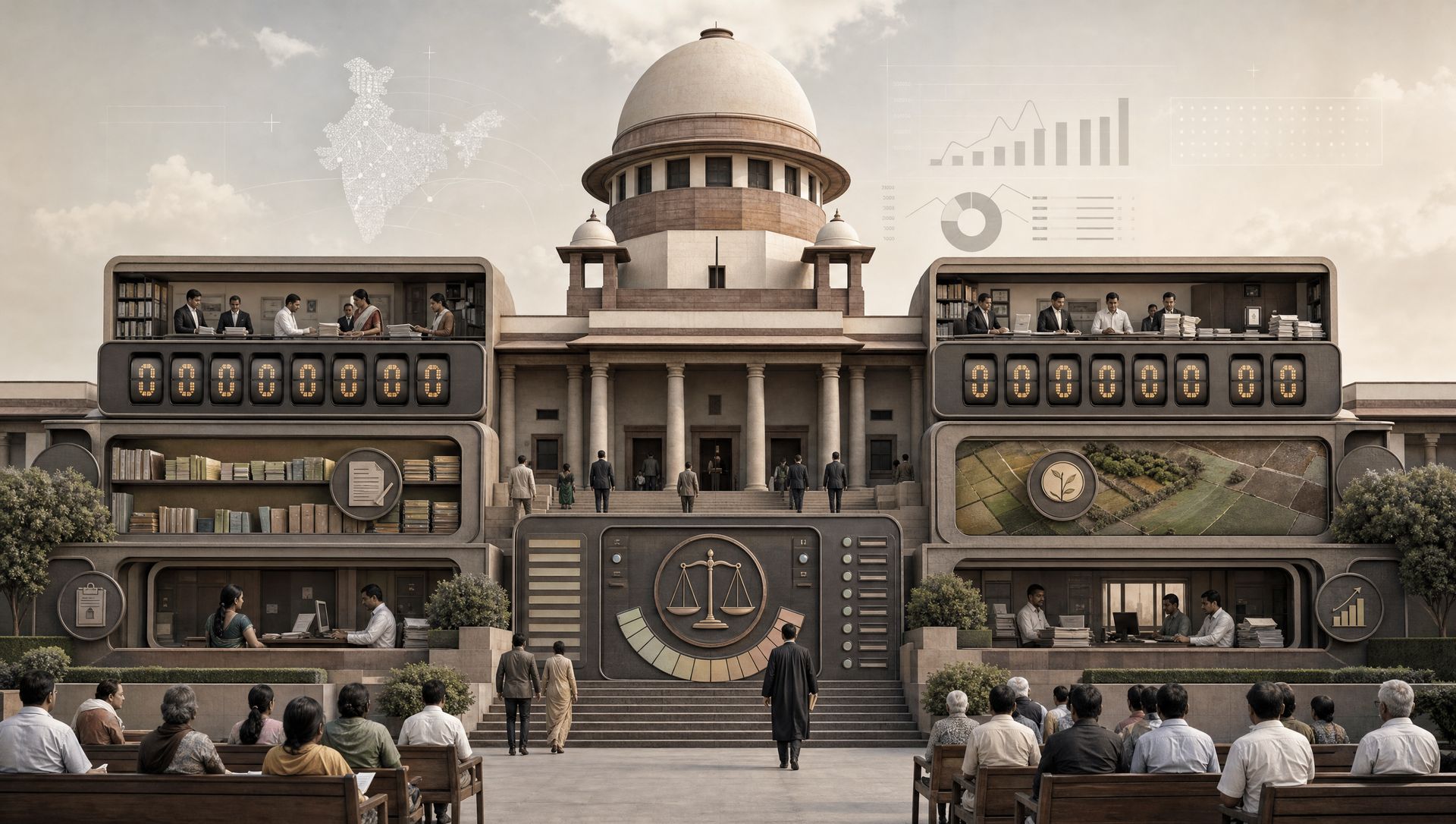
That tax is now enormous. A February 2026 Lok Sabha answer, based on National Judicial Data Grid information, said that as of February 10, 2026, India had 5,46,15,374 pending cases across courts: 92,320 in the Supreme Court, 63,62,174 in High Courts and 4,81,60,880 in District and Subordinate Courts.
This is not a backlog. It is a parallel climate.
Every Indian lives under it, even if they never enter a courtroom.
The honest question is no longer whether India has a pendency problem. The honest question is whether India is willing to treat justice delivery as core state capacity, not as a polite legal-sector concern.
The Supreme Court Expansion Is Necessary. It Is Not Sufficient.
In May 2026, the President promulgated the Supreme Court (Number of Judges) Amendment Ordinance, 2026, raising the sanctioned strength of the Supreme Court from 34 judges, including the Chief Justice of India, to 38.
This is sensible.
The Supreme Court cannot carry nearly one lakh pending matters with an old manpower frame and then be expected to act as a constitutional court, final appellate court, public-interest forum, bail court, tax court, service-law court, death-penalty court and emergency governance referee all at once.
Four additional judges will help.
But four judges cannot fix a system that produces too many appeals, too many adjournments, too many vacancies, too little professional court management, too much state litigation, too many weak investigations, too many poorly drafted laws, too many interim orders, too many execution delays and too little accountability for time.
Adding judges is like adding lanes to a highway where the toll booths, exits, police checks and broken bridges remain unchanged.
Traffic may move better for a while.
Then the jam returns.
India needs more judges. But it also needs fewer unnecessary cases, better-managed cases, faster evidence, stronger trial courts, professional administration, sharper state lawyering and a culture that treats delay as failure.
The District Court Is Where India Actually Meets Justice.
The public imagination often begins with the Supreme Court.
The citizen's reality begins below.
District and subordinate courts carry the overwhelming bulk of India's pending cases. The February 2026 official answer placed them at more than 4.81 crore pending matters. That is where criminal trials, property disputes, family matters, cheque cases, civil suits, motor accident claims, local commercial disputes and ordinary citizen grievances accumulate.
If district courts are weak, justice fails at the point of first contact.
The High Courts and the Supreme Court then become pressure valves for a system that should have resolved more matters earlier. Bail matters travel upward. Property disputes linger. Commercial enforcement slows. Victims wait. Accused persons wait. Families wait. Businesses wait. Files wait.
India cannot solve pendency from the top alone.
It must strengthen the first court where citizens actually stand.
That means filling district-judge vacancies, building enough court halls, providing trained staff, improving service of summons, managing evidence, reducing adjournments, digitising records properly, strengthening prosecution and police coordination, and using local mediation where appropriate.
The Constitution may speak in grand language.
Justice is delivered in district scheduling lists.
The Economic Cost Is Everywhere.
When justice is slow, capital becomes cautious.
A factory that cannot enforce a supply contract will demand higher margins. A lender that cannot recover collateral quickly will price credit defensively. A landlord trapped in litigation will prefer informal arrangements. A land parcel in dispute will not become a factory, warehouse or housing project. A startup fighting a shareholder dispute will lose focus. A family property case can freeze wealth across generations.
Delayed justice turns productive assets into legal inventory.
It is not only businesses that pay. Workers pay when companies avoid expansion. Farmers pay when land titles remain uncertain. Consumers pay when contract enforcement is weak. Women pay when maintenance and domestic-violence cases drag. Undertrials pay with years of life. Victims pay with memory fatigue. Honest citizens pay by lowering their expectations.
The Indian Express recently cited estimates that court delays could cost as much as 1.5 to 2 percent of India's GDP. Whether the exact number is debated or refined, the direction is obvious. No serious economy can treat legal delay as a side issue.
If India wants more FDI, faster manufacturing, deeper credit markets, cleaner land transactions, better insolvency outcomes and stronger small-business confidence, it needs faster courts.
Ease of doing business is not complete until ease of enforcing business exists.
Court Managers Are Not Glamorous. They Are Essential.
One of the most useful current reform debates is also one of the least glamorous: court managers.
Judges should judge.
They should not be forced to become logistics supervisors, HR officers, infrastructure monitors, performance analysts and file-flow managers by default. Courts are large, complex institutions. They need professional administration.
The idea is not new. The 13th Finance Commission supported a cadre of court managers more than a decade ago. But implementation was weak, uneven and temporary. Indian Express reported that only a small fraction of allocated funds was used and around 128 positions were filled by March 2015. Many posts disappeared or stayed ad hoc after central funding ended.
This is exactly the kind of reform India often mishandles.
The idea was correct.
The institution was not built.
Court managers should handle case-flow dashboards, roster support, infrastructure tracking, HR coordination, data quality, technology adoption, litigant services, maintenance and performance monitoring. They should not interfere with judicial independence. They should protect it by freeing judges from avoidable administrative load.
The Supreme Court has repeatedly pushed this issue. The real test is whether High Courts and states now create permanent cadres with clear roles, training and budgets.
Digitisation without management becomes scanned chaos.
Management turns technology into time saved.
Execution Is The Forgotten Stage Of Justice.
Winning a case is not the same as receiving justice.
Execution can become another litigation journey. A decree-holder may spend years proving what a court has already declared. Commercial awards, property decrees, maintenance orders and compensation claims can all become trapped in post-judgment delay.
This is one of the most insulting parts of the justice system.
The citizen is told to trust the court, spends years fighting, finally receives a decision, and then discovers that enforcement is a second mountain.
India must treat execution as a separate reform mission.
Execution petitions should have strict timelines, specialised rosters, asset-disclosure requirements, digital attachment tools, penalties for obstruction and dashboards visible to High Courts. If a decree is not enforceable in reasonable time, the original judgment loses force in the real world.
The rule of law is not what the order says.
It is what the order can make happen.
The State Is The Biggest Litigant. It Must Behave Like A Citizen.
No judicial reform can succeed if governments keep litigating carelessly.
The Indian state is one of the largest sources of litigation. Departments appeal routinely. Officers prefer filing cases to taking decisions. Weak drafting produces disputes. Poor procurement creates contract fights. Tax administration generates avoidable litigation. Service matters clog courts. Land acquisition disputes drag for years. Public-sector entities contest what they should settle.
This behaviour is not free.
Every weak government case consumes court time that should go to citizens and businesses. Every routine appeal sends a signal that the state values delay more than finality. Every avoidable tax or service dispute lowers trust.
India needs litigation budgets for departments, but not only in rupees.
It needs litigation budgets in time.
Each ministry and state department should publish case inflow, appeals filed, success rate, settlement rate, average age, contempt matters, execution delays and cost imposed on citizens. Officers who pursue hopeless litigation should face administrative review. Departments that reduce avoidable litigation should be rewarded.
The government cannot demand judicial efficiency while feeding the backlog.
Technology Helps Only When Procedure Changes.
India has made real progress on court technology.
The eCourts Mission Mode Project, NJDG, video-conferencing, e-filing, virtual courts, eSewa Kendras, Digital Courts 2.1 and digitised records are meaningful reforms. A January 2026 PIB release said more than 579 crore pages of judicial records had been digitised under Phase III work, 3.93 crore virtual hearings had taken place in High Courts and district courts by the end of 2025, and Digital Courts 2.1 was under pilot implementation.
This is good infrastructure.
But technology does not automatically reduce pendency.
If a case is e-filed and then adjourned ten times, technology has only made delay digital. If a scanned record is unreadable, it is not access. If data dashboards exist but judges and registries cannot act on them, they become decoration. If AI tools assist research but listing practices remain chaotic, the bottleneck simply moves.
Technology should be tied to procedure.
Summons should be served through reliable digital and physical channels with proof. Adjournments should be limited and reason-coded. Older cases should be automatically flagged. Frivolous filings should carry costs. Case categories should have realistic timelines. Mediation should be used before litigation hardens. Evidence should be recorded efficiently. Orders should be uploaded promptly. Execution should be tracked separately.
The point is not to computerise delay.
The point is to remove it.
Fast Track Cannot Become A Permanent Excuse.
Fast Track Courts and Fast Track Special Courts are necessary for sensitive categories, especially rape and POCSO matters.
But the data also shows why fast-track reform must be honest. The February 2026 Lok Sabha answer said 774 FTSCs, including 398 exclusive e-POCSO courts, had been established as of December 31, 2025, with a January-December 2025 disposal rate of 46.20 percent. A January 2026 PIB year-ender said FTSCs were disposing 7.41 cases per month per court during January-November 2025, against a target of 13.75, though still faster than regular courts.
Speed alone can mislead. Even as disposal improved, conviction rates in POCSO fast-track matters appear to have fallen — by some accounts from around 35 percent in 2019 to roughly 19 percent in 2024. A court that finishes faster but convicts less is not self-evidently a better court. Throughput is not the same as justice.
This is progress, but not enough.
Fast track cannot mean "slightly less slow."
It must mean protected rosters, dedicated prosecutors, witness availability, forensic support, victim support, working infrastructure, low vacancy, strict adjournment control and continuous monitoring.
India should not keep creating special courts to compensate for ordinary courts. Specialisation helps. But if every urgent problem needs a new court label, the base system remains unrepaired.
The real target is not endless fast tracks.
It is making ordinary justice reliable.
Judicial Independence And Judicial Accountability Must Grow Together.
Any serious reform discussion must respect judicial independence.
Courts cannot become government departments. Judges cannot be pressured to decide cases according to political convenience. Appointment, transfer and case allocation must remain protected from executive capture. A slow independent court is frustrating. A fast captured court is dangerous.
But independence is not immunity from performance questions.
The judiciary should own more public dashboards: case age, reserved judgments, adjournments, listing delays, clearance rates, old-case disposal, execution petitions, vacancy timelines and administrative bottlenecks. None of this requires telling a judge how to decide a case. It simply tells the country whether justice administration is working.
Independence protects decisions.
Accountability improves delivery.
India needs both.
The Reform Agenda Is Not Mysterious.
The reforms are known.
Fill vacancies faster.
Increase sanctioned strength where caseloads justify it.
Build enough court halls and staff capacity.
Create permanent court-manager cadres.
Professionalise registry operations.
Reduce government litigation.
Use mediation and Lok Adalats where they actually fit.
Strengthen commercial courts and arbitration.
Digitise records with usable quality.
Make summons and notice service reliable.
Penalise deliberate delay.
Track execution petitions separately.
Publish court performance dashboards.
Invest in prosecution, forensics and witness systems.
Treat undertrial detention as a governance failure.
Use AI carefully for translation, research, classification and scheduling, not for replacing judicial reasoning.
Most of this does not require ideological warfare.
It requires administrative seriousness.
Courts Are Economic Infrastructure.
India wants to become a developed economy.
Then it must stop treating justice delay as background noise.
A developed economy is not only one with highways, ports, airports, semiconductors, metro lines and digital payments. It is one where a small business can enforce a contract, a woman can get maintenance, an undertrial can get timely bail review, a land dispute can be resolved before the next generation inherits it, a foreign investor can trust dispute resolution, and a citizen can believe that the law moves faster than fatigue.
Courts are infrastructure for trust.
That trust has economic value.
It lowers transaction costs. It deepens credit. It supports investment. It protects property. It disciplines the state. It enables enterprise. It gives citizens dignity.
When justice is slow, the country pays quietly.
When justice works, the country grows with confidence.
The Supreme Court expansion to 38 judges is a start. It should be welcomed.
But the real reform is larger.
India must build a justice-delivery system that behaves like national infrastructure: funded, measured, maintained, modernised and held to public standards.
Delayed justice is an economic tax.
And Bharat has paid it for too long.
BarathVector covers India's governance, institutions, and political economy. Subscribe for the weekly briefing.