By Ramachandran Rajeev Kumar — 2026-01-09
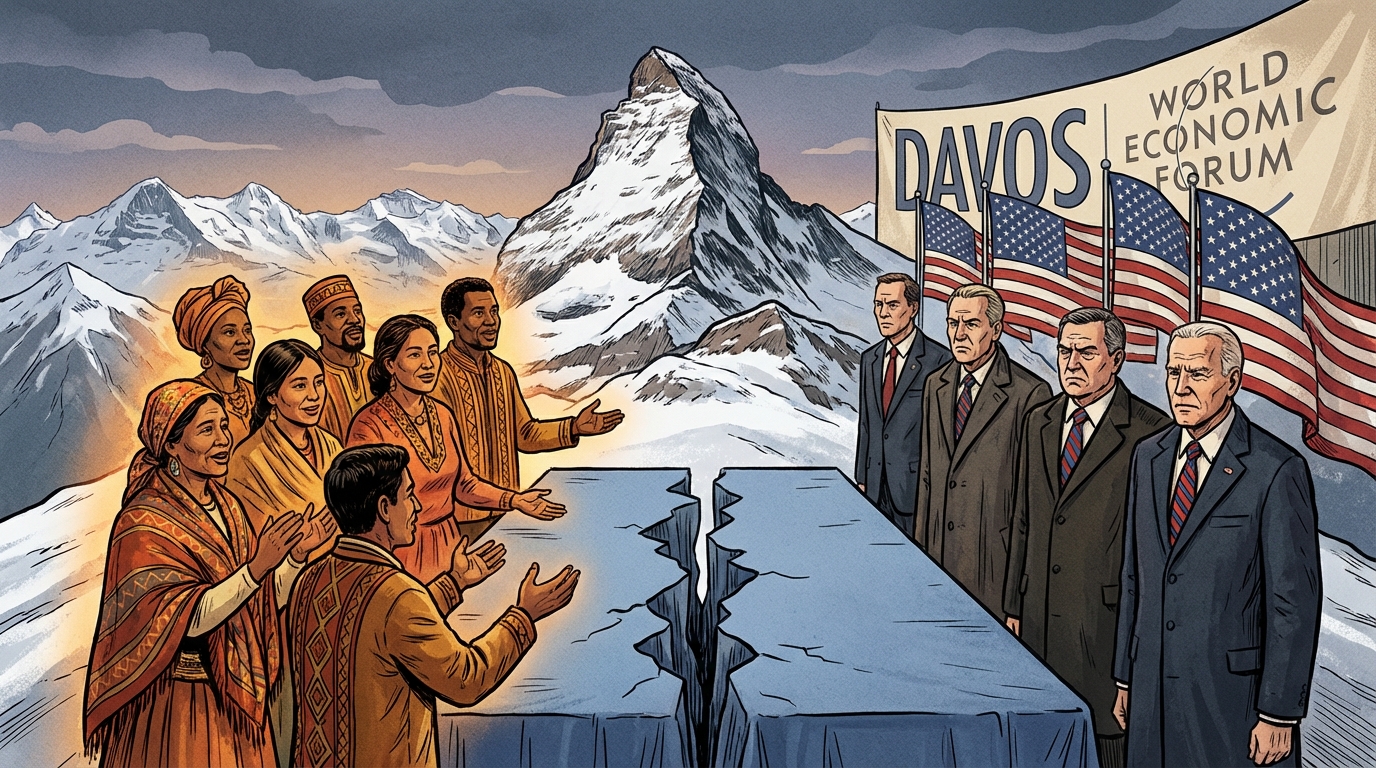
Two Worlds at Davos: When the Global South Meets America First
For the first time, half of Davos attendees will come from the Global South. They'll be greeted by a Trump administration that demanded "woke" topics be dropped. The collision could define 2026.
In ten days, the Swiss Alpine town of Davos-Klosters will host what may be the most consequential World Economic Forum in its 56-year history.
Not because of the usual parade of billionaires and heads of state. Not because of the networking dinners or the panel discussions on sustainable investing. But because two fundamentally incompatible visions of the global order will occupy the same conference halls—and neither is inclined to yield.
On one side: the Global South, arriving in unprecedented numbers, convinced that their moment has finally come. On the other: Donald Trump and his "America First" delegation, freshly returned to power and ready to upend the multilateral consensus that Davos has long championed.
The theme of this year's meeting is "A Spirit of Dialogue." The reality may be closer to a spirit of confrontation.
The Global South's Moment
For decades, Davos has been criticised as a gathering of Western elites—a place where American CEOs and European finance ministers congratulated themselves on globalisation while the rest of the world supplied cheap labour and raw materials.
That critique is becoming harder to sustain.
This year, approximately half of attending leaders will come from the Global South. Representatives from G20 nations will mingle with those from BRICS—the expanded bloc that now includes Brazil, Russia, India, China, South Africa, Saudi Arabia, Egypt, UAE, Ethiopia, Indonesia, and Iran. Emerging market perspectives will be impossible to ignore.
The numbers tell the story. Registration for the 2026 Annual Meeting has hit a record high: up to 3,000 leaders from nearly 130 countries, including around 60 heads of state and government. Many of those leaders represent economies that have outperformed the developed world in recent years.
Latin America's equity markets delivered 47% returns in 2025, crushing the S&P 500's 18%. Copper prices have hit $12,500 per tonne as the "Green Tech supercycle" enriches mineral-rich nations like Chile and Peru. Gulf states are emerging as major investors across Africa. The centre of global economic gravity is shifting—and Davos is belatedly acknowledging it.
Enter Trump
Into this transformed landscape walks Donald Trump, attending in person for the first time since 2020.
The president's participation came with conditions. According to reports, Trump agreed to attend only after receiving assurances that "woke" topics—diversity initiatives, female empowerment, green energy transition—would be dropped or scaled back from the agenda.
This is not subtle. The Forum that once championed stakeholder capitalism, ESG investing, and climate action is now curating its programme to avoid offending an American president who has called climate change a "hoax" and described diversity initiatives as "discrimination."
Trump will be accompanied by a formidable delegation: Treasury Secretary Scott Bessent, Commerce Secretary Howard Lutnick, Energy Secretary Chris Wright, Trade Representative Jamieson Greer, and Middle East envoy Steve Witkoff. This isn't a ceremonial visit. It's a power projection.
The president has announced he'll discuss "new housing and affordability proposals"—domestic policy at an international forum—signalling that American interests will dominate his Davos agenda, global concerns notwithstanding.
The Clash of Frameworks
The tension at Davos 2026 runs deeper than personalities or policies. It reflects fundamentally different theories of how the world should work.
The Global South arrives with a set of grievances and aspirations. Grievances: that the post-1945 international order was designed by Western powers for Western interests; that the IMF and World Bank impose conditions that benefit creditors over borrowers; that climate commitments demand sacrifice from nations that didn't cause the problem; that trade rules entrench existing advantages.
Aspirations: for a multipolar world where power is distributed more equitably; for reform of international institutions to reflect 21st-century realities; for development pathways that don't require Western approval; for technology transfer and financing on fair terms.
Trump's "America First" framework offers a different vision entirely. International institutions are constraints to be escaped, not reformed. Trade relationships are zero-sum competitions where one side wins and one side loses. Alliances are transactional arrangements, not values-based partnerships. Climate commitments are economic sabotage dressed up as environmentalism.
These frameworks don't compromise easily. The Global South wants a seat at the table; Trump wants to flip the table.
What the Forum Is Actually About
The official agenda for Davos 2026 is organised around five themes: cooperation in a contested world, unlocking new sources of growth, investing in people, deploying innovation responsibly, and building prosperity within planetary boundaries.
Translation: the traditional Davos concerns, repackaged for a fractured era.
The AI discussions will be revealing. Generative artificial intelligence is transforming economies worldwide, but the benefits and risks are distributed unevenly. Silicon Valley builds the models; the Global South provides the training data. Western companies capture the profits; developing nations worry about job displacement.
Energy transition will be equally fraught. The Global South wants financing for renewable development—the $100 billion annual climate commitment that rich nations have repeatedly failed to deliver. The Trump administration wants to maximise American fossil fuel exports. These goals are not obviously compatible.
Geopolitics will overshadow everything. With Ukraine still at war, the Middle East in flames, and US-China competition intensifying, the question of global order will hang over every session. Can cooperation be renewed amid "contested global norms, strained alliances and fragmented supply chains," as the Forum's preview materials hopefully suggest? Or are we witnessing the unravelling of the rules-based international order?
The India Factor
For India, Davos 2026 presents both opportunity and challenge.
As a major Global South voice and current BRICS chair, India will be central to emerging market discussions. Its digital public infrastructure—UPI, Aadhaar, CoWIN—offers a model that developing nations are eager to study. Its growing economic weight commands attention.
But India also needs American partnership. The US is India's largest export market. American technology, investment, and strategic support are crucial to India's ambitions. And as of this week, an American bill threatens 500% tariffs on Indian goods.
Prime Minister Modi's representatives at Davos will need to navigate carefully: championing Global South interests without antagonising an American administration that demands loyalty.
This balance—between emerging power solidarity and great power necessity—will be tested not just at Davos, but throughout 2026.
The Real Significance
Davos has always been more symbol than substance. The deals announced are often pre-cooked. The declarations are frequently ignored. The networking is more valuable than the panels.
But symbols matter. And the symbol of Davos 2026 is a world in transition.
For seventy years, the United States set the global economic agenda. American preferences became international norms. American institutions shaped global governance. American capital flowed to where American interests dictated.
That era isn't over—American power remains formidable—but it's increasingly contested. The Global South is no longer content to follow rules it didn't write. China offers an alternative development model. BRICS provides an alternative convening platform. The dollar's dominance is questioned, if not yet threatened.
Trump's return accelerates these trends. By demanding that international forums accommodate American preferences, he inadvertently validates the critique that these forums were always about American power. By threatening tariffs on allies and partners, he pushes them toward alternative arrangements. By withdrawing from multilateral commitments, he creates space for others to lead.
A Dialogue—Or a Divorce?
The Forum's theme—"A Spirit of Dialogue"—is either aspirational or ironic, depending on your perspective.
Genuine dialogue requires mutual respect, shared assumptions, and willingness to compromise. It's not clear any of those conditions hold in 2026. The Global South wants systemic change; Trump wants American advantage. The Forum wants multilateral cooperation; the most powerful nation in the room is explicitly nationalist.
What Davos 2026 may actually demonstrate is the limits of dialogue in an age of divergence. The limits of forums designed for consensus when the participants disagree on fundamentals. The limits of global governance when global power is fragmenting.
Or perhaps—against the odds—it will demonstrate that even adversaries can find common ground. That the rising South and the defensive West can negotiate new arrangements. That a "spirit of dialogue" can emerge from a cacophony of competing interests.
We'll know in ten days. The mountains are watching.
Ramachandran Rajeev Kumar is the Founder and Editor-in-Chief of BarathVector.