By Ramachandran Rajeev Kumar — 2026-05-30
Critical Minerals: Permission Is Not Sovereignty
India should welcome the Quad's critical-minerals framework. It should welcome the India-US agreement on securing supply in mining and processing of critical minerals and rare earths. It should welcome financing, technology access, market coordination and friendly supply chains.
Then it should ask the only question that matters: how much of the value chain will be built on Indian soil?
Because the danger is obvious. India may escape one dependency only to enter another. Yesterday the choke point was Beijing's processing capacity. Tomorrow it could be Washington's financing, Australian offtake, Japanese technology, or a "trusted" supply chain in which India is mainly a buyer, assembler and policy endorser.
That is not strategic autonomy. That is dependency with better branding.
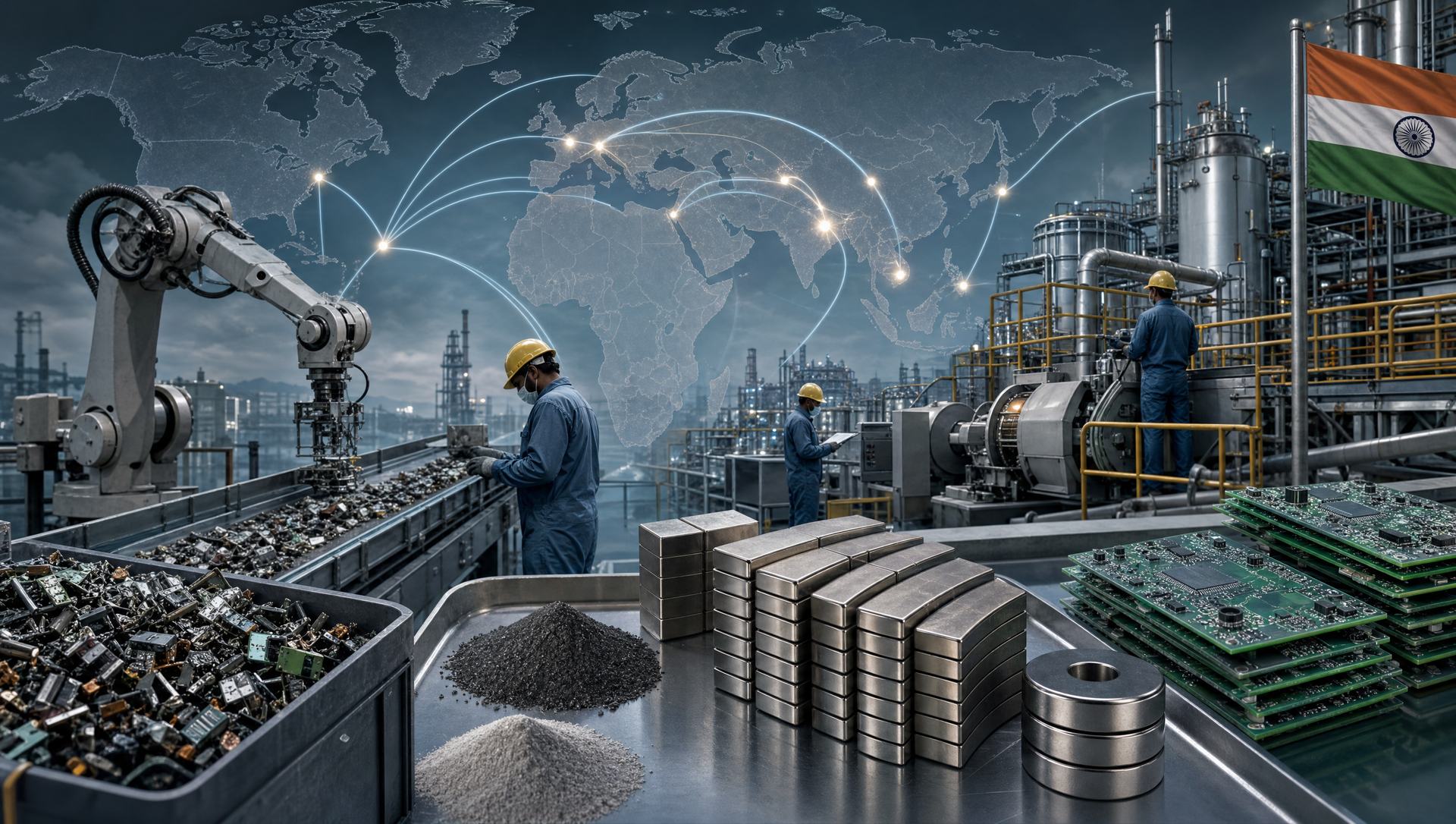
Critical minerals are not only mining assets. They are the base layer of electric vehicles, batteries, permanent magnets, wind turbines, solar panels, drones, semiconductors, telecom equipment, defence electronics, AI data centres and the grid itself. A country that wants to build the industries of the next twenty years cannot outsource the material foundations of those industries.
The rock matters. The refinery matters more. The magnet matters most.
The Quad Has Spotted The Right Problem
The New Delhi Quad meeting did get the problem right.
The joint statement warned against economic coercion, arbitrary export restrictions, price manipulation and disruptions in critical minerals that affect global supply chains. It announced a Quad Critical Minerals Initiative Framework to coordinate investment and policy tools across mining, processing and recycling. Business Standard reported that Quad partners intend to mobilise up to $20 billion in public and private support for these supply chains.
This is not diplomatic filler. It is a response to a real vulnerability.
China dominates much of the rare-earth and critical-minerals processing chain. The exact shares vary by mineral and stage, but the structure is unmistakable: the democratic world allowed extraction, processing, refining, separation and magnet production to concentrate in one system for too long. Now export controls, licensing uncertainty and price manipulation have turned industrial inputs into strategic levers.
India knows this pattern. It has lived versions of it in energy, telecom, electronics, defence equipment and semiconductors. The strategic lesson is the same each time: dependency is not only about where a product is bought. It is about where the bottleneck sits.
If Beijing controls processing, Beijing controls timing.
If Washington controls finance, standards and offtake, Washington controls permission.
India's objective should be neither Chinese dependence nor American permission. It should be Indian capacity.
Why Critical Minerals Are Not A Mining Story
The public debate often talks as if mineral security means finding deposits. That is only the first chapter.
Lithium in the ground is not a battery. Rare earth ore is not a permanent magnet. Graphite is not an anode. Gallium is not a semiconductor input until it moves through a chain of extraction, separation, purification, processing, component manufacture, quality assurance and industrial demand.
The highest strategic leverage often sits after the mine.
China's advantage did not come only from having reserves. It came from processing scale, environmental tolerance, patient industrial policy, downstream manufacturing and the ability to absorb margin pain until competitors gave up. The West woke up late because mining is visible and processing is boring. But boring is where power lives.
India cannot repeat that mistake.
If India signs critical-mineral agreements but imports refined materials, imports magnets, imports battery-grade chemicals and imports processing technology, it has not solved the problem. It has only diversified the invoice.
What India needs is a domestic chain with five hard links:
Mining where feasible.
Foreign asset access where necessary.
Processing and refining in India.
Recycling at industrial scale.
Guaranteed demand from Indian manufacturers through offtake, procurement and standards.
Without all five, the chain breaks exactly where pressure is applied.
The National Mission Is The Correct Starting Point
India is not beginning from zero.
The National Critical Mineral Mission, launched in 2025, is the right kind of policy instrument because it recognizes that minerals are a value-chain problem. The mission tasks the Geological Survey of India with 1,200 exploration projects through 2030-31. It targets domestic and foreign sourcing, critical-mineral blocks, processing parks, innovation, skill development, mineral stockpiles and recycling.
The mission also contains the element India must now push hardest: processing and recovery.
PIB's mission outline lists value-chain strengthening across exploration, mining, beneficiation, processing and recycling. It includes targets for mineral processing parks, patents across the critical-minerals value chain, skill development and strategic reserves. The Rs 1,500 crore recycling incentive scheme is especially important because mining and foreign acquisition take time. Recycling can build near-term feedstock, technical capability and industry discipline.
The scale deserves a sober comparison. India's entire seven-year National Critical Mineral Mission is funded at about Rs 34,300 crore — roughly four billion dollars, or a fifth of the twenty billion the Quad says it will mobilise. Used well, partner capital is leverage. Used lazily, it is the very dependency this argument warns against, wearing a better suit.
This is where India has a window.
E-waste, spent lithium-ion batteries, catalytic converters, industrial scrap, tailings, fly ash and red mud are not waste categories alone. They are secondary mines. A country that imports most of the minerals required for its future should not casually throw away the minerals already inside its economy.
But the recycling programme must avoid a familiar Indian trap: scheme announced, portal opened, interest collected, capacity counted, real extraction underbuilt.
Black mass is not enough. Collection is not enough. Sorting is not enough. India needs actual recovery of lithium, nickel, cobalt, rare earth elements and other strategic inputs to industrial purity. It needs environmental standards that are strict enough to avoid poisoning workers and rivers, but clear enough that serious companies can invest without regulatory roulette.
The mission is a beginning. The question is whether it becomes an industrial base.
The India-US Deal Is Useful, But Not Sufficient
The India-US framework signed in New Delhi is useful because India needs partners.
India needs capital, geological intelligence, processing technology, market access, environmental methods, equipment, offtake agreements and diplomatic support in mineral-rich regions. It cannot build a diversified critical-minerals chain by sitting alone in a room and chanting self-reliance. Strategic autonomy requires partnerships.
But partnership and dependence are not the same thing.
The United States is not doing this as charity. Washington is trying to reduce exposure to Chinese supply chains, secure inputs for its own defence and technology sectors, and build trusted mineral networks aligned with its strategic preferences. That is legitimate. Great powers pursue their interests. India should pursue its own with equal clarity.
The Indian interest is not merely to be included in an American-led supply chain. It is to become an indispensable node in a non-coercive mineral system.
That means India must bargain for processing, not only supply.
It must bargain for technology transfer, not only financing.
It must bargain for Indian manufacturing demand, not only imported materials.
It must bargain for joint ventures that create capability, not trading houses that create commissions.
It must bargain for offtake structures that make Indian refiners and recyclers bankable.
If the agreement helps India build domestic capacity, it is strategic. If it mainly guarantees access to materials controlled elsewhere, it is insurance. Insurance is useful. It is not sovereignty.
The Magnet Test
A simple test can separate serious policy from decorative policy: can India make the magnet?
Rare-earth permanent magnets are used in electric vehicle motors, wind turbines, industrial automation, defence systems, drones, robotics, medical devices and precision electronics. They are small components with large strategic consequences. A country can assemble electric vehicles and still depend on imported magnets. A country can manufacture drones and still import the part that makes the motor efficient. A country can announce renewable-energy targets and still depend on a foreign processing chain for the turbine heart.
That is why India's rare-earth strategy must move beyond ore and oxides.
India has monazite resources. It has IREL. It has rare-earth extraction and refining experience. It has demand from electric mobility, wind power, defence electronics and industrial manufacturing. What it lacks is scaled, globally competitive downstream manufacturing across separation, alloys, magnet production and component integration.
That is the gap that matters.
If India can move from mineral to oxide to metal to alloy to magnet to motor, it changes its industrial position. If it cannot, it remains a large market with strategic anxiety.
The same logic applies across batteries, semiconductors, grid storage and advanced manufacturing. The final component is where dependence becomes visible.
Do Not Repeat The Solar Mistake
India has seen this movie before.
In solar, India built deployment scale faster than domestic manufacturing depth. Panels went up, targets were met, and import dependence quietly remained embedded in the system. Only later did the country begin seriously correcting with production-linked incentives, domestic manufacturing pushes and tariff measures.
Critical minerals should not repeat that sequence.
If India waits until EVs, batteries, wind turbines, semiconductors and AI infrastructure scale up before building the mineral-processing base, the dependency will already be locked in. Manufacturers will have supplier relationships. Banks will finance established import chains. Standards will be set elsewhere. Domestic processors will be told they are too late, too expensive, or too uncertain.
Industrial policy has to arrive before the market structure hardens.
That means India must tie mineral strategy directly to manufacturing strategy. Battery plants should come with domestic material plans. EV incentives should consider mineral and magnet localization. Defence procurement should reward trusted mineral chains. Semiconductor policy should include gallium, germanium, graphite, rare earths, specialty gases and tool materials. Grid-storage procurement should support domestic recycling and material recovery.
The minerals file cannot sit only in the Ministry of Mines. It belongs equally in heavy industry, electronics, defence, power, commerce, environment, finance and external affairs.
This is not a commodity issue. It is a national production system.
Strategic Stockpiles Are Not Enough
Stockpiles are necessary. They are not a strategy by themselves.
India should build reserves of the minerals most exposed to coercion and supply disruption. It should track the vulnerabilities of defence, telecom, EVs, energy storage and semiconductors. It should map which inputs have single-country exposure, which have processing bottlenecks, and which have short substitution windows.
But a stockpile only buys time. It does not create capability.
If India stores a mineral it cannot process, the stockpile is a warehouse with patriotic signage. If it stores refined material but lacks component manufacturing, it still waits for someone else. If it stores magnets but cannot replenish them under pressure, it has a buffer, not independence.
The correct hierarchy is clear:
First, know the dependency.
Second, build the stockpile.
Third, build the processing.
Fourth, build the downstream manufacturing.
Fifth, build the recycling loop.
That loop is sovereignty.
Environmental Discipline Is Strategic Discipline
There is one uncomfortable reason critical-mineral processing concentrated in China: it is dirty, difficult and politically thankless.
Rare-earth processing can involve toxic chemicals and waste. Battery recycling can be hazardous if done informally. Mining can damage land, water and communities when badly governed. If India rushes into this space with weak environmental enforcement, it will create poisoned districts and a backlash that sets the industry back by a decade.
The answer is not to avoid processing. The answer is to do it properly.
India needs designated processing parks with clear environmental standards, common effluent systems, transparent monitoring, local consent mechanisms, worker safety rules and fast but serious approvals. "Ease of doing business" cannot mean ease of pollution. But environmental law cannot become a weapon of indefinite delay either.
The country needs regulatory clarity, not regulatory theatre.
This is where India can differentiate itself from both extremes: not China's old model of environmental sacrifice, and not the West's model of outsourcing dirty work while claiming clean virtue. India can build a responsible processing base because its own citizens will live near it. That should make the standards better, not impossible.
What India Should Demand From The Quad
The Quad framework should be turned into an Indian checklist.
One: processing parks in India with Quad-linked technology partners.
Two: offtake agreements for Indian refiners and recyclers so projects can be financed.
Three: joint rare-earth magnet facilities tied to EV, wind and defence demand.
Four: battery-material recycling capacity with actual extraction, not just collection.
Five: mineral traceability standards that are usable by Indian firms, not compliance systems designed for rich-country incumbents.
Six: research partnerships that produce Indian patents, Indian engineers and Indian process know-how.
Seven: overseas assets where India has equity, offtake and operating knowledge, not merely diplomatic photo opportunities.
Eight: strategic stockpiles connected to domestic processing capacity.
Nine: a public vulnerability map for key sectors, kept sensitive where necessary but honest enough to guide industry.
Ten: a procurement policy that rewards trusted and diversified supply chains.
If the Quad helps deliver these, it becomes practical. If it produces conferences, frameworks and reassuring vocabulary while the real value chain remains elsewhere, it becomes theatre.
India does not need theatre. It needs furnaces, separators, laboratories, recycling plants, magnets, batteries and contracts.
The Real Meaning Of Self-Reliance
Self-reliance is often caricatured as doing everything alone. That is childish.
No serious industrial power is self-reliant in that sense. Japan imports. The United States imports. China imports. Europe imports. What matters is not whether a country imports. What matters is whether it has enough domestic capability, partner diversity, technical depth and market power to avoid coercion.
India should import where sensible. It should partner where useful. It should invest abroad where necessary. But it should build the critical nodes at home.
That is the difference between integration and dependence.
Critical minerals will decide whether India's clean-energy transition is secure, whether its EV industry is deep or shallow, whether its defence electronics are resilient, whether its semiconductor ambitions have material support, and whether its AI infrastructure rests on a supply chain someone else can throttle.
The Quad has offered a useful door. The India-US framework has opened another.
India should walk through both.
But it should carry its own blueprint.
Because the future will not be owned by the country that signs the most frameworks. It will be owned by the country that processes, refines, recycles, manufactures and compounds advantage from the ground up.
Permission is not sovereignty.
Capacity is.
BarathVector covers India's industrial strategy and strategic autonomy. Subscribe for the weekly briefing.