By Ramachandran Rajeev Kumar — 2026-05-30
Cotton Is Not A Farm Problem. It Is A National Competitiveness Test.
India has finally admitted that cotton is not only a crop.
It is a national competitiveness test.
That is the correct way to read the Cabinet's approval of Rs. 5,659.22 crore for the Mission for Cotton Productivity from 2026-27 to 2030-31. The mission speaks of high-yielding, climate-resilient and pest-resistant seeds, high-density planting, closer spacing, integrated cotton management, extra-long staple cotton, better ginning and least-contaminant supply to industry.
Good.
This is the right language.
But Bharath has heard good language before. The cotton question is whether India can now convert language into lint, farmer income, textile competitiveness and export strength.
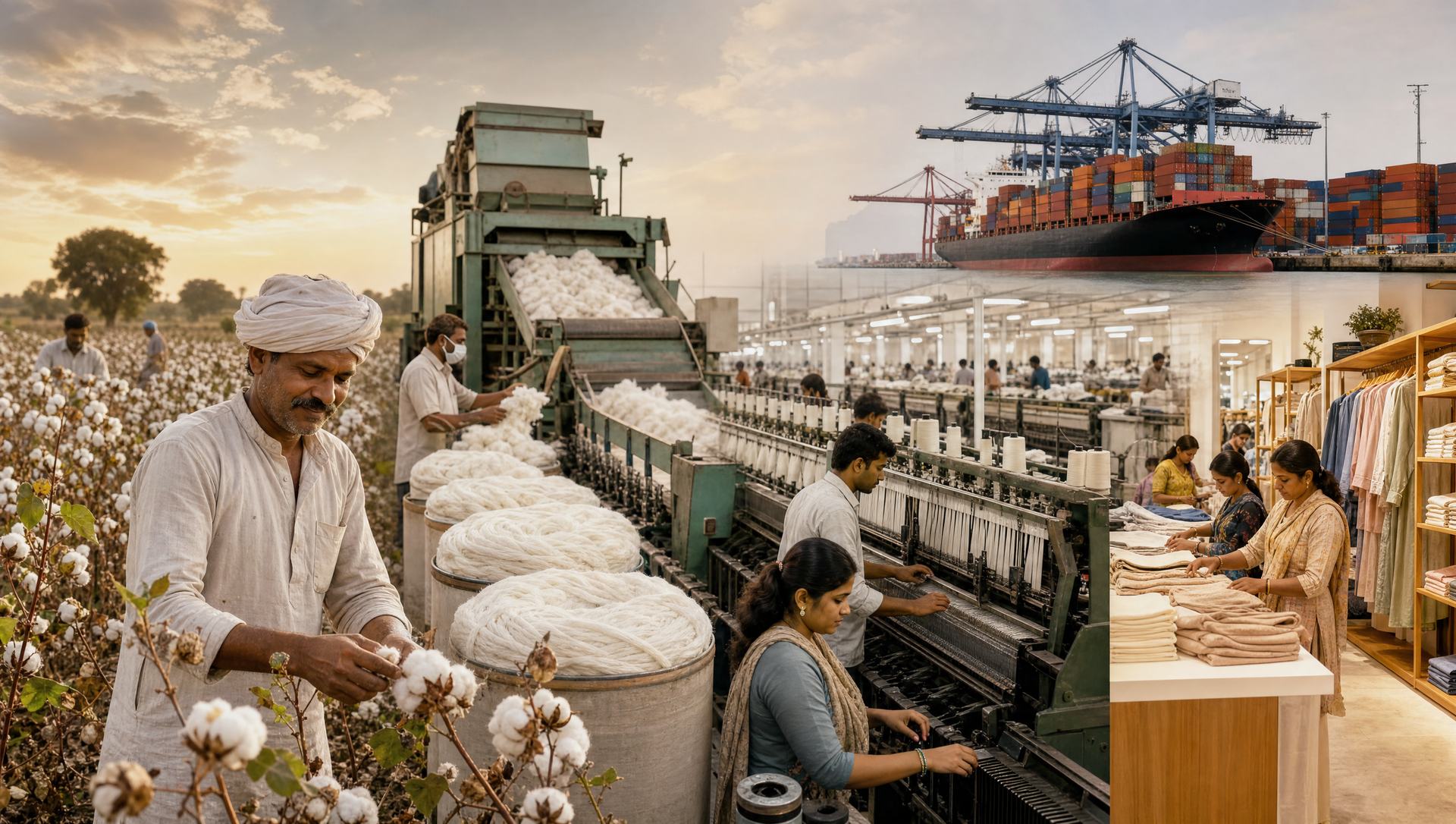
Cotton begins in the farm. It ends in shirts, towels, denim, bedsheets, yarn, fabric, technical textiles, medical products, home furnishings, global retail shelves and foreign exchange. Between the farm and the shelf sit seed companies, agronomists, irrigation, pest surveillance, mandis, MSP procurement, ginners, spinners, dyeing units, apparel makers, MSMEs, ports, trade agreements and brands.
If one part of this chain fails, the whole chain pays.
That is why the Cotton Mission must not become another agriculture scheme trapped inside agriculture. It must be treated as farm reform, textile policy, rural-income policy, export strategy and industrial strategy together.
Cotton is where Bharat's farmer and India's factory meet.
If that meeting is weak, the country loses twice.
The Acreage Is Large. The Productivity Is Not.
India grows cotton across a vast landscape. The sector supports millions of farmers and feeds one of the country's largest employment-generating industries. The government has said cotton cultivation is spread across more than 11.447 million hectares, and that India accounts for more than 21 percent of global cotton production.
But the uncomfortable fact is productivity.
In a March 2026 Rajya Sabha answer, the agriculture ministry said India's cotton yield in 2024-25 was estimated at 440 kg per hectare. It cited ICAC's global productivity estimate of 834 kg per hectare for 2024. It also gave the comparison that should disturb every serious policymaker: China at 2,125 kg lint per hectare, Brazil at 1,845 kg, and the United States at 888 kg lint per hectare.
The Mission sets its own bar plainly: lift the national average from 440 to 755 kilograms per hectare by 2030-31 — a 71 percent jump in five years, on land that is two-thirds rain-fed. Ambition is not the problem. Delivery is.
India has scale.
Others have output discipline.
This is the oldest Indian development problem in a cotton field: large area, large labour, large national pride, but weak productivity.
The reasons are not mysterious. The same Rajya Sabha answer listed the hard constraints. About 67 percent of India's cotton area is rainfed. Extreme weather is becoming more frequent. Pink bollworm resistance has weakened available Bt cotton protection. Whitefly, cotton leaf curl virus, boll rot, tobacco streak virus, cotton stem weevil and tea mosquito bug have added pressure. Soil health has suffered under monocropping. Spurious and low-quality seeds remain a problem. Long-duration hybrids, low ginning out-turn, limited irrigation, shallow soils, wider spacing and crop shifts have also hurt production.
This is not one problem.
It is a system.
And systems do not improve through slogans. They improve through agronomy, accountability and execution.
The Mission Is Correct, But The Test Is Delivery
The Cotton Mission's design points in the right direction.
High-yielding and pest-resistant seeds are essential. Climate resilience matters because cotton is exposed to monsoon risk and heat stress. High-density planting and closer spacing can lift productivity when matched to region, soil, water and variety. Integrated cotton management can reduce wasteful input use. Extra-long staple cotton can reduce dependence on imported high-quality fibre. Better ginning and processing can reduce contamination and improve industry confidence.
The question is not whether these ideas are good.
They are good.
The question is whether they will reach the farmer and the ginner in time, at scale, with discipline.
India already has evidence that better practices can work. A February 2026 PIB note said the Special Project on Cotton under the National Food Security Mission, implemented through ICAR-CICR, achieved yield gains of 40 percent under high-density planting and more than 32 percent under closer spacing. That is exactly the kind of field result a mission should scale.
But scaling is where India often loses seriousness.
A demonstration plot is not a national transformation.
The mission should publish district-level targets: yield, pest incidence, seed adoption, ginning contamination, ELS acreage, farmer income, water-use efficiency and procurement delays. It should not only spend Rs. 5,659 crore. It should show what changed per district, per season, per rupee.
Cotton farmers do not need inspirational posters.
They need the right seed, the right advisory, the right pest warning, the right price, the right procurement slot and a buyer who values clean cotton.
Seed Science Cannot Remain Frozen
India's cotton story after Bt cotton proves both the power and danger of technology adoption.
Bt cotton helped transform production for a period. But the technology has aged. Pest ecology has moved. Pink bollworm resistance has become a serious concern. Farmers cannot be expected to fight evolving pests with yesterday's tools while the country demands export competitiveness from them.
This does not mean India should blindly approve anything in the name of technology.
It means India needs a faster, more credible, more transparent seed-approval and biosafety system.
Farmers need climate-resilient, pest-resistant, region-specific varieties. They need extra-long staple options that do not collapse under pest pressure or uneconomic yields. They need protection from spurious seeds. They need public breeding, private innovation and regulatory seriousness together.
The Cotton Mission should not become a subsidy for old seed systems.
It should become a bridge to modern seed science.
India cannot ask farmers to compete with Brazil, China and the United States while denying them the tools that serious cotton economies use: genetics, data, irrigation, mechanisation, pest surveillance, extension and quality-linked markets.
MSP Protects Farmers. It Does Not Build Competitiveness Alone.
The Cotton Corporation of India has played an important role in protecting farmers when market prices fall. The government said CCI expanded procurement centres from 508 in 2024-25 to 571 in 2025-26 across 150 districts in 11 cotton-growing states. It procured 100.16 lakh bales worth Rs. 37,437 crore in 2024-25, and 90.97 lakh bales worth Rs. 36,355 crore in 2025-26 as of February 5, 2026.
That is significant state support.
The Kapas Kisan app also matters. The March 2026 Rajya Sabha answer said about 42 lakh cotton farmers had registered, with self-registration and slot booking for MSP sales intended to reduce congestion and waiting time.
These are useful reforms.
But MSP is a floor, not a strategy.
If India relies only on procurement, it will protect distress but not create excellence. Cotton competitiveness comes when farmers earn more because their fibre is better, contamination is lower, ginning out-turn is higher, staple length is valued, mills trust domestic supply and exporters can meet specifications without switching to imports.
The farmer must be rewarded for quality, not only rescued from price collapse.
That requires grading, testing, traceability and transparent premiums. A farmer producing clean, high-quality, longer-staple cotton should see the difference in income. If the market pays the same for care and carelessness, the country should not be surprised when quality stagnates.
The Ginning Factory Is A National Infrastructure Problem
India talks too little about ginning.
That is a mistake.
Cotton quality is not created only in the field. It is preserved or damaged after harvest. Contamination, moisture, poor handling, mixing, weak storage, old machinery and careless ginning can destroy value that farmers worked hard to grow.
The Cotton Mission's focus on least-contaminant cotton and modernisation of ginning and processing factories is therefore not a technical footnote. It is central.
For textile mills, cotton is not an emotional product. It is a production input. If domestic cotton comes with contamination, variable quality or uncertain staple characteristics, mills will import. They may prefer Indian farmers in speeches, but they will choose reliable fibre in factories.
That is not betrayal.
That is production logic.
So India must make clean cotton a national standard. Ginning units should be upgraded, audited and linked to quality certification. Bale-level traceability should become normal. Moisture and contamination testing should be trusted. Farmer groups, FPOs and ginners should be linked through quality contracts. Textile mills should publish what they need and pay premiums where quality is delivered.
The cotton chain must stop treating quality as someone else's problem.
Cotton Imports Are A Symptom
India should not panic about importing cotton.
Sometimes imports are rational. Mills need specific staple lengths, contamination-free fibre and reliable quality. Textile exporters compete in unforgiving global markets. If domestic supply is inadequate or inconsistent, imports fill the gap.
But imports should make India think.
The USDA FAS annual report said India's raw cotton imports had been supported by a temporary duty-free window in 2025, and that the standard 11 percent raw cotton import duty was reinstated from January 1, 2026. It also noted that mills were expected to continue relying on imports to supplement insufficient domestic supplies of machine-picked, contamination-free fibre.
That sentence should sting.
India is one of the world's great cotton countries, yet mills still need imported clean fibre because domestic supply does not always meet quality requirements.
This is not an argument against farmers.
It is an argument against a weak value chain.
Farmers cannot solve machine-picked contamination standards alone. Ginners cannot solve seed quality alone. Mills cannot solve pest resistance alone. Exporters cannot solve monsoon risk alone. The state cannot solve all of this by announcing money alone.
The cotton economy needs coordination.
Textile MSMEs Need Fibre Discipline
Textiles are one of India's great employment sectors. Budget 2025 materials noted that 80 percent of textile capacity is driven by MSMEs. That matters because textile competitiveness is not only about large corporate mills. It is about thousands of smaller units in spinning, weaving, knitting, dyeing, processing, printing, garmenting and home textiles.
These units do not have infinite working capital.
When cotton prices spike, quality becomes inconsistent, import duties shift, freight rises or yarn prices move unpredictably, MSMEs suffer first. Large firms can hedge, source, negotiate and absorb volatility. Smaller units often cannot.
That is why cotton productivity is an MSME policy.
Cheaper and better domestic cotton reduces input stress. Stable quality reduces wastage. Better fibre allows higher-value products. Export access improves when reliability improves. Credit schemes and export promotion help, but they cannot compensate forever for weak raw material foundations.
India wants to climb from yarn and fabric into garments, technical textiles, design-led products and global brands.
That climb begins with fibre confidence.
The 5F Vision Must Become A Chain, Not A Slogan
Farm to Fibre to Factory to Fashion to Foreign is a good phrase.
But it is only useful if every F is connected.
Farm means better seed, soil, water, pest control, mechanisation, farmer income and climate resilience.
Fibre means staple length, strength, cleanliness, moisture discipline, grading and traceability.
Factory means ginning, spinning, weaving, knitting, dyeing, processing, apparel and technical textile capability.
Fashion means design, branding, compliance, sustainability, speed and consumer relevance.
Foreign means export markets, trade agreements, tariff competitiveness, standards, logistics and buyer trust.
If India treats these as separate ministries, the chain will break.
The Cotton Mission should therefore have a single public dashboard across agriculture, textiles, commerce and state governments. Farmers should know what mills need. Mills should know where quality cotton is coming from. Exporters should know whether India can fulfil orders. States should compete on field productivity and processing quality. The Centre should track outcomes, not only outlays.
A chain is only as strong as the weakest official file.
Water Must Be In The Cotton Conversation
Cotton cannot be discussed honestly without water.
Because much of India's cotton is rainfed, productivity depends heavily on monsoon behaviour. But the answer cannot be indiscriminate irrigation either. Cotton policy must be region-specific. In some areas, drip irrigation and precision water management can reduce risk. In others, crop diversification may be wiser. In areas where cotton competes with paddy, the water logic may favour cotton if the agronomy and procurement system work.
The point is discipline.
India should not use cotton expansion as a blind acreage target. The aim should be better yield, better quality and better farmer income from suitable areas, not simply more land under cotton.
Climate change will punish lazy planning. Heat waves, untimely rain, boll rot, pest movement and drought risk will grow. The Cotton Mission must therefore include weather advisory, pest forecasting, soil-health restoration and localised extension.
Cotton cannot be made competitive by ignoring climate.
The Export Opportunity Is Real, But Not Guaranteed
India's textile and apparel sector remains a major exporter with a healthy trade surplus. A March 2026 PIB reply said India's imports of textiles and apparel, including handicrafts, were Rs. 83,590.9 crore during April 2025 to January 2026, while exports were Rs. 2,68,951.5 crore. That is a real strength.
But the cotton segment is not racing ahead. Government export updates showed growth in textile and apparel exports in November 2025, with cotton yarn, fabrics, made-ups and handloom products growing 4.1 percent in that month. Other reports based on ministry data indicated that total textile exports grew modestly in FY26, while cotton yarn, fabrics and made-ups were broadly flat.
This means India has opportunity, but not automatic dominance.
Bangladesh, Vietnam, China, Turkey, Indonesia and others are not sleeping. Buyers care about cost, compliance, speed, reliability, sustainability documentation and quality. They do not award orders because India has a civilizational textile story.
History helps.
Delivery wins.
If India wants to move from cotton supplier to textile power, the Cotton Mission must be tied to FTAs, logistics, labour skilling, processing infrastructure, green compliance, design, branding and MSME credit.
Raw cotton alone will not make India rich.
Value-added cotton can.
What Success Should Look Like By 2031
By the end of the Cotton Mission, India should not judge success by how much money was spent.
It should judge success by outcomes.
National average yield should rise meaningfully toward global competitiveness.
Rainfed cotton districts should show climate-resilient productivity improvements.
Pink bollworm losses should fall.
Spurious seed complaints should collapse.
ELS cotton output should expand with viable farmer economics.
High-density planting and closer spacing should move beyond demonstration mode.
Ginning contamination should become measurable and visibly lower.
Farmers producing quality cotton should receive premiums.
MSP procurement should become smoother and less congested.
Domestic mills should reduce quality-driven imports.
Textile MSMEs should see more reliable input costs and fibre quality.
Cotton-based exports should move from raw and intermediate products toward higher-value finished goods.
That is the scoreboard.
Cotton Is A Sovereignty Crop
India often reserves the word sovereignty for defence, chips, energy and data.
Cotton deserves a place in that conversation.
Not because cotton is glamorous.
Because cotton connects rural livelihoods, manufacturing jobs, MSME survival, export earnings, women's employment, industrial clusters, fashion, technical textiles and global supply chains.
A country that grows cotton badly, contaminates it after harvest, underpays quality farmers, forces mills to import clean fibre and exports too little value-added product is leaving money on the field.
The Cotton Mission is a chance to correct that.
But only if India treats cotton as a complete system.
The farmer cannot be separated from the factory. The ginner cannot be separated from the exporter. The seed cannot be separated from the trade agreement. The pest cannot be separated from the garment order.
Cotton is not a farm problem.
It is a national competitiveness test.
And this time, India should pass it with numbers, not slogans.
BarathVector covers India's economy, agriculture, and manufacturing competitiveness. Subscribe for the weekly briefing.